Iowa Life Documents Planning Package, including Will, Power of Attorney and Living Will

Overview of this form package
The Iowa Life Documents Planning Package provides essential legal documents tailored for residents of Iowa. This package includes a Last Will, two types of Power of Attorney (for property and for health care), and a Living Will, all specifically drafted to comply with Iowa state laws. It is designed to help individuals plan for their future by ensuring their wishes regarding health care, estate distribution, and personal affairs are documented and communicated clearly.
Forms you’ll find in this package
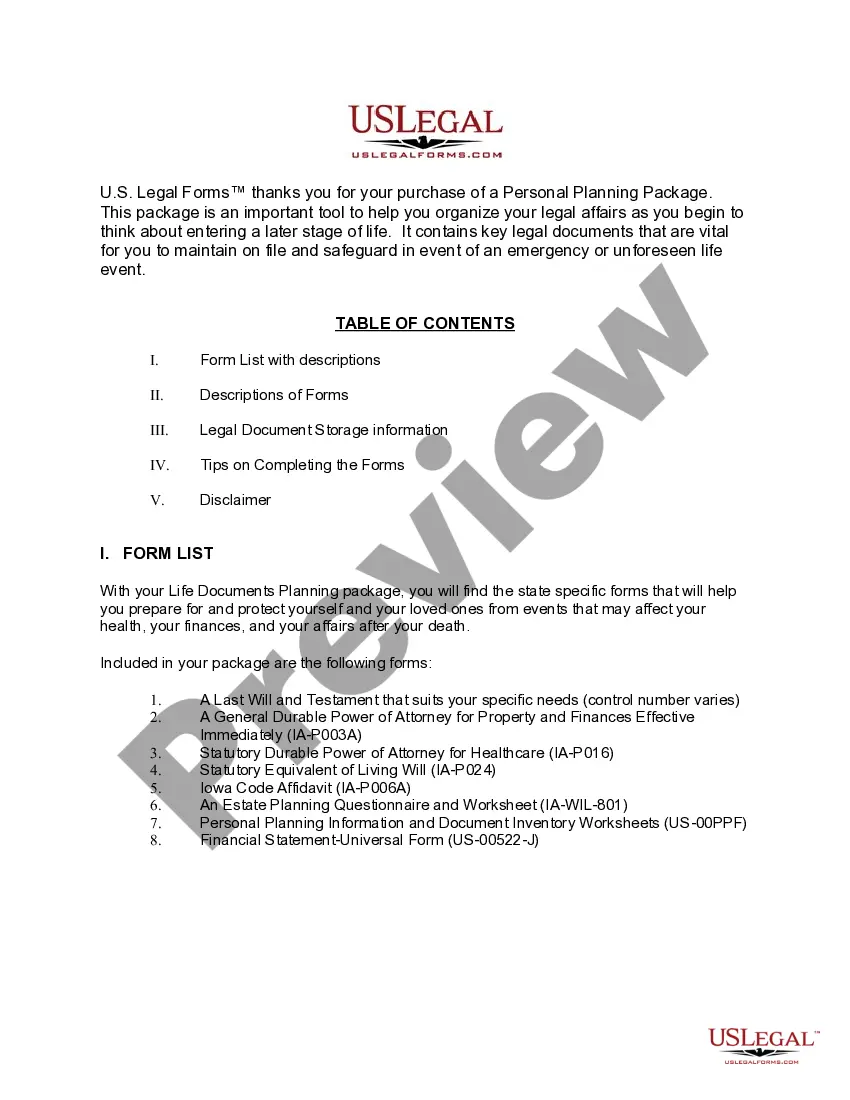
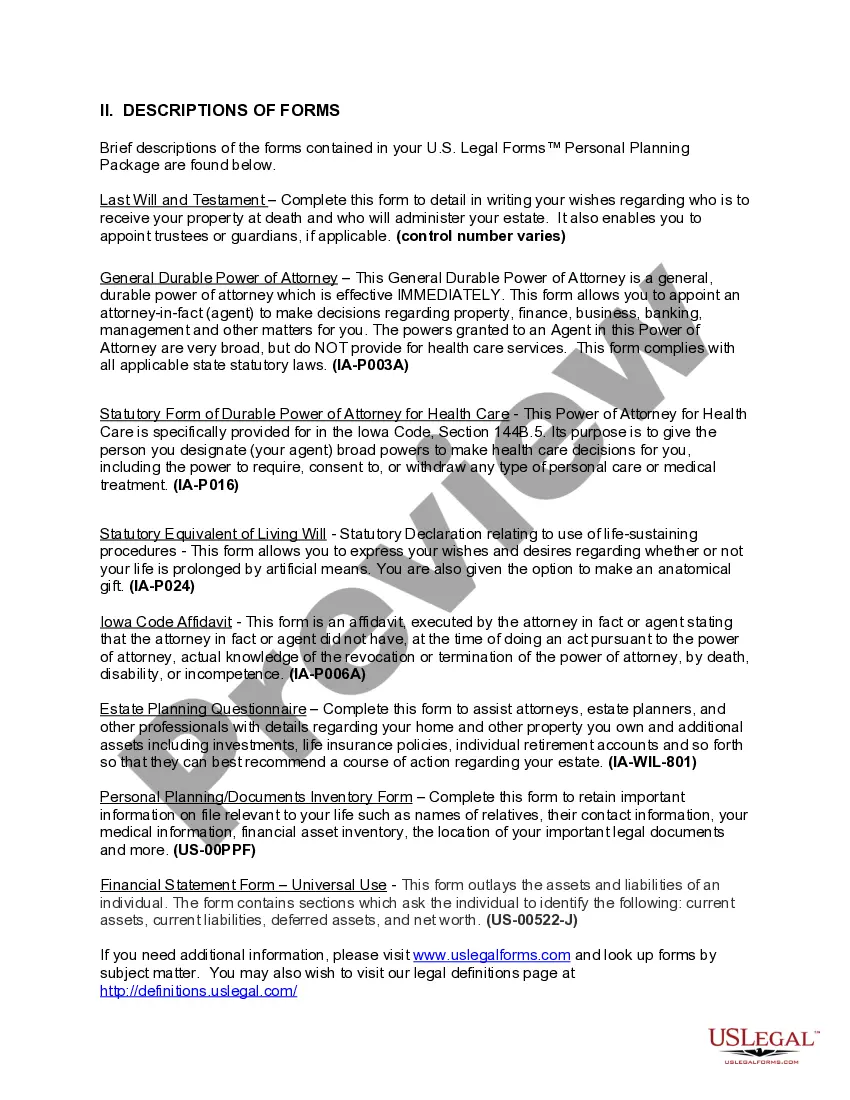
- Last Will and Testament
- General Durable Power of Attorney for Property and Finances or Financial Effective Immediately
- Code Affidavit regarding Power of Attorney Revocation or Termination
- Durable Power of Attorney for Health Care
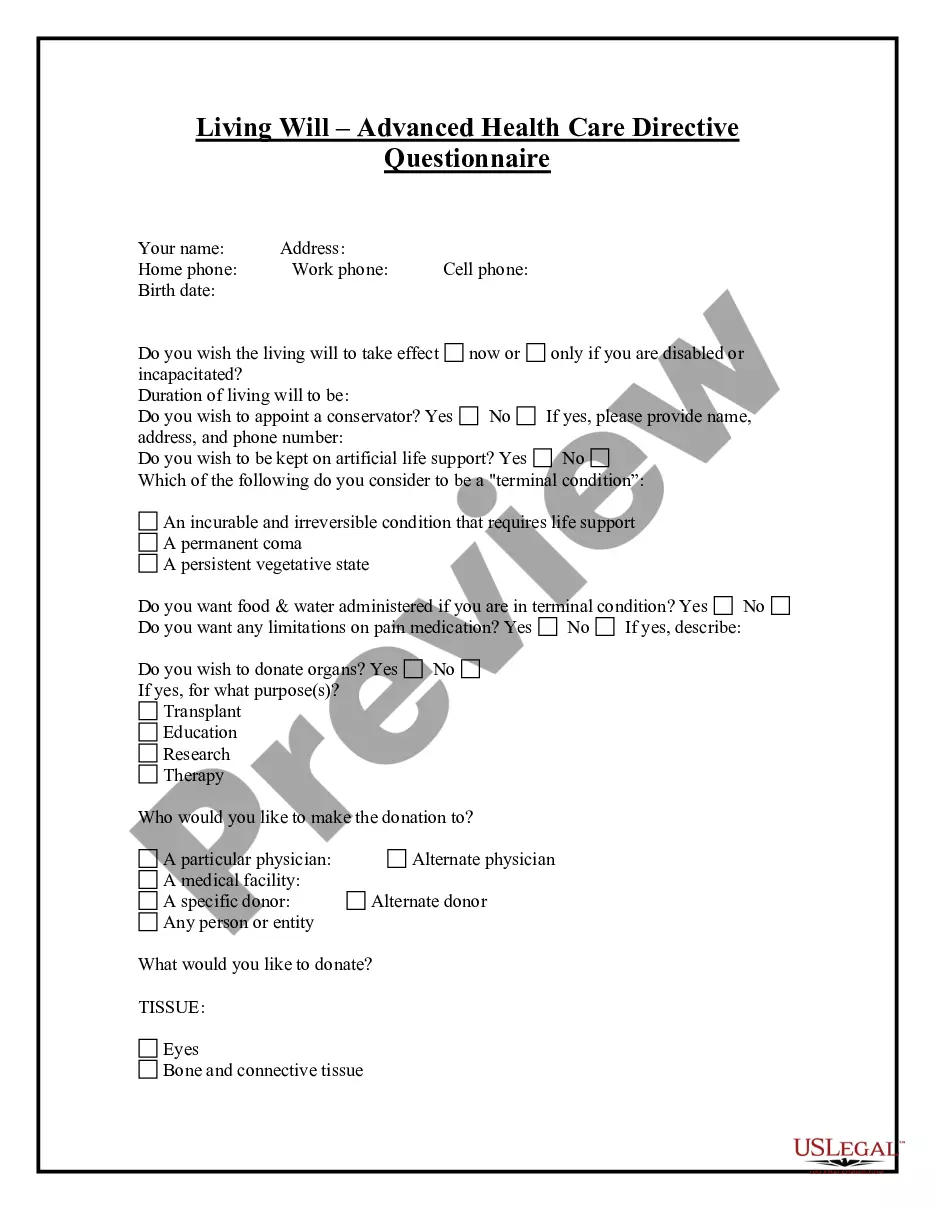
- Statutory Equivalent of Living Will or Declaration - Statutory Declaration relating to use of life sustaining procedures
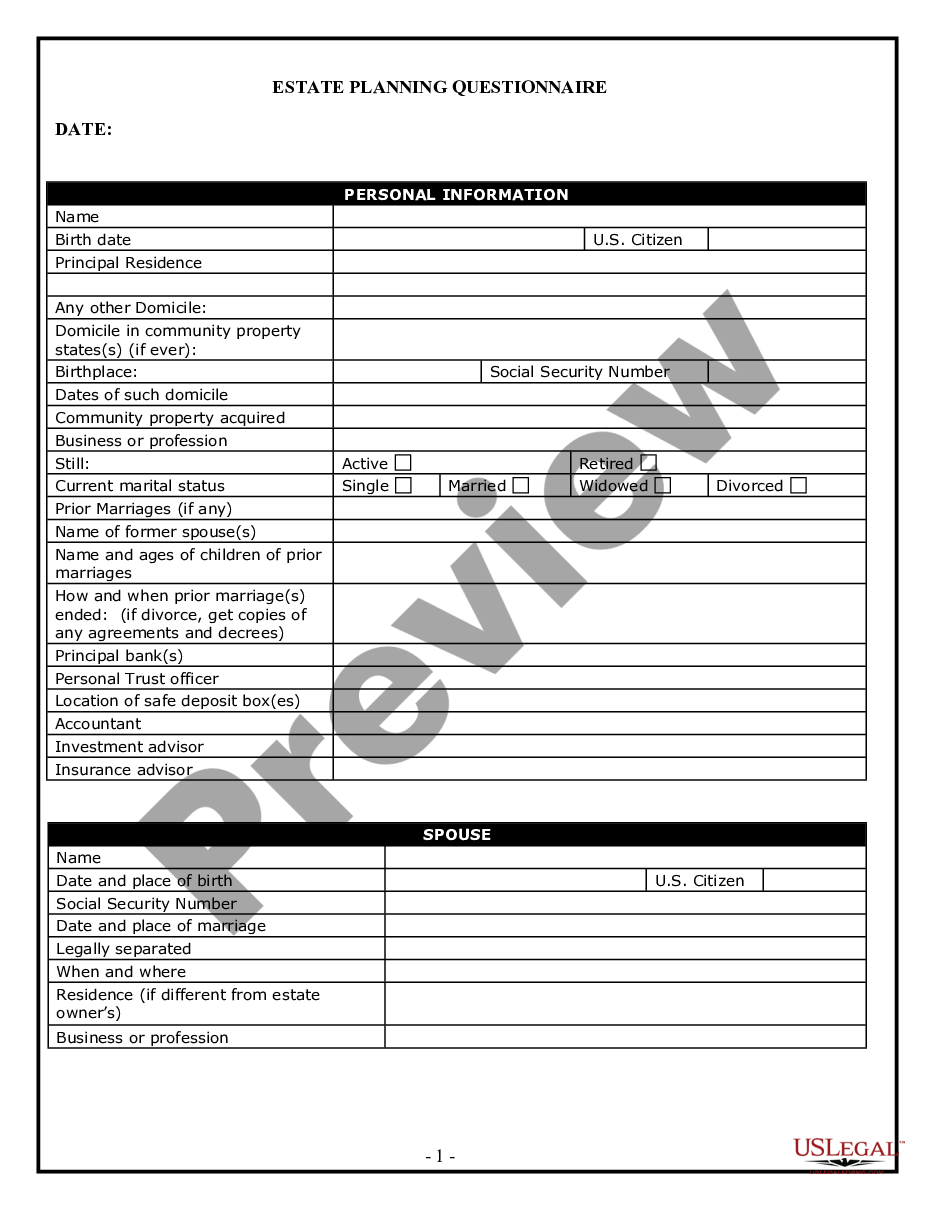
- Estate Planning Questionnaire and Worksheets
- Sample Letter for Request for Free Credit Report Allowed by Federal Law
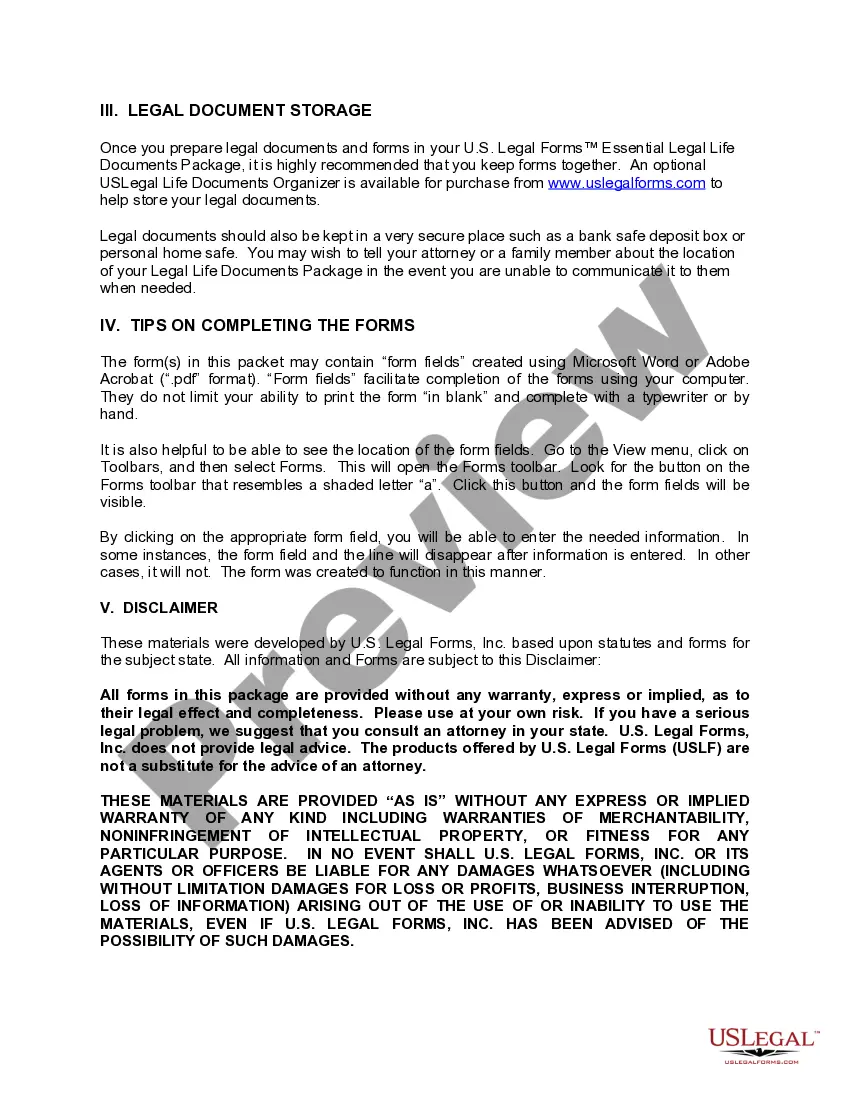
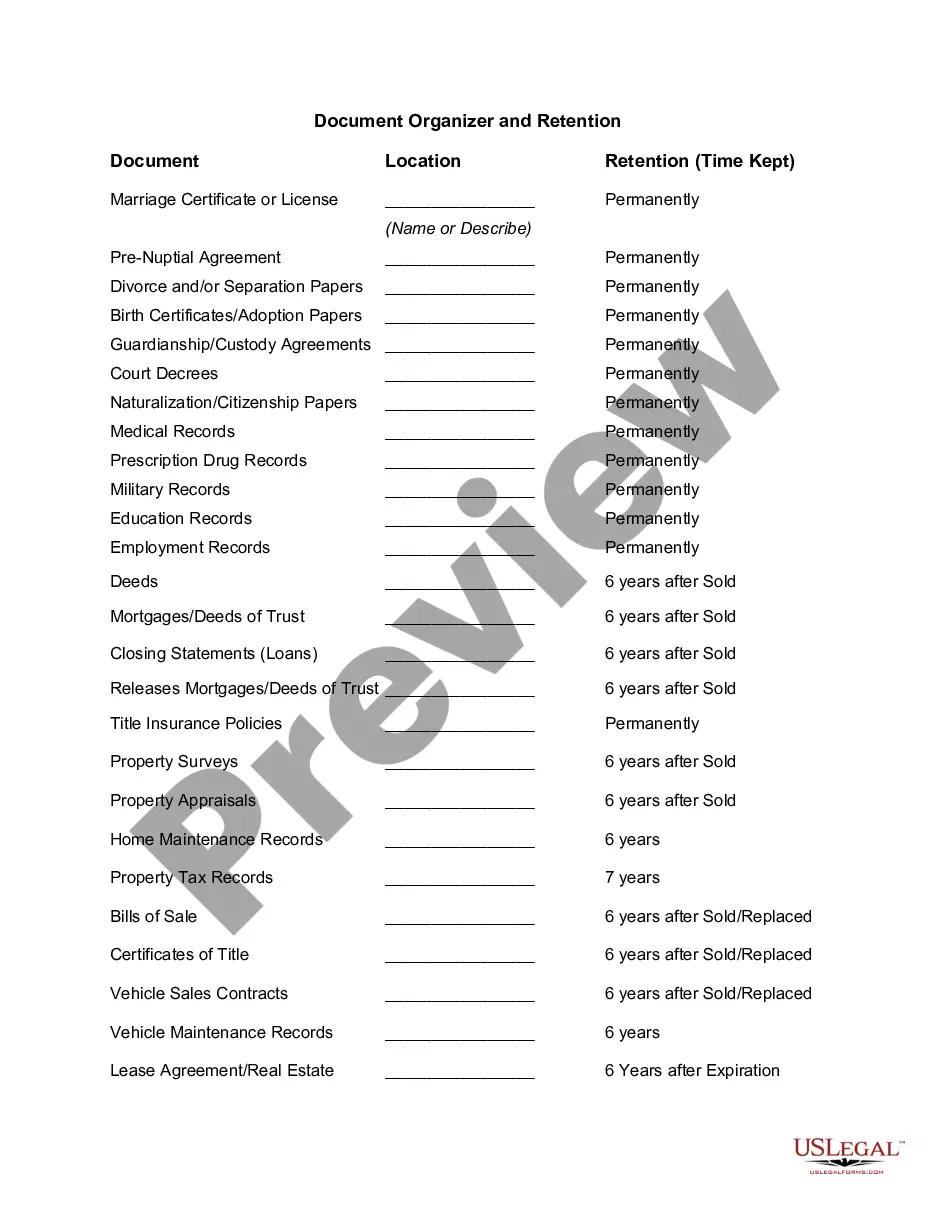
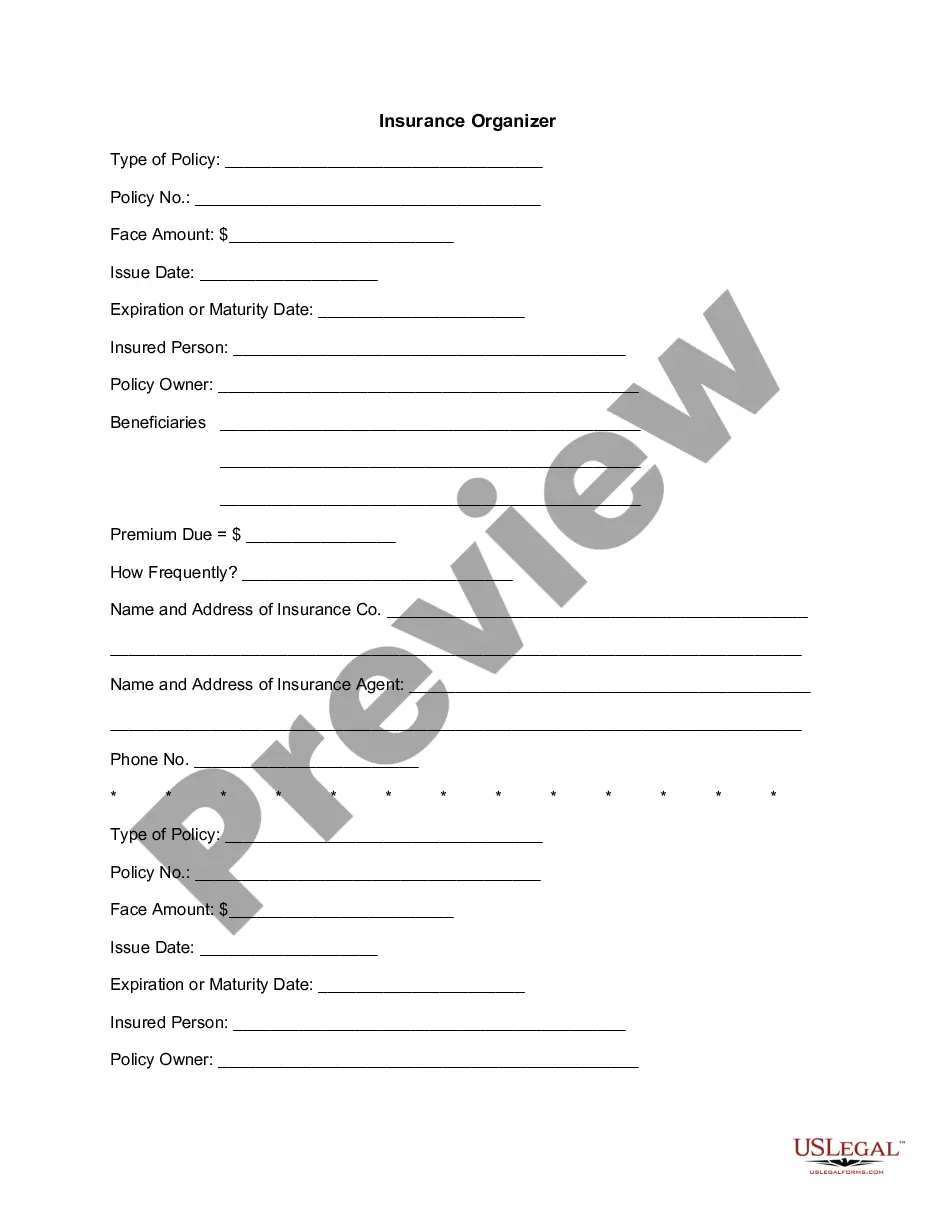
- Personal Planning Information and Document Inventory Worksheets - A Legal Life Document
- Estate Planning Questionnaire

Situations where these forms applies
This package is useful in various situations, including:
- When you want to specify how your assets should be distributed after your death.
- If you need to appoint someone to manage your finances and property in case of incapacity.
- When you want to ensure your health care wishes are respected during medical emergencies.
- If you are planning for future care or end-of-life decisions.
Who this form package is for
- Individuals in Iowa who are beginning estate planning.
- Anyone wanting to clarify their health care decisions.
- People needing to designate someone to make financial decisions on their behalf.
- Families preparing for future health care or financial needs.
Completing these forms step by step
- Review each included form and determine which ones apply to your situation.
- Consult the instructions for each document to understand its purpose.
- Gather necessary personal information, including asset details, health care preferences, and contact information for designated agents.
- Carefully complete each form, ensuring all required fields are filled out accurately.
- Sign and date the forms where specified, following any additional state-notarization requirements.
Do documents in this package require notarization?
Some included forms must be notarized to ensure validity. US Legal Forms provides secure online notarization powered by Notarize, allowing you to complete the process through a verified video call anytime.
Get your form ready online
Our built-in tools help you complete, sign, share, and store your documents in one place.
Make edits, fill in missing information, and update formatting in US Legal Forms—just like you would in MS Word.
Download a copy, print it, send it by email, or mail it via USPS—whatever works best for your next step.
Sign and collect signatures with our SignNow integration. Send to multiple recipients, set reminders, and more. Go Premium to unlock E-Sign.
If this form requires notarization, complete it online through a secure video call—no need to meet a notary in person or wait for an appointment.
We protect your documents and personal data by following strict security and privacy standards.

Make edits, fill in missing information, and update formatting in US Legal Forms—just like you would in MS Word.

Download a copy, print it, send it by email, or mail it via USPS—whatever works best for your next step.

Sign and collect signatures with our SignNow integration. Send to multiple recipients, set reminders, and more. Go Premium to unlock E-Sign.

If this form requires notarization, complete it online through a secure video call—no need to meet a notary in person or wait for an appointment.

We protect your documents and personal data by following strict security and privacy standards.
Common mistakes to avoid
- Failing to review and understand all forms before completing them.
- Not updating the documents after life changes, such as marriage, divorce, or changes in health status.
- Overlooking the need for witnesses or notarization where applicable.
- Neglecting to communicate your wishes to family members or designated agents.
Why use this package online
- Convenience of accessing and completing forms from home at your own pace.
- Editable forms that allow for personalized amendments before finalizing.
- Guidance provided with each form, simplifying the document preparation process.
- Peace of mind knowing that the forms comply with Iowa legal standards.
Looking for another form?

Form popularity
FAQ
Living will. A living will is a written, legal document that spells out medical treatments you would and would not want to be used to keep you alive, as well as your preferences for other medical decisions, such as pain management or organ donation. In determining your wishes, think about your values.
An advance directive is a set of instructions someone prepares in advance of ill health that determines his healthcare wishes. A living will is one type of advance directive that becomes effective when a person is terminally ill.
Step 1 Download Your Living Will. Download in Adobe PDF, Microsoft Word (. Step 2 Health Care Directive. Step 3 Life Support. Step 4 Life-Sustaining Treatment. Step 5 End of Life Wishes. Step 6 Medical Power of Attorney. Step 7 Witness Acknowledgment. Step 8 Notary Acknowledgment.
Even though you set out your wishes in your living will, such documents can never cover every circumstance, and the person who has a durable power of attorney for healthcare can make decisions not covered by your living will.
Issue #1: Claiming Inheritance When There's a Power of Attorney. This is a common situation where a person, who has Power of Attorney, finds out they are entitled to an inheritance.As a result, the Power of Attorney should handle all inheritance work on behalf of beneficiary with their best interests at heart.
There are two basic documents that allow you to set out your wishes for medical care: a living will and a durable power of attorney for health care. It's wise to prepare both. In some states, the living will and the power of attorney are combined into a single formoften called an advance directive.
Living will. A living will is a written, legal document that spells out medical treatments you would and would not want to be used to keep you alive, as well as your preferences for other medical decisions, such as pain management or organ donation. In determining your wishes, think about your values.
You do not need a lawyer to make a living will, although you can get one from a lawyer if you prefer to. Every state has its own requirements for making a living will, so if you make one on your own, make sure you find a form that meets your state's requirements.
A Living Will must be made in writing and witnessed by at least two adults. There are additional rules for witnessing and signing a Living Will. The witnesses must be adults who affirm that you are of sound mind and that signing the Living Will is your own choice. You cannot witness your own Living Will.