Virginia Final Notice of Forfeiture and Request to Vacate Property under Contract for Deed
What is this form?
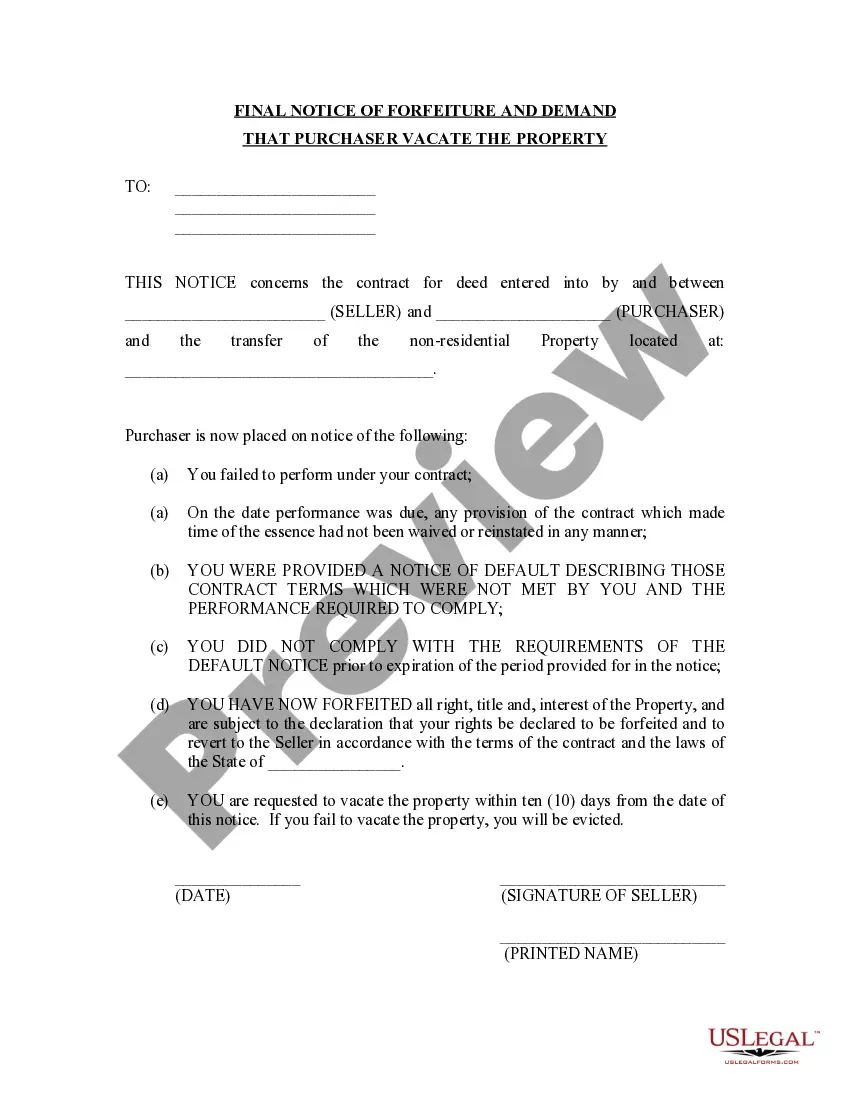
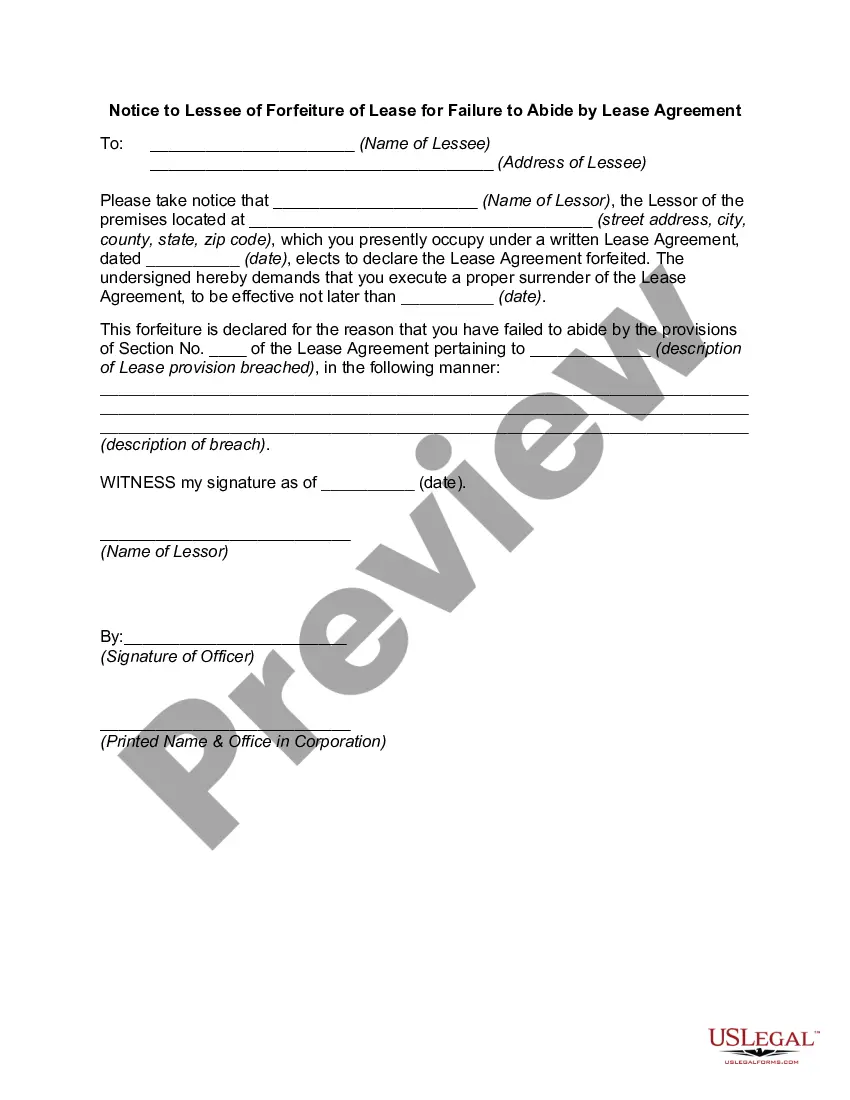
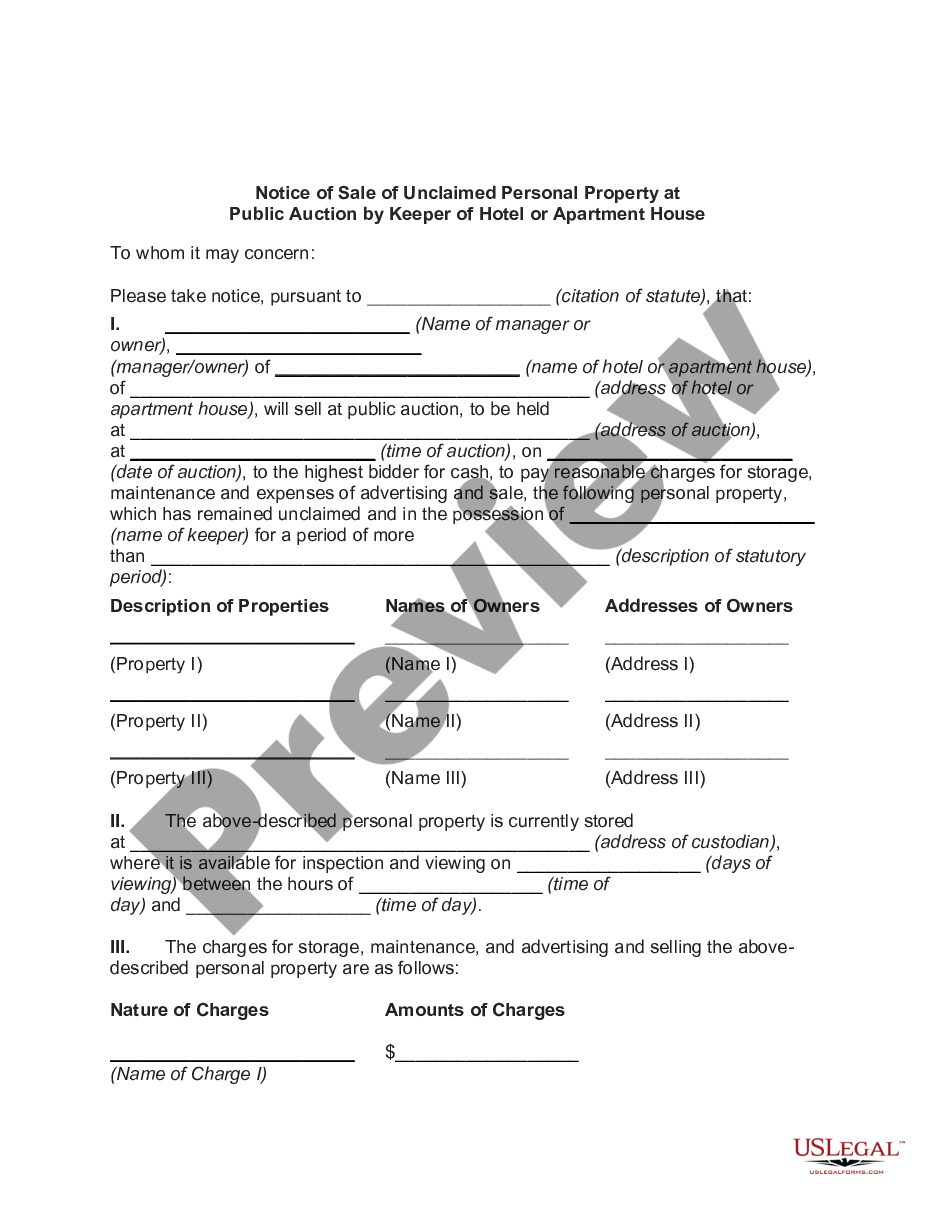
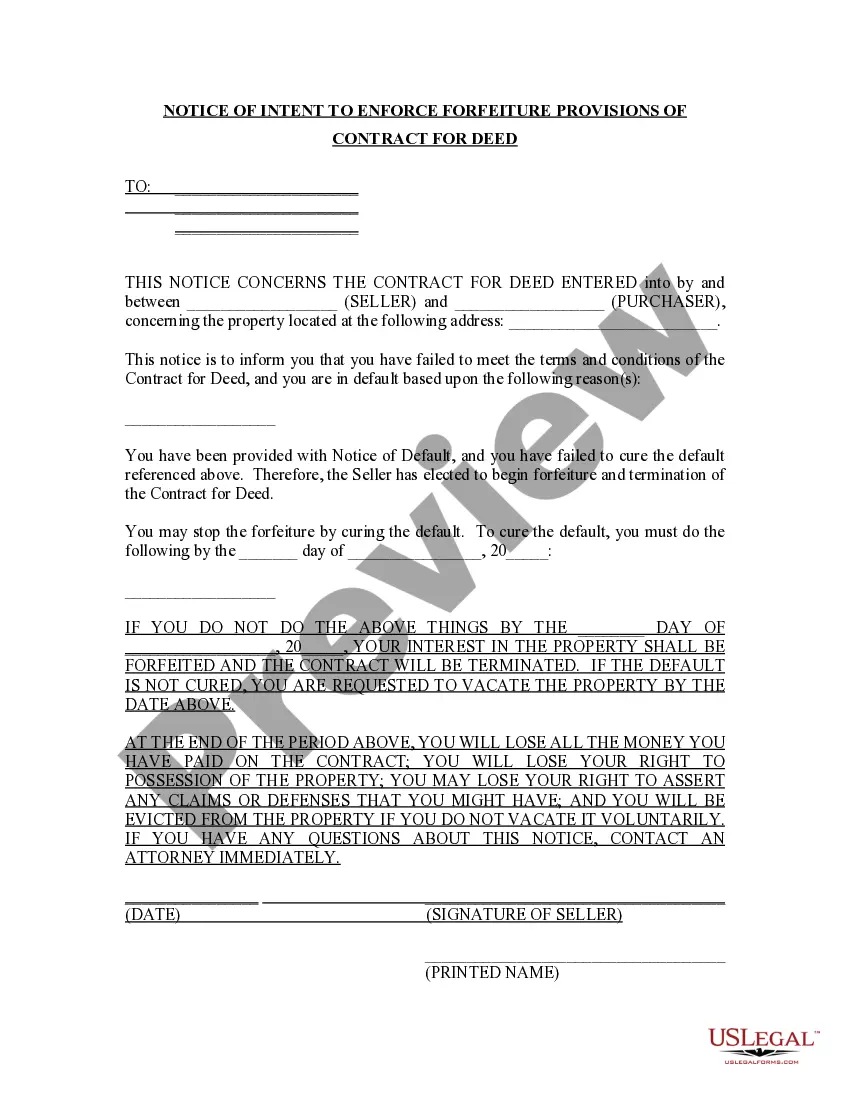
The Final Notice of Forfeiture and Request to Vacate Property under Contract for Deed is a legal document that formalizes the cancellation of a contract for deed between a seller and a purchaser. This notice is issued after the purchaser has failed to remedy earlier breaches, making all previous payments forfeited. It clearly states that the purchaser must vacate the property to avoid eviction, distinguishing it from other notices by focusing on the termination of the purchaser's rights to the property.
What’s included in this form
- Identification of the seller and purchaser involved in the contract.
- Details of the property subject to the contract for deed.
- Specific notice of default and the terms of the original agreement that were breached.
- Deadline for vacating the property, typically within ten days of the notice.
- Signature and printed name of the seller to validate the notice.
Common use cases
This form should be used when a seller has decided to cancel a contract for deed due to the purchaser's failure to meet the contractual obligations, such as making timely payments. It is typically used in situations where previous notices of default have been issued and the requisite periods for compliance have lapsed, signaling the final opportunity for the purchaser to vacate the premises before legal eviction proceedings are initiated.
Intended users of this form
- Property sellers who need to terminate a contract for deed due to purchaser default.
- Purchasers who have received notice of their contractual breaches and need to understand their obligations.
- Real estate professionals involved in the sale and purchase of properties under contract for deed.
- Legal representatives assisting sellers with the enforcement of contract for deed terms.
Completing this form step by step
- Identify the seller and purchaser by entering their full names in the specified sections.
- Provide the address and details of the property involved in the contract for deed.
- Clearly outline the breaches of the contract that have occurred, based on notice of default.
- Specify the date by which the purchaser must vacate the property.
- Sign and date the document to authenticate the notice.
Is notarization required?
This form does not typically require notarization unless specified by local law. However, it is advisable to confirm with applicable state regulations to ensure compliance.
Get your form ready online
Our built-in tools help you complete, sign, share, and store your documents in one place.
Make edits, fill in missing information, and update formatting in US Legal Forms—just like you would in MS Word.
Download a copy, print it, send it by email, or mail it via USPS—whatever works best for your next step.
Sign and collect signatures with our SignNow integration. Send to multiple recipients, set reminders, and more. Go Premium to unlock E-Sign.
If this form requires notarization, complete it online through a secure video call—no need to meet a notary in person or wait for an appointment.
We protect your documents and personal data by following strict security and privacy standards.

Make edits, fill in missing information, and update formatting in US Legal Forms—just like you would in MS Word.

Download a copy, print it, send it by email, or mail it via USPS—whatever works best for your next step.

Sign and collect signatures with our SignNow integration. Send to multiple recipients, set reminders, and more. Go Premium to unlock E-Sign.

If this form requires notarization, complete it online through a secure video call—no need to meet a notary in person or wait for an appointment.

We protect your documents and personal data by following strict security and privacy standards.
Mistakes to watch out for
- Failing to accurately fill in the names of the seller and purchaser.
- Not providing complete details about the property, such as the address.
- Neglecting to specify all breaches of the contract, which may weaken the notice.
- Missing the deadline for the purchaser to vacate the property or improperly calculating the notice period.
Benefits of completing this form online
- Immediate access to legal forms tailored to your specific needs.
- The ability to edit and customize the form to reflect your unique situation.
- Access to forms drafted by licensed attorneys, ensuring legal compliance.
- Convenient download options for easy printing and distribution.
Legal use & context
- This notice serves as a formal declaration of forfeiture under contract law.
- It lays the groundwork for potential eviction proceedings against the purchaser.
- Ensures the seller's rights to the property are protected within defined legal boundaries.
Summary of main points
- The Final Notice of Forfeiture serves as the last step in notifying a buyer of contract cancellation.
- It is essential for sellers to follow proper legal procedures to avoid disputes.
- Understanding and adhering to state-specific laws ensures a smoother process.
Looking for another form?
Form popularity
FAQ
Contract for Deed Seller Financing. A contract for deed is used by some sellers who finance the sale of their homes. Seller's Ownership Liability. Buyer Default Risk. Seller Performance. Property Liens Could Hinder Purchase.
A real estate deal can take a turn for the worst if the contract is not carefully written to include all the legal stipulations for both the buyer and seller.You can write your own real estate purchase agreement without paying any money as long as you include certain specifics about your home.
Generally, contract for deed sellers use IRS Form 6252 to report installment sales in the year in which they take place. You also use Form 6252 during each year you receive income from your contract for deed.
Should I record the contract? The seller must record the contract or a memorandum of the contract within 10 days of the date of sale. They must do this at the county recorder of deeds where the property is located.
A contract for deed is an agreement for buying property without going to a mortgage lender. The buyer agrees to pay the seller monthly payments, and the deed is turned over to the buyer when all payments have been made.
A disadvantage to the seller is that a contract for deed is frequently characterized by a low down payment and the purchase price is paid in installments instead of one lump sum. If a seller needs funds from the sale to buy another property, this would not be a beneficial method of selling real estate.
A disadvantage to the seller is that a contract for deed is frequently characterized by a low down payment and the purchase price is paid in installments instead of one lump sum.The legal fees and time frame for this process will be more extensive than a standard Power of Sale foreclosure.
A contract for deed is a legal agreement for the sale of property in which a buyer takes possession and makes payments directly to the seller, but the seller holds the title until the full payment is made.
Usually the contract requires the buyer to make payments over time with interest payable on the unpaid balance. Once a buyer pays all of the payments called for under the contract, the owner transfers to the buyer a deed to the property.
The buyer should record the contract for deed with the county recorder where the land is located and does so normally within four months after the contract is signed, though the time may vary depending on state law.