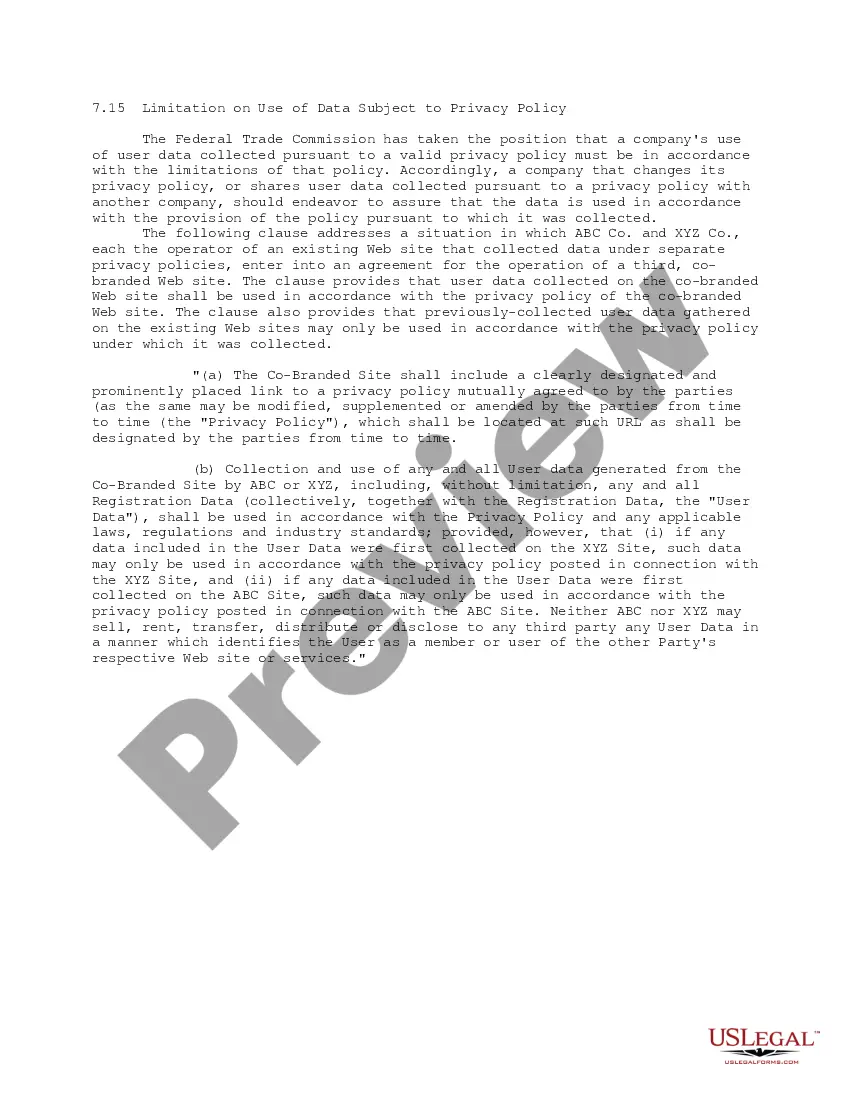
Limitation on Use of Data Subject to Privacy Policy
Understanding this form
The Limitation on Use of Data Subject to Privacy Policy form helps companies regulate how user data is utilized following changes to their privacy policy or when sharing data with third parties. This form ensures that the data is handled according to the privacy policy under which it was originally collected, distinguishing it from other data handling agreements.
Main sections of this form
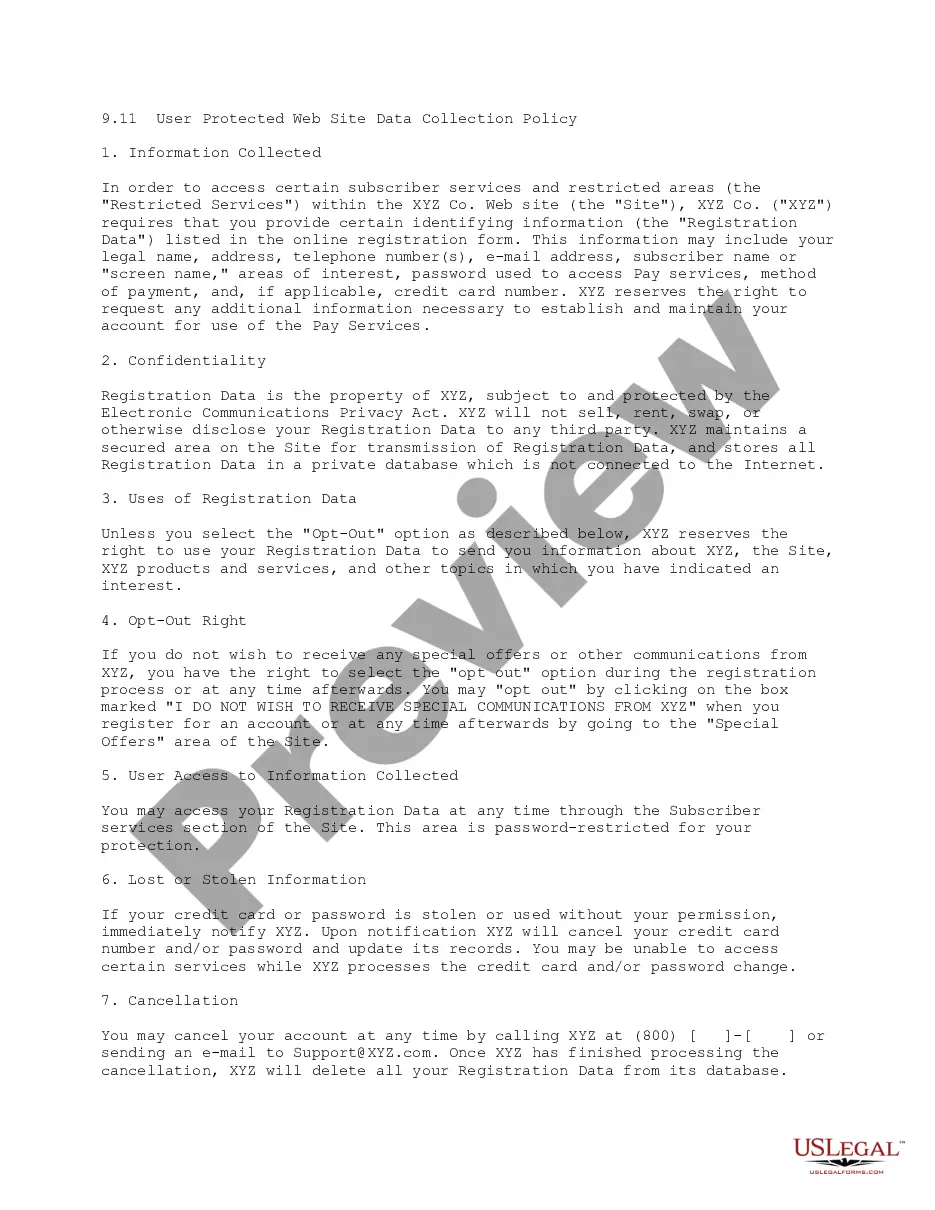
- Privacy policy reference: Clearly designates a link to the mutual privacy policy of the parties involved.
- User data usage: Outlines how user data collected from a co-branded site must be used according to the privacy policies of the originating sites.
- Data protection clause: Prohibits selling or disclosing user data in a way that identifies users as members of either party's respective sites.
When to use this form
This form is essential when a business alters its privacy policy or collaborates with another business on a co-branded website. It serves to protect user data collected under previous privacy policies and to ensure transparency and compliance with privacy regulations.
Who this form is for
- Businesses that collect user data and want to change their privacy policy.
- Companies that share user data with a partner or third-party website.
- Organizations looking to establish a co-branded online presence while maintaining data compliance.
How to complete this form
- Identify the parties involved and their respective privacy policies.
- Include the URL of the co-branded website's privacy policy.
- Specify the data collection methods and how user data will be utilized.
- Ensure both parties review and agree on how to handle pre-collected user data.
- Have authorized representatives sign the form to confirm agreement.
Does this form need to be notarized?
This form usually doesn’t need to be notarized. However, local laws or specific transactions may require it. Our online notarization service, powered by Notarize, lets you complete it remotely through a secure video session, available 24/7.
Get your form ready online
Our built-in tools help you complete, sign, share, and store your documents in one place.
Make edits, fill in missing information, and update formatting in US Legal Forms—just like you would in MS Word.
Download a copy, print it, send it by email, or mail it via USPS—whatever works best for your next step.
Sign and collect signatures with our SignNow integration. Send to multiple recipients, set reminders, and more. Go Premium to unlock E-Sign.
If this form requires notarization, complete it online through a secure video call—no need to meet a notary in person or wait for an appointment.
We protect your documents and personal data by following strict security and privacy standards.

Make edits, fill in missing information, and update formatting in US Legal Forms—just like you would in MS Word.

Download a copy, print it, send it by email, or mail it via USPS—whatever works best for your next step.

Sign and collect signatures with our SignNow integration. Send to multiple recipients, set reminders, and more. Go Premium to unlock E-Sign.

If this form requires notarization, complete it online through a secure video call—no need to meet a notary in person or wait for an appointment.

We protect your documents and personal data by following strict security and privacy standards.
Avoid these common issues
- Failing to update the privacy policy in line with new data usage practices.
- Not establishing clear terms on how pre-existing data can be used.
- Neglecting to obtain proper signatures from all parties involved.
Benefits of using this form online
- Convenient access allows for easy download and customization.
- Edit forms to fit specific business needs without legal jargon.
- Assures compliance with federal and state privacy laws.
Legal use & context
- This form helps businesses align their data practices with applicable privacy laws.
- It provides a legal framework for companies to collaborate without violating user privacy.
- Using this form can help mitigate risks of data misuse and regulatory penalties.
Summary of main points
- The form ensures proper handling of user data when privacy policies are changed or data is shared.
- It is crucial for companies to comply with privacy laws to avoid legal repercussions.
- Clearly defining data usage and linking to privacy policies are essential components.
Looking for another form?








Form popularity
FAQ
The Role of the Information Commissioner's Office (ICO) in Relation to the GDPR. The Information Commissioner's Office (ICO) is the independent regulatory office in charge of upholding information rights in the interest of the public. The organisation covers the following: Data Protection Act.
The fifth principle is storage limitation. It entails that personal data must be kept in a form that makes it possible to identify data subjects for no longer than is necessary for the purposes of the processing.
It means that personal data are to be collected only for specified, explicit and legitimate purposes and it is not allowed to process them further in a way that is not compatible with those purposes.
The data subject's right to access to information. The right of correction, technically known as the right to rectification. The also mentioned right to be forgotten (erasure). The rights in the scope of consent (if that's the legal ground for processing).
Lawfulness, fairness and transparency. Purpose limitation. Data minimisation. Accuracy. Storage limitation. Integrity and confidentiality (security) Accountability.
In this chapter, we focus on the five core principles of privacy protection that the FTC determined were "widely accepted," namely: Notice/Awareness, Choice/Consent, Access/Participation, Integrity/Security, and Enforcement/Redress.
Processing is necessary for the purposes of the legitimate interests pursued by the controller or by a third party, except where such interests are overridden by the interests or fundamental rights and freedoms of the data subject which require protection of personal data, in particular where the data subject is a
Under the General Data Protection Regulation (GDPR), for example, purpose limitation is a requirement that personal data be collected for specified, explicit, and legitimate purposes, and not be processed further in a manner incompatible with those purposes (Article 5(1)(b), GDPR).
In practice, this means that you must: be clear from the outset why you are collecting personal data and what you intend to do with it; comply with your documentation obligations to specify your purposes; comply with your transparency obligations to inform individuals about your purposes; and.