ADA Issues Checklist
What is this form?
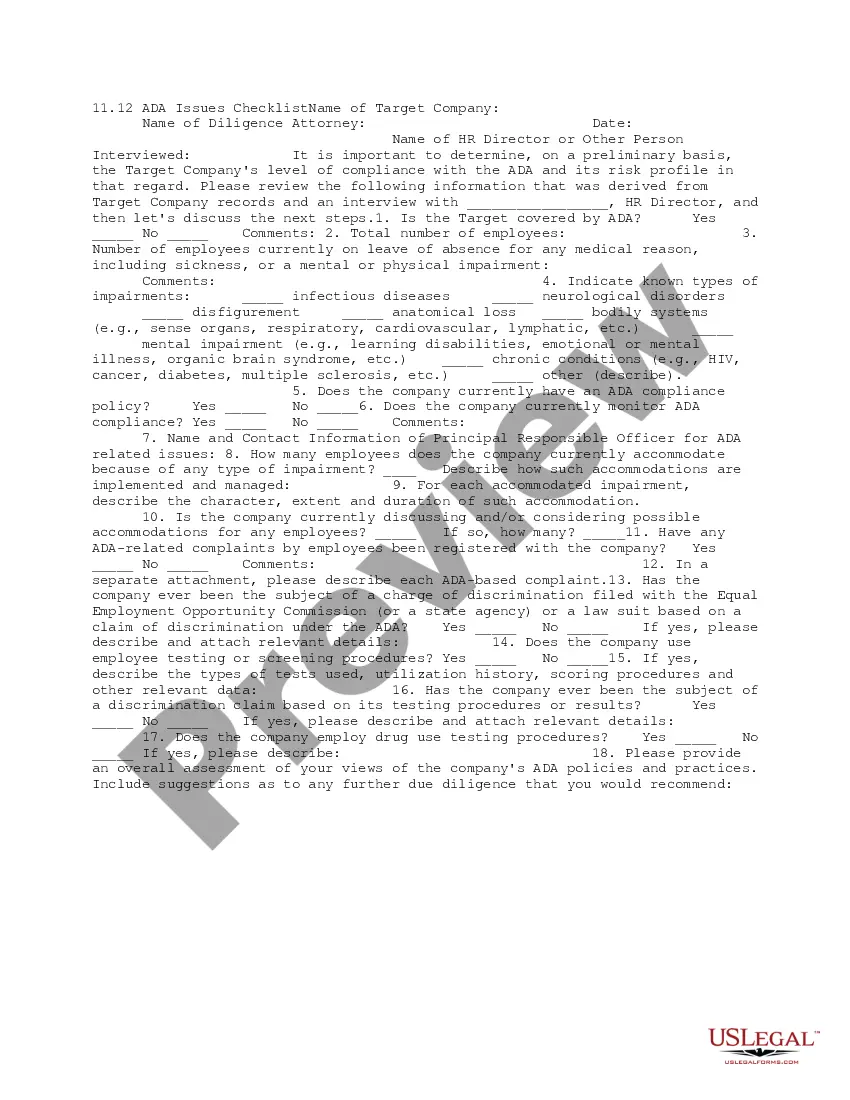
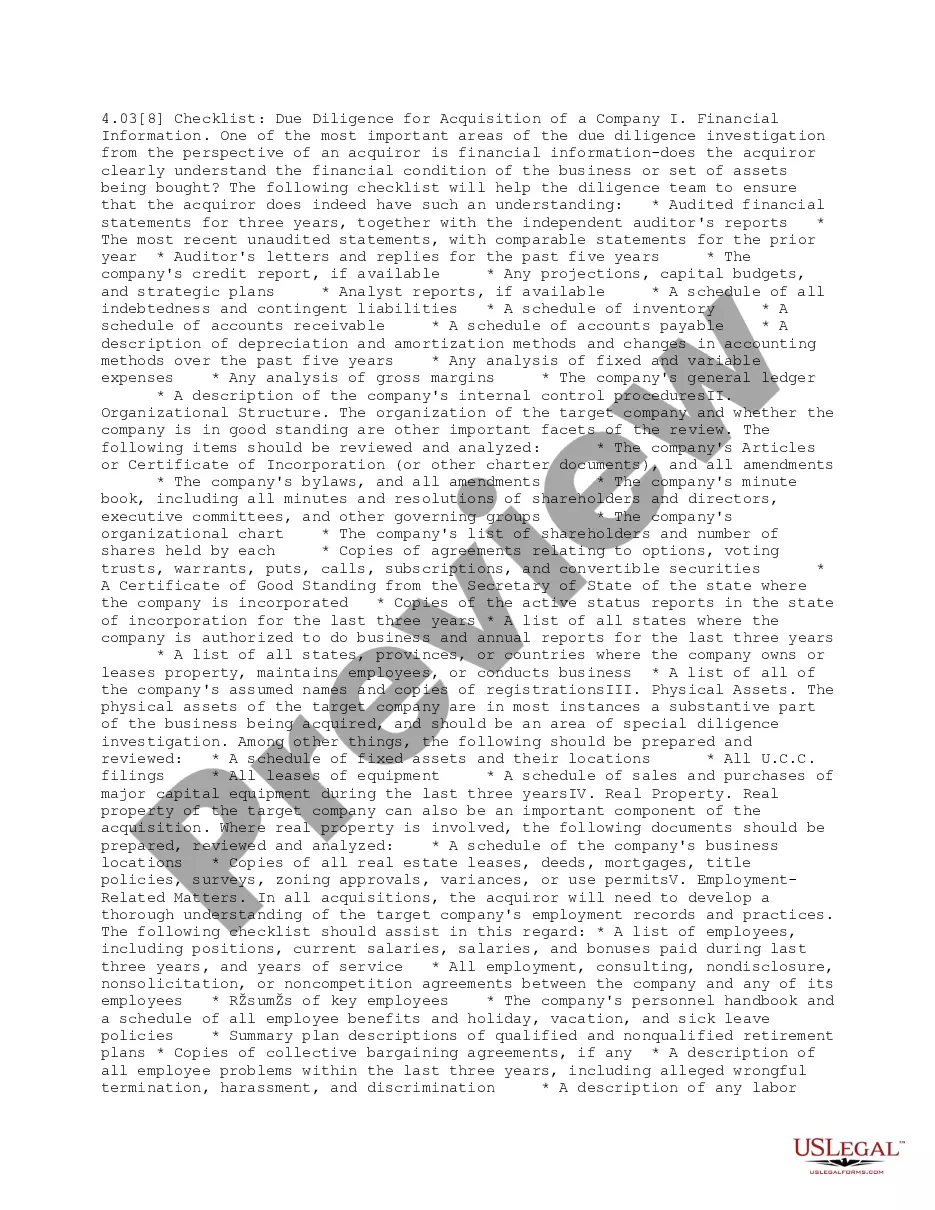
The ADA Issues Checklist is a due diligence tool designed to assess a company's compliance with the Americans with Disabilities Act (ADA). This checklist helps companies identify their level of adherence to ADA regulations and evaluates potential risks related to business transactions. Unlike other generic compliance forms, this checklist specifically focuses on disability-related issues within the workplace, ensuring comprehensive coverage of ADA obligations.
What’s included in this form
- Name of the target company and diligence attorney
- Compliance status of the target company with the ADA
- Total number of employees and those currently on medical leave
- Details of known impairments within the workforce
- Company's existing ADA compliance policies and monitoring practices
- Employee accommodation descriptions and management
- Information about any ADA-related complaints or discrimination claims
Situations where this form applies
This form is essential when assessing a potential business transaction involving a company, particularly if there are concerns about ADA compliance. It is typically used during mergers, acquisitions, or partnerships to ensure that the target company's practices align with legal requirements. Additionally, companies can use this checklist to evaluate their own ADA compliance proactively, helping to avoid future legal issues.
Intended users of this form
- Compliance officers and company executives involved in due diligence
- Human Resources professionals responsible for workplace compliance
- Legal counsel conducting audits or assessments of potential business partners
- Companies aiming to evaluate and improve their ADA practices
Steps to complete this form
- Enter the name of the target company and the attorney responsible for the diligence.
- Determine if the target company is covered by the ADA and note the total number of employees.
- Document the number of employees on medical leave and identify any known impairments.
- Assess the companyâs existing ADA compliance policy and monitoring practices.
- Provide details about any accommodations made for employees with impairments.
- Note any ADA-related complaints or discrimination charges against the company.
Does this form need to be notarized?
This form does not typically require notarization unless specified by local law. It can be completed and utilized without notarization to assess ADA compliance effectively.
Get your form ready online
Our built-in tools help you complete, sign, share, and store your documents in one place.
Make edits, fill in missing information, and update formatting in US Legal Forms—just like you would in MS Word.
Download a copy, print it, send it by email, or mail it via USPS—whatever works best for your next step.
Sign and collect signatures with our SignNow integration. Send to multiple recipients, set reminders, and more. Go Premium to unlock E-Sign.
If this form requires notarization, complete it online through a secure video call—no need to meet a notary in person or wait for an appointment.
We protect your documents and personal data by following strict security and privacy standards.

Make edits, fill in missing information, and update formatting in US Legal Forms—just like you would in MS Word.

Download a copy, print it, send it by email, or mail it via USPS—whatever works best for your next step.

Sign and collect signatures with our SignNow integration. Send to multiple recipients, set reminders, and more. Go Premium to unlock E-Sign.

If this form requires notarization, complete it online through a secure video call—no need to meet a notary in person or wait for an appointment.

We protect your documents and personal data by following strict security and privacy standards.
Mistakes to watch out for
- Failing to accurately record the total number of employees and those on leave.
- Omitting any known impairments from the checklist.
- Not including comments or additional details in the provided sections.
- Neglecting to follow up on any identified ADA compliance issues.
Benefits of using this form online
- Easy access and downloading for immediate use.
- Editable format allowing for customization as needed.
- Reliable templates drafted by licensed attorneys ensuring legal accuracy.
- Convenient record-keeping for compliance documentation.
Legal use & context
This form serves as a preliminary assessment tool for ADA compliance, which is critical in legal contexts. If deficiencies are found, companies may need to address them promptly to avoid potential legal consequences, such as lawsuits or fines for non-compliance.
What to keep in mind
- The ADA Issues Checklist helps assess a companyâs compliance with the ADA.
- This checklist is useful for businesses involved in transactions that require due diligence.
- Key areas of focus include employee accommodations and compliance policies.
Looking for another form?



Form popularity
FAQ
Your name and position. The date. Information about your disability. A request for accommodation. Accommodation ideas. Medical information.
Providing an assistant as needed may be a reasonable accommodation for a person with a disability, if this does not impose an undue hardship. Examples include: An assistant may be needed to retrieve items on shelves, file, or selectively assist a person with quadriplegia with other clerical duties.
Step One: Determine whether an individual has a disability and meets minimum qualification standards. Step Two: Determine the essential functions of the job. Step Three: Identify the abilities and limitations of the individual. Step Four: Identify potential accommodations.
A reasonable accommodation is any change to the application or hiring process, to the job, to the way the job is done, or the work environment that allows a person with a disability who is qualified for the job to perform the essential functions of that job and enjoy equal employment opportunities.
In order for you to prove that you were the victim of disability discrimination, you must first meet the criteria of a disability as defined by the ADA. To meet the definition, you must suffer from a mental or physical impairment that causes a substantial limitation of a major life activity.
Needed accommodations may include providing: Accessible training sites; Training materials in alternate formats (e.g., large print, Braille, audiotape, or electronic format) to accommodate a disability; and. Sign language interpreters or captioning.
Identify yourself as a person with a disability. State that you are requesting accommodations under the ADA (or the Rehabilitation Act of 1973 if you are a federal employee) Identify your specific problematic job tasks. Identify your accommodation ideas.
An individual meets the Americans with Disabilities with Act definition act of disability that would qualify them for reasonable accommodations if they have a physical or mental impairment that substantially limits one or more major life activities (sometimes referred to in the regulations as an actual disability)