FMLA Tracker Form - Rolling Method - Variable Schedule Employees
What this document covers
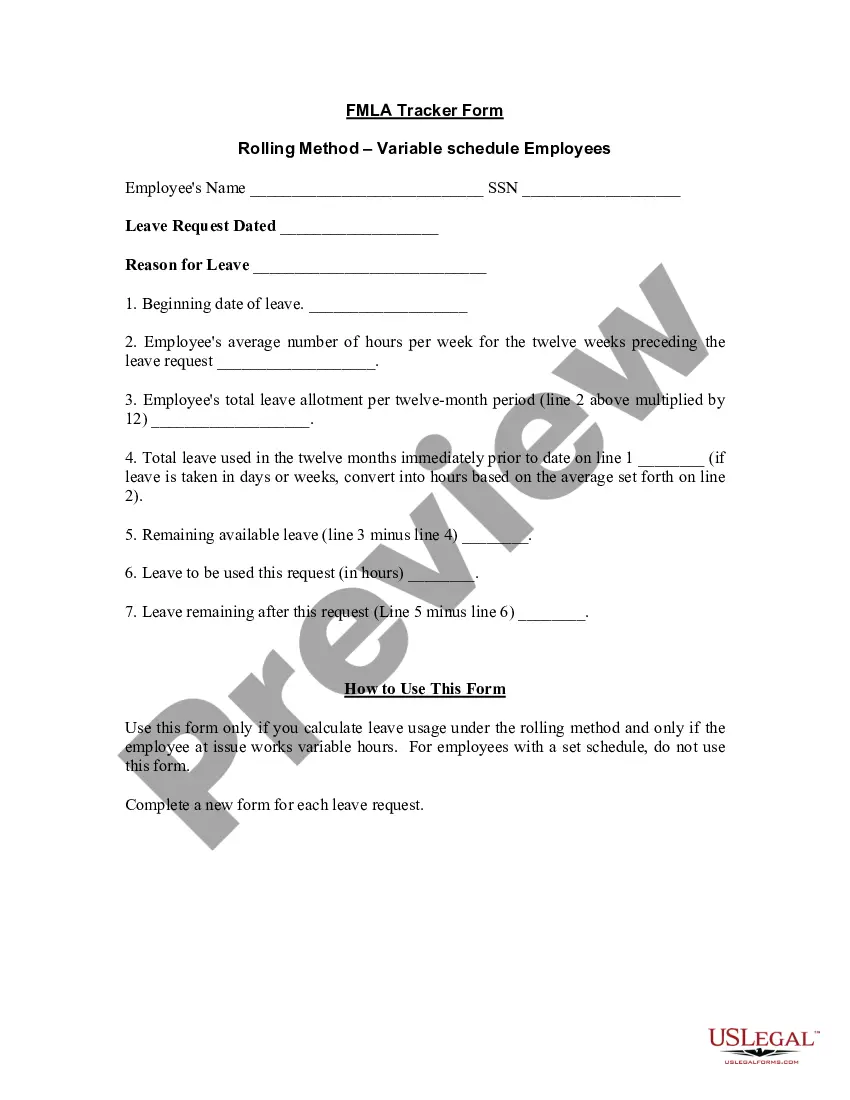
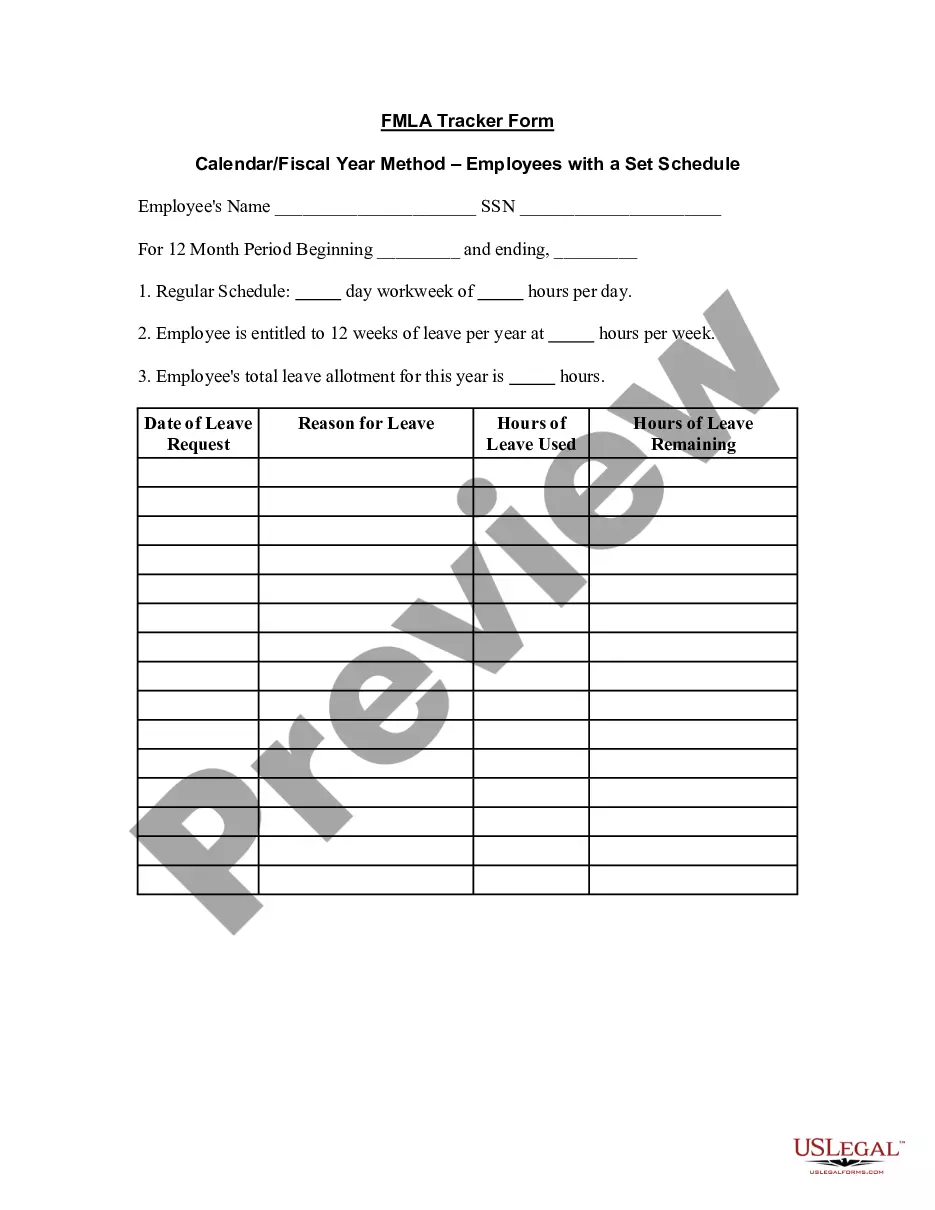
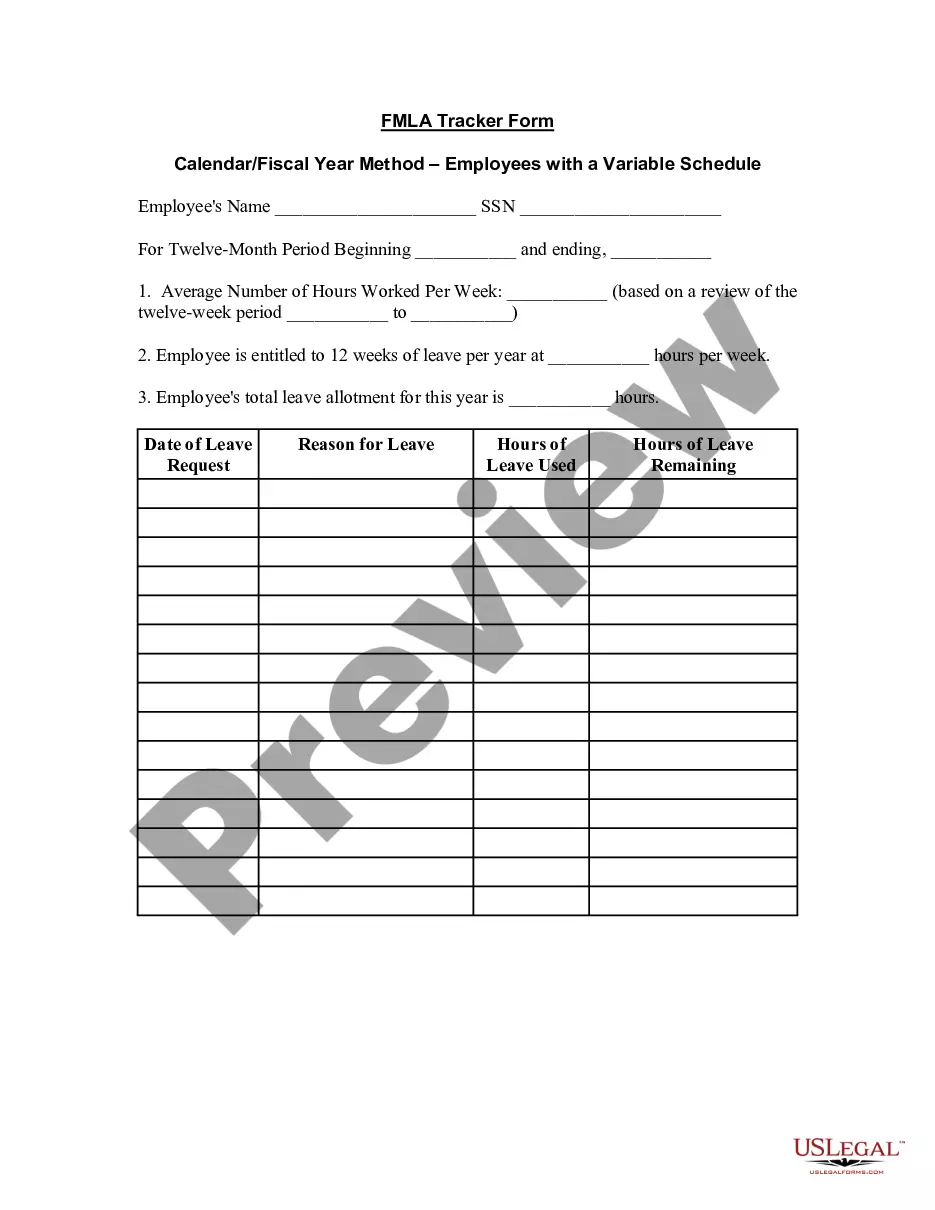
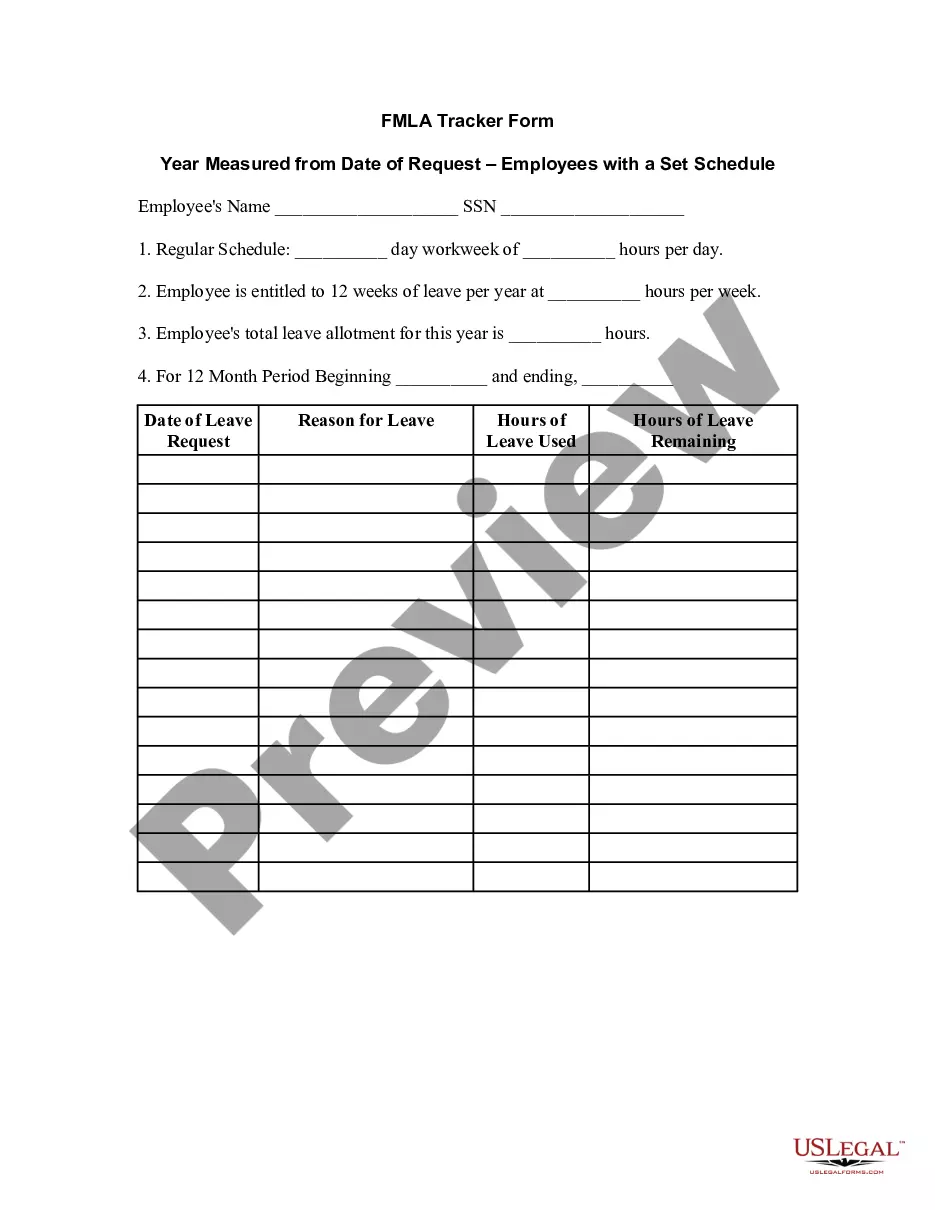
The FMLA Tracker Form - Rolling Method - Variable Schedule Employees is designed to help employers track the leave taken by employees who work variable hours, following the rolling method of Family and Medical Leave Act (FMLA) calculations. This form differentiates itself from other leave tracking forms by specifically catering to employees who do not have a fixed schedule, allowing for accurate monitoring of their leave entitlements and usage.
Main sections of this form
- Employee's name and Social Security number.
- Date of leave request and reason for taking leave.
- Beginning date of leave.
- Average number of hours the employee worked per week over the previous twelve weeks.
- Total leave allotment for the twelve-month period.
- Amount of leave used in the twelve months prior to the current leave request.
- Remaining available leave after previous usages.
- Requested leave in hours and leave remaining after this request.
When to use this form
This form should be used when an employee who works variable hours is requesting leave under the FMLA. It is particularly relevant in cases where the leave is calculated using the rolling method, which takes into account the employee's average hours worked over the past twelve weeks. Each time an employee requests leave, a new form must be completed to ensure accurate tracking.
Who should use this form
- Employers managing variable schedule employees.
- HR personnel responsible for tracking employee leave.
- Managers overseeing FMLA leave requests in their department.
- Employees seeking to understand and track their leave entitlements.
Steps to complete this form
- Enter the employee's name and Social Security number at the top of the form.
- Specify the date of the leave request and the main reason for leave.
- Fill in the beginning date of the leave and the average number of hours worked per week over the last twelve weeks.
- Calculate the total leave allotment for the twelve-month period and record it on the form.
- Document the total leave taken in the prior twelve months, converted into hours.
- Subtract previous leave usage from the total allotment to determine remaining leave, then complete the leave request details.
Does this document require notarization?
Notarization is generally not required for this form. However, certain states or situations might demand it. You can complete notarization online through US Legal Forms, powered by Notarize, using a verified video call available anytime.
Get your form ready online
Our built-in tools help you complete, sign, share, and store your documents in one place.
Make edits, fill in missing information, and update formatting in US Legal Forms—just like you would in MS Word.
Download a copy, print it, send it by email, or mail it via USPS—whatever works best for your next step.
Sign and collect signatures with our SignNow integration. Send to multiple recipients, set reminders, and more. Go Premium to unlock E-Sign.
If this form requires notarization, complete it online through a secure video call—no need to meet a notary in person or wait for an appointment.
We protect your documents and personal data by following strict security and privacy standards.
Make edits, fill in missing information, and update formatting in US Legal Forms—just like you would in MS Word.
Download a copy, print it, send it by email, or mail it via USPS—whatever works best for your next step.
Sign and collect signatures with our SignNow integration. Send to multiple recipients, set reminders, and more. Go Premium to unlock E-Sign.
If this form requires notarization, complete it online through a secure video call—no need to meet a notary in person or wait for an appointment.
We protect your documents and personal data by following strict security and privacy standards.
Typical mistakes to avoid
- Forgetting to update the average hours worked when leave requests are made.
- Not using a new form for each leave request, which can lead to inaccurate tracking.
- Miscalculating the remaining leave due to incorrect conversion between days/weeks and hours.
- Failing to provide a valid reason for leave on the form.
Why use this form online
- Immediate access to the latest legal form templates created by licensed attorneys.
- The ability to easily edit and save information as needed.
- Secure storage and retrieval of completed forms without physical paperwork.
- Reduces the potential for errors with guided fields and calculations.
Key takeaways
- The FMLA Tracker Form for Variable Schedule Employees is essential for managing leave under the FMLA for employees with fluctuating hours.
- Accurate calculations are crucial to ensure compliance and proper leave management.
- Use this form for each new leave request to maintain up-to-date records.
Looking for another form?









Form popularity
FAQ
A private-sector employer is covered by the FMLA if it employs 50 or more employees in 20 or more workweeks in the current or previous calendar year. An employee is considered to be employed each working day of the calendar week if the employee works any part of the week. The workweeks do not have to be consecutive.
Under the ''rolling'' 12-month period, each time an employee takes FMLA leave, the remaining leave entitlement would be the balance of the 12 weeks which has not been used during the immediately preceding 12 months. Example 1: Michael requests three weeks of FMLA leave to begin on July 31st.
The amount of FMLA leave taken is divided by the number of hours the employee would have worked if the employee had not taken leave of any kind (including FMLA leave) to determine the proportion of the FMLA workweek used.
Under the regulations, an employer should request medical certification, in most cases, at the time an employee gives notice of the need for leave or within five business days. If the leave is unforeseen, the employer should request medical certification within five days after the leave begins.
Calendar year. Another fixed 12-month period (business year, etc.) The 12 months measured forward from when an employee first takes leave, or. A rolling 12-month period measured backward from the date an employee uses any FMLA leave.
The FMLA gives employers four ways to count the 12-month period (also called the "leave year") for FMLA purposes. Employers may use the calendar year.Some employers use a third method called "counting forward." In this system, the 12-month period officially begins on the first day an employee takes FMLA leave.
Using this method, the employer will look back over the last 12 months from the date of the request, add all FMLA time the employee has used during the previous 12 months and subtract that total from the employee's 12-week leave allotment.
The DOL provides a model Designation Notice (Form WH-382) that can be used to notify the employee whether his or her FMLA request has been approved or denied.
Using this method, the employer will look back over the last 12 months from the date of the request, add all FMLA time the employee has used during the previous 12 months and subtract that total from the employee's 12-week leave allotment.