Nebraska Transfer on Death Deed or TOD - Beneficiary Deed - Individual to Individual with provision for Alternate Beneficiary

Understanding this form
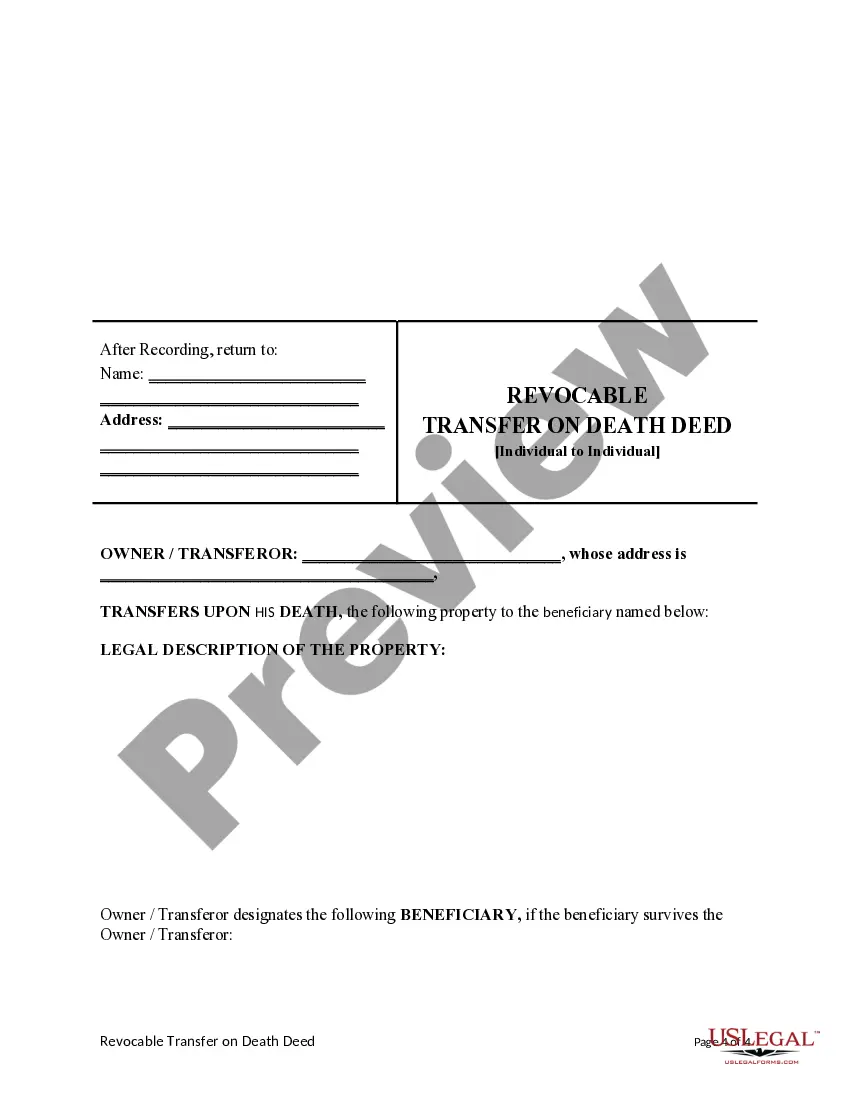
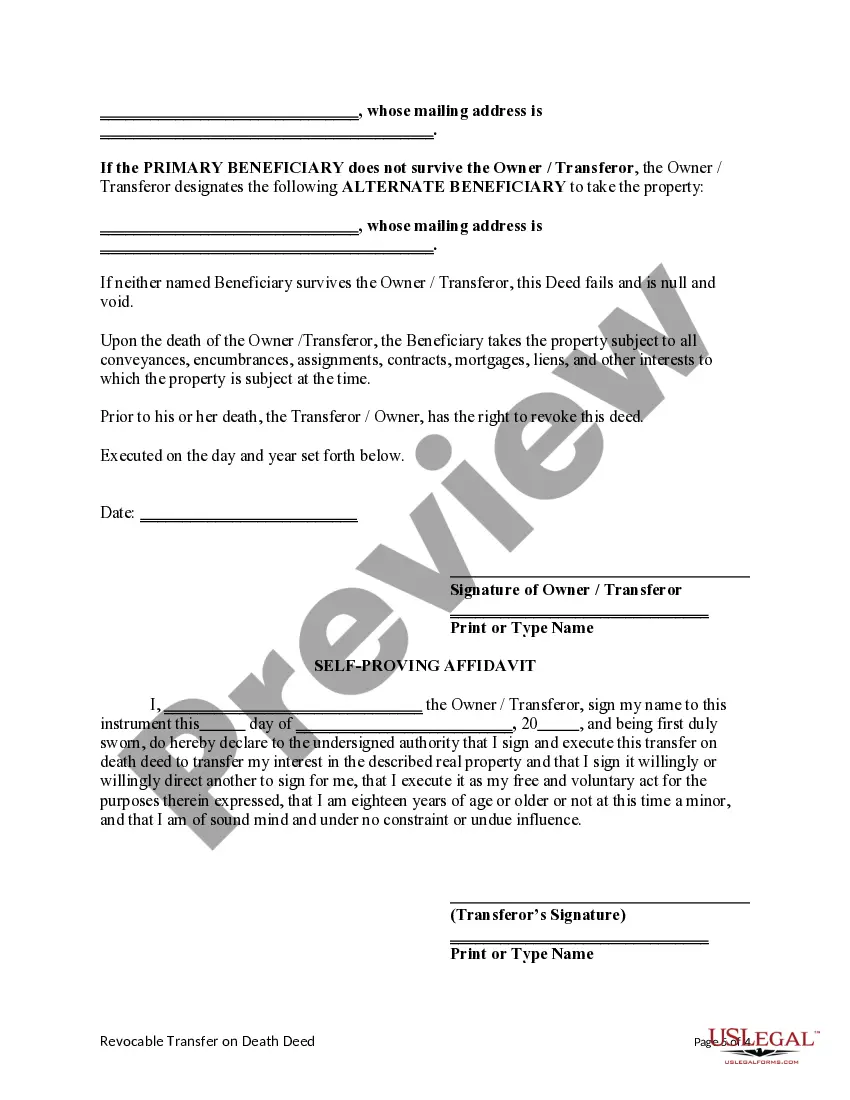
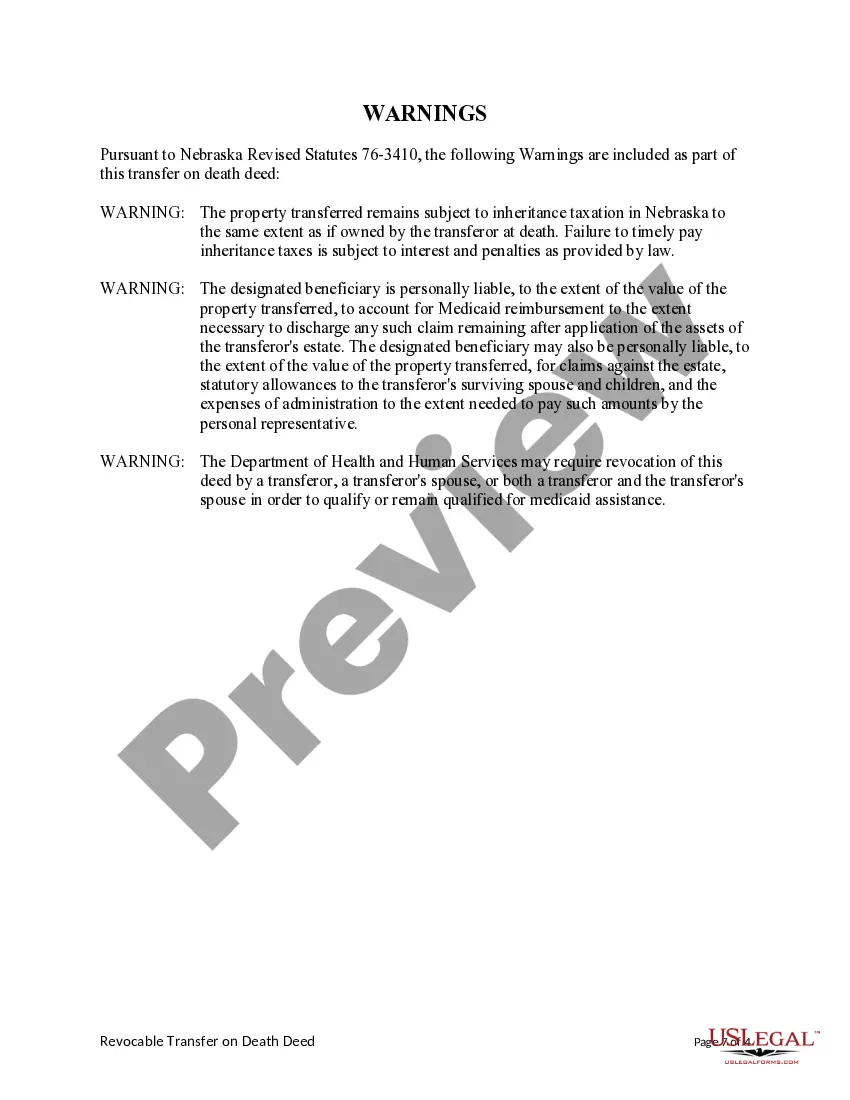
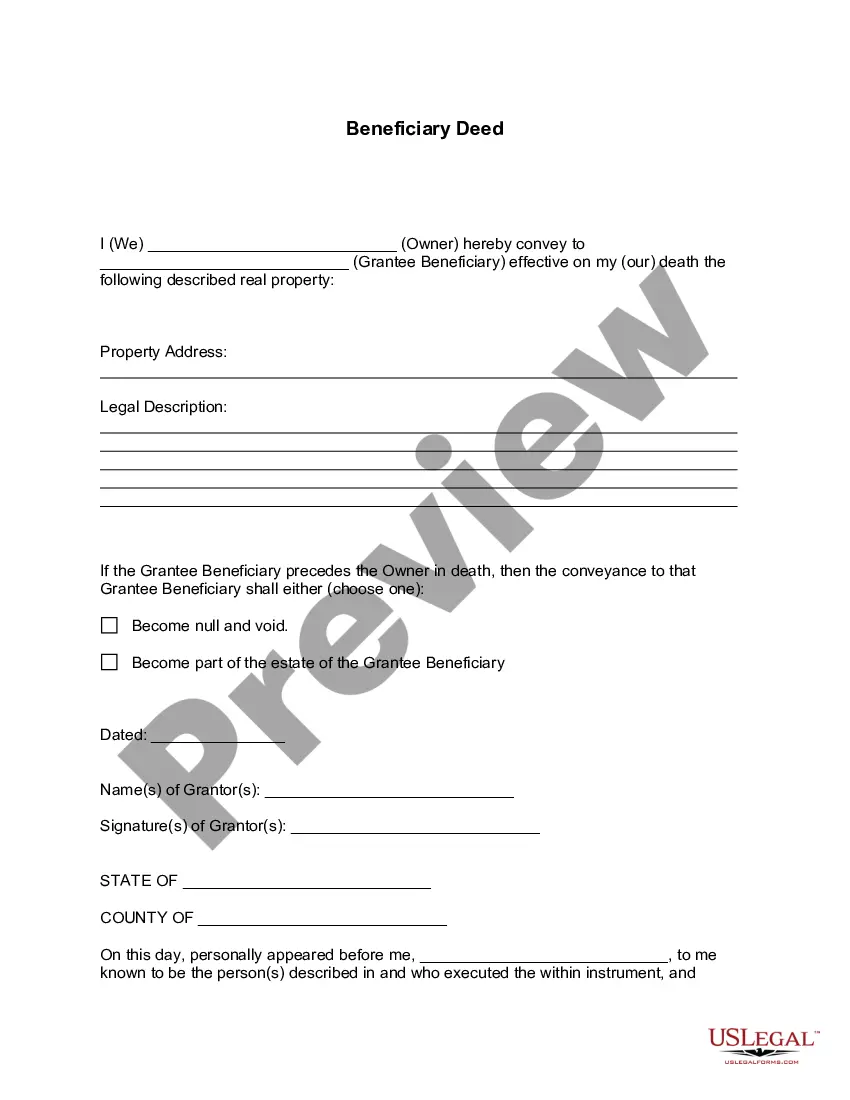
The Transfer on Death Deed (TOD) is a legal instrument used to transfer the title of real estate from an individual (Transferor) to a designated beneficiary (Grantee) upon the death of the Transferor. Unlike a traditional deed, this form allows the Transferor to retain full ownership during their lifetime, and it only takes effect after death, thus avoiding probate. This specific TOD form includes provisions for an alternate beneficiary if the primary beneficiary does not survive the Transferor.
Key parts of this document
- Identification of the Transferor and Beneficiaries
- Legal description of the property being transferred
- Provisions for an alternate beneficiary
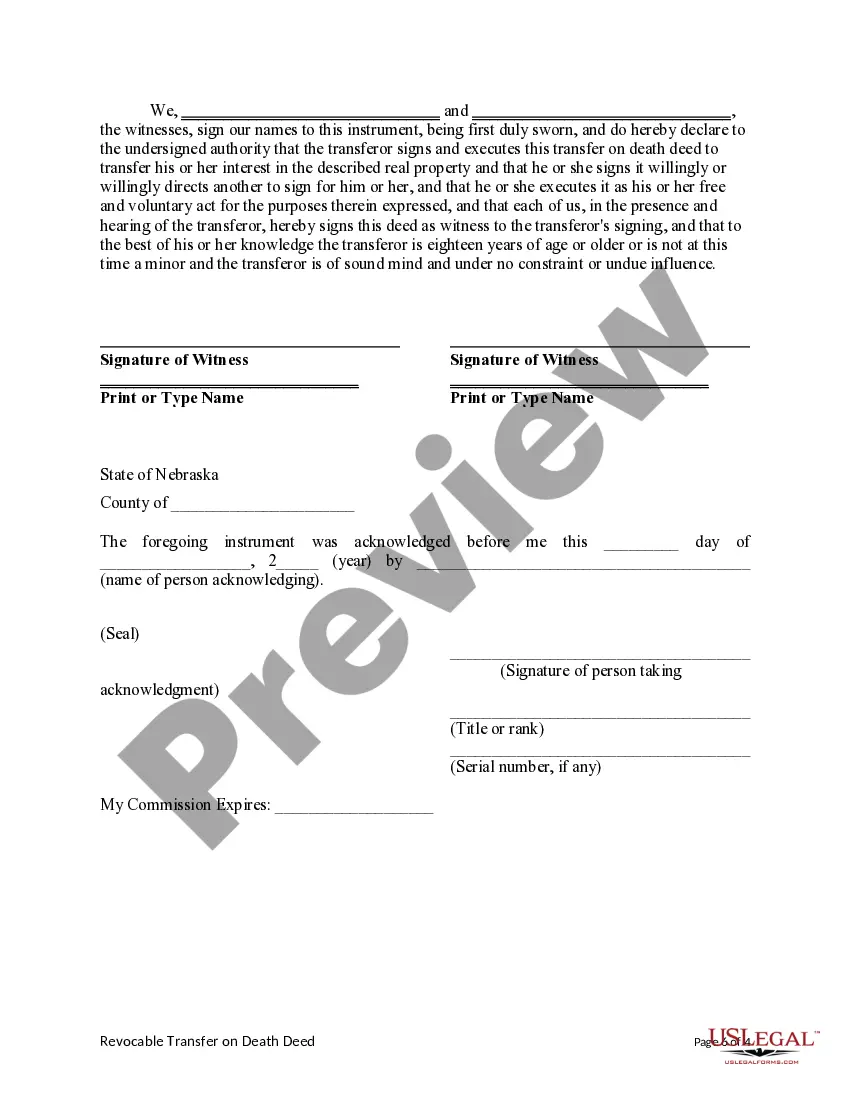
- Execution and signing requirements, including notarization
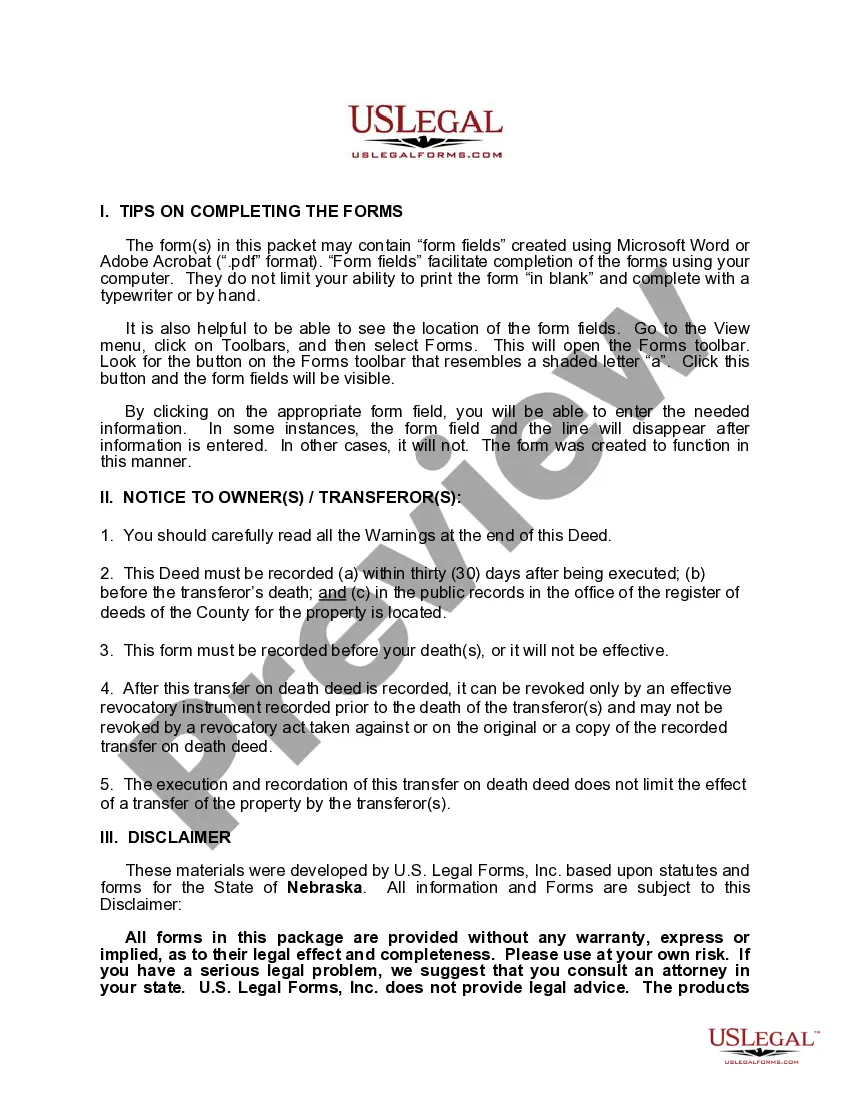
- Timing and registration obligations with local authorities

When to use this document
This form should be used when an individual wishes to ensure that their property is transferred directly to a beneficiary upon their death, thereby minimizing complications related to probate. It is particularly useful when the Transferor wants to maintain control over the property during their lifetime while providing a clear path for transferring ownership after death. This is commonly used in estate planning as part of a broader strategy to manage assets.
Who needs this form
- Individuals seeking to transfer real estate upon death
- Property owners looking to simplify the inheritance process for their beneficiaries
- Individuals who have a primary beneficiary and possibly an alternate beneficiary in mind
- Those who want to retain control over the property during their lifetime
- Residents of Nebraska and individuals with property in Nebraska
How to prepare this document
- Identify the Transferor by entering their full name and address.
- Detail the property being transferred, including a legal description.
- Specify the name and address of the primary beneficiary.
- If desired, designate an alternate beneficiary in case the primary beneficiary does not survive the Transferor.
- Sign the document in the presence of a Notary Public and include witness signatures if required.
- File the completed deed with the local recorder of deeds within thirty days of signing.
Does this form need to be notarized?
This form needs to be notarized to ensure legal validity. US Legal Forms provides secure online notarization powered by Notarize, allowing you to complete the process through a verified video call, available anytime.
Get your form ready online
Our built-in tools help you complete, sign, share, and store your documents in one place.
Make edits, fill in missing information, and update formatting in US Legal Forms—just like you would in MS Word.
Download a copy, print it, send it by email, or mail it via USPS—whatever works best for your next step.
Sign and collect signatures with our SignNow integration. Send to multiple recipients, set reminders, and more. Go Premium to unlock E-Sign.
If this form requires notarization, complete it online through a secure video call—no need to meet a notary in person or wait for an appointment.
We protect your documents and personal data by following strict security and privacy standards.

Make edits, fill in missing information, and update formatting in US Legal Forms—just like you would in MS Word.

Download a copy, print it, send it by email, or mail it via USPS—whatever works best for your next step.

Sign and collect signatures with our SignNow integration. Send to multiple recipients, set reminders, and more. Go Premium to unlock E-Sign.

If this form requires notarization, complete it online through a secure video call—no need to meet a notary in person or wait for an appointment.

We protect your documents and personal data by following strict security and privacy standards.
Common mistakes
- Failing to record the deed within the required thirty days.
- Not having the deed notarized, which is essential for validation.
- Neglecting to specify a secondary beneficiary, which may create complications.
- Omitting essential details about the property, such as the legal description.
- Not considering potential tax implications for beneficiaries.
Advantages of online completion
- Convenient access to legally vetted forms ready for download.
- Editability allows users to customize documents quickly and easily.
- Reliable source ensures compliance with state-specific laws.
- 24/7 availability makes it easy to obtain forms at any time.
- Instantly downloadable formats for ease of use and printing.
Legal use & context
- Transfer on Death Deeds are recognized by Nebraska law, providing a mechanism to avoid probate.
- They allow for direct transfer of property, minimizing delays and disputes over the estate.
- Failure to properly execute or record the deed can render it ineffective, making adherence to requirements crucial.
Summary of main points
- The Transfer on Death Deed allows for the seamless transfer of property upon death.
- It is imperative to record the deed within thirty days after signing for it to be effective.
- Notarization and clear identification of beneficiaries are essential to avoid legal issues.
- Using this form can simplify estate planning and help beneficiaries receive property directly.
Looking for another form?
Form popularity
FAQ
A revocable TOD deed does not avoid the owner's creditors. Creditors may seek collection against the designated beneficiaries as to secured and unsecured obligations of the original owner.A revocable TOD deed, if incorrect, cannot be resolved informally after the owner's death without tax consequences.
When a person dies, beneficiaries might learn that the decedent made a deed that conflicts with the specific wording in his will. Generally, a deed will override the will. However, which legal document prevails also depends on state property laws and whether the state has adopted the Uniform Probate Code.
No a will does not override a deed. A will only acts on death. The deed must be signed during the life of the owner. The only assets that pass through the will are assets that are in the name of the decedent only.
Receiving an inheritance can be an unexpected windfall. In fact, transfer on death accounts are exposed to all the same income and capital gains taxes when the account owner is alive, as well as estate and inheritance taxes upon the owner's death.
A beneficiary form states who will directly inherit the asset at your death. Under a TOD arrangement, you keep full control of the asset during your lifetime and pay taxes on any income the asset generates as you own it outright. TOD arrangements require minimal paperwork to establish.
A TOD designation supersedes a will. For bank accounts, you can set up a similar account known as payable-on-death, sometimes referred to as a Totten trust. Your beneficiaries can't touch the account while you're alive, and you're free to change beneficiaries or close the accounts at any time.
If you'd like to avoid having your property going through the probate process, it's a good idea to look into a transfer on death deed. A transfer on death deed allows you to select a beneficiary who will receive your property, but only when you've passed away.