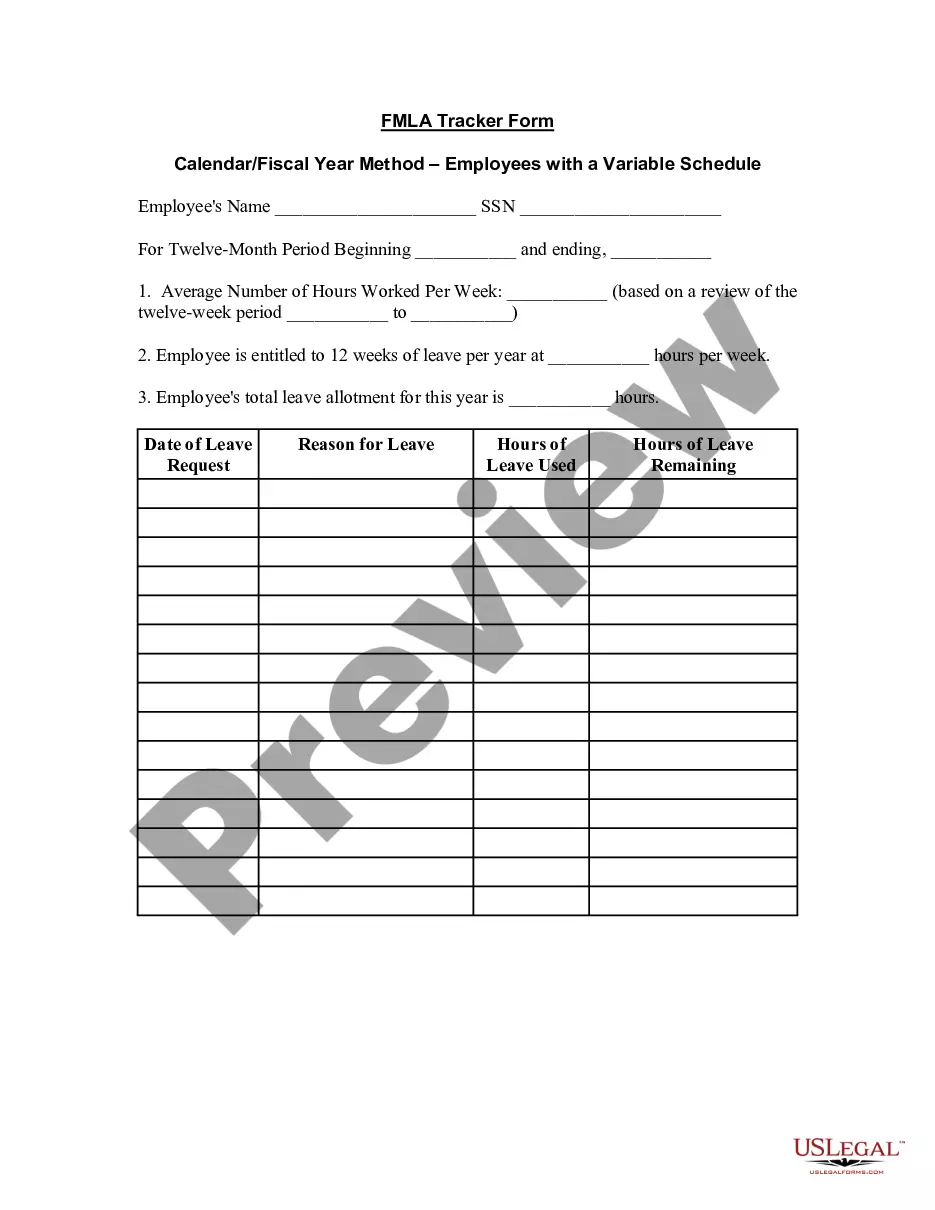
FMLA Tracker Form - Calendar - Fiscal Year Method - Employees with Variable Schedule
About this form
The FMLA Tracker Form - Calendar - Fiscal Year Method - Employees with Variable Schedule is a tool designed to track the Family and Medical Leave Act (FMLA) leave for employees who work variable schedules. This form differs from standard FMLA leave trackers, which are suitable for employees with set schedules. It helps employers accurately calculate FMLA leave entitlements based on the average number of hours worked by employees over a specified period.
What’s included in this form
- Employee details: Name and Social Security Number.
- Timeframe: Designated twelve-month period for tracking FMLA leave.
- Average hours: Calculation of the average number of hours worked per week.
- Leave tracking: Documentation of leave requests and total hours used.
- Leave balance: Updates on remaining FMLA leave after each request.
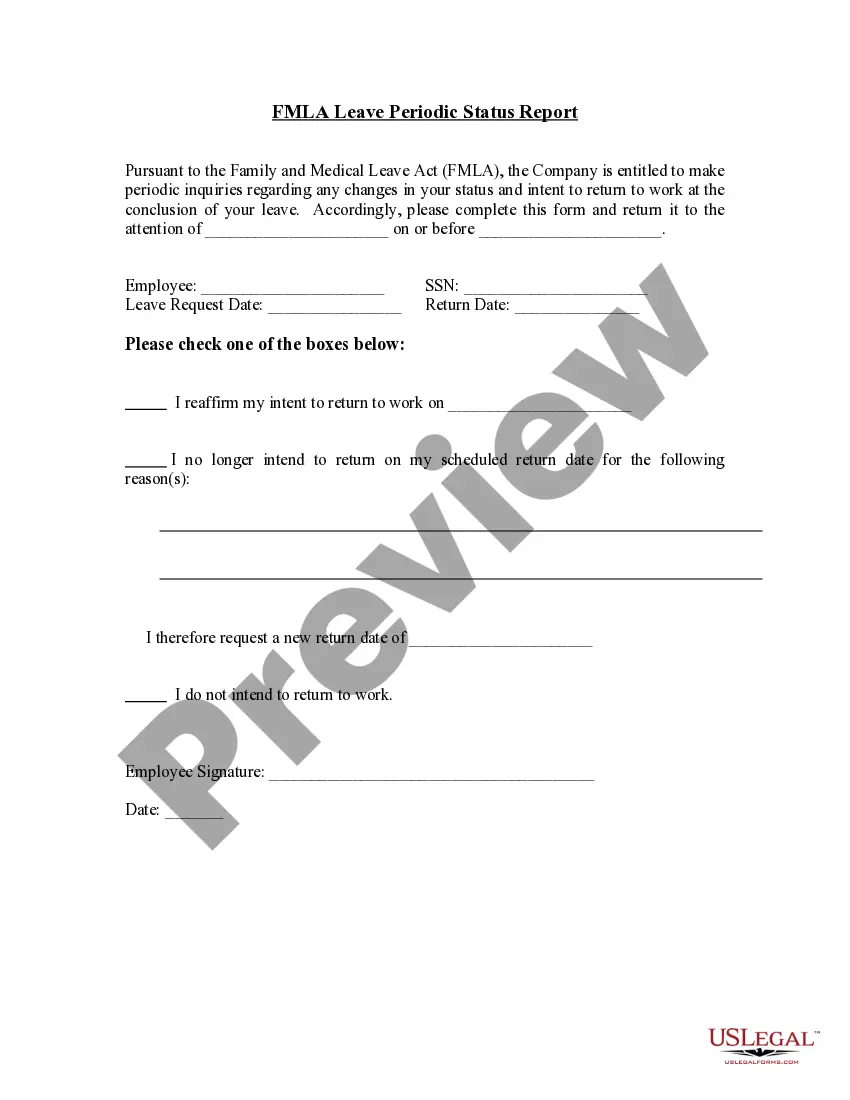
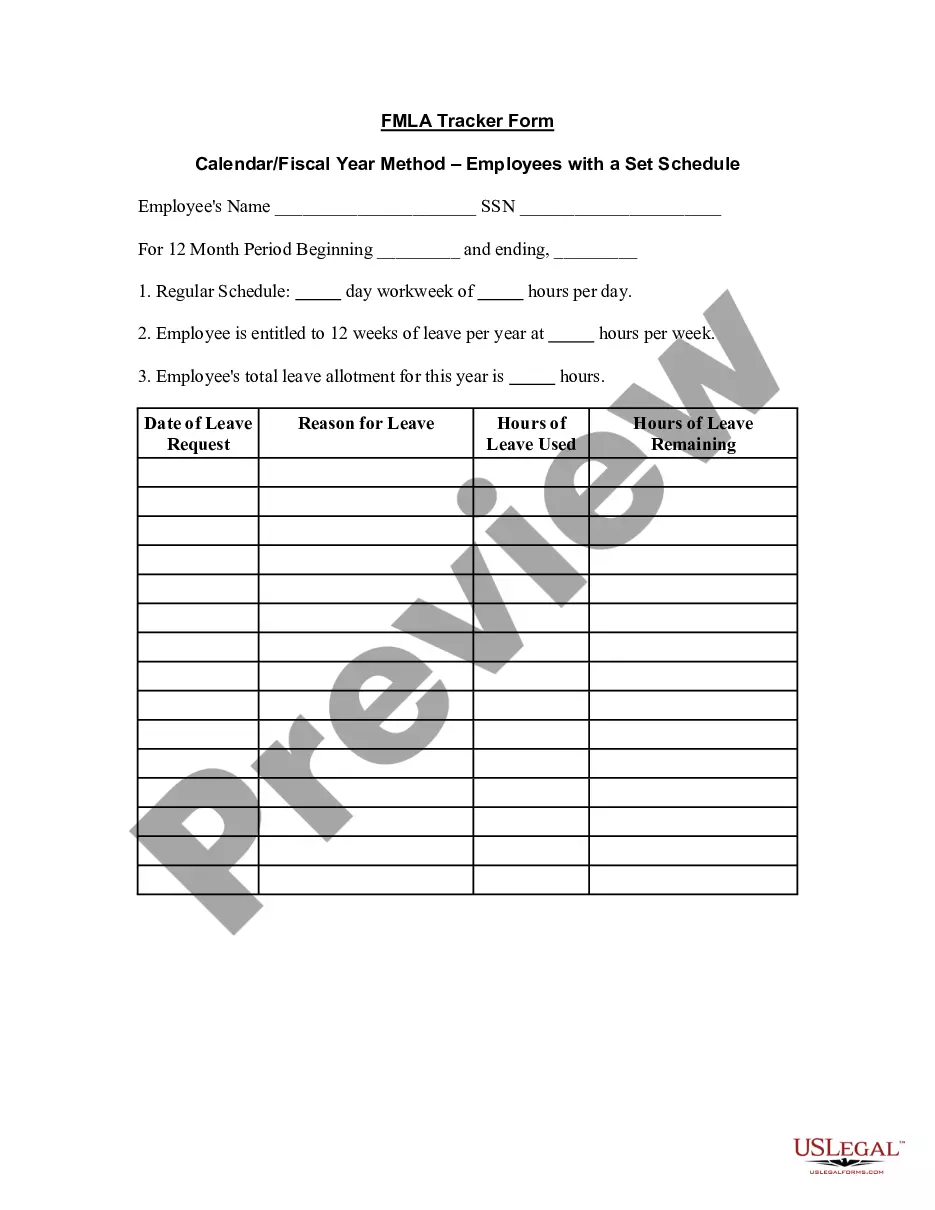
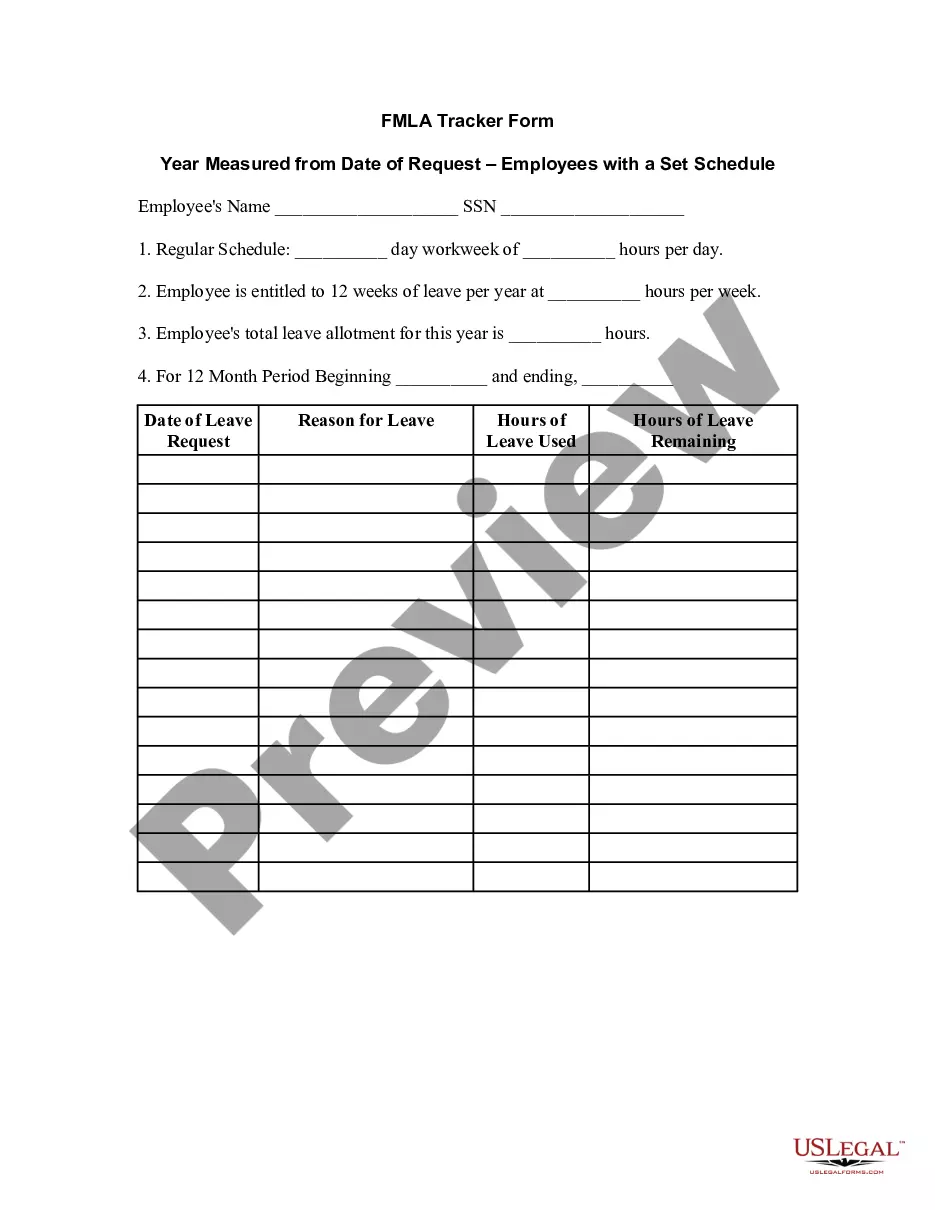
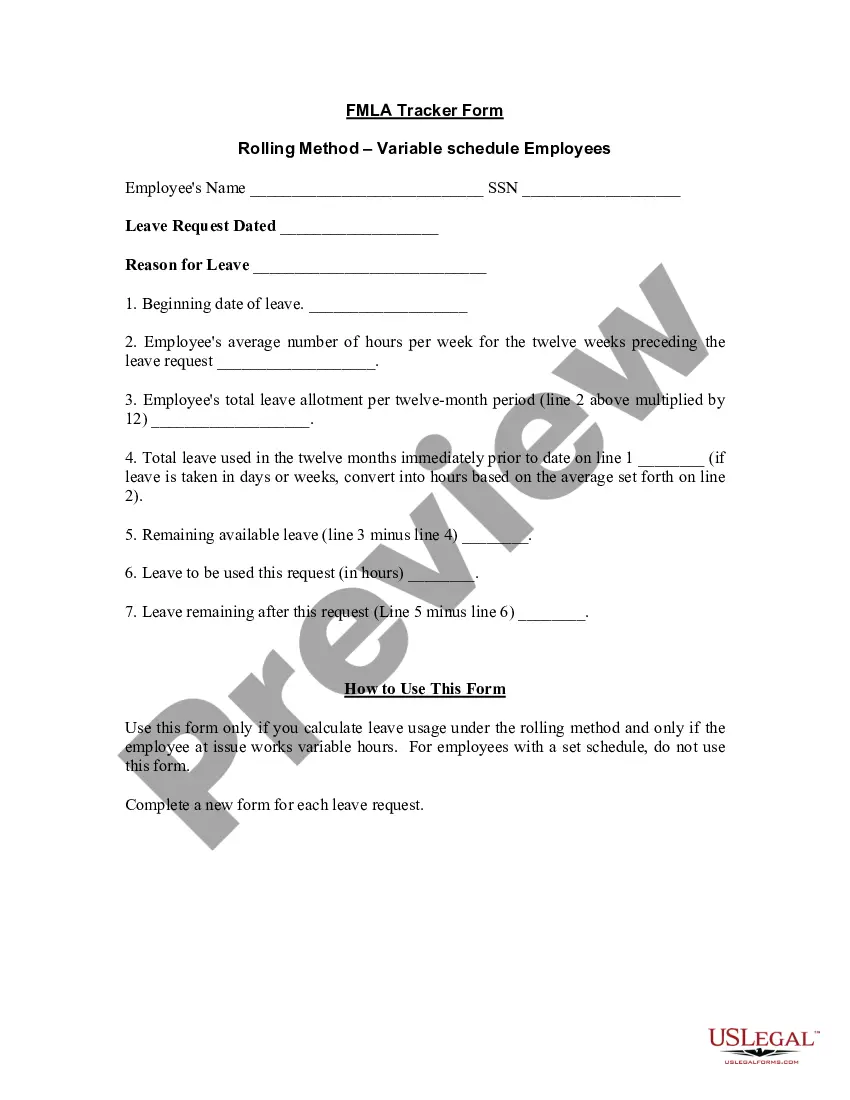
When this form is needed
This form should be used when managing FMLA leave for employees whose work hours vary from week to week. It is essential for situations where an employee requests FMLA leave but does not have a consistent work schedule, ensuring that their leave is calculated accurately according to the hours they typically work.
Who should use this form
- Employers who have employees eligible for FMLA leave and who work variable schedules.
- Human Resource departments responsible for tracking employee leave and maintaining compliance with FMLA regulations.
- Managers overseeing employees whose hours fluctuate and need to document leave requests and usage.
How to complete this form
- Fill in the employee's name and Social Security Number at the top of the form.
- Specify the twelve-month period during which you are tracking FMLA leave.
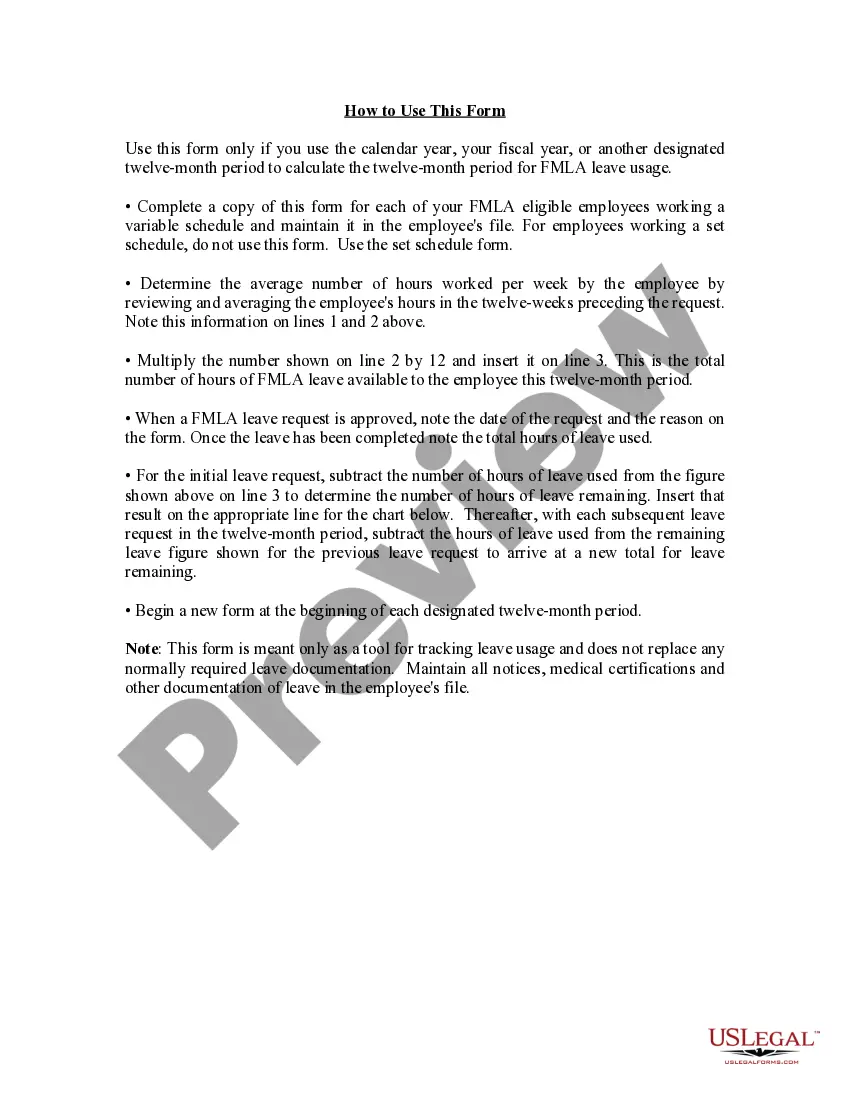
- Calculate the average number of hours worked per week based on the preceding twelve weeks and enter this information in the designated field.
- Calculate the total FMLA leave hours available by multiplying the average weekly hours by twelve and record this number.
- Document each leave request by noting the request date and reason, followed by tracking the total hours of leave used.
Does this document require notarization?
This form does not typically require notarization unless specified by local law. It should be kept on file for record-keeping purposes as part of the employee's documentation.
Get your form ready online
Our built-in tools help you complete, sign, share, and store your documents in one place.
Make edits, fill in missing information, and update formatting in US Legal Forms—just like you would in MS Word.
Download a copy, print it, send it by email, or mail it via USPS—whatever works best for your next step.
Sign and collect signatures with our SignNow integration. Send to multiple recipients, set reminders, and more. Go Premium to unlock E-Sign.
If this form requires notarization, complete it online through a secure video call—no need to meet a notary in person or wait for an appointment.
We protect your documents and personal data by following strict security and privacy standards.

Make edits, fill in missing information, and update formatting in US Legal Forms—just like you would in MS Word.

Download a copy, print it, send it by email, or mail it via USPS—whatever works best for your next step.

Sign and collect signatures with our SignNow integration. Send to multiple recipients, set reminders, and more. Go Premium to unlock E-Sign.

If this form requires notarization, complete it online through a secure video call—no need to meet a notary in person or wait for an appointment.

We protect your documents and personal data by following strict security and privacy standards.
Avoid these common issues
- Failing to calculate the average hours worked over the correct twelve-week period.
- Not keeping the completed forms up to date after each leave request.
- Using this form for employees who have a fixed work schedule.
Benefits of using this form online
- Convenience: Downloadable and ready to use at your fingertips.
- Editability: Easily update and track FMLA leave for multiple employees in a digital format.
- Reliability: Forms are drafted by licensed attorneys, ensuring legal compliance and accuracy.
Legal use & context
This form is designed to comply with the Family and Medical Leave Act, offering a structured approach to tracking FMLA leave for qualifying employees. It is important to adhere to federal guidelines while also considering any state-specific regulations that may apply. Employers should maintain these records for legal and compliance purposes.
Quick recap
- The FMLA Tracker Form is essential for employees on variable schedules.
- Proper calculation of FMLA hours ensures compliance with federal regulations.
- Regular updates are crucial to maintaining accurate leave records.
Looking for another form?


Form popularity
FAQ
Under the ''rolling'' 12-month period, each time an employee takes FMLA leave, the remaining leave entitlement would be the balance of the 12 weeks which has not been used during the immediately preceding 12 months. Example 1: Michael requests three weeks of FMLA leave to begin on July 31st.
The employee's actual workweek is the basis for determining the employee's FMLA leave entitlement. An employee does not accrue FMLA leave at any particular hourly rate. FMLA leave may be taken in periods of whole weeks, single days, hours, and in some cases even less than an hour.
Using this method, the employer will look back over the last 12 months from the date of the request, add all FMLA time the employee has used during the previous 12 months and subtract that total from the employee's 12-week leave allotment.
An employee's 12 weeks of leave under the federal Family and Medical Leave Act (FMLA) don't automatically renew at the beginning of the calendar year. The FMLA gives employers four options for calculating the leave year.The employer may use a 12-month period that starts on the first day an employee takes FMLA leave.
Using this method, the employer will look back over the last 12 months from the date of the request, add all FMLA time the employee has used during the previous 12 months and subtract that total from the employee's 12-week leave allotment.
Under the ''rolling'' 12-month period, each time an employee takes FMLA leave, the remaining leave entitlement would be the balance of the 12 weeks which has not been used during the immediately preceding 12 months. Example 1: Michael requests three weeks of FMLA leave to begin on July 31st.
To determine the person's eligibility, the hours he or she would have worked during the period of USERRA-covered service (20 x 40 = 800 hours) must be added to the hours actually worked during the 12-month period prior to the start of the leave to determine if the 1,250 hour requirement is met.
Calendar year. Another fixed 12-month period (business year, etc.) The 12 months measured forward from when an employee first takes leave, or. A rolling 12-month period measured backward from the date an employee uses any FMLA leave.
The FMLA gives employers four ways to count the 12-month period (also called the "leave year") for FMLA purposes. Employers may use the calendar year.Some employers use a third method called "counting forward." In this system, the 12-month period officially begins on the first day an employee takes FMLA leave.