Washington Subcontractors Package
About this form package
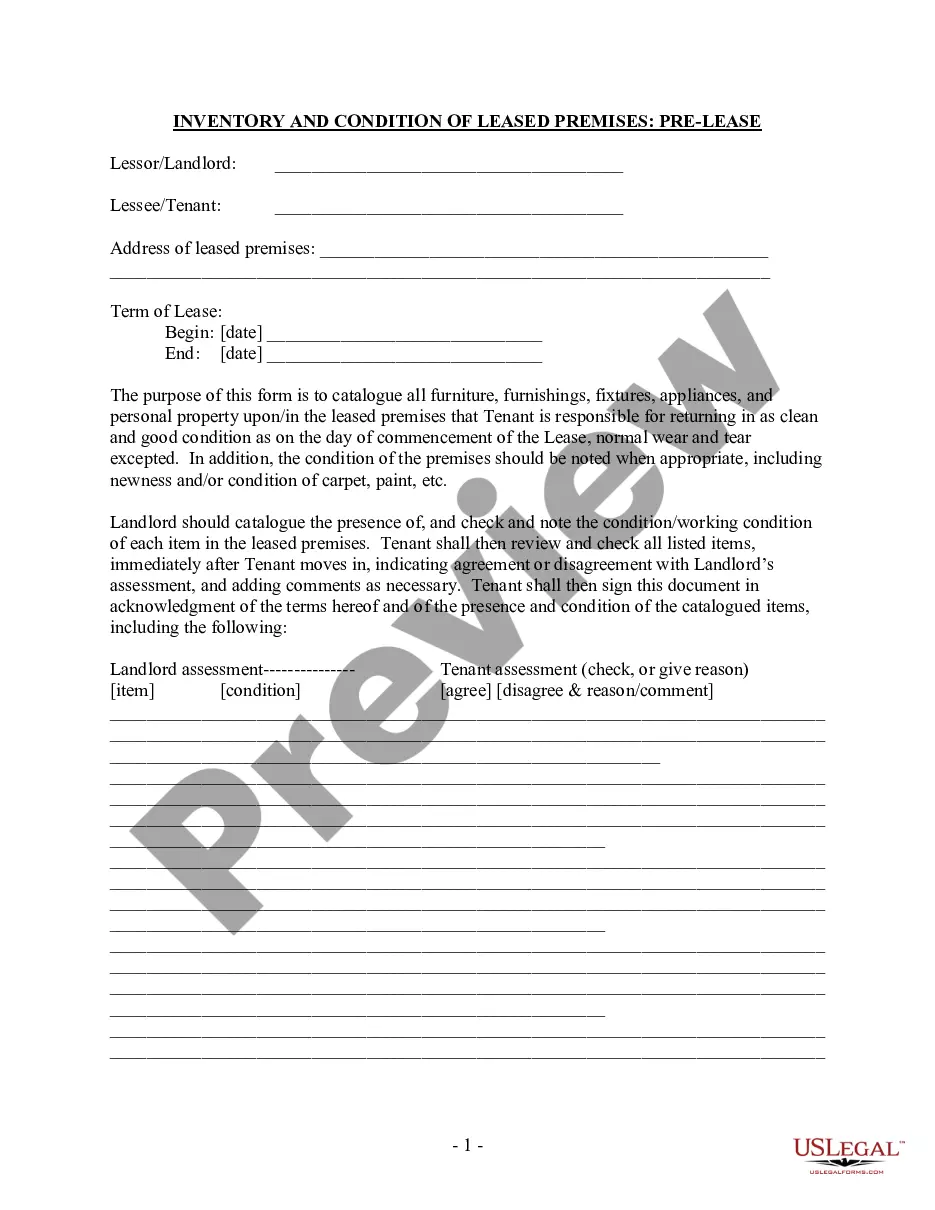
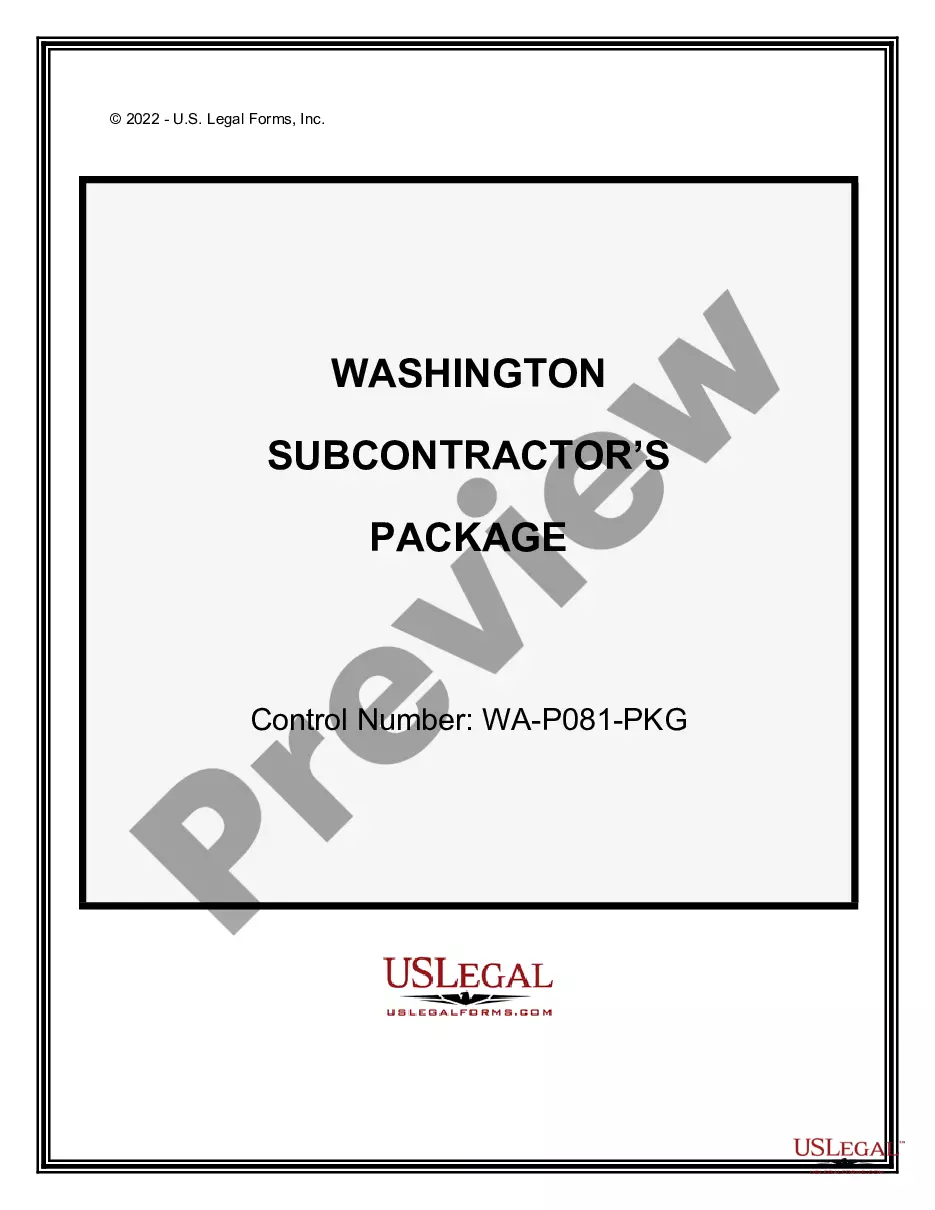
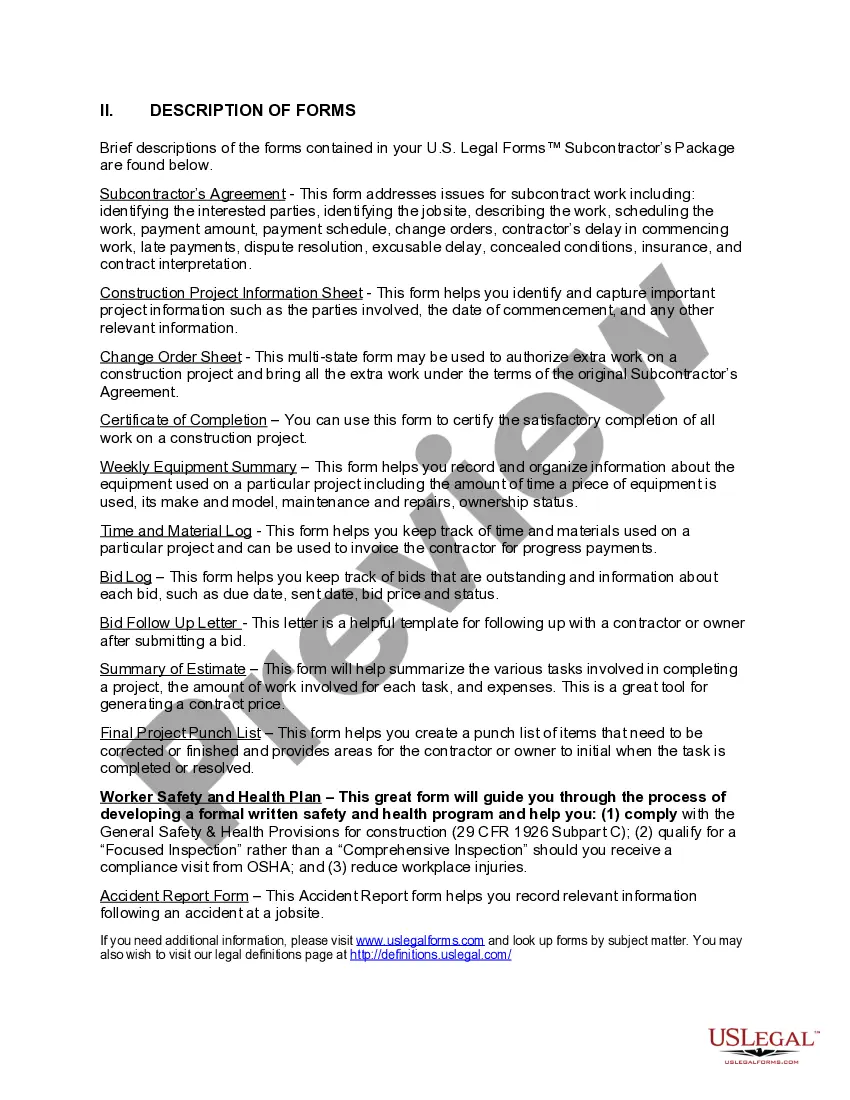
The Washington Subcontractors Package is a comprehensive collection of legal forms specifically designed for subcontractors involved in construction projects in Washington State. This package includes essential documents that help manage construction projects and safeguard legal rights, with the cornerstone being a subcontractor's agreement compliant with state law. Unlike generic form packages, this one is tailored to the unique requirements of subcontractors operating in Washington, ensuring adherence to local regulations.
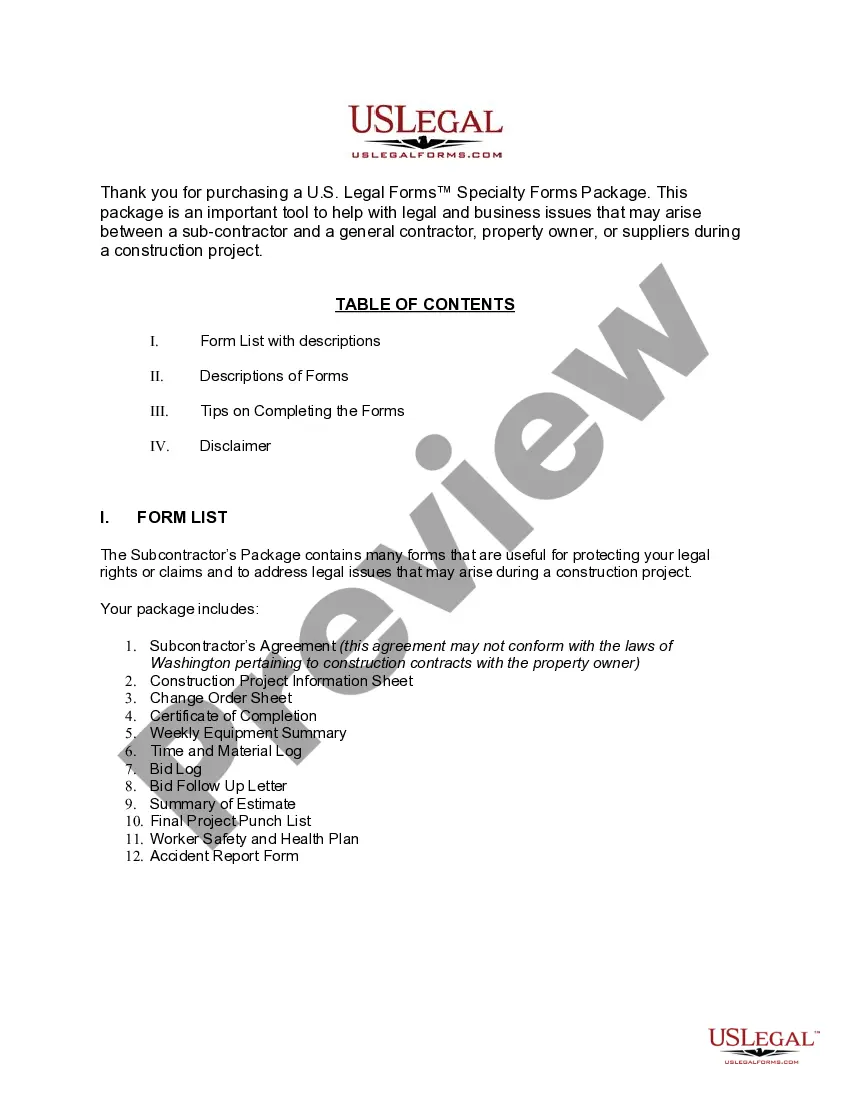
Forms you’ll find in this package
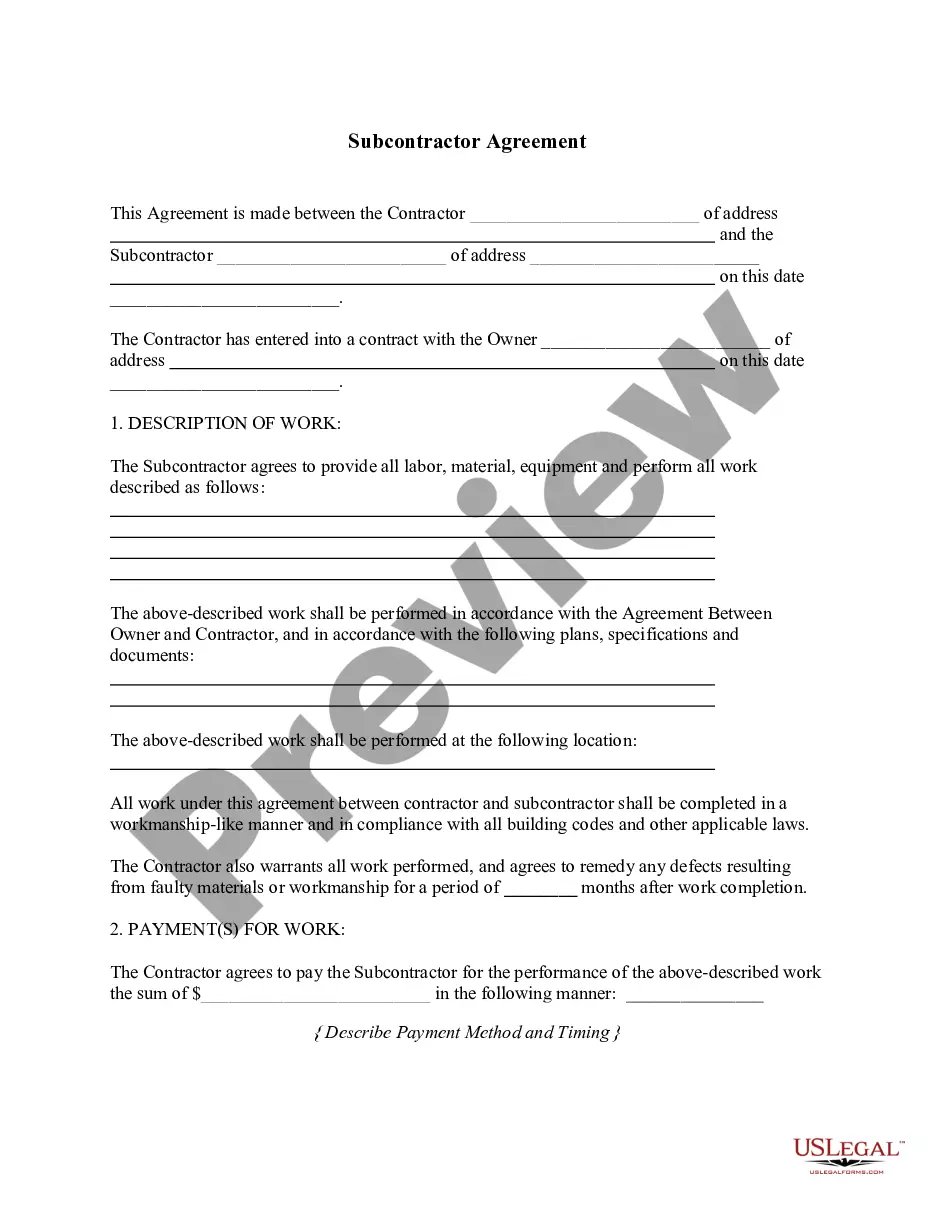
- Subcontractor's Agreement
- Contractor's Weekly Equipment Summary
- Contractor's Time and Materials Log
- Contractor's Bid Log
- Contractor's Bid Follow Up Letter
- Contractor's Summary of an Estimate
- Contractor's Final Punch List
- Construction Accident Report
- Construction Safety and Health Plan
- Change Order for Construction or Repairs by Contractor
- Certification of Completion by Contractor
- Construction Project Information Sheet



Common use cases
This form package is ideal for subcontractors who need to:
- Establish clear contractual agreements with general contractors.
- Document crucial project details and changes throughout the construction process.
- Maintain a record of work completion and safety protocols.
- Ensure compliance with Washington State construction laws and regulations.
Who this form package is for
- Subcontractors working on construction projects in Washington State.
- Small business owners in the construction industry.
- New subcontractors seeking to establish professional practices.
- Contractors looking to ensure legal compliance in their operations.
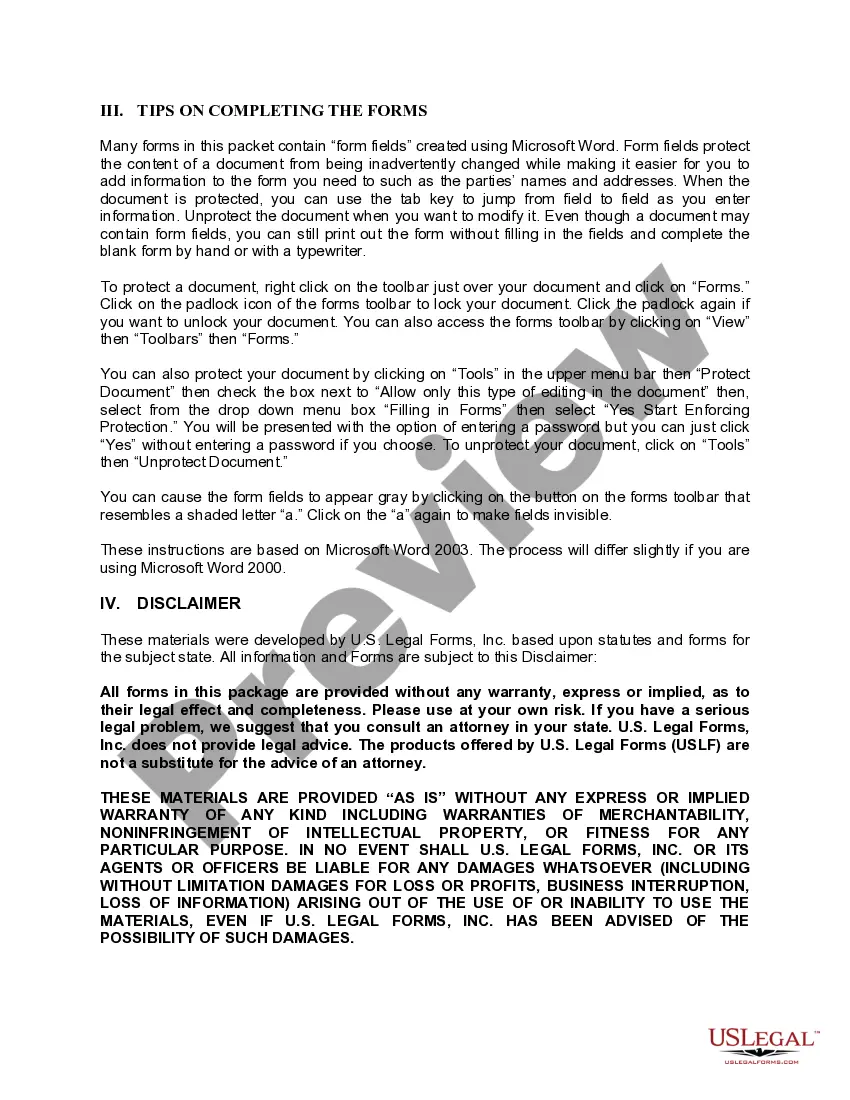
Instructions for completing these forms
- Review the included forms to understand their purpose and requirements.
- Identify the parties involved, including subcontractors, general contractors, and property owners.
- Fill in the relevant information for each form, such as project details, dates, and signatures.
- Ensure all parties review and agree to the terms before signing the contracts and agreements.
- Keep copies of all completed forms for your records and future reference.
Notarization details for included forms
Forms in this package typically do not require notarization unless required by local law. It is important to verify specific requirements for each form based on your project circumstances.
Get your form ready online
Our built-in tools help you complete, sign, share, and store your documents in one place.
Make edits, fill in missing information, and update formatting in US Legal Forms—just like you would in MS Word.
Download a copy, print it, send it by email, or mail it via USPS—whatever works best for your next step.
Sign and collect signatures with our SignNow integration. Send to multiple recipients, set reminders, and more. Go Premium to unlock E-Sign.
If this form requires notarization, complete it online through a secure video call—no need to meet a notary in person or wait for an appointment.
We protect your documents and personal data by following strict security and privacy standards.

Make edits, fill in missing information, and update formatting in US Legal Forms—just like you would in MS Word.

Download a copy, print it, send it by email, or mail it via USPS—whatever works best for your next step.

Sign and collect signatures with our SignNow integration. Send to multiple recipients, set reminders, and more. Go Premium to unlock E-Sign.

If this form requires notarization, complete it online through a secure video call—no need to meet a notary in person or wait for an appointment.

We protect your documents and personal data by following strict security and privacy standards.
Common mistakes to avoid
- Neglecting to include all necessary parties in the subcontractor's agreement.
- Failing to document changes adequately with the Change Order Sheet.
- Not keeping copies of completed forms, which may be needed later for contract enforcement.
- Overlooking the required safety protocols in the Worker Safety and Health Plan.
Why use this package online
- Immediate access to vital legal documents without the need for lengthy consultations.
- Edit and customize forms easily to fit specific project needs.
- Reliability of forms drafted by licensed attorneys familiar with Washington law.
- Reduced costâsave over 50 percent compared to purchasing forms individually.
Legal use & context
- All forms in the Washington Subcontractors Package are created based on current state law.
- Using these forms helps ensure legal compliance and supports enforceability.
- Proper completion and appropriate usage of these documents can protect your rights in a construction project.
Main things to remember
- The Washington Subcontractors Package provides essential legal forms for subcontractors.
- It helps manage construction projects while ensuring compliance with Washington law.
- Proper use of these forms can mitigate legal risks and protect your interests.
Looking for another form?

Form popularity
FAQ
Contractors and subcontractors don't affect your payroll, because they're not employees.When it comes to tax obligations, both the contractor and the subcontractor are responsible for paying their own taxes. Typically, you would provide the contractor with a IRS Form 1099 for the work they did for you.
Payments to contractors are liable for payroll tax unless an exemption applies. To determine if an exemption applies, first check: if the contractor is an employee, even if they have an ABN or call themselves a contractor or.
An independent contractor should never fill out an employee application. Each applicant should be provided with a copy of the enclosed document, which indicates that it is for independent contractor use only.
The IRS requires contractors to fill out a Form W-9, request for Taxpayer Identification Number and Certification, which you should keep on file for at least four years after the hiring. This form is used to request the correct name and Taxpayer Identification Number, or TIN, of the worker or their entity.
Finally, the new stimulus bill provides independent contractors with paid sick and paid family leave benefits through March 14, 2021.Under CARES Act II, unemployed or underemployed independent contractors who have an income mix from self-employment and wages paid by an employer are still eligible for PUA.
Tax Does not collect retail sales tax on road work where the road is a city, county, or federal road. Roads for the state of Washington are subject to sales tax.Tax Contractor is defined by law as the consumer and must pay sales/use tax on all materials used, applied, or installed by him.
A subcontractor is a worker who is not your employee. You give a Form 1099 to a subcontractor showing the amounts you paid him. The subcontractor is responsible for keeping his or her own records and paying his or her own income and self-employment taxes.
Income-verification letter. The most reliable method for proving earnings for independent contractors is a letter from a current or former employer describing your working arrangement. Contracts and agreements. Invoices. Bank statements and Pay stubs.
An independent contractor is not considered an employee for Form I-9 purposes and does not need to complete Form I-9.