Relocation Expense Agreement
Understanding this form
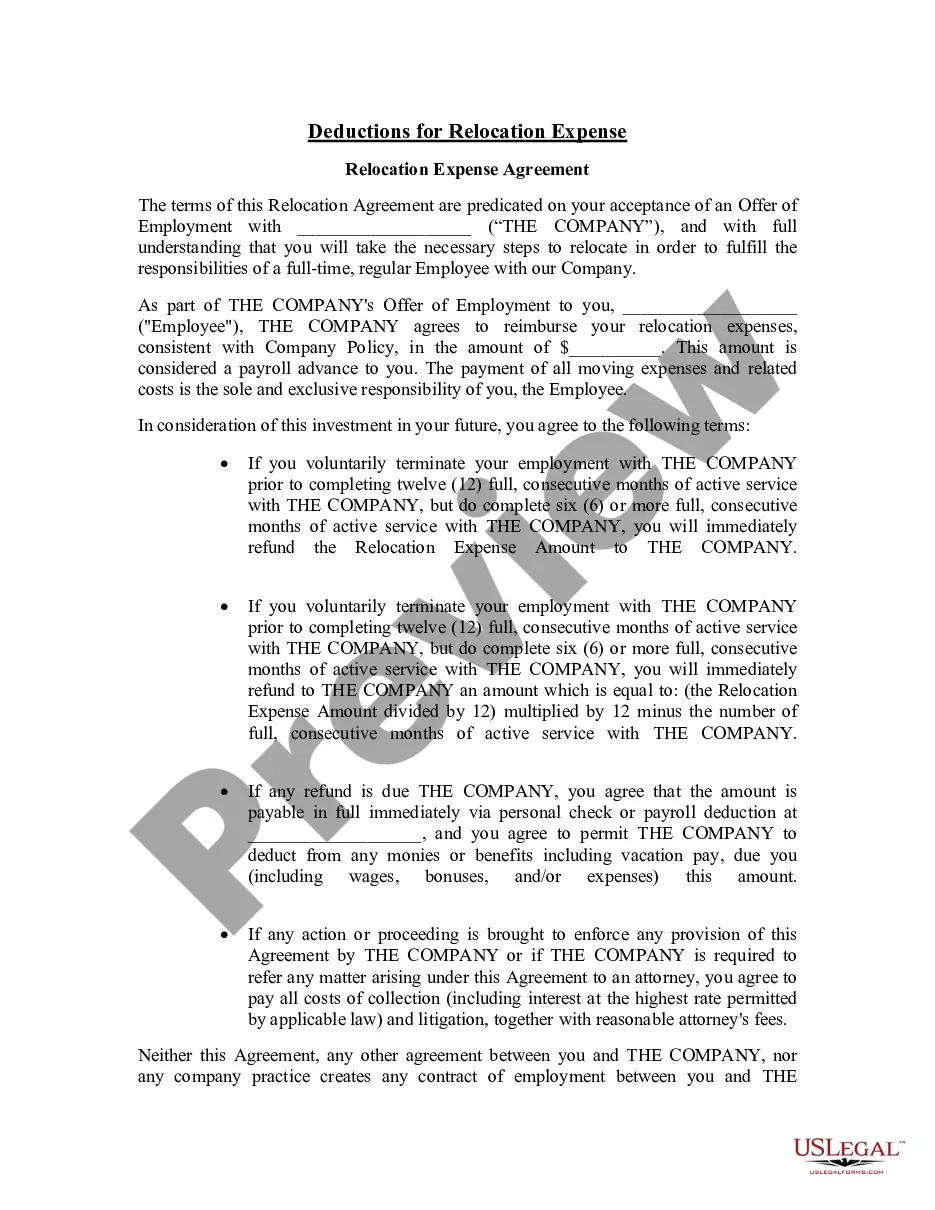
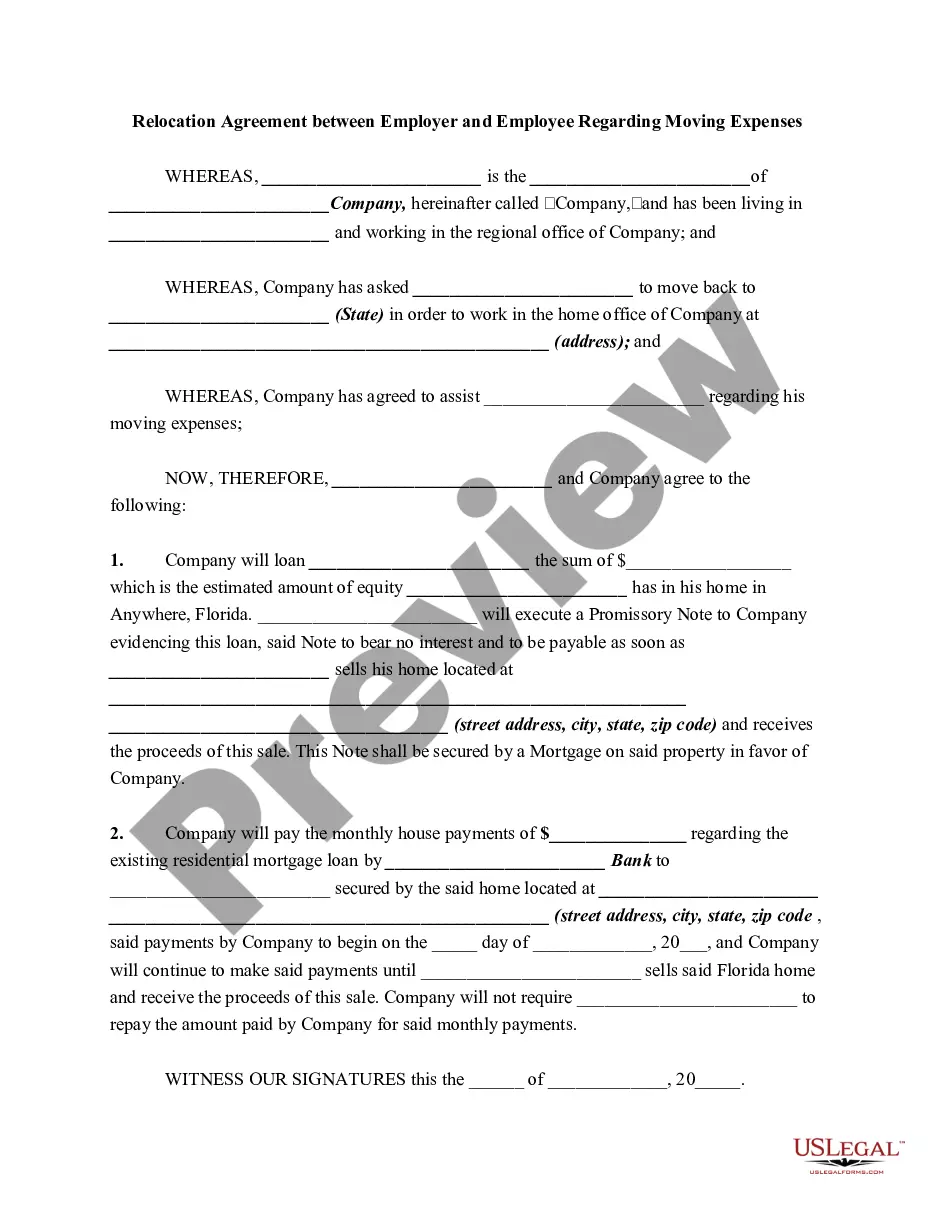
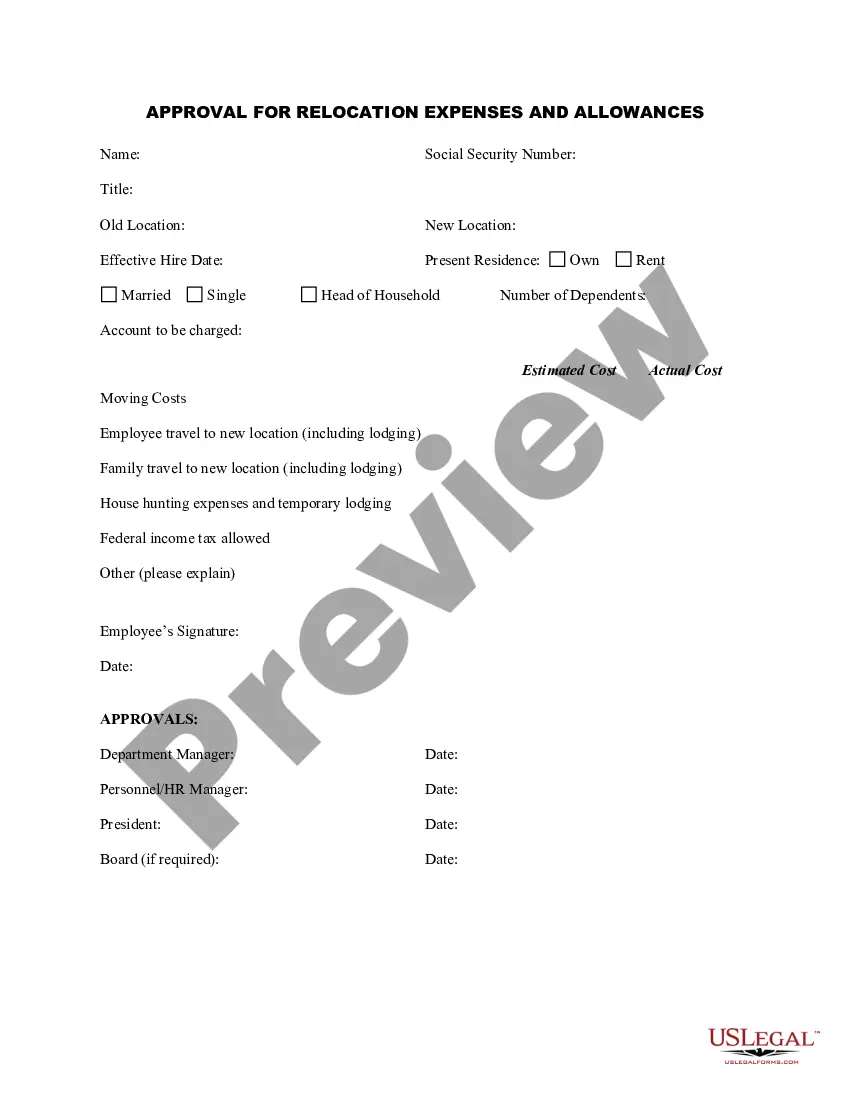
The Relocation Expense Agreement is a legal document that outlines the terms under which a company will reimburse an employee for certain relocation expenses. This agreement specifies the conditions that apply if the employee decides to leave the company before fulfilling a specified period of service. Unlike other employment-related agreements, it focuses specifically on financial responsibilities tied to relocation, ensuring both parties clearly understand their obligations.
What’s included in this form
- Employee and Company Details: Enter the names of the employee and the company involved.
- Relocation Expense Amount: Specify the total amount the company will reimburse for relocation expenses.
- Repayment Conditions: Outline conditions for repayment if employment is terminated within a specified period.
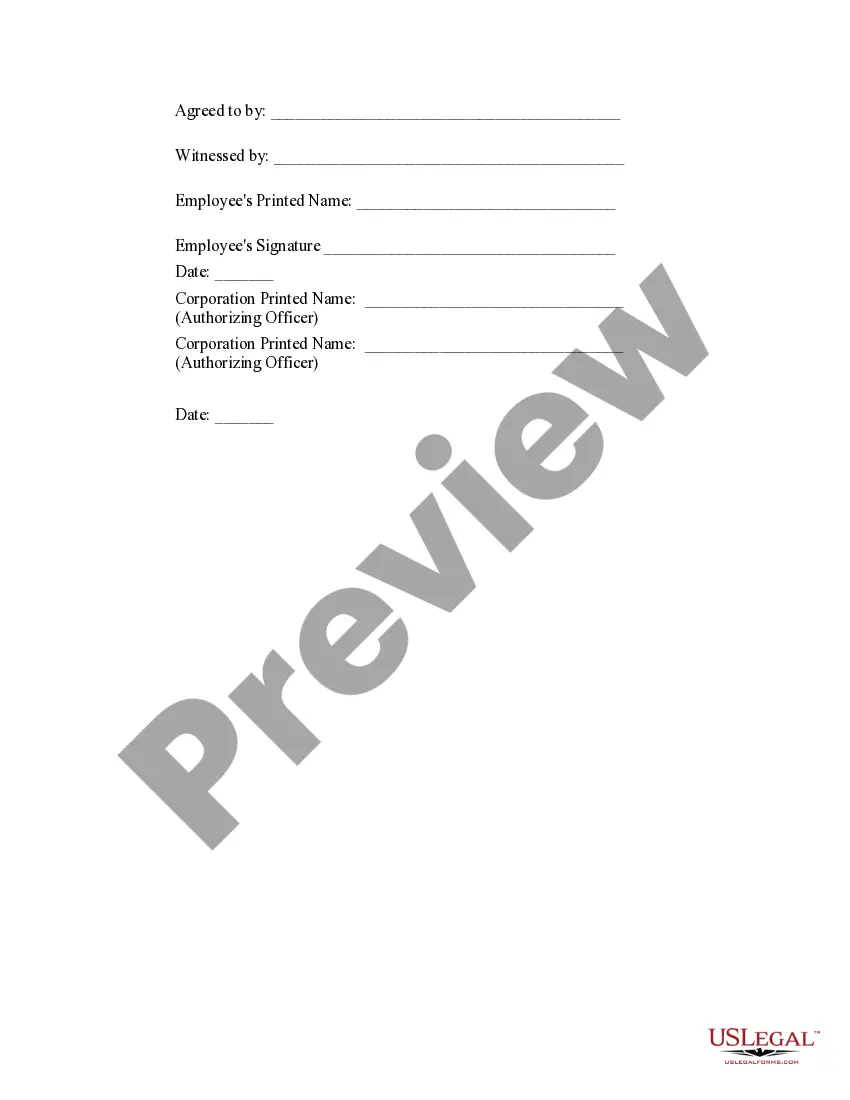
- Authorization Signatures: Space for signatures of both the employee and authorized company officers.
- Payment Responsibility: Clarifies that moving expenses are the employee's responsibility unless otherwise stated.
Common use cases
This form should be used when an employee accepts an offer of employment that requires relocation. It is particularly important when the company agrees to cover relocation costs. The agreement ensures that both the company and the employee have a mutual understanding of the terms surrounding the relocation expenses, particularly regarding reimbursement if the employee does not complete the required period of service.
Who should use this form
- Employees who are relocating for a new job position.
- Employers who are offering financial assistance for employee relocation.
- Human resources professionals involved in drafting employment contracts.
Completing this form step by step
- Identify the parties by filling in the names of the employee and the company.
- Specify the total relocation expense amount that the company agrees to reimburse.
- Detail the repayment conditions for the employee in case of early termination.
- Ensure all necessary parties sign and date the document to validate the agreement.
- Keep a copy of the signed agreement for both the employee and the company records.
Notarization guidance
This form does not typically require notarization to be legally valid. However, some jurisdictions or document types may still require it. US Legal Forms provides secure online notarization powered by Notarize, available 24/7 for added convenience.
Get your form ready online
Our built-in tools help you complete, sign, share, and store your documents in one place.
Make edits, fill in missing information, and update formatting in US Legal Forms—just like you would in MS Word.
Download a copy, print it, send it by email, or mail it via USPS—whatever works best for your next step.
Sign and collect signatures with our SignNow integration. Send to multiple recipients, set reminders, and more. Go Premium to unlock E-Sign.
If this form requires notarization, complete it online through a secure video call—no need to meet a notary in person or wait for an appointment.
We protect your documents and personal data by following strict security and privacy standards.

Make edits, fill in missing information, and update formatting in US Legal Forms—just like you would in MS Word.

Download a copy, print it, send it by email, or mail it via USPS—whatever works best for your next step.

Sign and collect signatures with our SignNow integration. Send to multiple recipients, set reminders, and more. Go Premium to unlock E-Sign.

If this form requires notarization, complete it online through a secure video call—no need to meet a notary in person or wait for an appointment.

We protect your documents and personal data by following strict security and privacy standards.
Common mistakes to avoid
- Leaving out key details regarding the repayment terms.
- Failing to have all parties sign the agreement.
- Not clearly stating the relocation expense amount.
- Misunderstanding state-specific laws that may affect the agreement.
Why complete this form online
- Convenient access to legally compliant templates.
- Easy to customize for specific circumstances without legal fees.
- Immediate download for quick use.
- Secure and reliable process for creating important legal documents.
Legal use & context
The Relocation Expense Agreement is enforceable as a contract, provided it meets the requirements for contract formation: offer, acceptance, consideration, and mutual consent. It is important for both parties to understand their rights and obligations as outlined in the agreement to prevent disputes.
Key takeaways
- This agreement clearly defines the terms of relocation expense reimbursement.
- It establishes conditions for repayment should the employee leave early.
- Both parties must sign to validate the agreement and ensure mutual understanding.
- Consult local laws to address any applicable legal nuances.
Looking for another form?
Form popularity
FAQ
Yes, report relocation assistance money on your tax return (it is taxable). You may receive a 1099-MISC form for this payment. Either way, enter the income received as Other Income on line 21 of your 1040. In TurbTax under Income and expenses, select Miscellaneous Income, then Other Reportable Income.
Debit "Relocation Benefits" or "Moving Expenses" for the same amount. For example, if you issue a $25,000 relocation benefit, credit the accrual account $25,000 and debit the expense account $25,000.
The IRS allows taxpayers to deduct eligible moving costs.If you moved to a new location because of work, you may qualify to use IRS Form 3903 to claim the cost of your moving expenses as a deduction on your federal income tax return.
When you transfer an employee from one of your places of business to another, the amount you pay or reimburse the employee for certain moving expenses is usually not a taxable benefit. This includes any amounts you incurred to move the employee, the employee's family, and their household effects.
When you give a relocating employee any sort of relocation benefitwhether it's in the form of a signing bonus, reimbursement for moving expenses, or even when you book a flight or pay for a service on behalf of your employeethat money and/or those services are considered taxable income.
A core or typical job relocation package usually covers the costs of moving and storing furnishings and other household goods, along with help selling an existing home and costs incurred house hunting, temporary housing if necessary and all travel costs by the employee and family to the new location.
Relocation reimbursement. Flexible start date. Free visits. Temporary housing. Familial support. Real estate cost assistance. Pay adjustments or bonuses. Payback clause.
If you have moving expenses that are greater than the amount of reimbursement shown in box 12 of Form 1040, or your reimbursement was reported as wages in box 1, then you can file Form 3903 with your tax return to report moving expenses and reimbursements to the IRS.
Look on your Form W-2, box 12. If there is an amount with a code P, that amount is included in your taxable income. You should take a moving expense deduction to avoid paying tax on your reimbursements. You should also take a moving deduction if your employer included your reimbursement with wages in box 1 of Form W-2.