Utah New Resident Guide
About this form
The New Resident Guide is an informational resource designed to assist individuals who are moving to a new state. This form outlines various state requirements that new residents need to fulfill, including voter registration, identification cards, driverâs licenses, and vehicle title and registration. It differs from other legal forms by providing a comprehensive overview of residency obligations, making it easier for new residents to navigate their responsibilities in a new state.
What’s included in this form
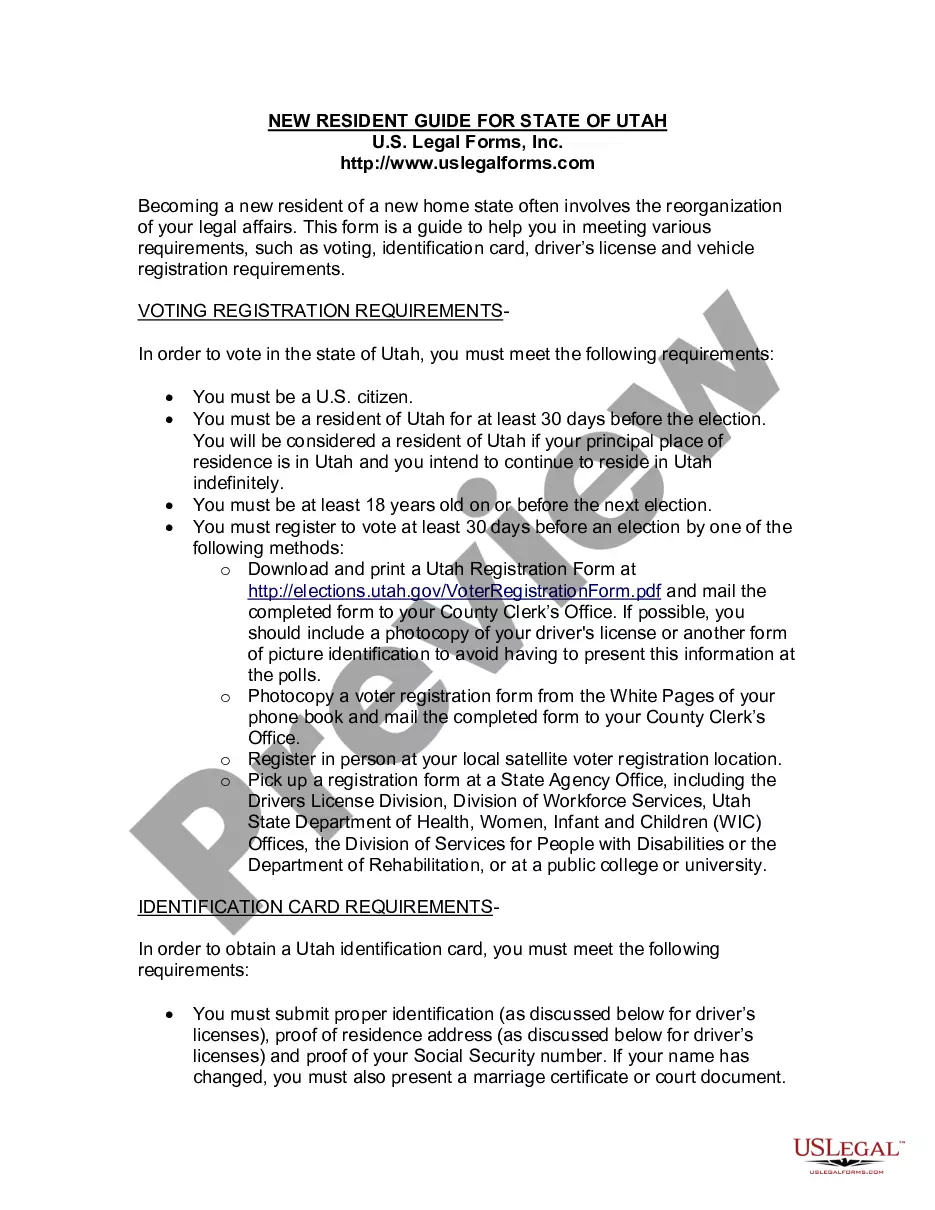
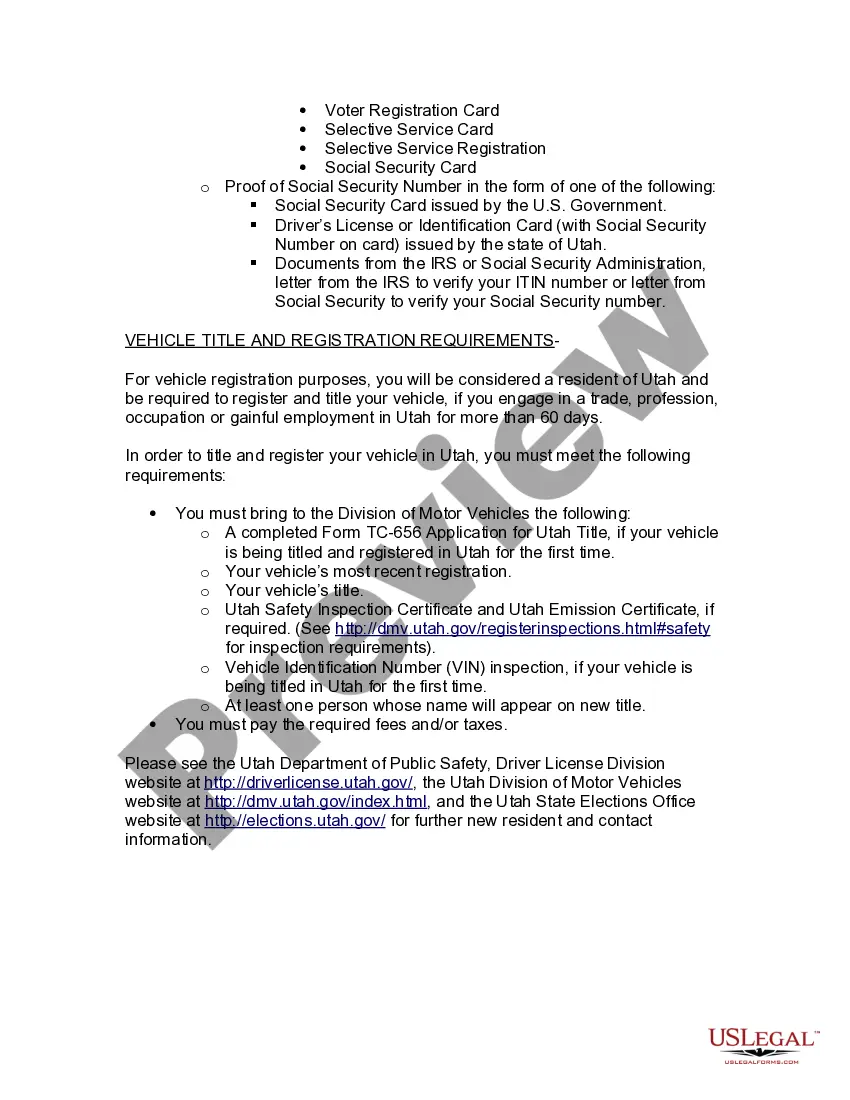
- Voting registration requirements
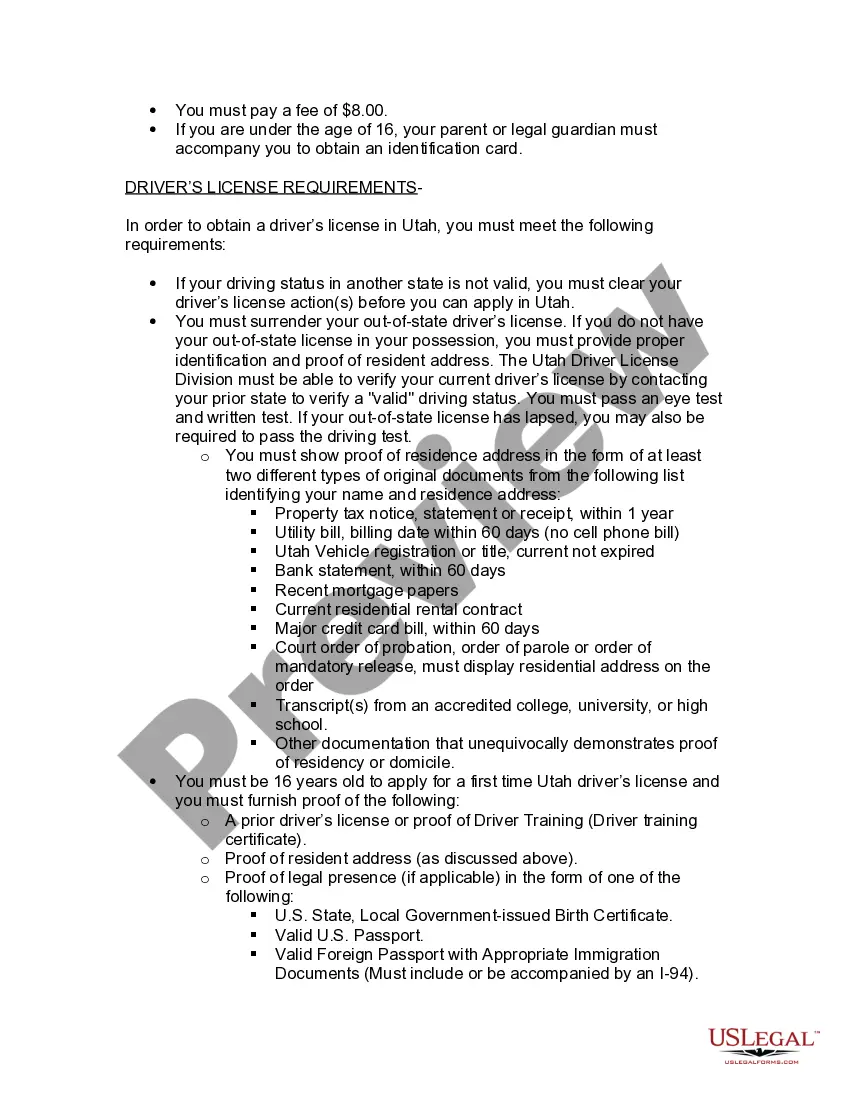
- Identification card application process
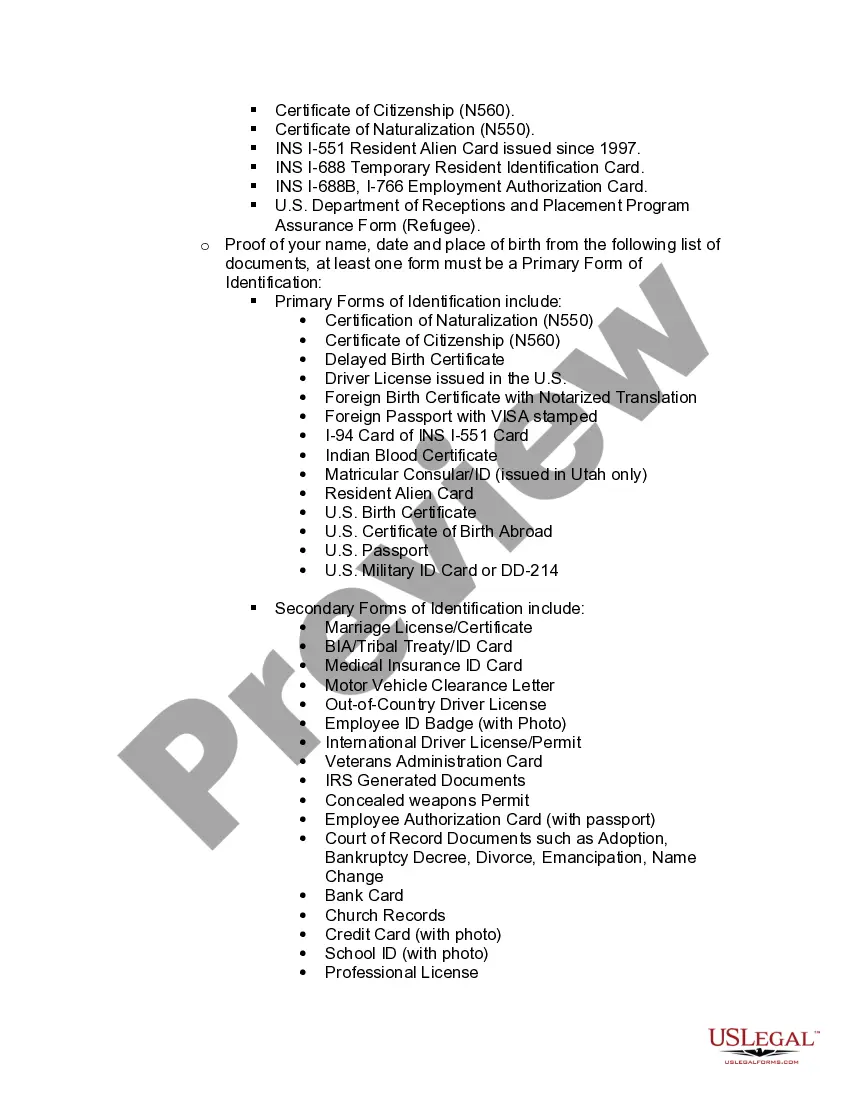
- Driver's license requirements and steps
- Vehicle title and registration procedures
- Proof of residency documentation







When to use this document
This form is useful for anyone who has recently relocated to a new state. You should use the New Resident Guide when you need to register to vote, apply for a state identification card, obtain a driverâs license, or register your vehicle in the new state. It provides essential information that can streamline the process of adjusting your legal status after a move.
Who this form is for
- Individuals who have recently moved to a new state
- New residents needing to navigate state-specific legal requirements
- Anyone requiring assistance with voter registration
- People looking to obtain a driverâs license or identification card in their new state
- Motor vehicle owners planning to register their vehicle in a new state
How to prepare this document
- Review the voting registration requirements based on your state.
- Prepare the necessary identification documents for obtaining a state ID or driverâs license.
- Gather proof of residency documentation to comply with your new state's regulations.
- Complete the vehicle title application if you are registering a vehicle in your new state.
- Submit your applications by the required deadlines to avoid any legal complications.
Notarization guidance
This form does not typically require notarization unless specified by local law. However, certain applications for identification or vehicle registration might require notarized documents. Always check local regulations to confirm.
Get your form ready online
Our built-in tools help you complete, sign, share, and store your documents in one place.
Make edits, fill in missing information, and update formatting in US Legal Forms—just like you would in MS Word.
Download a copy, print it, send it by email, or mail it via USPS—whatever works best for your next step.
Sign and collect signatures with our SignNow integration. Send to multiple recipients, set reminders, and more. Go Premium to unlock E-Sign.
If this form requires notarization, complete it online through a secure video call—no need to meet a notary in person or wait for an appointment.
We protect your documents and personal data by following strict security and privacy standards.

Make edits, fill in missing information, and update formatting in US Legal Forms—just like you would in MS Word.

Download a copy, print it, send it by email, or mail it via USPS—whatever works best for your next step.

Sign and collect signatures with our SignNow integration. Send to multiple recipients, set reminders, and more. Go Premium to unlock E-Sign.

If this form requires notarization, complete it online through a secure video call—no need to meet a notary in person or wait for an appointment.

We protect your documents and personal data by following strict security and privacy standards.
Typical mistakes to avoid
- Failing to meet voter registration deadlines.
- Not providing sufficient proof of residency when applying for an ID or license.
- Overlooking the need for certain documents when registering a vehicle.
Benefits of completing this form online
- Instant access to the latest state requirements and forms.
- Edit and customize the guide for your specific situation.
- Reliable, attorney-drafted content ensures compliance with legal standards.
Legal use & context
- Understanding residency requirements is vital for legal voting rights.
- Failure to comply with state ID and driverâs license regulations can result in penalties.
- Using the guide helps to ensure that all legal processes are followed correctly when moving.
Key takeaways
- The New Resident Guide is essential for understanding state-specific legal requirements.
- Each section details steps to register to vote, obtain an ID, receive a driverâs license, and title a vehicle.
- Completing this form correctly helps new residents navigate their transition smoothly.
Looking for another form?
Form popularity
FAQ
1. Physical presence. You must be continuously physically present in California for more than one year (366 days) immediately prior to the residence determination date of the term for which you request resident status.
Tax purposes are the most important reason for establishing residency after you move. The state you claim residency in should be the state where you spend the most time. Many states require that residents spend at least 183 days or more in a state to claim they live there for income tax purposes.
Generally, you need to establish a physical presence in the state, an intent to stay there and financial independence. Then you need to prove those things to your college or university. Physical presence: Most states require you to live in the state for at least a full year before establishing residency.
You must live in Utah for twelve (12) or more continuous months immediately before the term for which you are applying without leaving for a total of thirty (30) days or more during the twelve months.
Step 1: Cancel your license in the previous resident state and your non-resident license in Utah. Step 2: Apply for a resident license at www.sircon.com/utah or www.nipr.com and print out your confirmation. Step 3: Make a fingerprinting appointment at a Prometric test center by visiting Prometric's website.
Living in Utah for twelve months. Be financially independent to become a Utah resident. Become a Utah resident by relinquishing residency in any other state. Social Security verification. Provide the documentation of a current Utah vehicle registration. You can register to vote in Utah.
To apply in Utah for a license without your out-of-state license, you must present original or copies certified by the issuing agency showing identity, legal/lawful presence, full social security number or ITIN, two (2) documents of your Utah residence and evidence of name change, if applicable.
You can have multiple residences, reside in multiple states but can have only one domicile. domicile is important for income tax purposes and estate tax purposes and possibly other purposes. Many states look to a person's domicile to determine residency.
Utah Residency Verification Current mortgage or rental contract; Major credit card bill (dated within 60 days) Property tax notice (statement or receipt dated within one year); School transcript (dated within 90 days)