Utah Contractors Forms Package

Understanding this form package
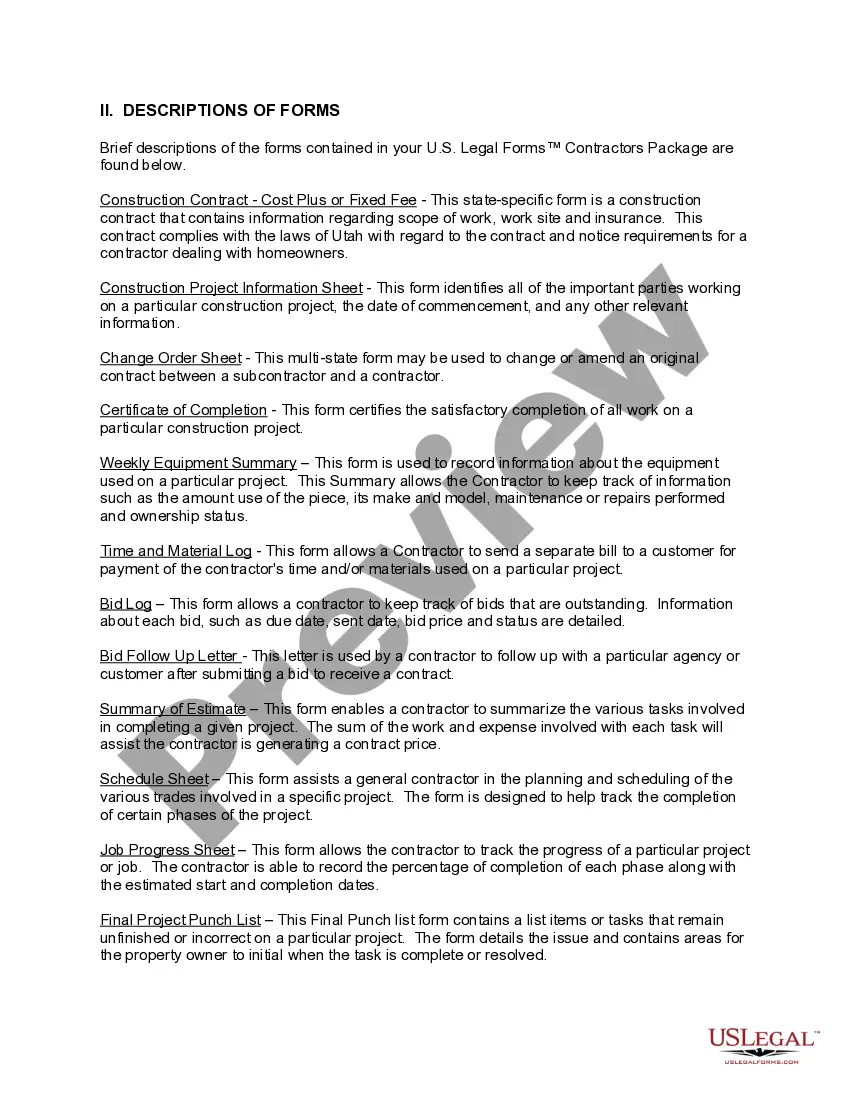
The Utah Contractors Forms Package is designed to provide contractors, owners, suppliers, and subcontractors with essential legal documents specifically tailored for construction projects in Utah. This package includes various forms that help these parties assert their legal rights, manage project details, and communicate effectively throughout the construction process. Unlike generic form packages, this package includes state-specific documents to ensure compliance with Utah laws and regulations.
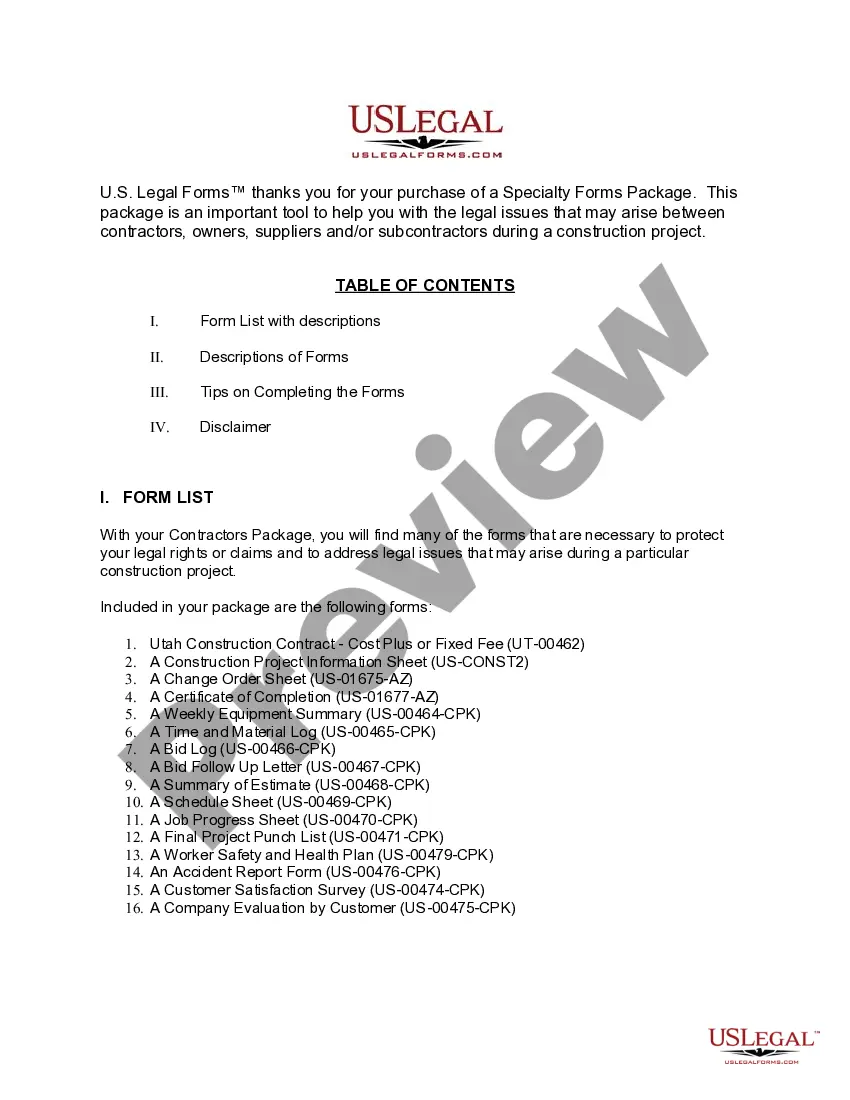
Forms provided in this package
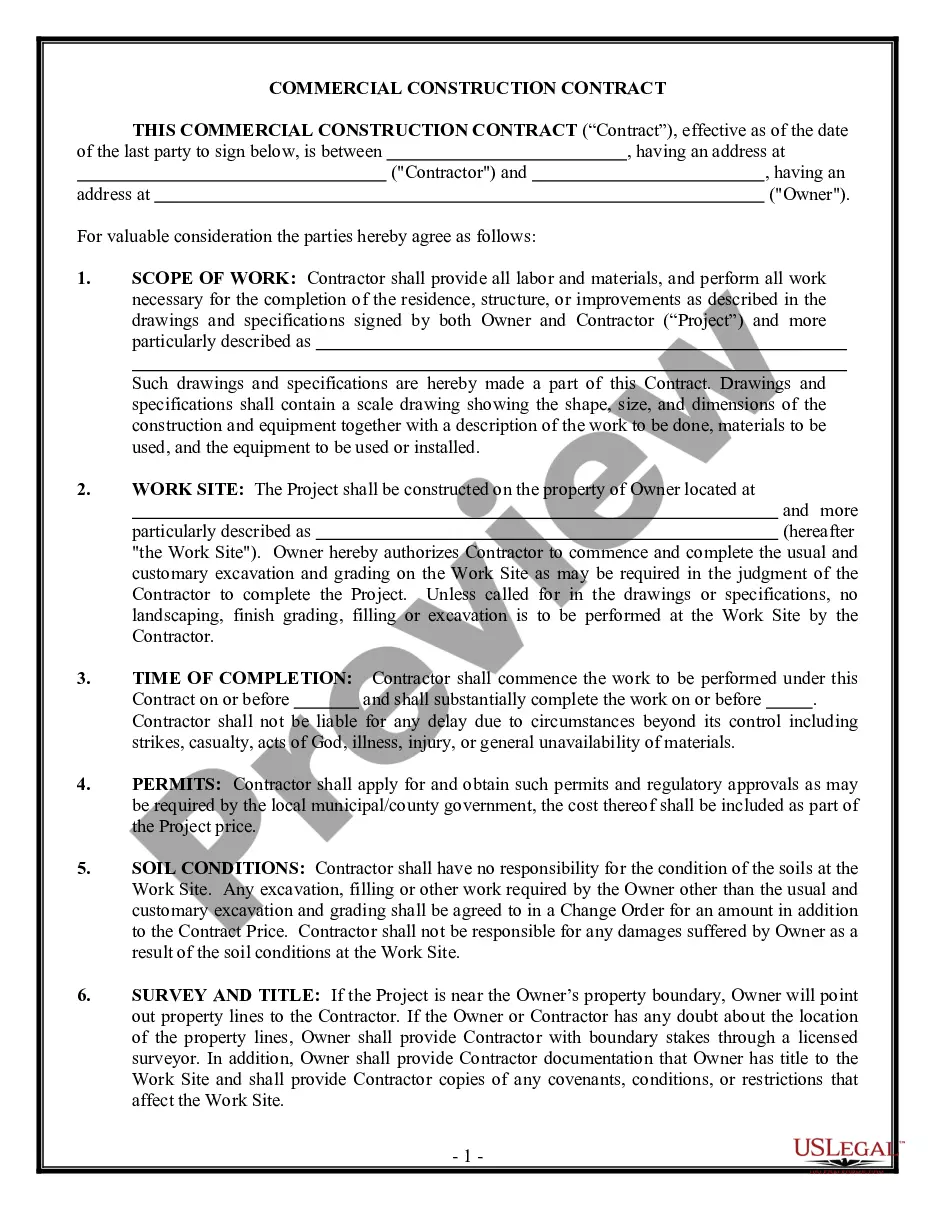
- Construction Contract Cost Plus or Fixed Fee
- Contractor's Weekly Equipment Summary
- Contractor's Time and Materials Log
- Contractor's Bid Log
- Contractor's Bid Follow Up Letter
- Contractor's Summary of an Estimate
- Contractor's Schedule Sheet
- Contractor's Job Progress Sheet
- Contractor's Final Punch List
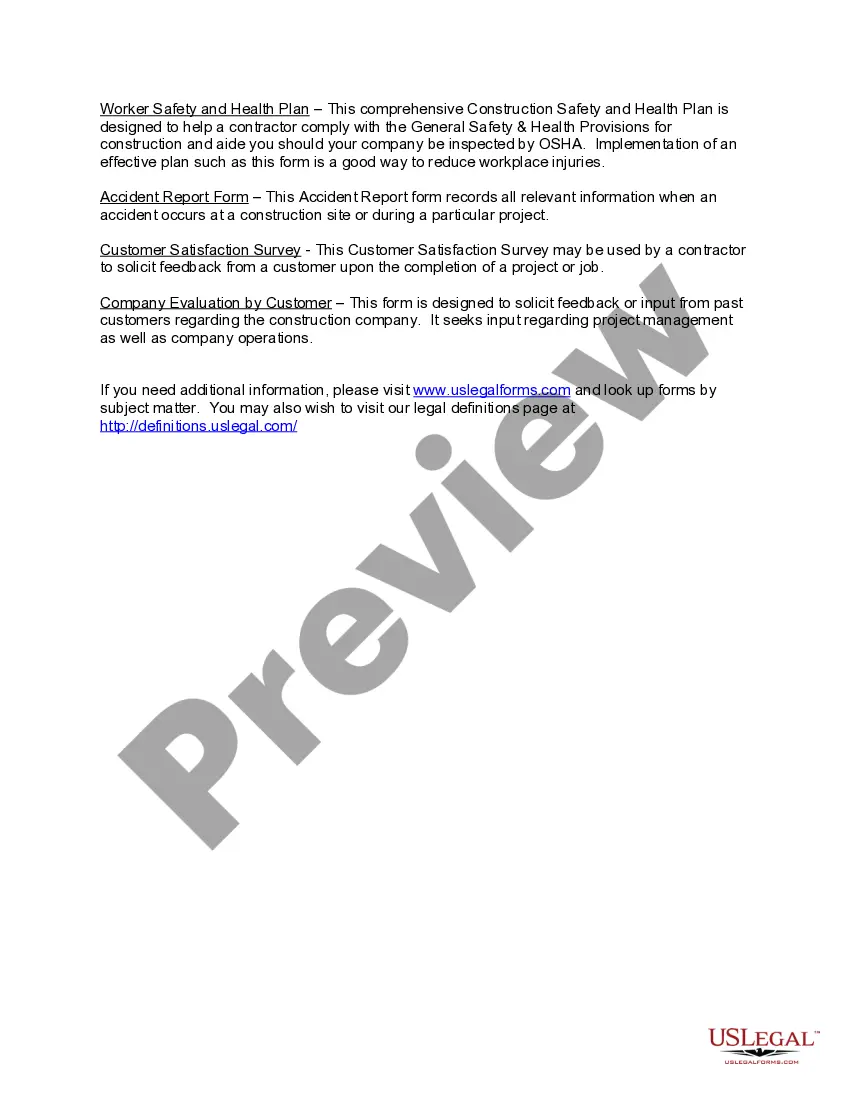
- Customer Satisfaction Survey
- Construction Company Evaluation by a Customer
- Construction Accident Report
- Construction Safety and Health Plan
- Change Order for Construction or Repairs by Contractor
- Certification of Completion by Contractor
- Construction Project Information Sheet
When to use this form package
This form package is ideal when you are entering into a construction project in Utah and need to manage initial agreements, project changes, and progress documentation. You should consider using this package if you need to:
- Create a legally binding construction contract with clear pricing agreements.
- Document any changes to the project scope through change orders.
- Track project progress, timeline, and compliance with safety standards.
- Collect feedback from clients about project satisfaction upon completion.
Who can use this document
- Contractors involved in construction projects in Utah.
- Subcontractors working under a primary contractor.
- Construction project owners seeking legal protection and clarity.
- Suppliers providing materials or equipment for construction projects.
Steps to complete these forms
- Review the included forms to understand the necessary documentation for your project.
- Identify all relevant parties and details needed for each form, such as project scope and timelines.
- Complete each form by entering the required information, including dates and signatures.
- Save and print copies of completed forms for your records and distribution as needed.
- Follow the structure provided in forms such as the Change Order Sheet and Bid Log for accurate reporting.
Notarization guidance for this package
Notarization is not commonly needed for forms in this package. However, if your state’s laws require it, our notarization service, powered by Notarize, allows you to finalize documents online 24/7 without in-person visits.
Get your form ready online
Our built-in tools help you complete, sign, share, and store your documents in one place.
Make edits, fill in missing information, and update formatting in US Legal Forms—just like you would in MS Word.
Download a copy, print it, send it by email, or mail it via USPS—whatever works best for your next step.
Sign and collect signatures with our SignNow integration. Send to multiple recipients, set reminders, and more. Go Premium to unlock E-Sign.
If this form requires notarization, complete it online through a secure video call—no need to meet a notary in person or wait for an appointment.
We protect your documents and personal data by following strict security and privacy standards.

Make edits, fill in missing information, and update formatting in US Legal Forms—just like you would in MS Word.

Download a copy, print it, send it by email, or mail it via USPS—whatever works best for your next step.

Sign and collect signatures with our SignNow integration. Send to multiple recipients, set reminders, and more. Go Premium to unlock E-Sign.

If this form requires notarization, complete it online through a secure video call—no need to meet a notary in person or wait for an appointment.

We protect your documents and personal data by following strict security and privacy standards.
Avoid these common issues
- Leaving fields incomplete or unclear.
- Failing to include all necessary signatures on contracts and change orders.
- Not updating the documents when project scope or timelines change.
- Neglecting to maintain copies of all completed and submitted forms.
Why use this package online
- Convenience of accessing and downloading forms anytime, anywhere.
- Editability allows customization for specific project needs.
- Reliability in legal compliance with forms drafted by licensed attorneys.
- Prevention of common legal pitfalls through clear, standardized documentation.
Legal use & context
- These forms serve as legally binding documents when completed correctly.
- Using standard forms can help avoid disputes during and after project completion.
- Proper documentation through this package aids legal compliance under Utah law.
Summary of main points
- The Utah Contractors Forms Package contains essential documents specifically for the construction industry.
- Ideal for contractors, subcontractors, and project owners working in Utah.
- Helps prevent legal issues by ensuring clarity and documentation throughout the project.
Looking for another form?
Form popularity
FAQ
Get it in writing. Keep it simple. Deal with the right person. Identify each party correctly. Spell out all of the details. Specify payment obligations. Agree on circumstances that terminate the contract. Agree on a way to resolve disputes.
IRS Form W-9 is most commonly used by individuals when they are working as a freelancer or independent contractor. If you ever find yourself filling out a Form W-9, it generally means that a business or person who is paying you money needs your Social Security number so it can notify the IRS of the amount.
Terms. This is the first section of any agreement or contract and states the names and locations of the parties involved. Responsibilities & Deliverables. Payment-Related Details. Confidentiality Clause. Contract Termination. Choice of Law.
If you paid someone who is not your employee, such as a subcontractor, attorney or accountant $600 or more for services provided during the year, a Form 1099-NEC needs to be completed, and a copy of 1099-NEC must be provided to the independent contractor by January 31 of the year following payment.
Identifying/Contact Information. Title and Description of the Project. Projected Timeline and Completion Date. Cost Estimate and Payment Schedule. Stop Work Clause and Stop Payment Clause. Act of God Clause. Change Order Agreement. Warranty.
The Construction Documents contain contract forms, conditions of the contract, specifications, and drawings. Bidding requirements are also produced during this phase. Stringent contractor qualifications are delineated, ensuring that only contractors with a proven track record will be prequalified to bid.
Bidding Documents. Construction Contractor Agreement. Architectural Drawings. Specifications. Bill of Quantities. Schedule. Work Orders. Subcontractor Application.
Timeframe or key milestones of the project; hours of work; deliverables of the project; and. way the business will pay the contractor for their services.
The Agreement. The agreement is the most fundamental document in a construction contract bundle. General Conditions. Special Conditions. Scope of Work. Drawings. Specifications. Bill of Quantities. Construction Schedule.