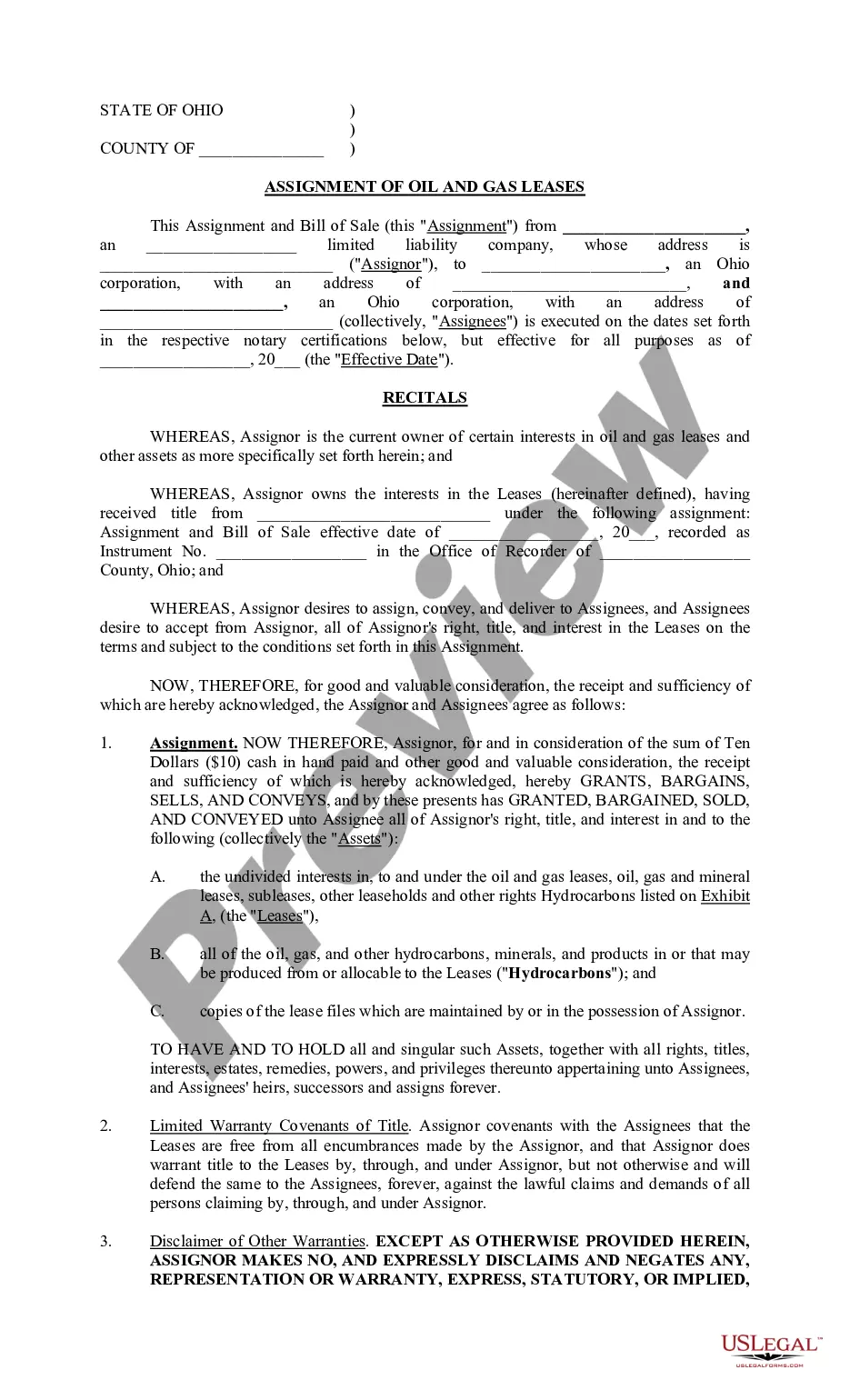
Assignment - Joint Inventors
About this form
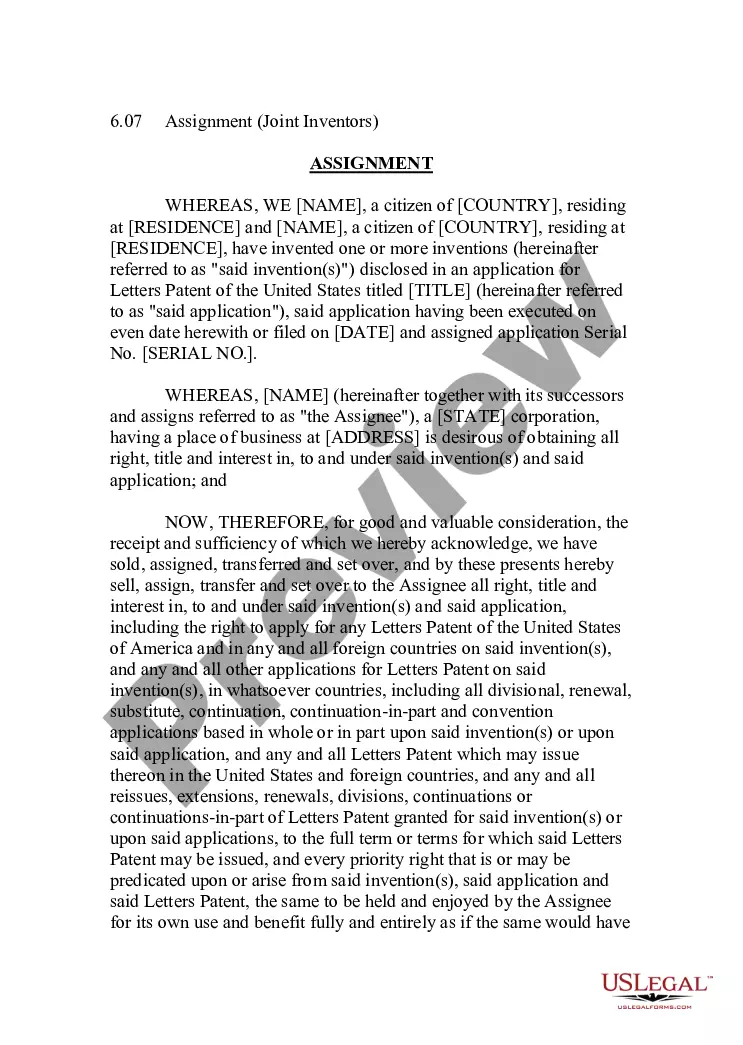
The Assignment - Joint Inventors form is a legal document used by individuals who have jointly invented something and wish to assign their rights in the invention to another party, typically a corporation or individual. This form specifies the terms of the assignment, including the inventions involved and the rights being transferred, which may include patent rights. Unlike simple agreements, this form provides comprehensive protections and clarifications vital for joint inventors seeking to formalize the ownership of their intellectual property.
Main sections of this form
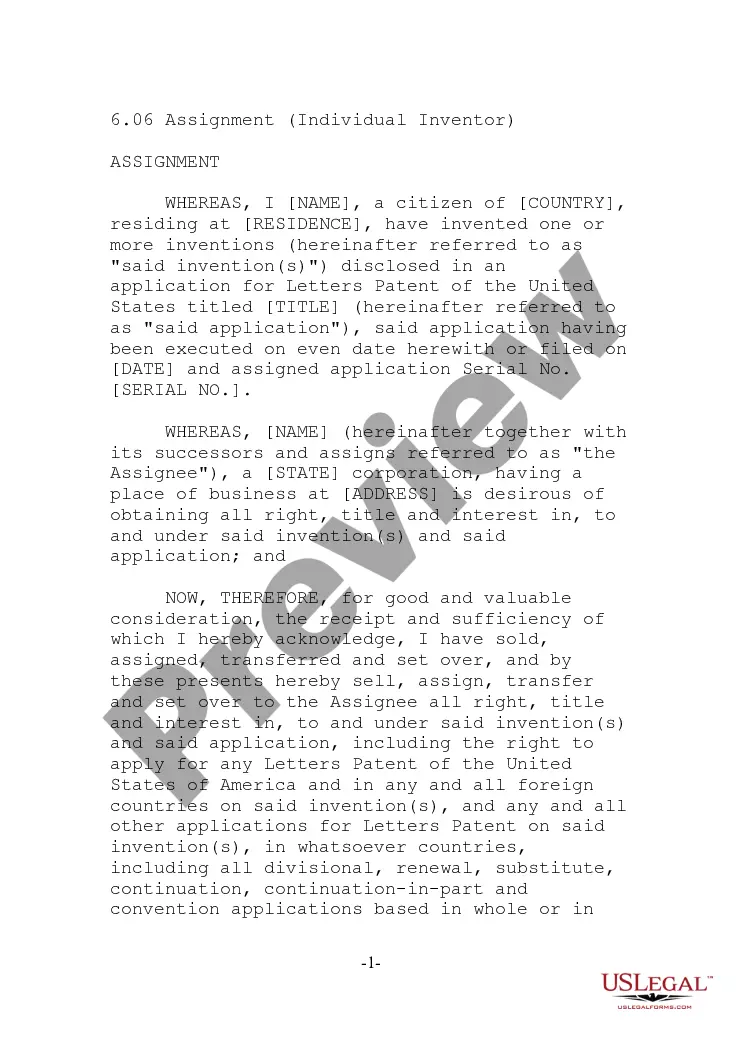
- Identification of the inventors and their residence information.
- Details regarding the invention and patent application, including titles and serial numbers.
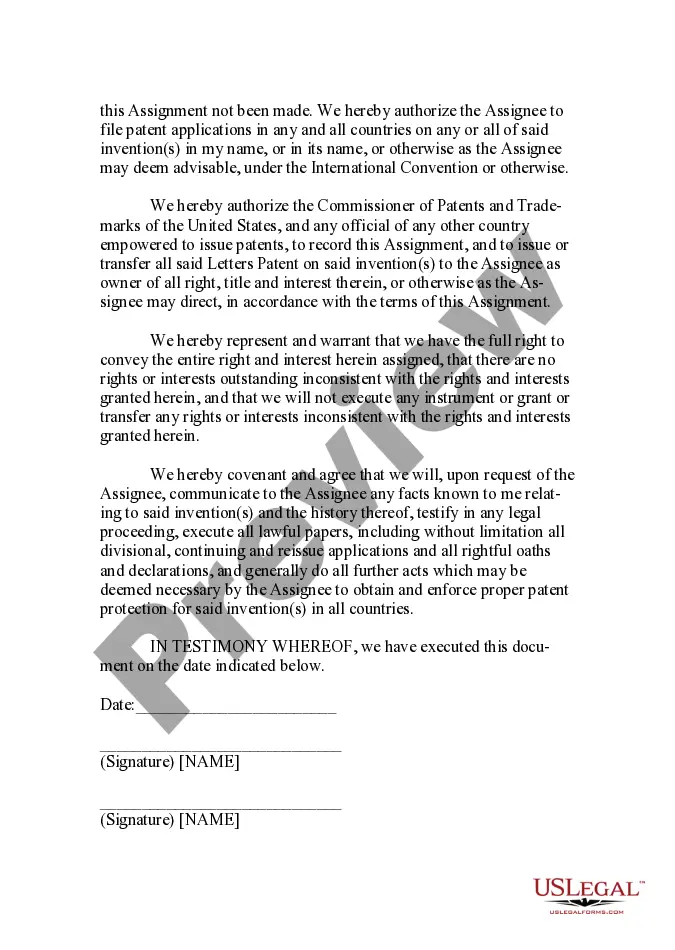
- A declaration of the rights being assigned, including all related patent applications and any future rights.
- Authorization for the assignee to apply for patents in the inventors' names.
- Warranties regarding the full rights to convey the assigned interests.
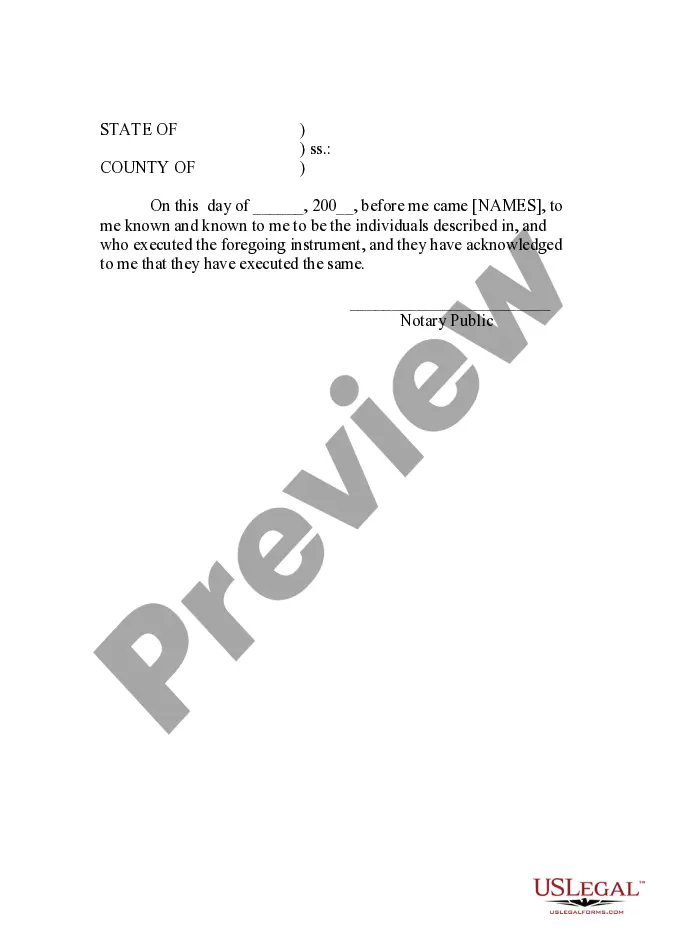
- Instructions for notarization and execution of the document.

When to use this form
This form is used when joint inventors wish to officially assign their rights in an invention to a corporation, individual, or other entity. It is essential in scenarios where the inventors intend to commercially exploit the invention, such as developing a product or securing investment. It is also crucial when entering agreements with partners or investors that require a clear understanding of inventorship and ownership rights.
Who should use this form
- Joint inventors looking to assign their patent rights to another party.
- Corporations interested in acquiring inventions from inventors.
- Individuals needing to formalize a partnership agreement related to shared inventions.
- Legal professionals assisting clients with intellectual property assignments.
- Entrepreneurs seeking to protect their interests in newly invented products.
How to complete this form
- Identify the inventors by entering their names and residences at the top of the form.
- Detail the invention, including its title and patent application serial number.
- Specify the assignee, including the company name and address.
- Enter the date of the assignment and signatures of all inventors.
- Ensure the document is notarized to comply with legal requirements.
Notarization guidance
Notarization is required for this form to take effect. Our online notarization service, powered by Notarize, lets you verify and sign documents remotely through an encrypted video session, available 24/7.
Get your form ready online
Our built-in tools help you complete, sign, share, and store your documents in one place.
Make edits, fill in missing information, and update formatting in US Legal Forms—just like you would in MS Word.
Download a copy, print it, send it by email, or mail it via USPS—whatever works best for your next step.
Sign and collect signatures with our SignNow integration. Send to multiple recipients, set reminders, and more. Go Premium to unlock E-Sign.
If this form requires notarization, complete it online through a secure video call—no need to meet a notary in person or wait for an appointment.
We protect your documents and personal data by following strict security and privacy standards.

Make edits, fill in missing information, and update formatting in US Legal Forms—just like you would in MS Word.

Download a copy, print it, send it by email, or mail it via USPS—whatever works best for your next step.

Sign and collect signatures with our SignNow integration. Send to multiple recipients, set reminders, and more. Go Premium to unlock E-Sign.

If this form requires notarization, complete it online through a secure video call—no need to meet a notary in person or wait for an appointment.

We protect your documents and personal data by following strict security and privacy standards.
Avoid these common issues
- Failing to include all inventors' names and signatures.
- Not clearly identifying the invention and associated patent application details.
- Leaving out the notarization, risking the validity of the assignment.
- Not reviewing the document for consistency with state laws.
- Assigning rights without fully understanding the implications or without legal advice.
Why use this form online
- Convenience of downloading and filling out the form at your own pace.
- Editability allows customization to fit specific circumstances and needs.
- Reliable templates drafted by licensed attorneys enhance legal accuracy.
- Immediate access reduces the downtime in formalizing important agreements.
- Secure storage of completed forms for future reference and documentation.
Legal use & context
- The form ensures that ownership rights are clearly defined and legally enforceable.
- Misunderstandings about ownership can lead to future disputes; this form helps prevent that.
- It provides a clear record of the assignment which is crucial during litigation or patent enforcement actions.
Main things to remember
- This form is essential for joint inventors who need to transfer ownership rights effectively.
- Accurate completion and notarization are crucial for legal validity.
- Using this form helps avoid future legal disputes regarding patent rights.
Looking for another form?
Form popularity
FAQ
Patent Assignment: A Basic Definition Basically speaking, a patent assignment is a legal way for an inventor to transfer ownership of a patent to a business.In this type of agreement, the assignor transfers their patent rights to the assignee.
A patent can only be applied for by the legal owner of the invention ('patent applicant'). The inventor is the legal owner of the invention unless this has been assigned to another party under a contract or by applicable law (see below). What benefits do inventors get from moral rights?
Inventor: individual(s) who have contributed to the claimed invention. However, they may or may not have an ownership interest in the legal rights of the patent. Assignee: Organization(s) and individual(s) that have an ownership interest in the legal rights a patent offers.
A patent application and any resulting patent is owned by the inventor(s) of the claimed invention, unless a written assignment is made or the inventors are under an obligation to assign the invention, such as an employment contract.
Basically speaking, a patent assignment is a legal way for an inventor to transfer ownership of a patent to a business.In this type of agreement, the assignor transfers their patent rights to the assignee.
A co-inventor is someone who contributes to the creation of an invention in partnership with one or more other inventors. Each contributor is listed as a co-inventor on the patent application. The group of co-inventors listed in the documentation is collectively referred to as an inventorship.
The general rule for independent contractors is that the independent contractor will own the invention unless there is an agreement between the independent contractor and the company where the independent contractor agrees to assign his or her rights to the invention to the company.
The assignee is the entity that has the property right to the patent. Patents are property. The inventor and the assignee may be one in the same but an employee will more than likely assign a patent to a company. The assignment of a patent is independent from the inventorship.