Company Data Summary
What is this form?
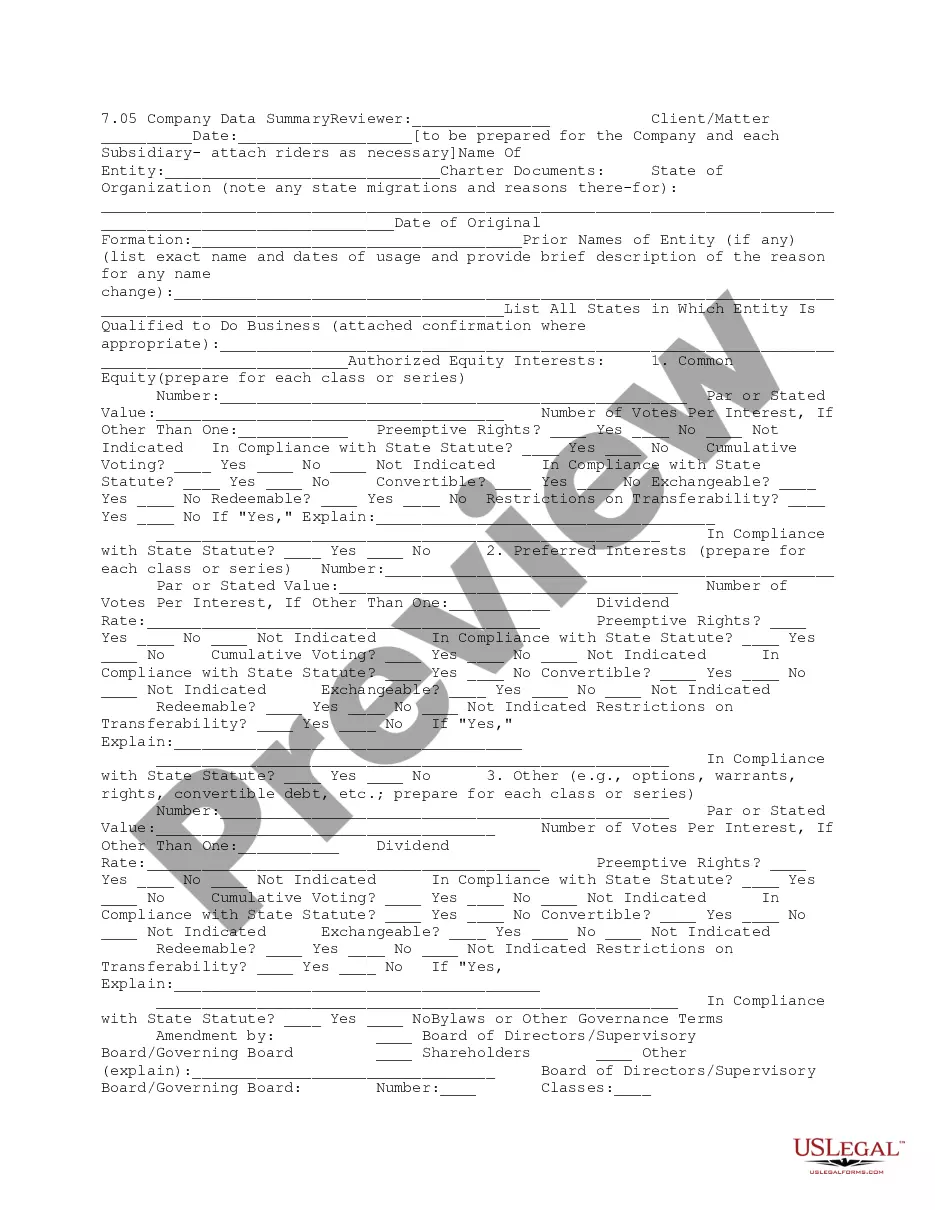
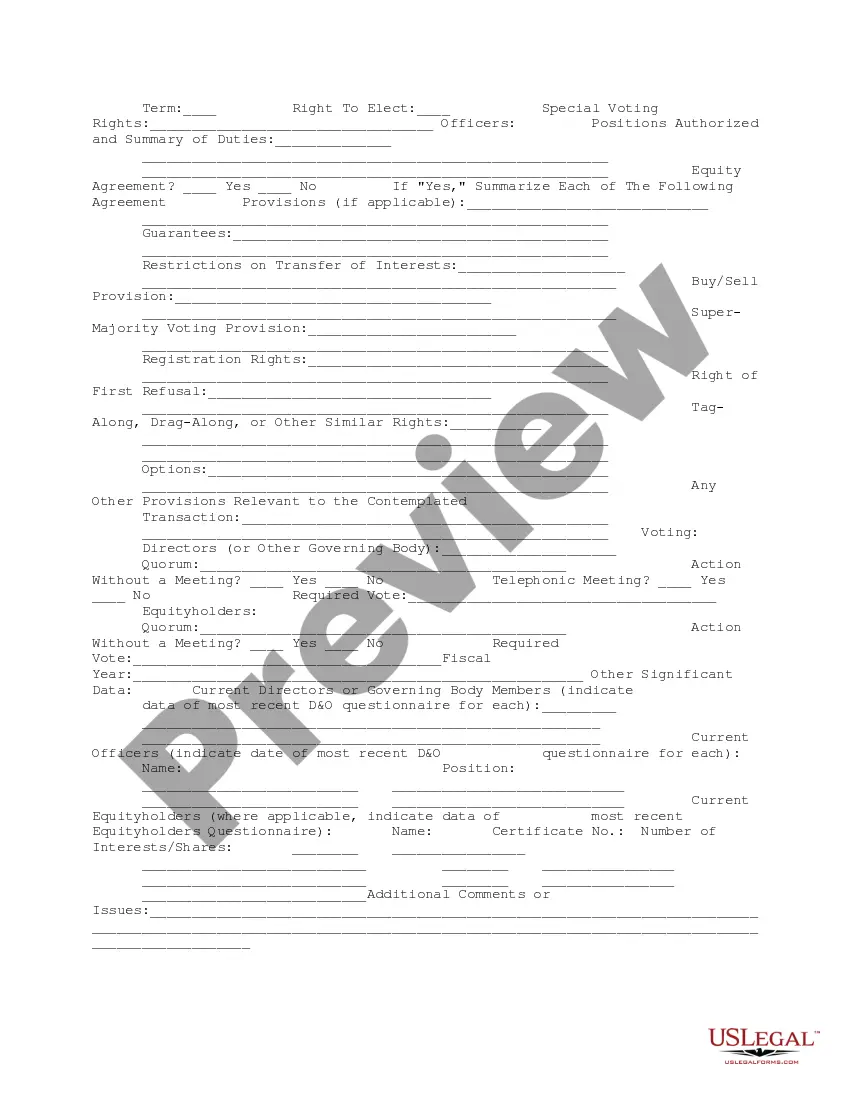
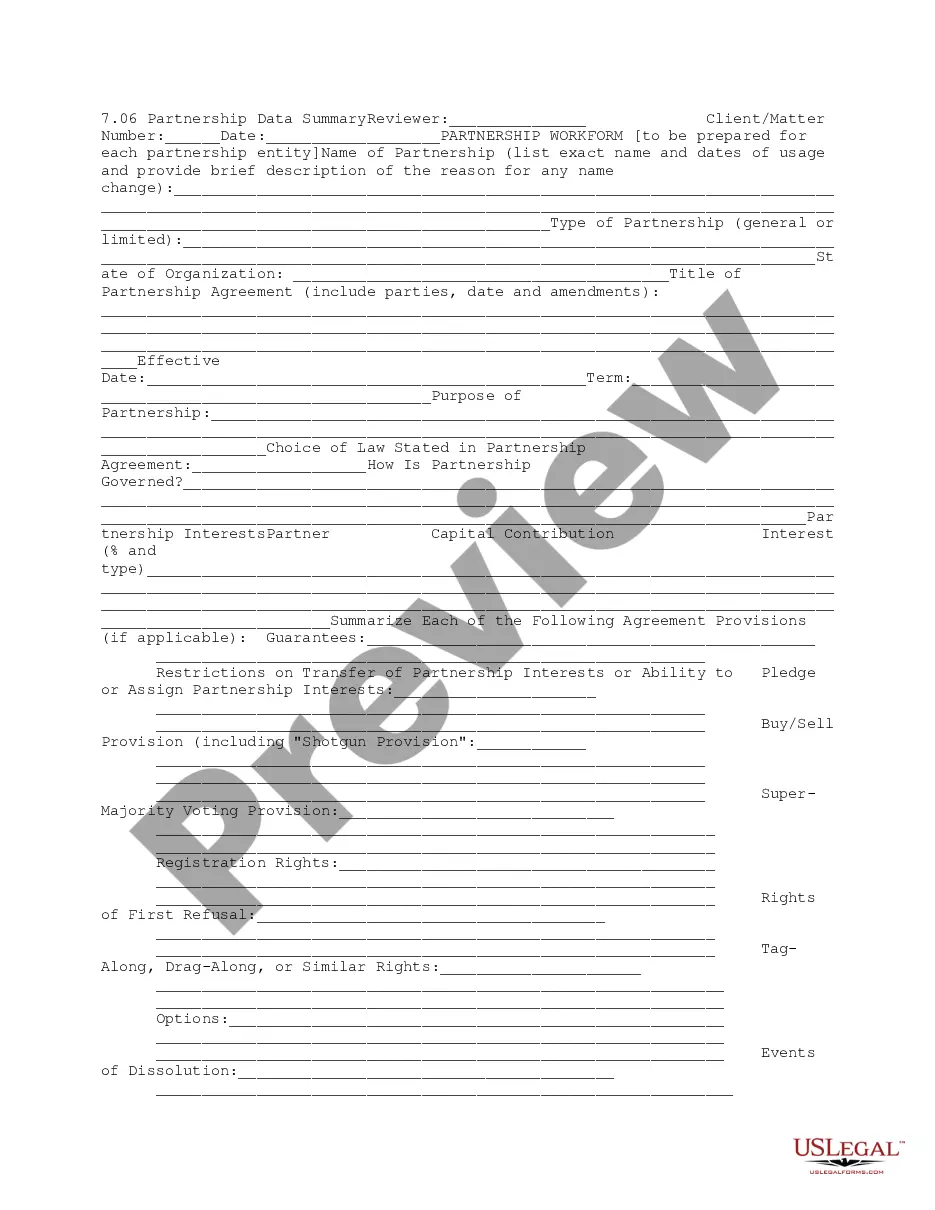
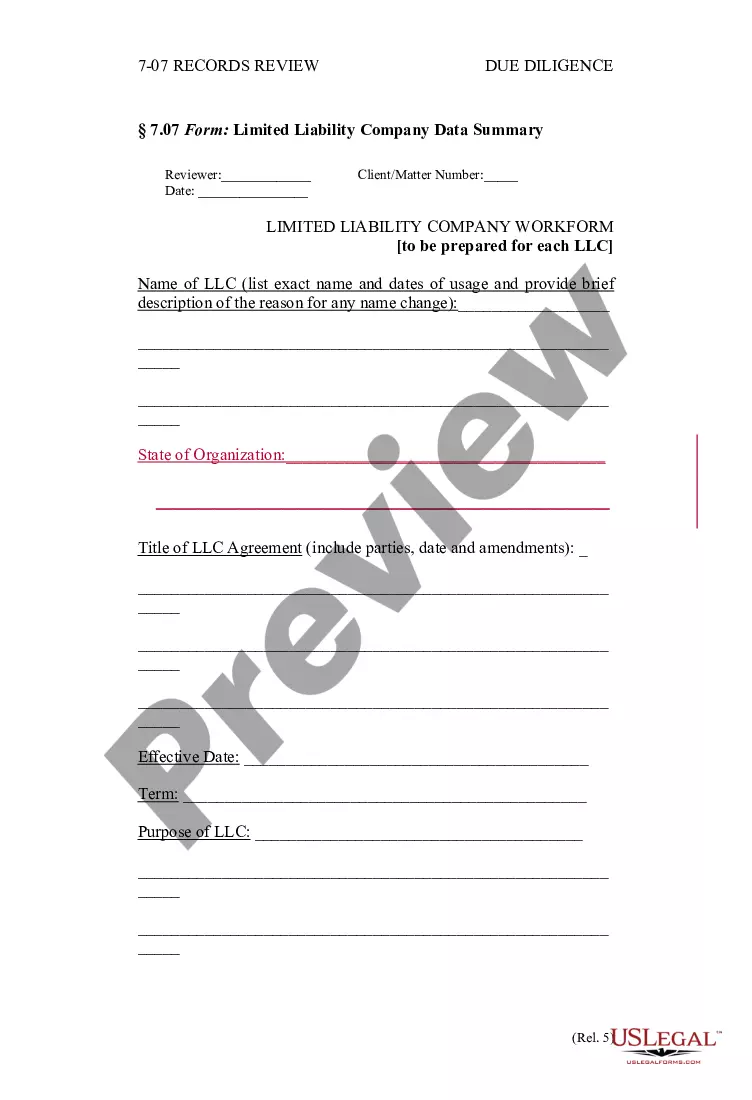
The Company Data Summary is a legal document used for assembling crucial information about a company and its subsidiaries during business transactions. This form is essential for conducting due diligence, which helps ensure that all relevant corporate data is transparent, accurate, and readily available. It is distinct from other business forms as it provides a comprehensive overview of the company's equity interests, governance structure, and operational details.
Form components explained
- General information about the entity, including its original formation date and prior names.
- States in which the entity is qualified to conduct business.
- Detailed descriptions of authorized equity interests, including common and preferred stocks.
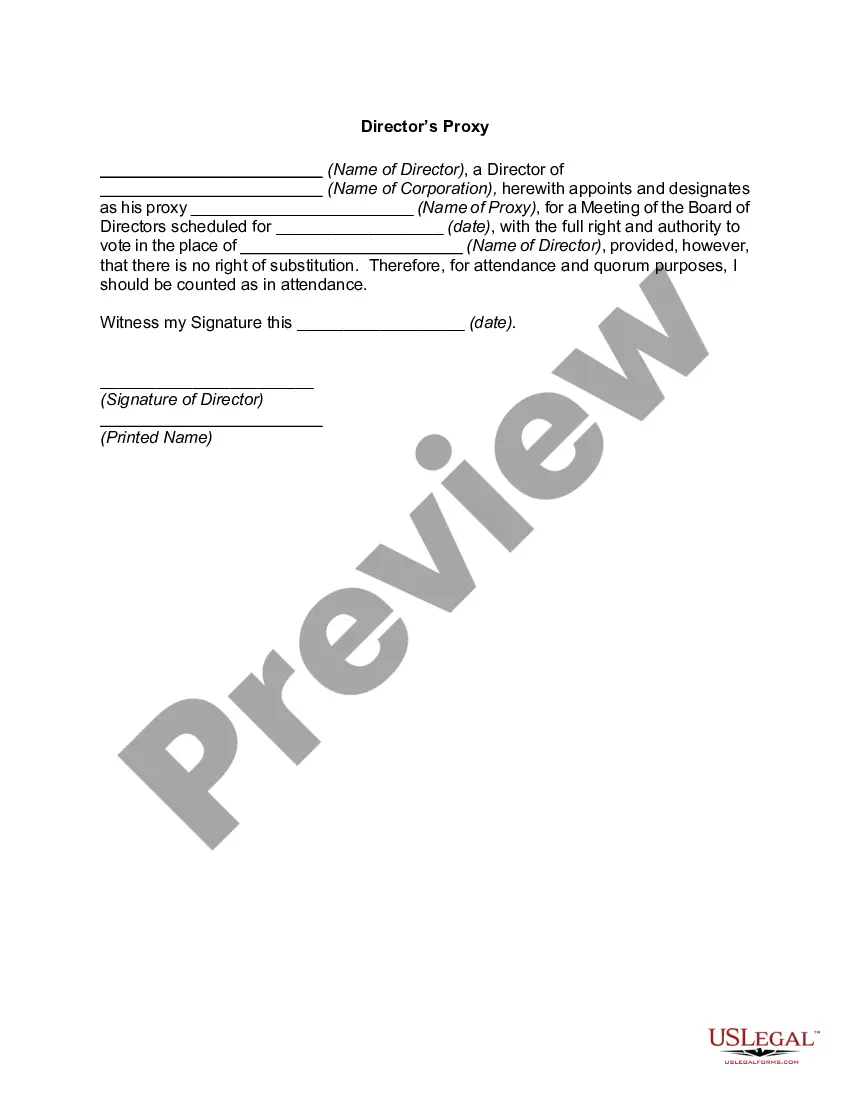
- Bylaws and governance terms, detailing the roles of directors and officers.
- Voting requirements and protocols for equityholders and directors.
- Significant data on current directors, officers, and equityholders.


Situations where this form applies
This form should be used when a company is engaged in business transactions that require due diligence. This includes mergers and acquisitions, investments, and partnerships where complete transparency regarding corporate structure, equity interests, and governance is necessary. It ensures all parties have a clear understanding of the company's legal and financial standing.
Intended users of this form
- Business owners looking to sell or restructure their company.
- Investors or partners performing due diligence before entering into a business transaction.
- Legal professionals assisting clients in corporate transactions.
- Accountants or financial advisors needing accurate company data for assessments.
Steps to complete this form
- Begin by entering the general information about the entity, including its name, original formation date, and any prior names.
- List all states where the entity is authorized to operate.
- Detail the various classes of equity interests, specifying numbers, values, and any associated rights.
- Document the governance framework, including information about directors and officers.
- Include current data on equityholders, including names and share quantities.
Does this document require notarization?
Notarization is not commonly needed for this form. However, certain documents or local rules may make it necessary. Our notarization service, powered by Notarize, allows you to finalize it securely online anytime, day or night.
Get your form ready online
Our built-in tools help you complete, sign, share, and store your documents in one place.
Make edits, fill in missing information, and update formatting in US Legal Forms—just like you would in MS Word.
Download a copy, print it, send it by email, or mail it via USPS—whatever works best for your next step.
Sign and collect signatures with our SignNow integration. Send to multiple recipients, set reminders, and more. Go Premium to unlock E-Sign.
If this form requires notarization, complete it online through a secure video call—no need to meet a notary in person or wait for an appointment.
We protect your documents and personal data by following strict security and privacy standards.

Make edits, fill in missing information, and update formatting in US Legal Forms—just like you would in MS Word.

Download a copy, print it, send it by email, or mail it via USPS—whatever works best for your next step.

Sign and collect signatures with our SignNow integration. Send to multiple recipients, set reminders, and more. Go Premium to unlock E-Sign.

If this form requires notarization, complete it online through a secure video call—no need to meet a notary in person or wait for an appointment.

We protect your documents and personal data by following strict security and privacy standards.
Common mistakes
- Failing to include all prior names of the entity.
- Omitting necessary details about local state qualifications for doing business.
- Incorrectly reporting the number of equity interests or values.
- Not updating governance structure information or current directors and officers.
Benefits of using this form online
- Convenience of completing the form from any location with internet access.
- Editability allows users to tailor the form to their specific needs before downloading it.
- Access to templates created by licensed attorneys ensures reliability and compliance with legal standards.
Legal use & context
- The Company Data Summary is crucial for establishing credibility during financial negotiations.
- Accurate data disclosure protects all parties from legal disputes arising from misinformation.
- This form can serve as evidence in legal claims related to business transactions and corporate structure.
Key takeaways
- The Company Data Summary is essential for due diligence in business transactions.
- Completing this form helps ensure clarity and accuracy in corporate data disclosure.
- It is suitable for a variety of users, including business owners and legal professionals.
Looking for another form?



Form popularity
FAQ
Determine the intent. Research the company or market. Identify a need. Open with a strong statement. Include relevant details. Keep it short and concise. Create a call to action. Close your letter.
Start with a Value Statement. Chewy.com, a pet supply retailer, uses a blurb on its Facebook page. Offer a Reason for Being. A passion for art lead DesignByHumans to retailing. Close with a Benefit. Finally, end your blurb with some sort of a benefit statement or implied benefit statement aimed at your customers.
Business name. Location. Legal structure (i.e., sole proprietorship, LLC, S Corporation, or partnership) Management team. Mission statement. Company history (when it started and important milestones) Description of products and services and how they meet the needs of the marketplace.
Start with a basic outline that includes the Who, What, Where and since When of your business story. Tell us what you stand for as a business. Talk about what you specialize in and the work you love doing. Tell a quick relatable story about why you started your business. Give us a glimpse into your future goals.
Reference the genre and central theme. Create intrigue around the main conflict. Dive right in and introduce your protagonist. Keep it short and punchy. Reference your book-writing or professional status, if it relates to your book.
When writing a summary, remember that it should be in the form of a paragraph. A summary begins with an introductory sentence that states the text's title, author and main point of the text as you see it. A summary is written in your own words. A summary contains only the ideas of the original text.
Executive summaries should include the following components: Write it last. Capture the reader's attention. Make sure your executive summary can stand on its own. Think of an executive summary as a more condensed version of your business plan. Include supporting research. Boil it down as much as possible.
The blurb should highlight the selling points of a bookthe hook. In the case of Saunders' book, the main selling point was Lincolnthe main character of the story.One of the best examples of this is the blurb for Stephanie Myers' Twilight: About three things I was absolutely positive.
Basic Company Information. Consider the company overview like an introduction for your business. Ownership and Management Team. Company History. Mission Statement. Product/Service and Customer. Future Goals.