Self-Employed Title Examiner Contract
About this form
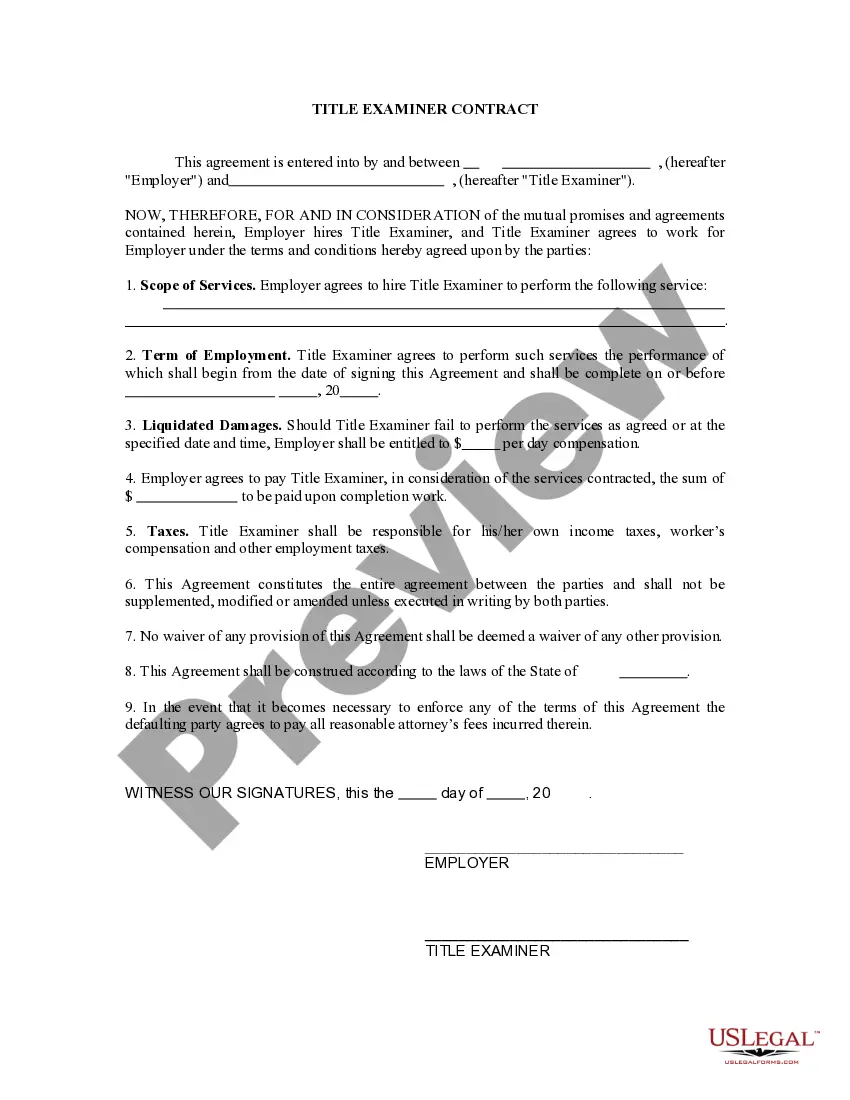
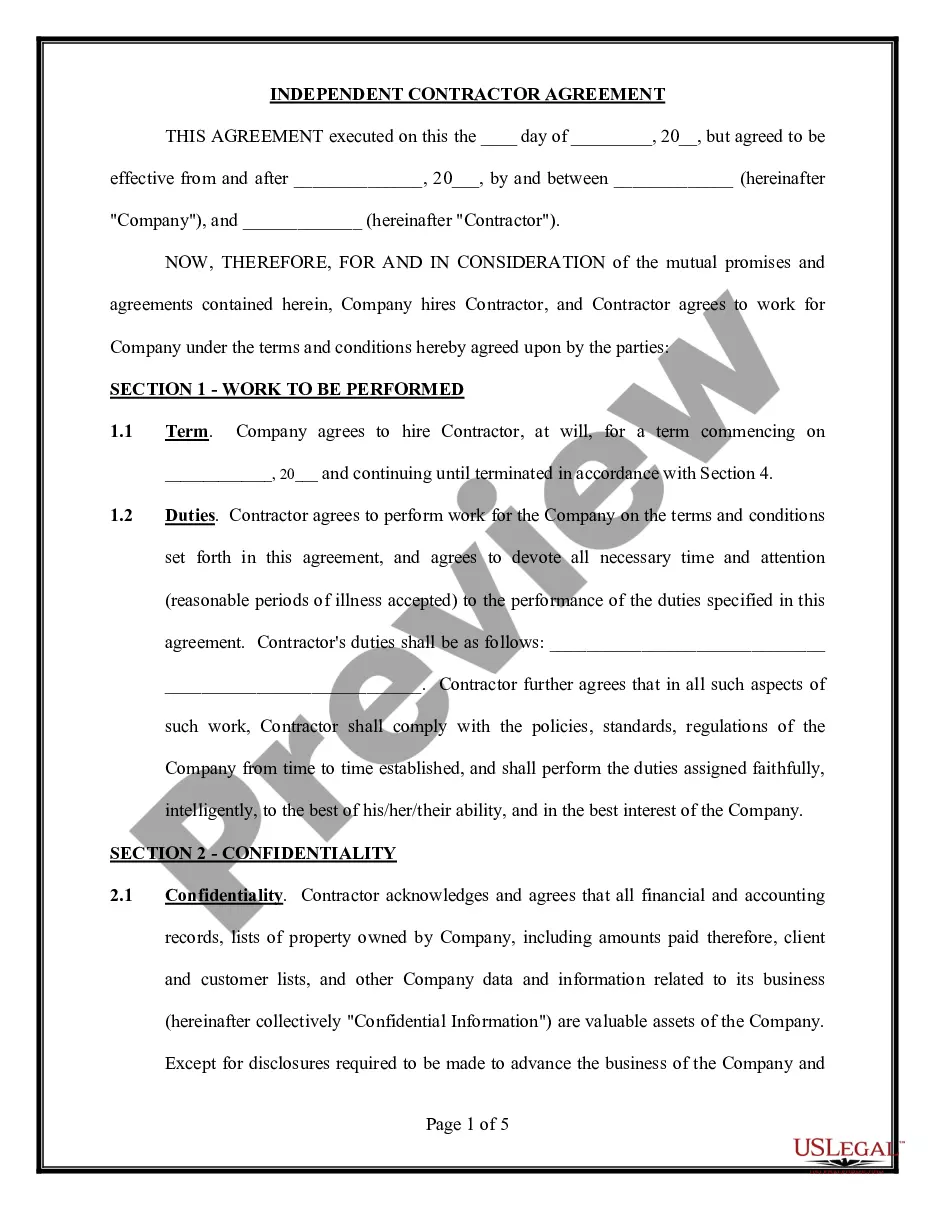
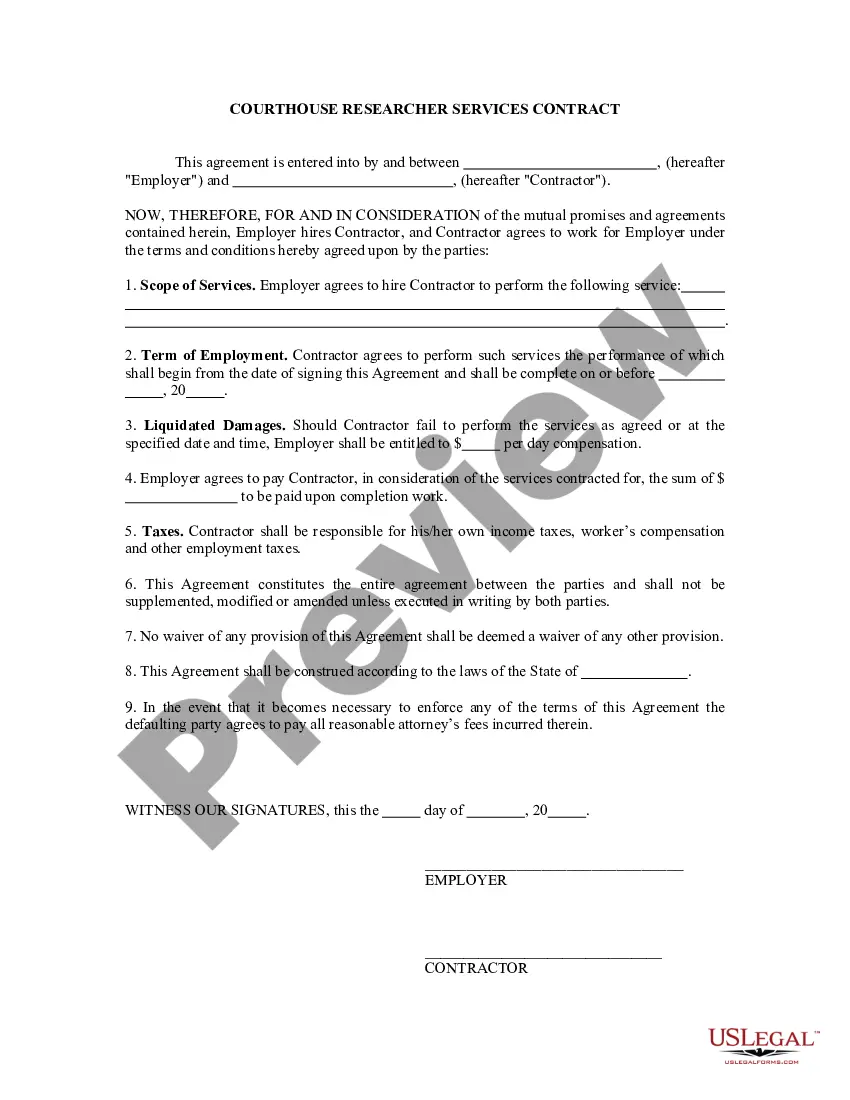
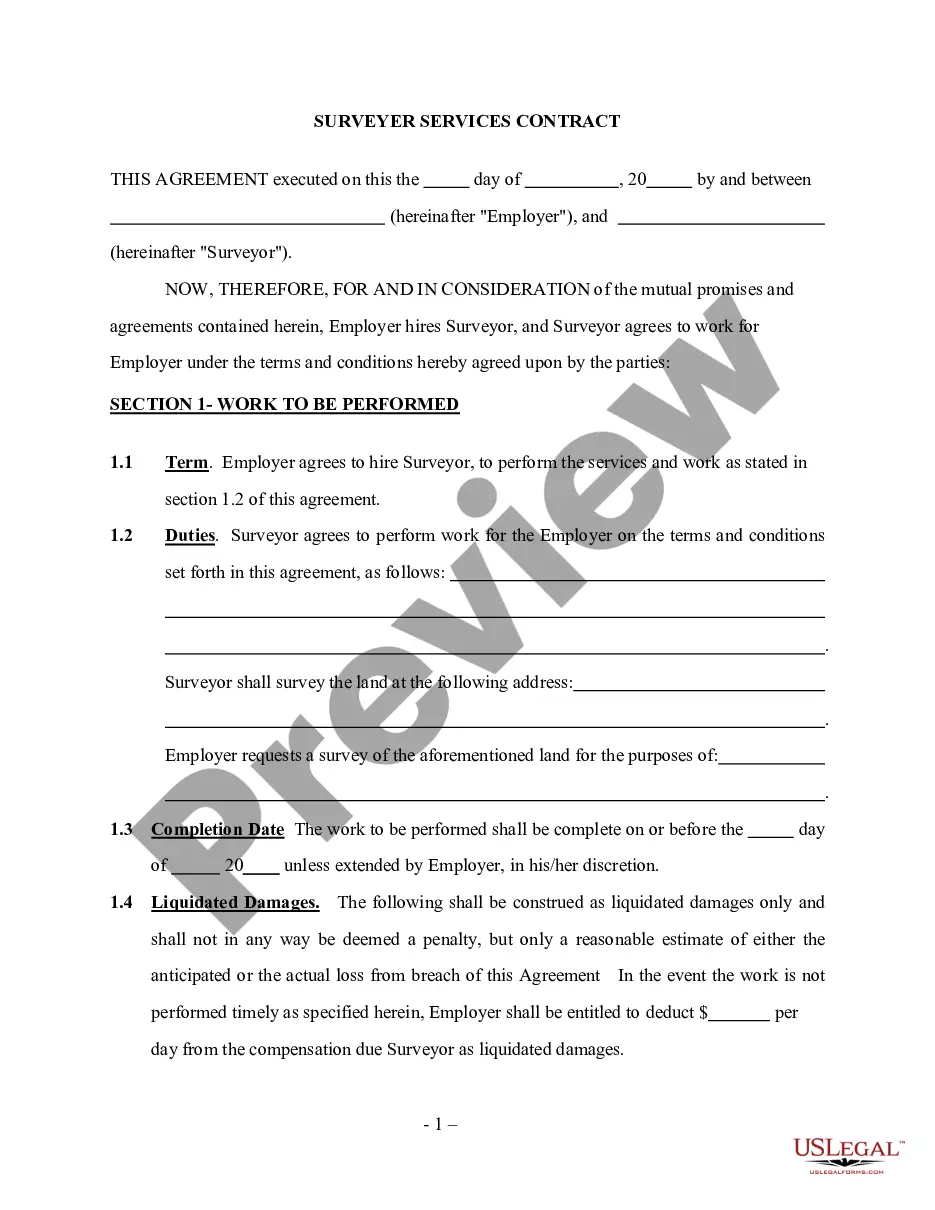
The Self-Employed Title Examiner Contract is a legal document used when an employer engages a title examiner as an independent contractor to perform title searching services. This form outlines the expectations, scope of work, and responsibilities of both parties in a clear manner, thus ensuring that all parties understand their obligations. Unlike employment contracts, this agreement defines the relationship as independent, setting specific terms for the services to be performed.
Key components of this form
- Scope of Services: Describes the specific title searching services to be provided.
- Compensation: Outlines how and when the title examiner will be paid.
- Independent Contractor Status: Clarifies that the title examiner is not an employee of the employer.
- Duration of Agreement: Specifies the term and conditions under which the contract is active.
- Termination Clause: Details the conditions under which either party can terminate the contract.
Common use cases
This form is essential when an employer needs to hire a title examiner to conduct title searches for properties. It is particularly useful in real estate transactions, refinancing, or any scenario where clear property title verification is needed. By utilizing this contract, both parties can establish a formal relationship, ensuring legal clarity and mutual understanding of the services agreed upon.
Who can use this document
This form is intended for:
- Real estate professionals hiring title examiners.
- Independent contractors providing title examination services.
- Property owners seeking title search services for transactions or clarification.
Completing this form step by step
- Begin by identifying the parties involved, including the employer's and title examiner's names and contact information.
- Clearly specify the scope of services to be performed by the title examiner.
- Enter the agreed compensation terms, including payment amounts and schedules.
- Define the duration of the contract, including start and end dates.
- Include any clauses for termination, detailing conditions under which either party can exit the agreement.
Notarization requirements for this form
This form does not typically require notarization to be legally valid. However, some jurisdictions or document types may still require it. US Legal Forms provides secure online notarization powered by Notarize, available 24/7 for added convenience.
Get your form ready online
Our built-in tools help you complete, sign, share, and store your documents in one place.
Make edits, fill in missing information, and update formatting in US Legal Forms—just like you would in MS Word.
Download a copy, print it, send it by email, or mail it via USPS—whatever works best for your next step.
Sign and collect signatures with our SignNow integration. Send to multiple recipients, set reminders, and more. Go Premium to unlock E-Sign.
If this form requires notarization, complete it online through a secure video call—no need to meet a notary in person or wait for an appointment.
We protect your documents and personal data by following strict security and privacy standards.

Make edits, fill in missing information, and update formatting in US Legal Forms—just like you would in MS Word.

Download a copy, print it, send it by email, or mail it via USPS—whatever works best for your next step.

Sign and collect signatures with our SignNow integration. Send to multiple recipients, set reminders, and more. Go Premium to unlock E-Sign.

If this form requires notarization, complete it online through a secure video call—no need to meet a notary in person or wait for an appointment.

We protect your documents and personal data by following strict security and privacy standards.
Common mistakes to avoid
- Failing to clearly define the scope of services, leading to misunderstandings.
- Not specifying payment details, which can cause disputes.
- Neglecting termination clauses, leading to complications if one party wishes to end the agreement.
Why complete this form online
- Convenience of downloading and completing the form at any time.
- Editability allows users to customize the document to fit their specific needs easily.
- Each form is drafted by licensed attorneys, ensuring reliability and legal compliance.
What to keep in mind
- The Self-Employed Title Examiner Contract formalizes the relationship between an employer and an independent title examiner.
- It is essential for clarifying responsibilities, compensation, and confidentiality.
- Completing the form accurately can prevent common legal issues and ensure smooth transactions.
Looking for another form?
Form popularity
FAQ
Who Is a Self-Employed Person? A self-employed person is an independent contractor or a sole proprietor who reports self-employment income. Self-employed people work for themselves at a variety of trades, professions, and occupations rather than working for an employer.
You Don't Need to Include Every Job on Your Resume: Highlight jobs that demonstrate your experience, skills, and fit for the role. Leave Off Jobs That Are Unrelated: You can also omit jobs that are more than 10 to 15 years old, to avoid age discrimination.
Treat this work experience as other independent contractors and other freelancers would on their resumes give yourself a title that reflects the type of work you were doing during your time of self-employment, and add the word "Contract," "Consultant," or "Freelancer" to that title.
List your entries just like you would do with any other job. Describe the work you did and describe it well. Use a functional job title, instead of simply putting self-employment or even worse self-work. Add clients. Include references!
The title of proprietor is similar to that of an owner, as they are both typically used to describe the owner of a small business. Sole proprietor is a commonly-used legal term that describes the single owner of a business, someone who is also legally tied to the respective company and considered the same legal entity.
List your entries just like you would do with any other job. Describe the work you did and describe it well. Use a functional job title, instead of simply putting self-employment or even worse self-work. Add clients. Include references!
Chief executive officer, or CEO, is a common title in the business world and will leave no one in doubt that you're in charge of your company. If you want to convey that your company is well-established or has a large team of employees, CEO might be the right title for you.
Resumes should be written in first person, meaning it's written as though you're writing about yourself. However, the standard, accepted practice is to leave out personal pronouns like I, my, and me. This style is referred to as first person implied.
Directly address your current unemployment and give it full context. Explain why you left your last job and why you've been out of the job market so long. This gives the hiring manager some background on the situation and keeps them from imagining the worst about you.