Receipt For Abstracts
What this document covers
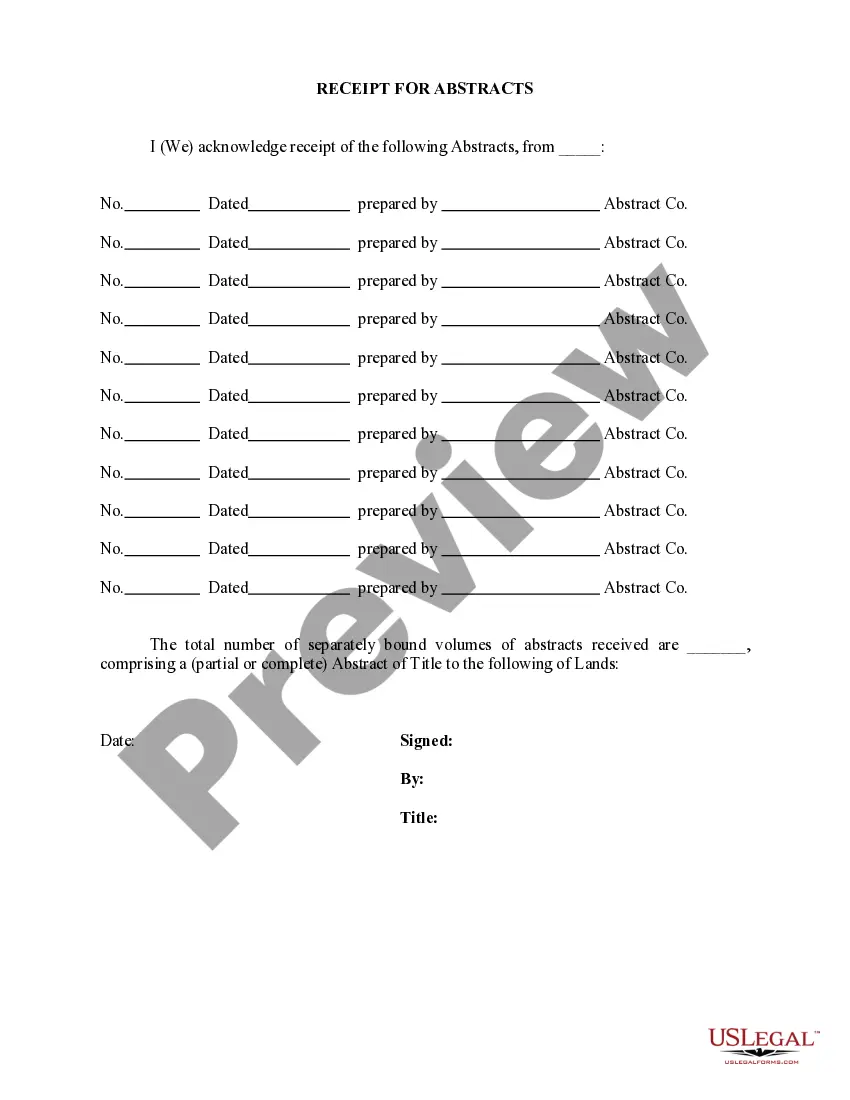
The Receipt for Abstracts is a legal document used to acknowledge the receipt of abstracts from an abstract company. This form provides a record for the property owner, confirming that they have delivered specific abstracts to a third party for the purpose of examining title. It helps establish accountability and clarity in property transactions, distinguishing itself from other forms by focusing on the receipt of title-related documents.
Main sections of this form
- Parties involved: Identifies the owner and the recipient of the abstracts.
- Abstract details: Lists the specific abstracts received, including their preparation dates and the abstract company names.
- Total count: States the total number of separately bound volumes received.
- Abstract description: Indicates whether the received abstract is partial or complete, along with the land description.
- Signatures: Provides spaces for the authorized signatory's name, title, and signature.
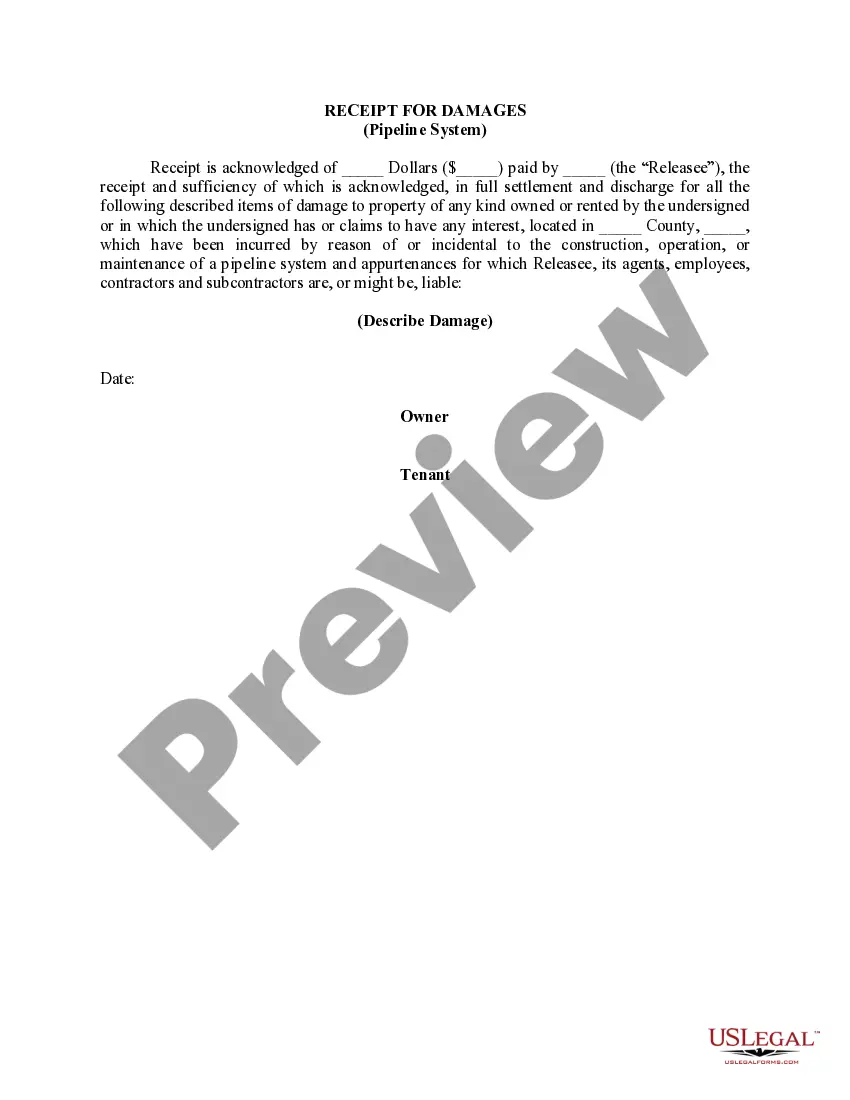
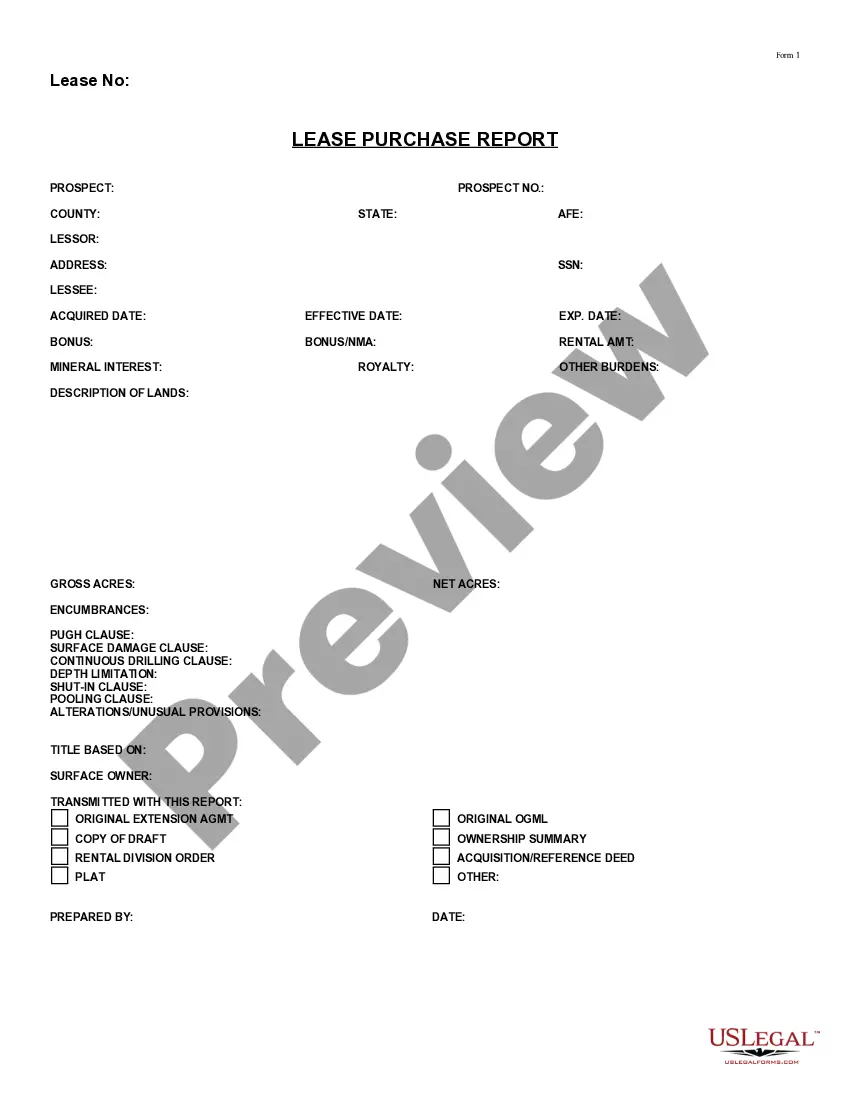
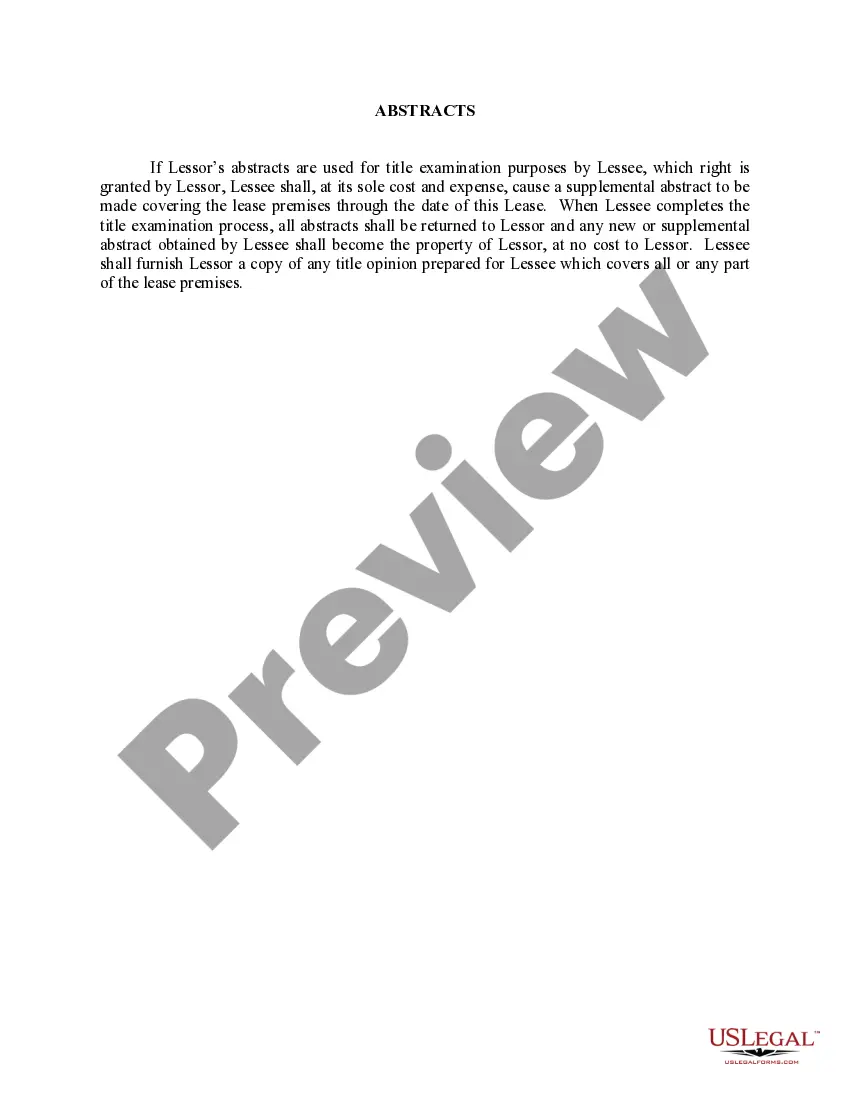
When this form is needed
This form is typically used when a property owner is delivering abstracts to a third party, such as an attorney or title company, who will use them to review the property title. It is essential in real estate transactions where title examination is necessary, ensuring that all parties involved have a clear record of what documents have been exchanged.
Who needs this form
- Property owners needing to provide title abstracts to third parties.
- Attorneys or title professionals conducting title examinations.
- Real estate agents involved in property sales or transfers.
How to prepare this document
- Identify the parties: Fill in the names of the sender and recipient of the abstracts.
- Specify the abstract details: Enter the abstract numbers, dates, and preparation history for each document.
- Count the abstracts: Indicate the total number of volumes received.
- Describe the abstract: Note if it's a partial or complete abstract, along with the corresponding land details.
- Provide signatures: Ensure the authorized representative signs and includes their title and date on the form.
Does this document require notarization?
This form usually doesn’t need to be notarized. However, local laws or specific transactions may require it. Our online notarization service, powered by Notarize, lets you complete it remotely through a secure video session, available 24/7.
Get your form ready online
Our built-in tools help you complete, sign, share, and store your documents in one place.
Make edits, fill in missing information, and update formatting in US Legal Forms—just like you would in MS Word.
Download a copy, print it, send it by email, or mail it via USPS—whatever works best for your next step.
Sign and collect signatures with our SignNow integration. Send to multiple recipients, set reminders, and more. Go Premium to unlock E-Sign.
If this form requires notarization, complete it online through a secure video call—no need to meet a notary in person or wait for an appointment.
We protect your documents and personal data by following strict security and privacy standards.

Make edits, fill in missing information, and update formatting in US Legal Forms—just like you would in MS Word.

Download a copy, print it, send it by email, or mail it via USPS—whatever works best for your next step.

Sign and collect signatures with our SignNow integration. Send to multiple recipients, set reminders, and more. Go Premium to unlock E-Sign.

If this form requires notarization, complete it online through a secure video call—no need to meet a notary in person or wait for an appointment.

We protect your documents and personal data by following strict security and privacy standards.
Typical mistakes to avoid
- Failing to include all relevant abstract details, such as preparation dates and company names.
- Not signing the form or missing the signature from the appropriate party.
- Inaccurate counting of the total number of abstracts received.
- Using outdated or incorrect information regarding property title specifics.
Benefits of completing this form online
- Convenience of instant download from any device regardless of location.
- Editability allows users to customize the form for specific needs quickly.
- Reliability from data protection and legal accuracy, ensuring compliance with typical legal formats.
Looking for another form?


Form popularity
FAQ
A valuable paper will be considered for publication in its entirety. In one word, no. Abstracts are not peer-reviewed publications, and don't contain enough information to be evaluated as such. Some people include abstracts in their lists of publications, others don't.
The abstract is the second page of a lab report or APA-format paper and should immediately follow the title page.
An abstract summarizes, usually in one paragraph of 300 words or less, the major aspects of the entire paper in a prescribed sequence that includes: 1) the overall purpose of the study and the research problem(s) you investigated; 2) the basic design of the study; 3) major findings or trends found as a result of your
The title should be descriptive, direct, accurate, appropriate, interesting, concise, precise, unique, and should not be misleading. The abstract needs to be simple, specific, clear, unbiased, honest, concise, precise, stand-alone, complete, scholarly, (preferably) structured, and should not be misrepresentative.
Begin writing the abstract after you have finished writing your paper. Pick out the major objectives/hypotheses and conclusions from your Introduction and Conclusion sections. Select key sentences and phrases from your Methods section. Identify the major results from your Results section.
To write an informative and interesting abstract: 1) State the problem; 2) Present only your key findings (i.e., the main points), making explicit how they address the problem; 3) State the overall significance of the research; 4) Provide background as needed; and 5) Make your writing as clear and accessible as
Although strictly not part of your Abstract, the title of the proposed paper is also important. Short attention-catching titles are the most effective. However, it is also important, for a conference paper, to ensure that the title describes the subject you are writing about.
According to Scientific Style and Format Council of Science Editors, Seventh Edition, 2006, meeting abstracts should be cited using the following format: Author(s) of abstract. Title of abstract abstract. In: Name of conference or title of publication.; conference dates; place of conference.
Do not indent the first line. Double-space the text. Use a legible font like Times New Roman (12pt.). Limit the length to 250 words.