South Dakota Electrical Contractor Package
Understanding this form package
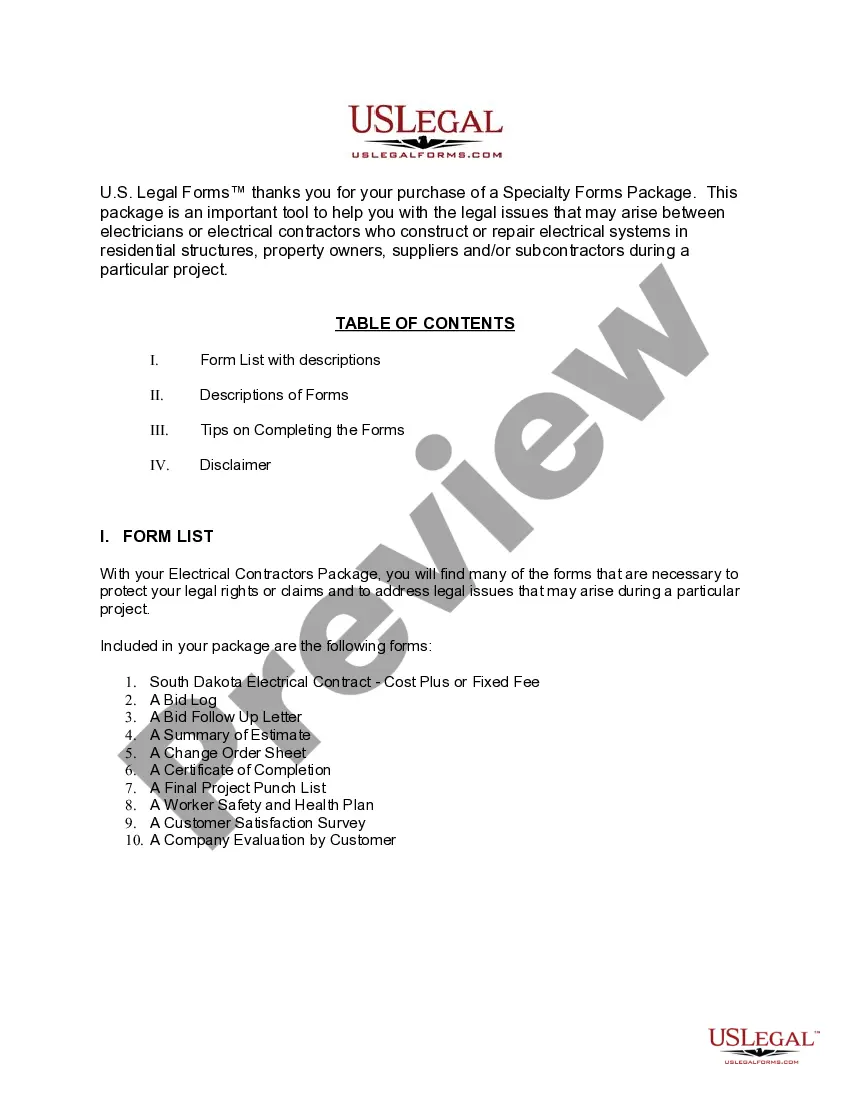
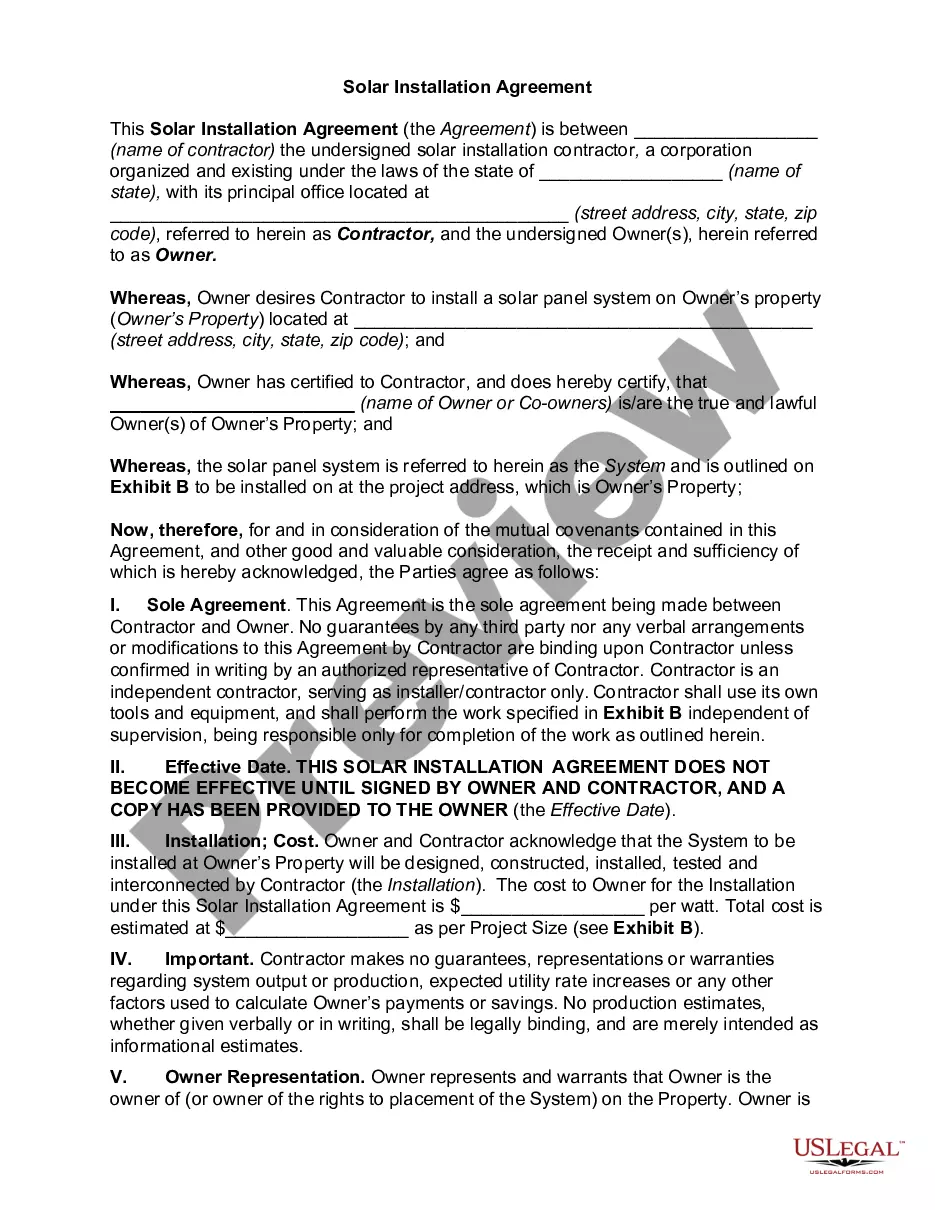
The South Dakota Electrical Contractor Package is a comprehensive set of legal forms designed specifically for electricians and electrical contractors working on projects in South Dakota. It stands out by including an electrical contract that adheres to state law, along with essential documents that support communication and project management throughout the lifespan of an electrical endeavor. This package streamlines the process of handling legal matters that may arise between contractors, property owners, and subcontractors.
Documents contained in this package
- Electrical Contract for Contractor
- Contractor's Bid Log
- Contractor's Bid Follow Up Letter
- Contractor's Summary of an Estimate
- Contractor's Final Punch List
- Customer Satisfaction Survey
- Construction Company Evaluation by a Customer
- Construction Safety and Health Plan
- Change Order for Construction or Repairs by Contractor
- Certification of Completion by Contractor






When to use this document
This package is useful in several scenarios, including:
- When starting a new electrical project or undertaking repairs
- When negotiating contracts or bids with clients and subcontractors
- When changes in project specifications need formal documentation
- To ensure compliance with safety regulations and project completion standards
- To gather feedback from customers post-project
Who this form package is for
- Electrical contractors operating in South Dakota
- Subcontractors working on electrical projects
- Property owners hiring electrical services
- Suppliers providing materials for electrical projects
- Individuals seeking to formalize agreements and maintain legal protections
How to prepare this document
- Review the included forms carefully to understand their purpose.
- Identify the parties involved in the electrical project.
- Fill in the appropriate details, such as dates, project scope, and payment terms.
- Ensure all necessary signatures are obtained before finalizing any agreements.
- Keep copies of completed forms for your records and future reference.
Do documents in this package require notarization?
Forms in this package typically do not require notarization unless mandated by local law. It is recommended to check specific requirements for any agreements or notices used in your project.
Get your form ready online
Our built-in tools help you complete, sign, share, and store your documents in one place.
Make edits, fill in missing information, and update formatting in US Legal Forms—just like you would in MS Word.
Download a copy, print it, send it by email, or mail it via USPS—whatever works best for your next step.
Sign and collect signatures with our SignNow integration. Send to multiple recipients, set reminders, and more. Go Premium to unlock E-Sign.
If this form requires notarization, complete it online through a secure video call—no need to meet a notary in person or wait for an appointment.
We protect your documents and personal data by following strict security and privacy standards.

Make edits, fill in missing information, and update formatting in US Legal Forms—just like you would in MS Word.

Download a copy, print it, send it by email, or mail it via USPS—whatever works best for your next step.

Sign and collect signatures with our SignNow integration. Send to multiple recipients, set reminders, and more. Go Premium to unlock E-Sign.

If this form requires notarization, complete it online through a secure video call—no need to meet a notary in person or wait for an appointment.

We protect your documents and personal data by following strict security and privacy standards.
Common mistakes to avoid
- Failing to obtain all necessary signatures before starting work.
- Not keeping a record of bid submissions and follow-ups.
- Missing key details in the Change Order Sheet, which can lead to disputes.
- Inadequately documenting project completion on the Certificate of Completion.
Benefits of completing this package online
- Convenient access to all necessary forms in one package.
- Easy to fill out with digital tools or by hand.
- Time-saving compared to purchasing forms separately.
- Reliability of forms drafted by licensed attorneys.
Looking for another form?




Form popularity
FAQ
Electricians may be paid by the hour or by day rate so they can only earn their rate or the maximum hours you can fit in a day. Sometimes they may be on a price so if they complete a job quickly, it'll maximise profits but regardless, you won't become that millionaire when you work for somebody.
Work at least two years as a journeyman electrician (4,000 hours) under a licensed electrical contractor. Possess a valid journeyman license. Pay a fee ($50). Deposit a sum of $10,000 with the South Dakota Electrical Commission. Pass an electrical contractor examination.
Electricians CAN make 100K per year. This is assuming that they are trained (gone through an apprenticeship) or certified (journeyman or Master) in their respective area.
To get a C-10 Electrical Contractor License in California, you must prove a minimum of 4 years journeyman level experience and pass a two part state exam with the Contractor State License Board. You must also have: 4 Years Journey Level Experience. Have a Qualifying Individual to sign off on your Experience.
Across the electrical and mechanical construction industry, gross margins were up almost 2 percent in 2017, but overall profitability decreased by 1 percent to 4.1 percent of revenue.
It's a four-year course, which involves both on-the-job and off-the-job training. Completing the Cert III allows you to become an electrician or electrical tradesperson in Australia. It's also a handy pathway to the Diploma of Electrical Engineering, which will open up a higher paying career area.
New York: $77,810. Alaska: $76,330. Illinois: $75,820. Hawaii: $75,810. New Jersey: $71,660. Minnesota: $70,410. Oregon: $69,330. California: $69,320.
You Could Make Six Figures According to PayScale, the average annual salary for electricians is $55,477. Per the BLS, the highest 10% of electricians earn more than $90,420.Electricians who join unions can make more than those who do not.
Classifications, a C10 Electrical Licensed Contractor places, installs, erects or connects any electrical wires, fixtures, appliances, apparatus, raceways, conduits, solar photovoltaic cells or any part thereof, which generate, transmit, transform or utilize electrical energy in any form or for any purpose.