Nevada New Resident Guide
What is this form?
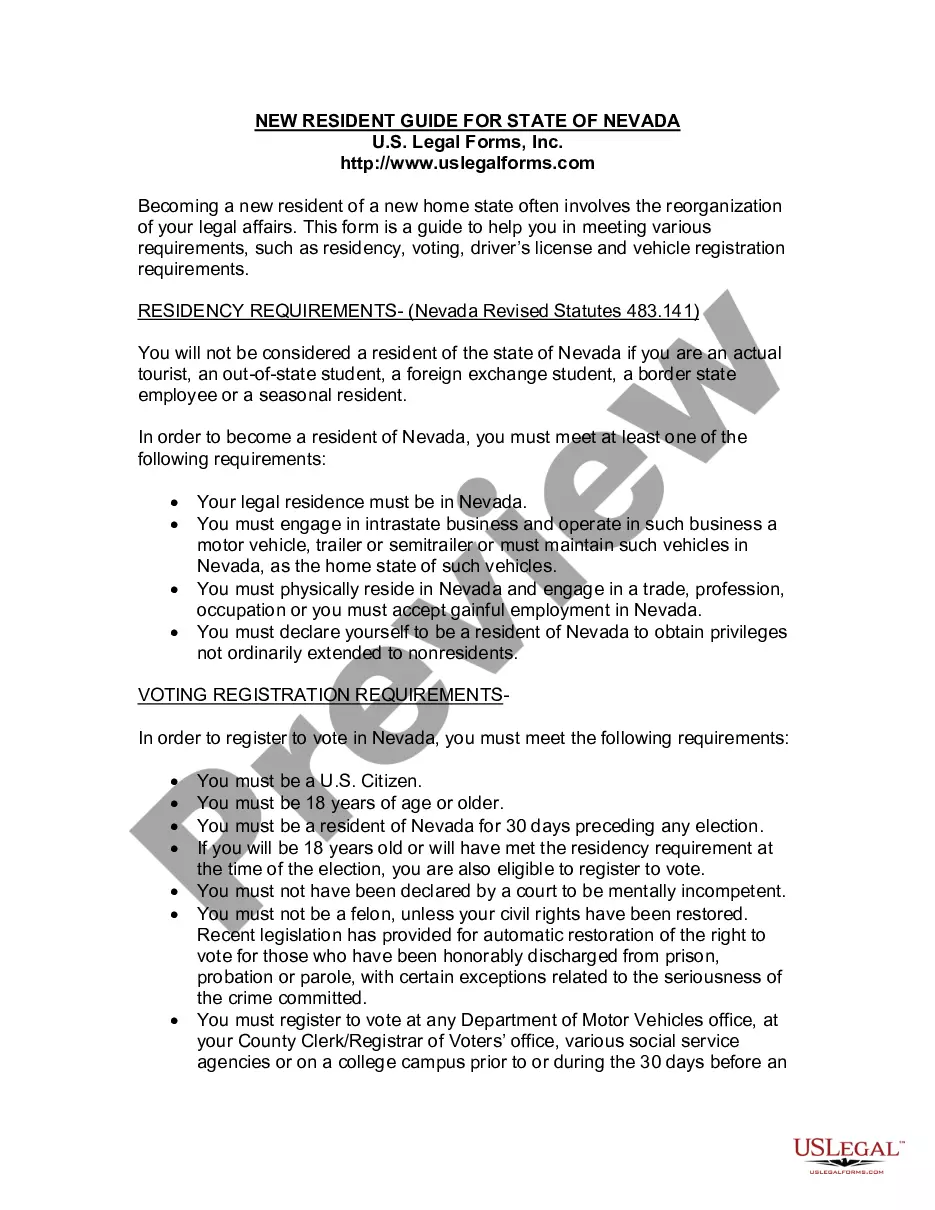
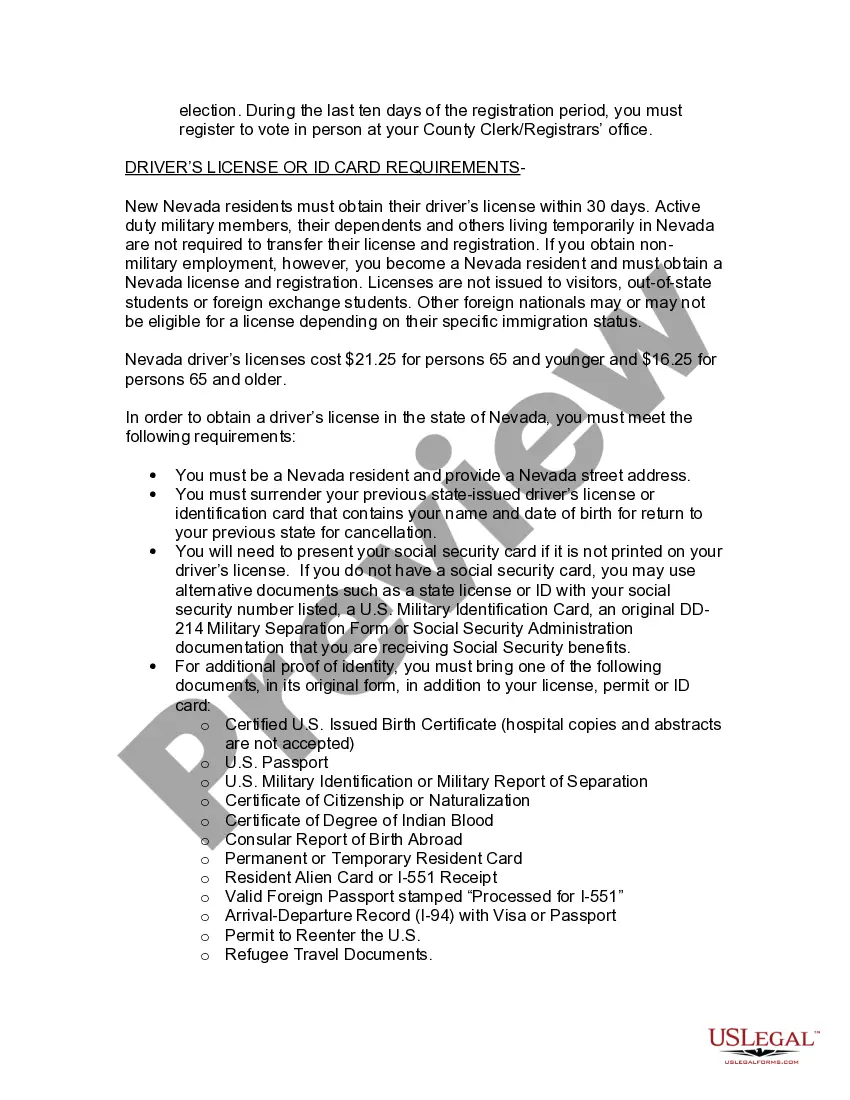
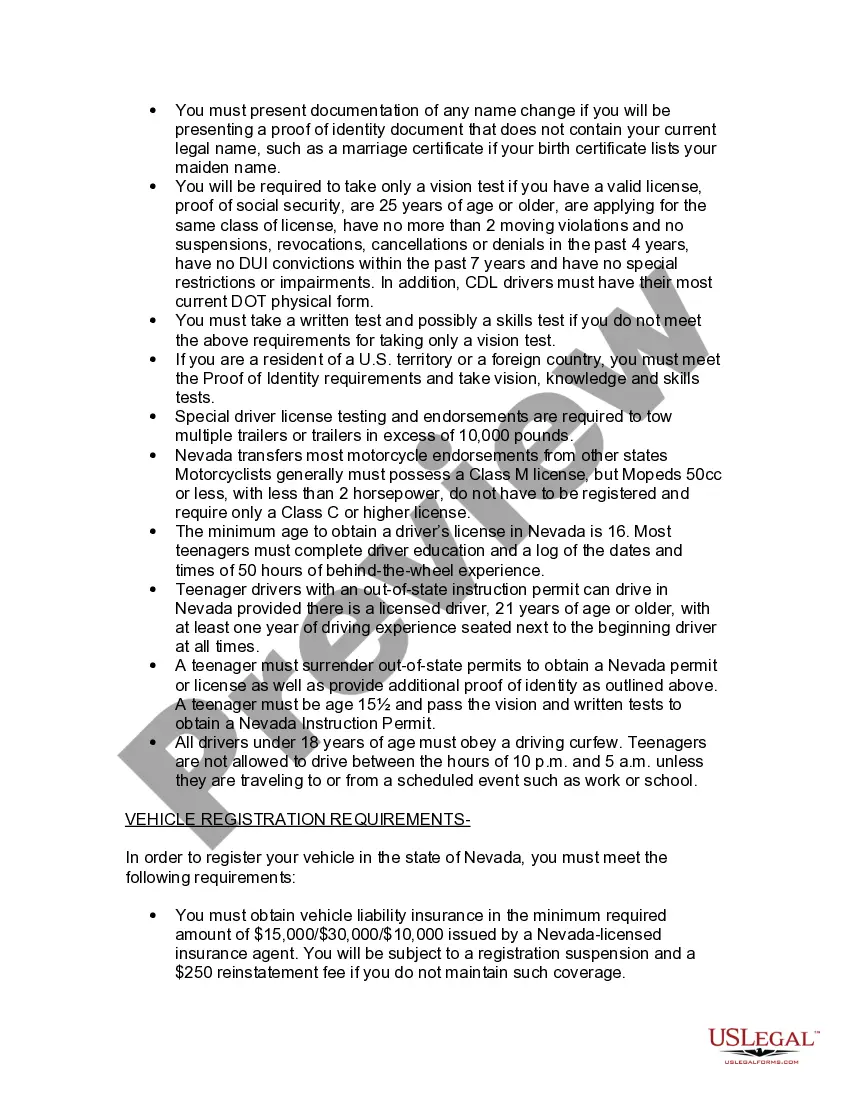
The New Resident Guide is an informational resource designed to assist individuals who are relocating to a new state. It outlines essential state requirements for residency, voter registration, driver's licenses, and vehicle registration. Unlike other legal forms that only cover specific areas, this guide provides a comprehensive understanding of the necessary steps and documentation needed for a smooth transition as a new resident.
Form components explained
- Residency requirements: Defines what qualifies someone as a resident in the new state.
- Voter registration guidelines: Details the eligibility criteria and registration process for new residents.
- Driverâs license and ID card requirements: Outlines the steps for obtaining a driver's license or state-issued ID as a new resident.
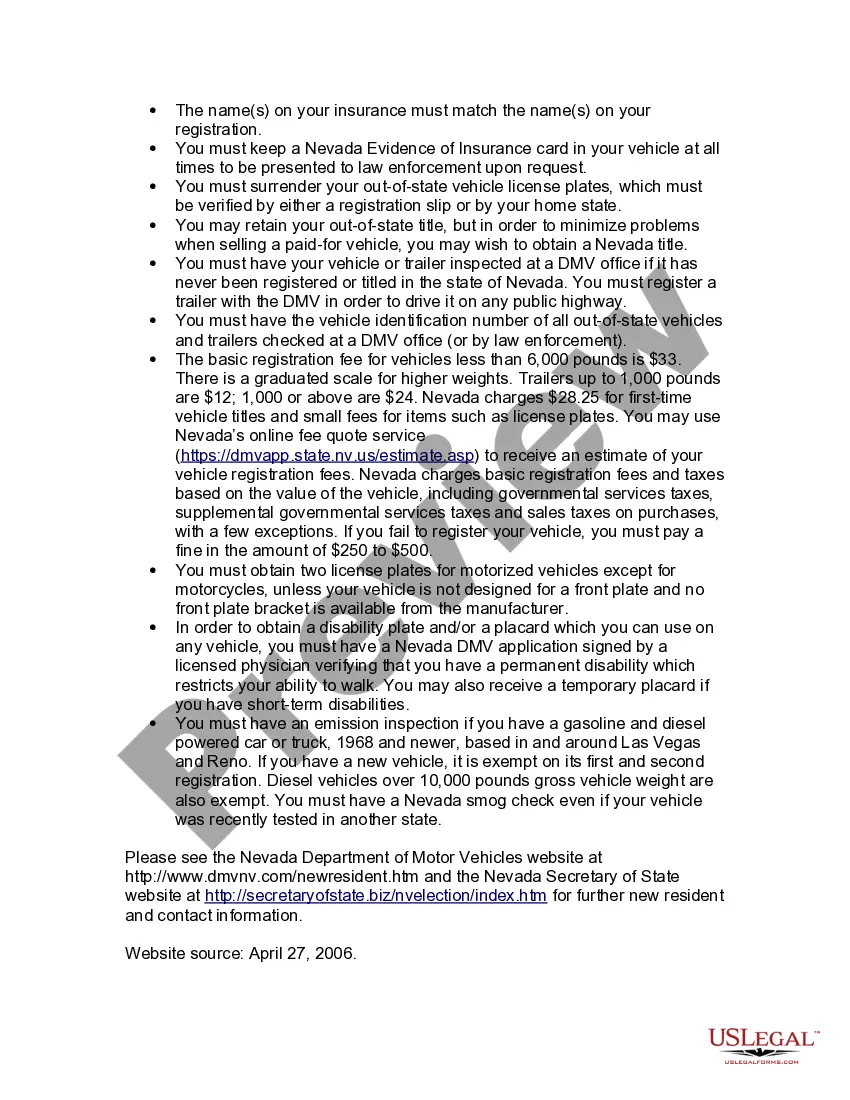
- Vehicle registration rules: Describes the necessary actions and documents required for registering your vehicle in the new state.
When to use this document
This form is particularly useful when moving to a new state. If you have recently relocated or plan to move soon, the New Resident Guide will equip you with the knowledge necessary to fulfill residency, voting, driver's license, and vehicle registration requirements. It is an essential tool for ensuring compliance with state laws and regulations after a move.
Who this form is for
- Individuals and families relocating to a new state.
- Active duty military members and their families moving to a new residence.
- Students transitioning to a new state for education or employment.
- Anyone needing clarity on state-specific residency and registration processes.
How to prepare this document
- Determine your residency status based on the state's criteria.
- Gather necessary identification and documentation for voter registration.
- Follow the steps to apply for a state driver's license or ID, including gathering proof of residency.
- Prepare the required documents to register your vehicle at the local DMV office.
- Keep this guide handy for reference as you complete each step of the process.
Does this form need to be notarized?
This form does not typically require notarization unless specified by local law. For the majority of users, it serves as an informational guide rather than a legally binding document, simplifying the process of compliance.
Get your form ready online
Our built-in tools help you complete, sign, share, and store your documents in one place.
Make edits, fill in missing information, and update formatting in US Legal Forms—just like you would in MS Word.
Download a copy, print it, send it by email, or mail it via USPS—whatever works best for your next step.
Sign and collect signatures with our SignNow integration. Send to multiple recipients, set reminders, and more. Go Premium to unlock E-Sign.
If this form requires notarization, complete it online through a secure video call—no need to meet a notary in person or wait for an appointment.
We protect your documents and personal data by following strict security and privacy standards.

Make edits, fill in missing information, and update formatting in US Legal Forms—just like you would in MS Word.

Download a copy, print it, send it by email, or mail it via USPS—whatever works best for your next step.

Sign and collect signatures with our SignNow integration. Send to multiple recipients, set reminders, and more. Go Premium to unlock E-Sign.

If this form requires notarization, complete it online through a secure video call—no need to meet a notary in person or wait for an appointment.

We protect your documents and personal data by following strict security and privacy standards.
Mistakes to watch out for
- Failing to meet residency requirements before registering.
- Not collecting sufficient identification for voter registration.
- Delaying the driver's license application beyond the 30-day limit.
- Neglecting to maintain vehicle insurance during the registration process.
Benefits of completing this form online
- Convenient access to information from anywhere at any time.
- Ability to easily download and print the guide for reference.
- Clarity on legal requirements helps reduce the stress of moving.
Main things to remember
- The New Resident Guide outlines essential requirements for establishing residency in a new state.
- It is important to understand specific criteria for voting, driver's licenses, and vehicle registration.
- Familiarizing yourself with these components ensures a smoother transition during your move.
Looking for another form?
Form popularity
FAQ
Becoming a Nevada resident A student who is financially dependent upon a family member or legal guardian who has been a resident of the state of Nevada 12 months prior to the first day of instruction of the semester in which the student intends to enroll.
Your valid, state-issued driver license or I.D. card. Proof of your social security number. Additional proof of your identity.
While there are requirements that a person must live in Nevada for a period of time in order to be eligible for some rights or entitlements, such as divorce, there is no such requirement for residency. Under NRS 125.020, a person must have resided in Nevada for six weeks before bringing suit for divorce.
Tax purposes are the most important reason for establishing residency after you move. The state you claim residency in should be the state where you spend the most time. Many states require that residents spend at least 183 days or more in a state to claim they live there for income tax purposes.
Regulations for determining residency and tuition charges are codified in the Board of Regents Handbook, Title 4, Chapter 15. Persons are eligible to vote if, before an election, they have continuously resided in the state and the county for 30 days and in the precinct for 10 days (NRS 293.485).
You must be a Nevada resident and provide a Nevada street address to obtain any driver's license, instruction permit or ID card.Standard cards and driver authorization cards may show either the physical or mailing address.
You can actually file a sworn statement with the district court in your county. They call this a declaration of domicile. You must present evidence of residency and your intent to make it permanent within the state of Nevada.
Receipt for the rent or lease of a residence. Lease of a residence on which the applicant appears as the lessee. Record from a public utility for a service address. Bank or credit card statement. Employment check stub. Document from a state or federal court. Record, receipt or bill requesting payment.
There are two main elements to determining residency in Nevada under NRS 10.155: 1. an intent to reside in Nevada for an indefinite period of time and 2. actual, physical presence in Nevada.These two elementsphysical presence and intent to remainhave not been analyzed separately by Nevada courts.