Minnesota Affidavit and Motion to Modify Order for Protection
What this document covers
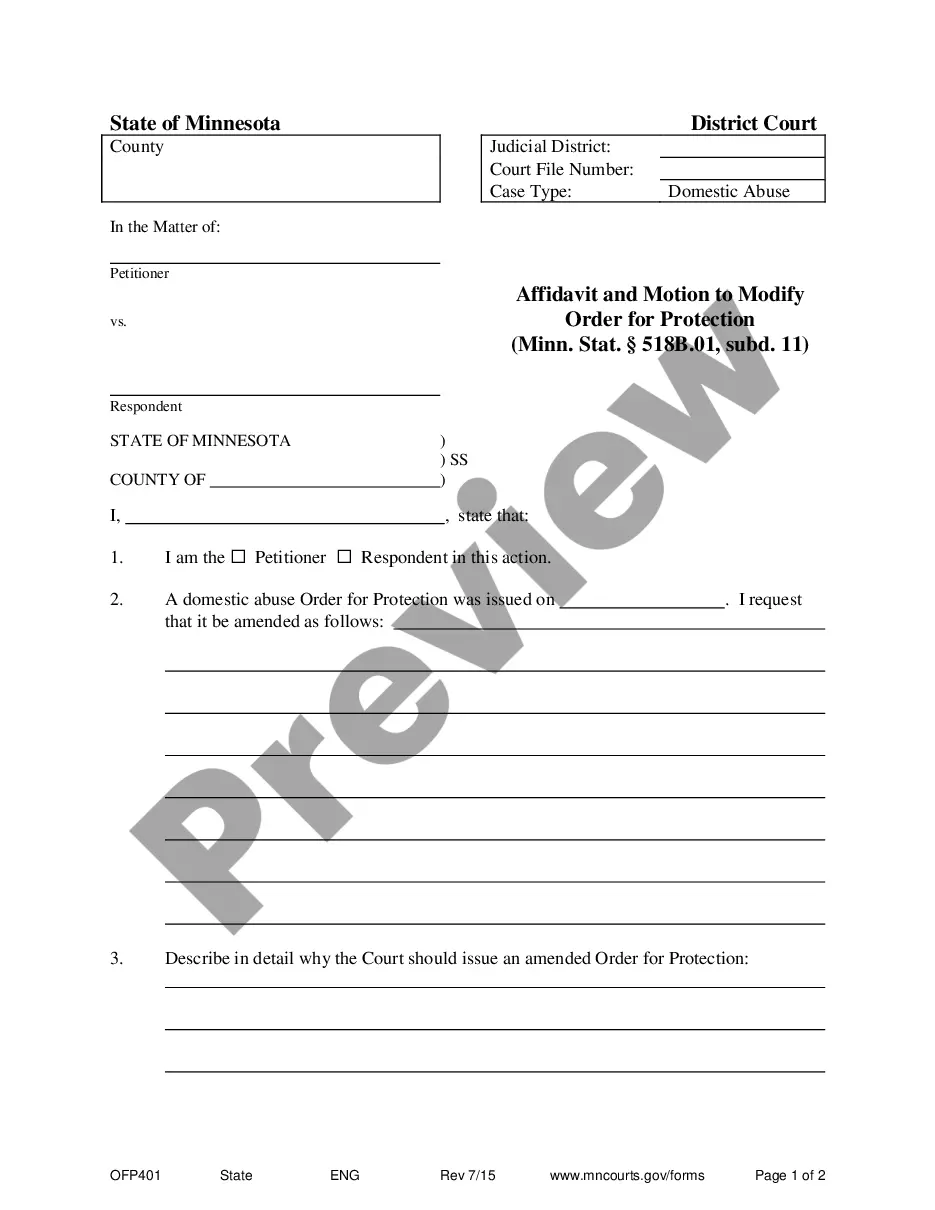
The Affidavit and Motion to Modify Order for Protection is an official legal document used in Minnesota to request changes to an existing order for protection in domestic abuse cases. This form is specifically designed to allow either the petitioner or respondent to articulate reasons for modifying the terms of the order, ensuring it continues to address current safety needs. Unlike a new order for protection, this form is focused on amending an existing order rather than establishing one for the first time.
Main sections of this form
- Identification of the parties involved (Petitioner and Respondent).
- Details regarding the original order for protection.
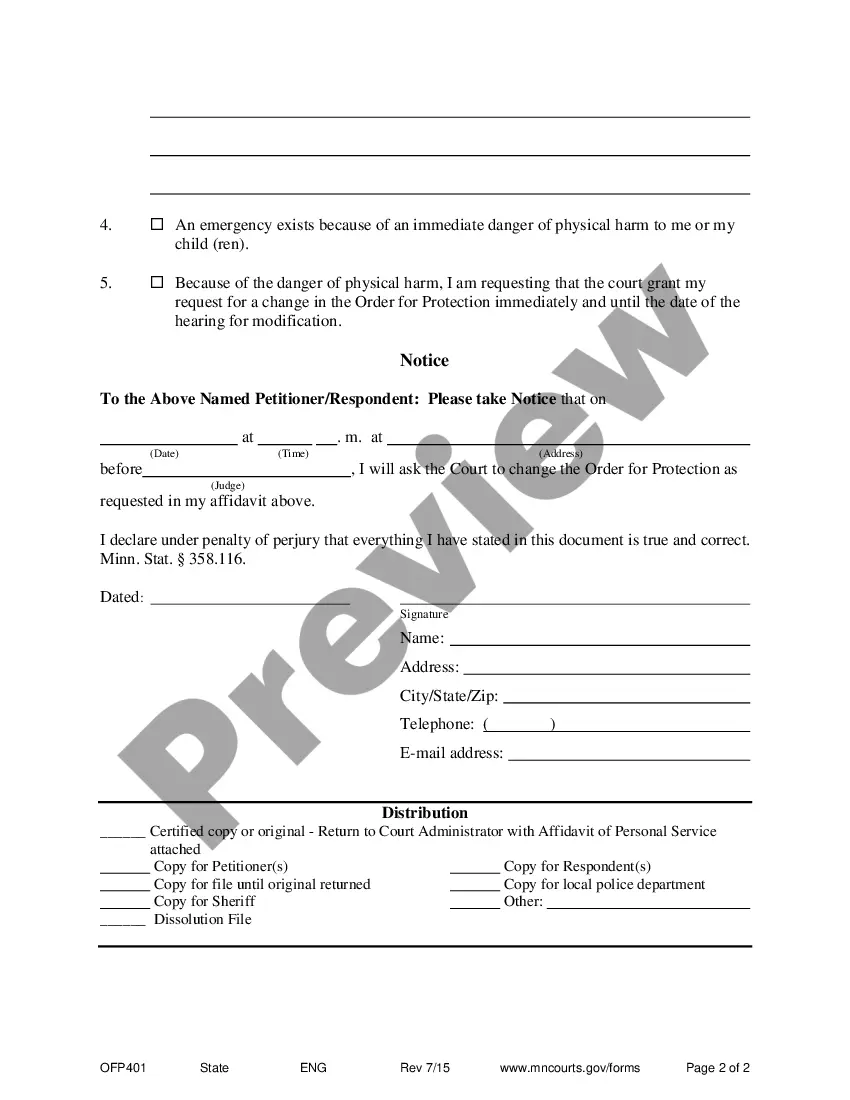
- A detailed explanation for the requested modifications.
- Indication of any emergency situations that may warrant immediate changes.
- Notice of the hearing date and time for the motion modification.
- Signature and contact information of the individual filing the motion.
When to use this document
This form should be used when there is a need to modify an existing domestic abuse order for protection. Common scenarios include changes in circumstances that might affect the safety of individuals involved, such as new threats, changes in living arrangements, or differing needs regarding contact with children. If you believe the current order does not adequately protect you or your children, this form can help address those concerns with the court.
Who needs this form
This form is suitable for individuals who are either:
- The original petitioner seeking changes to the order for protection.
- The respondent who wishes to contest or request modifications to the existing order.
How to prepare this document
- Identify yourself as the Petitioner or Respondent at the top of the form.
- Provide the date on which the original order for protection was issued.
- Clearly describe the specific changes you are requesting and the reasons for these changes.
- If there is an emergency situation, indicate that and provide relevant details.
- Complete the hearing notice section with the date and time of your request for modification.
- Sign the form with your name, address, and contact information.
Does this form need to be notarized?
This form does not typically require notarization unless specified by local law. However, it is always advisable to check with your local court for any specific requirements regarding notarization in your jurisdiction.
Get your form ready online
Our built-in tools help you complete, sign, share, and store your documents in one place.
Make edits, fill in missing information, and update formatting in US Legal Forms—just like you would in MS Word.
Download a copy, print it, send it by email, or mail it via USPS—whatever works best for your next step.
Sign and collect signatures with our SignNow integration. Send to multiple recipients, set reminders, and more. Go Premium to unlock E-Sign.
If this form requires notarization, complete it online through a secure video call—no need to meet a notary in person or wait for an appointment.
We protect your documents and personal data by following strict security and privacy standards.

Make edits, fill in missing information, and update formatting in US Legal Forms—just like you would in MS Word.

Download a copy, print it, send it by email, or mail it via USPS—whatever works best for your next step.

Sign and collect signatures with our SignNow integration. Send to multiple recipients, set reminders, and more. Go Premium to unlock E-Sign.

If this form requires notarization, complete it online through a secure video call—no need to meet a notary in person or wait for an appointment.

We protect your documents and personal data by following strict security and privacy standards.
Common mistakes
- Failing to specify clear reasons for requesting modifications.
- Not providing accurate personal contact information.
- Missing the filing deadline for the motion to modify.
- Neglecting to serve the correct party with a copy of the affidavit.
Why complete this form online
- Easy access to the latest version of the form, reflecting any recent legal updates.
- Convenient download option allows you to complete the form at your own pace.
- Reliable guidance from legal professionals ensures the form is correctly filled out.
Main things to remember
- The Affidavit and Motion to Modify Order for Protection is essential for altering existing protective orders in Minnesota.
- Clearly state your reasons for modification to help the court understand your situation.
- Stay informed about filing requirements to ensure you meet all legal obligations.
Looking for another form?
Form popularity
FAQ
Writing an affidavit for a restraining order involves clearly stating the facts that support your request. Begin by detailing your relationship with the individual in question and any incidents that prompted the need for protection. Be concise and factual in your writing, avoiding emotional language. Using a Minnesota Affidavit and Motion to Modify Order for Protection can guide you through this process and help ensure your affidavit meets legal requirements.
A petition motion to dismiss can potentially address other conditions of an order of protection, depending on the specifics of your case. When you file this motion, you can request that the court review and adjust not only the dismissal but also any related terms. To effectively present your case, utilizing a Minnesota Affidavit and Motion to Modify Order for Protection can be beneficial. This helps ensure the court fully understands your position and the changes you seek.
Yes, you can modify an order of protection by filing a motion with the court. This process allows you to request changes to the terms of the order, such as lifting restrictions or adjusting contact provisions. When submitting your request, it is crucial to include a Minnesota Affidavit and Motion to Modify Order for Protection to clearly outline your reasons for modification. This step ensures that the court has all necessary information to make an informed decision.
To get an order of protection dismissed, you must file a motion with the court that issued the order. In your motion, you should explain why you believe the order is no longer necessary. Providing evidence or testimony can strengthen your case. If you need assistance, consider using a Minnesota Affidavit and Motion to Modify Order for Protection to help you navigate this process.
An Order for Protection (OFP) is a restraining Order that is sought where abuse or threats of abuse are alleged. Often, such proceedings are improperly used as a vehicle when divorce is contemplated to have a spouse removed from the family home and/or to seek advantage in a subsequent custody proceeding.
A protection order may be varied, withdrawn or set aside if the complainant makes an application for variation or rescission, but only if the court is satisfied that the application is being made freely and voluntarily.The court may refuse to withdraw if it believes that you or your children require protection.
You can apply for an OFP for a child in your family or household. If you are worried about abuse of an adult in someone else's family or household, call Minnesota Adult Abuse Report Center at (844) 880-1574.
Use Minnesota Guide & File to create the forms you need to Ask for a MN Restraining Order - either an Order for Protection or Harassment Restraining Order. You can file the forms electronically (eFile) through Guide & File, or print your completed forms.
Consult with a family law attorney experienced in defending people against false restraining orders. You must go to court for the final restraining order hearing and present your evidence proving why the accusations against you are false. The evidence can be police reports, witnesses, text messages and or emails.
If you're the person who asked for the no contact order, you can ask the judge in your case to drop it. While there's no guarantee that the judge will do so, if you can show that you're not being forced or coerced into doing it, you'll have a better chance of getting it dropped.