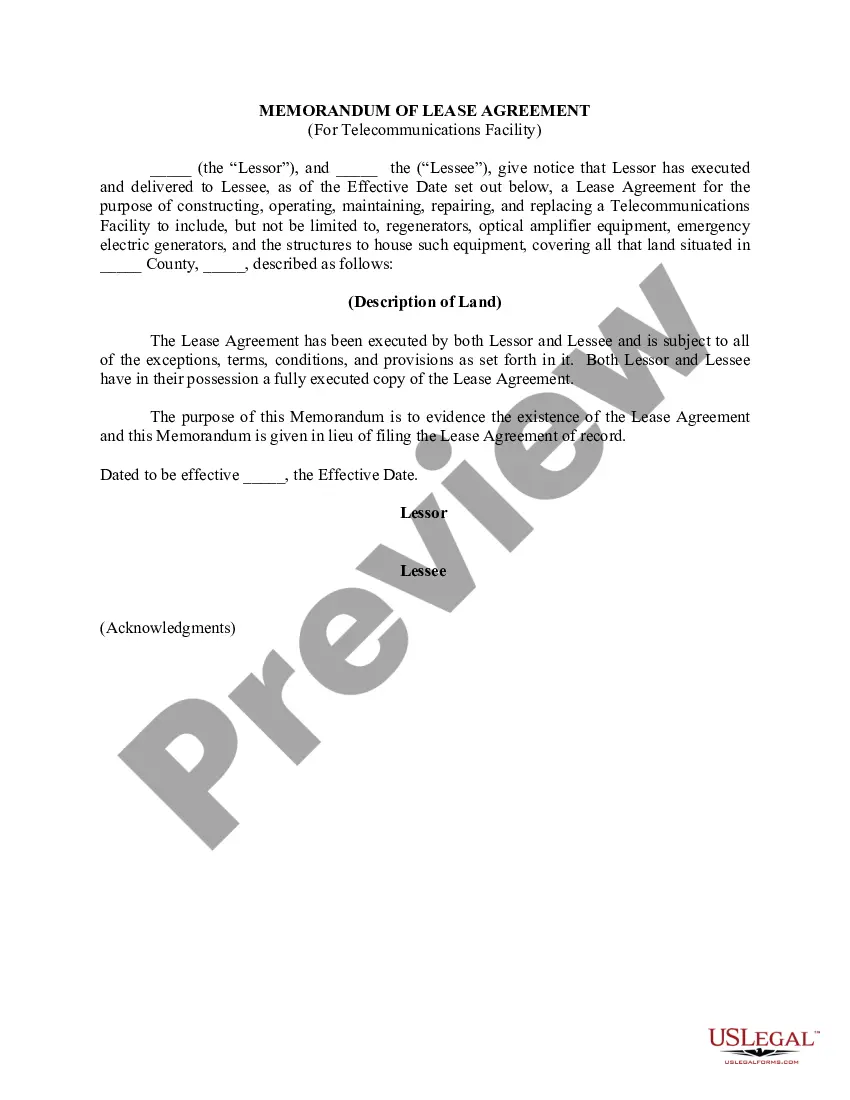
Memorandum of Lease Agreement (For Telecommunications Facility)
About this form
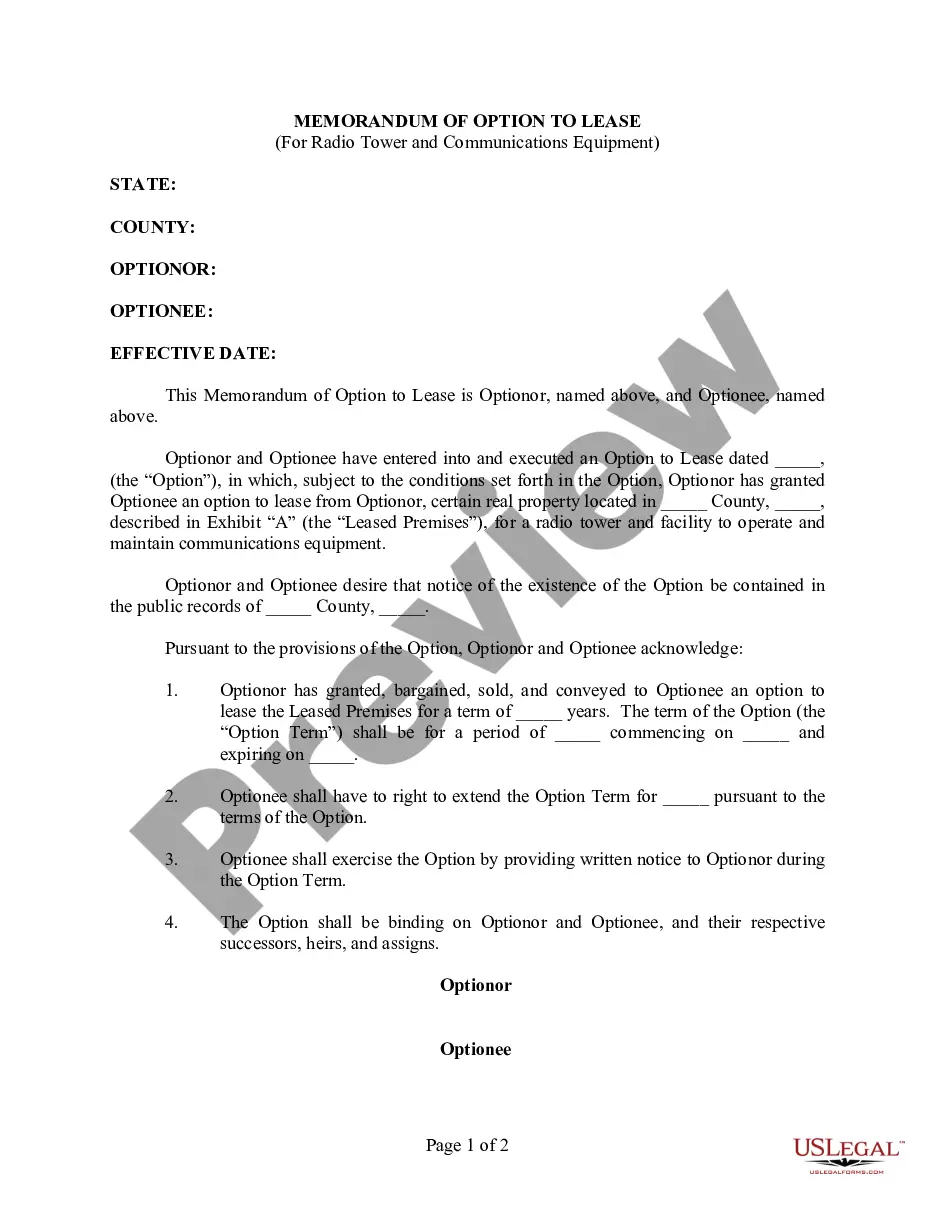
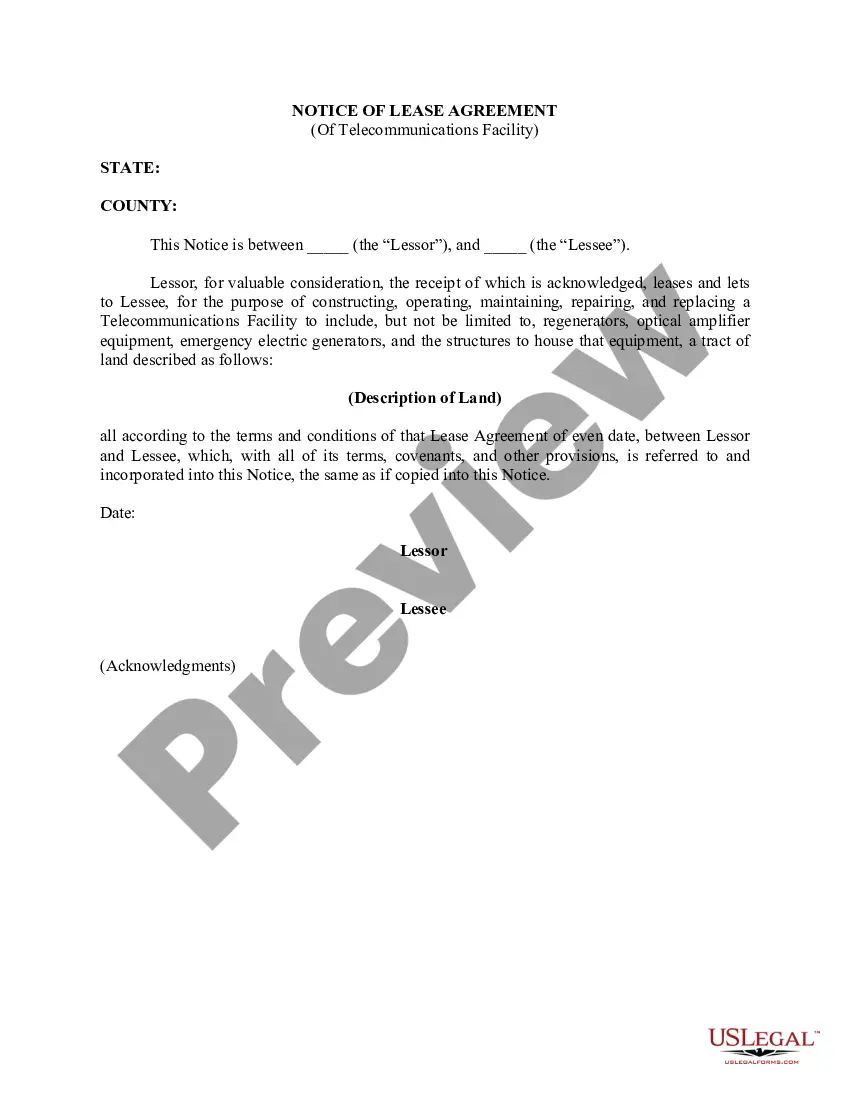
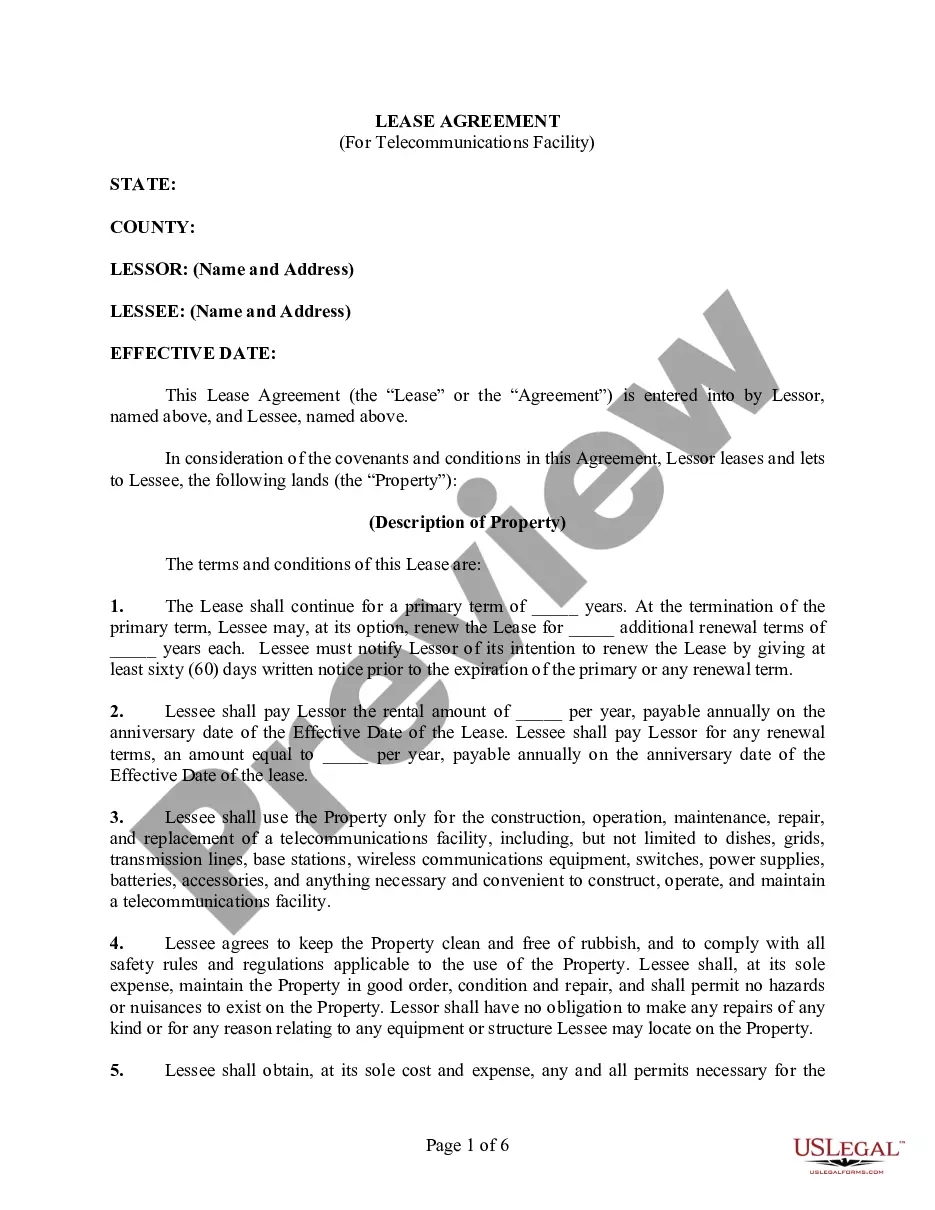
The Memorandum of Lease Agreement for Telecommunications Facility is a legal document that serves as a notice of a lease agreement between a Lessor and a Lessee for the use of land specifically for telecommunications purposes. This form is essential for summarizing the terms of the lease without needing to file the entire lease agreement publicly. It outlines the intention to construct and operate a telecommunications facility on designated land, ensuring that both parties have a record of their agreement while maintaining privacy regarding the full lease details.
Key components of this form
- Parties involved: Names of the Lessor and Lessee.
- Effective date: The date when the lease agreement becomes active.
- Description of the property: Detailed description of the land where the telecommunications facility will be located.
- Lease terms: References specific exceptions, terms, conditions, and provisions from the lease agreement.
- Signature lines: Spaces for both parties to sign, acknowledging the agreement.
Situations where this form applies
This form should be used when a Lessor enters into a lease agreement with a Lessee for the construction and operation of a telecommunications facility. It is applicable in situations where privacy is desired regarding the lease terms while still notifying interested parties of the agreement's existence. Common scenarios include agreements for infrastructure such as cell towers or data transmission buildings on specified land.
Who needs this form
- Property owners (Lessors) leasing land for telecommunications purposes.
- Telecommunications companies or service providers (Lessees) seeking to establish facilities on leased land.
- Attorneys or legal representatives facilitating lease agreements for telecommunications infrastructure.
Instructions for completing this form
- Identify the parties: Enter the names and details of the Lessor and Lessee.
- Specify the property: Provide a clear description of the land covering the telecommunications facility.
- Enter the effective date: Fill in the date the lease becomes operational.
- Review lease terms: Ensure all relevant terms, conditions, and exceptions are referenced accurately.
- Sign the document: Both the Lessor and Lessee must sign the memorandum to validate it.
Does this document require notarization?
This form does not typically require notarization unless specified by local law. This means the signed memorandum can remain effective as a private agreement without the need for notarization.
Get your form ready online
Our built-in tools help you complete, sign, share, and store your documents in one place.
Make edits, fill in missing information, and update formatting in US Legal Forms—just like you would in MS Word.
Download a copy, print it, send it by email, or mail it via USPS—whatever works best for your next step.
Sign and collect signatures with our SignNow integration. Send to multiple recipients, set reminders, and more. Go Premium to unlock E-Sign.
If this form requires notarization, complete it online through a secure video call—no need to meet a notary in person or wait for an appointment.
We protect your documents and personal data by following strict security and privacy standards.

Make edits, fill in missing information, and update formatting in US Legal Forms—just like you would in MS Word.

Download a copy, print it, send it by email, or mail it via USPS—whatever works best for your next step.

Sign and collect signatures with our SignNow integration. Send to multiple recipients, set reminders, and more. Go Premium to unlock E-Sign.

If this form requires notarization, complete it online through a secure video call—no need to meet a notary in person or wait for an appointment.

We protect your documents and personal data by following strict security and privacy standards.
Common mistakes to avoid
- Failing to accurately describe the property.
- Not including the effective date or misrecording it.
- Leaving out signatures from one or both parties.
- Confusing lease terms with unrelated agreements.
Why complete this form online
- Instant access to a professionally crafted legal document.
- Editable format allows for customization to fit specific needs.
- Convenient download with clear instructions for completion.
- Ensures compliance with current legal standards.
Looking for another form?
Form popularity
FAQ
Names of all tenants. Limits on occupancy. Term of the tenancy. Rent. Deposits and fees. Repairs and maintenance. Entry to rental property. Restrictions on tenant illegal activity.
Name the parties. A simple rental agreement form needs to name the parties signing the lease and where they live. Describe the premises. Define the term of the lease. Set how much rent is owed. Assign a security deposit amount. Finalize the lease.
As long as the contract spells out specific details and both parties have signed that they agree to the contract's terms, a handwritten contract is legally binding and enforceable in court.
The Person Liable for the Lease. Your Business Structure. How Long You Have Been in Business. The Nature of Your Business. Contact Information. Your Proposed Terms (or, Counter Offer) The Length of the Lease. Condition of the Property.
The Lease Must be in Writing It does not matter if the lease is handwritten or typed. If the lease is for more than one year, it must be in written form and contain the following terms.
A simple (1 page) lease agreement is a legally binding form used for renting out residential real estate.Unlike a standard residential lease, the form contains the bare-minimum for being an effective lease, foregoing many of the clauses found in standard leases.
Names of all tenants. Limits on occupancy. Term of the tenancy. Rent. Deposits and fees. Repairs and maintenance. Entry to rental property. Restrictions on tenant illegal activity.
The Introduction. The beginning of the lease agreement should contain the name of the landlord and tenant, as well as a statement of the agreement into which they are entering. Rent. Deposit. Taxes. Property Insurance. Utilities and Amenities. Remodeling and Improvements. Repairs and Maintenance.