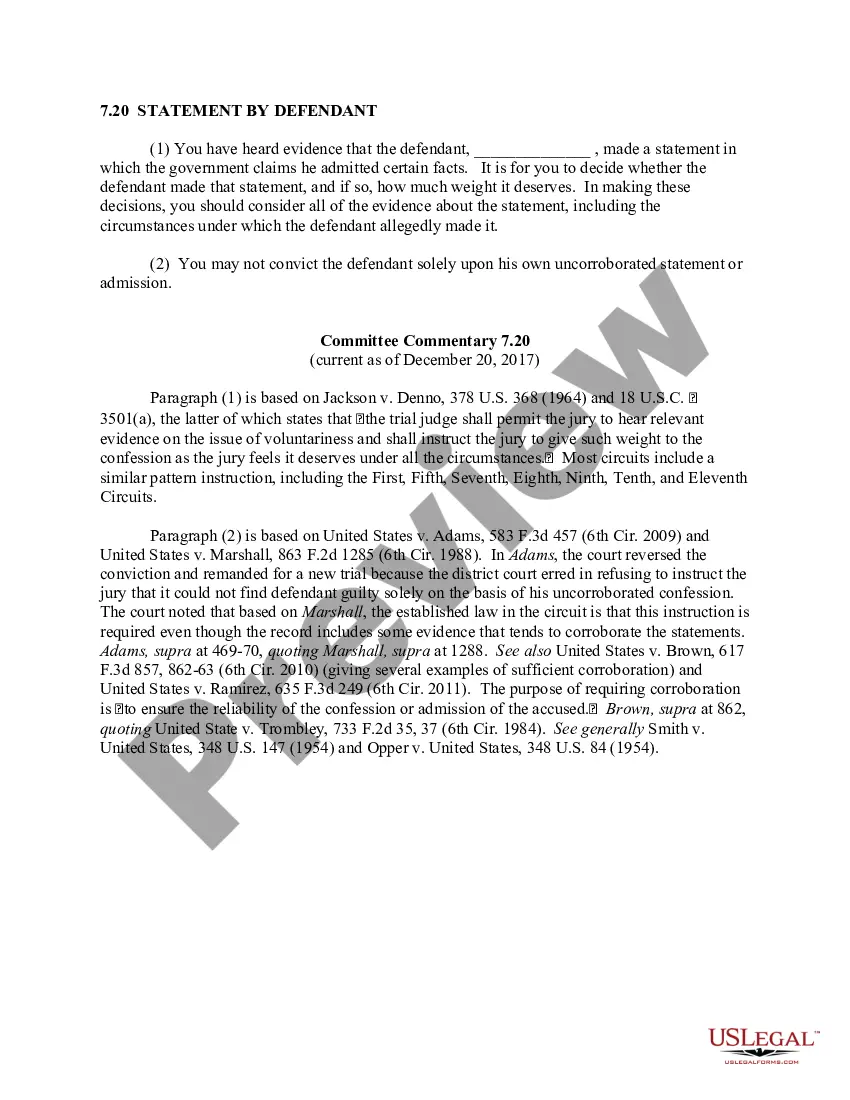
Minnesota Order to Transfer Venue - Agreed Stipulation
What this document covers
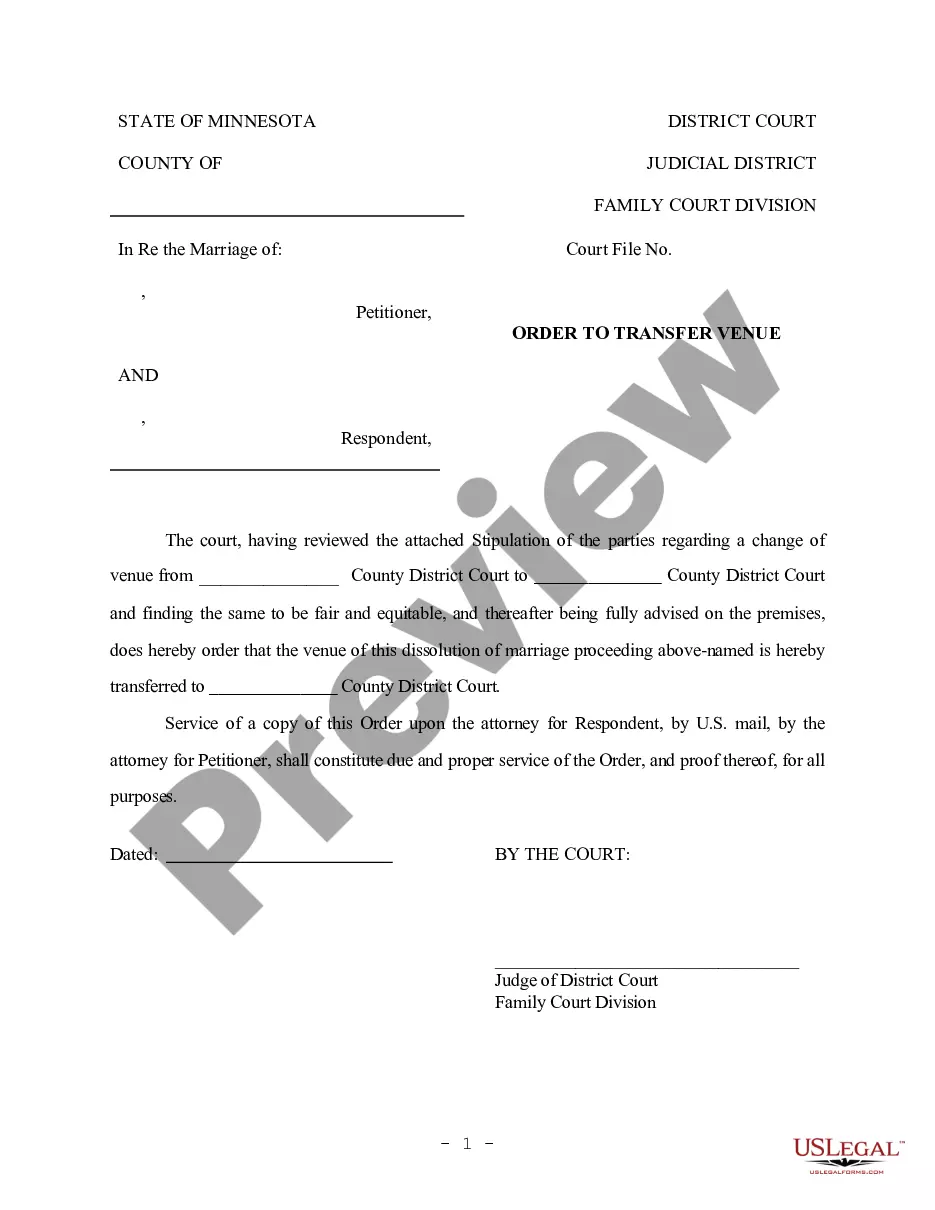
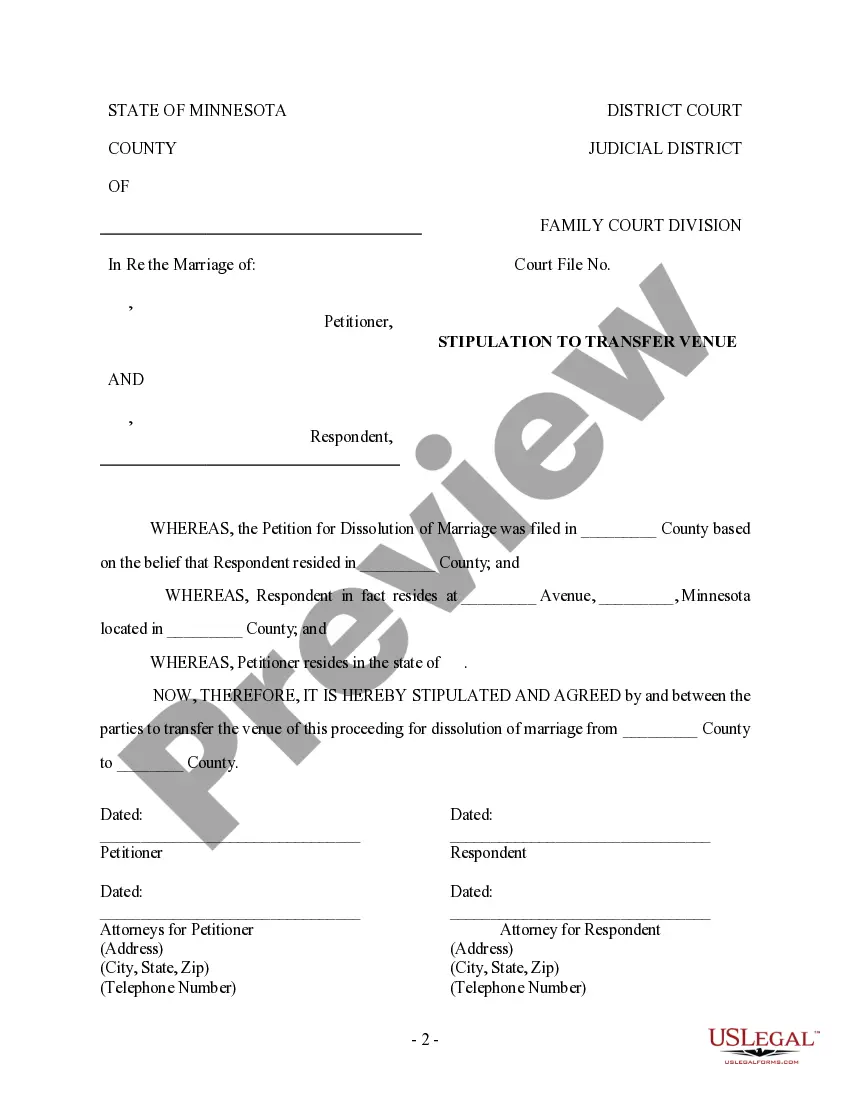
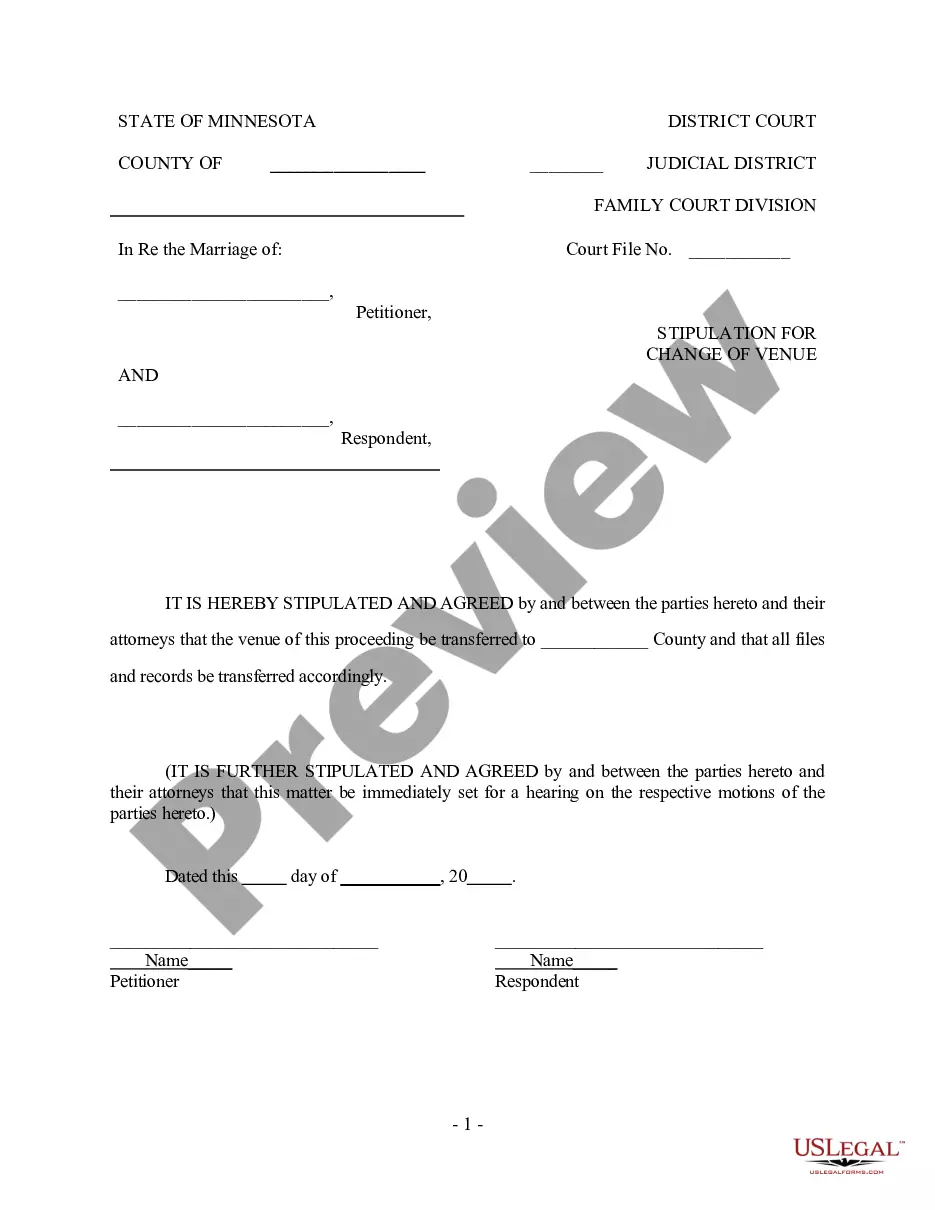
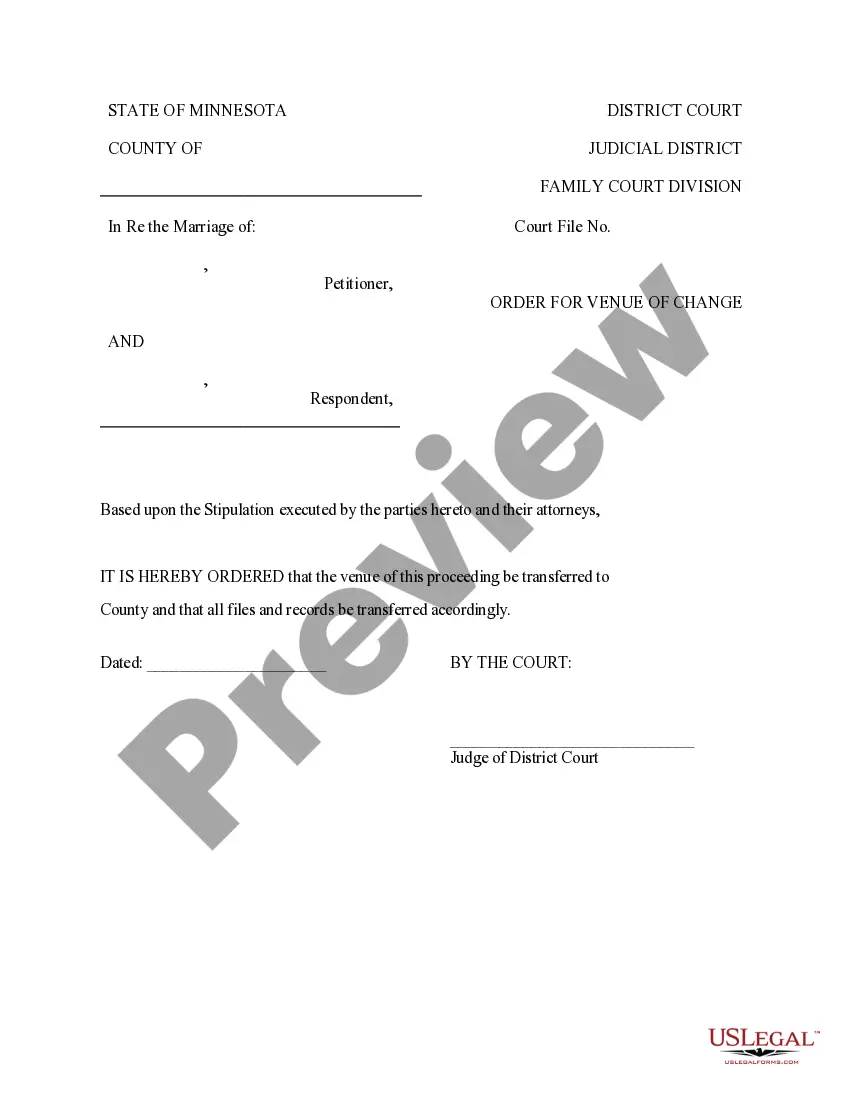
The Order to Transfer Venue - Agreed Stipulation is a legal document that formalizes the agreement between parties to move a court case from one jurisdiction to another. This form is specifically used in family court cases, such as divorce proceedings, and helps prevent confusion regarding where the case should be heard. By completing this form, both parties affirm their mutual desire for the venue change, contributing to a smoother legal process.
Form components explained
- Title of the court and case information.
- Petitioner and Respondent details including names and residence information.
- Stipulation clause indicating the agreement to transfer the case venue.
- Signature lines for both Petitioner and Respondent.
- Signature lines for the attorneys representing each party.

When to use this document
This form should be used when both parties in a family court case, such as a divorce, agree to change the location where the case is being heard. Common reasons for using this form include when one spouse moves to a different county or state, making it more practical to handle the case in the new location.
Who this form is for
This form is intended for:
- Individuals involved in a divorce or dissolution of marriage proceeding.
- Both Petitioner and Respondent must agree to the transfer of venue.
- Attorneys representing either party in the case.
Steps to complete this form
- Identify the Petitioner and Respondent, including their full names and addresses.
- Fill in the current and proposed counties where the case will be transferred.
- Ensure that both parties agree to the transfer by including their signatures and dates.
- Have attorneys for both parties sign and provide their contact information.
- File the completed form with the court to formally initiate the venue transfer.
Notarization guidance
This form does not typically require notarization to be legally valid. However, some jurisdictions or document types may still require it. US Legal Forms provides secure online notarization powered by Notarize, available 24/7 for added convenience.
Get your form ready online
Our built-in tools help you complete, sign, share, and store your documents in one place.
Make edits, fill in missing information, and update formatting in US Legal Forms—just like you would in MS Word.
Download a copy, print it, send it by email, or mail it via USPS—whatever works best for your next step.
Sign and collect signatures with our SignNow integration. Send to multiple recipients, set reminders, and more. Go Premium to unlock E-Sign.
If this form requires notarization, complete it online through a secure video call—no need to meet a notary in person or wait for an appointment.
We protect your documents and personal data by following strict security and privacy standards.

Make edits, fill in missing information, and update formatting in US Legal Forms—just like you would in MS Word.

Download a copy, print it, send it by email, or mail it via USPS—whatever works best for your next step.

Sign and collect signatures with our SignNow integration. Send to multiple recipients, set reminders, and more. Go Premium to unlock E-Sign.

If this form requires notarization, complete it online through a secure video call—no need to meet a notary in person or wait for an appointment.

We protect your documents and personal data by following strict security and privacy standards.
Avoid these common issues
- Failing to have both parties sign the stipulation.
- Incorrectly filling out the county information.
- Omitting attorney signatures, if applicable.
- Not providing accurate contact information for both parties.
Benefits of completing this form online
- Convenience of filling out the form at your own pace.
- Editability allows for easy corrections and updates.
- Access to templates drafted by licensed attorneys ensures legal compliance.
Looking for another form?

Form popularity
FAQ
Rule of Practice 521 in Minnesota governs the procedures for transferring venue in civil cases. This rule outlines specific conditions under which a party may file for a transfer, emphasizing fairness and efficiency. Understanding this rule is crucial when dealing with a Minnesota Order to Transfer Venue - Agreed Stipulation, as it ensures compliance with state regulations. Familiarizing yourself with this rule can empower you to navigate the legal landscape more effectively.
To request a change of venue in family court, you must file a motion that explains your reasons for the transfer. It's essential to provide supporting evidence and demonstrate how the change serves the best interest of the involved parties. A Minnesota Order to Transfer Venue - Agreed Stipulation can be an effective tool, as it reflects mutual consent and can strengthen your motion. This collaborative approach often leads to a more favorable outcome.
Filing a stipulation with the court involves drafting a formal document outlining the agreed terms between the parties. This document must be signed by all involved and then submitted to the appropriate court for approval. Utilizing a Minnesota Order to Transfer Venue - Agreed Stipulation simplifies this process, allowing you to clearly outline your agreement for the court. Ensuring all required forms and information are complete can help expedite your filing.
In Minnesota, a motion to transfer venue may arise from several grounds, such as the convenience of parties and witnesses, or the interest of justice. The main aim is to ensure that the case is heard in a location that better serves those involved. By filing a Minnesota Order to Transfer Venue - Agreed Stipulation, parties can collaboratively agree on the transfer, making the legal process smoother. This approach often reduces delays and enhances the overall efficiency of the proceedings.
A written Stipulation and Order includes the parties' agreement, both of their notarized signatures, and the judge's signature. Once signed by the judge, the agreement becomes a legally binding order.A Stipulation & Order tells the judge your new agreement and makes it part of the court record.
Since a stipulated judgment typically is not appealable, any post-judgment orders arising from such a judgment are also not appealable.
Orders are generally temporary pending the final resolution of the complaint issues by judgment after the trial or by a court-ratified settlement.A 'stipulation' is an agreement between parties that a certain fact may be considered true or accepted, or that a certain procedure may be followed in court.
Stipulated agreements can be modified after a party shows that any change of circumstance has occurred. With litigated judgments, a party will only be able to modify the child custody order if they can show a significantly changed circumstance warranting a modification.
Stipulate \\STIP-yuh-layt\\ verb. 1 : to make an agreement or covenant to do or forbear something : contract. 2 : to demand an express term in an agreement. 3 : to specify as a condition or requirement (as of an agreement or offer)
First of all, it's highly advisable that you refrain from signing any such document without first having it reviewed by your own attorney. Secondly, based on the limited information you have provided in your post, the stipulation will actually get filed with the court once it is signed by all necessary parties.