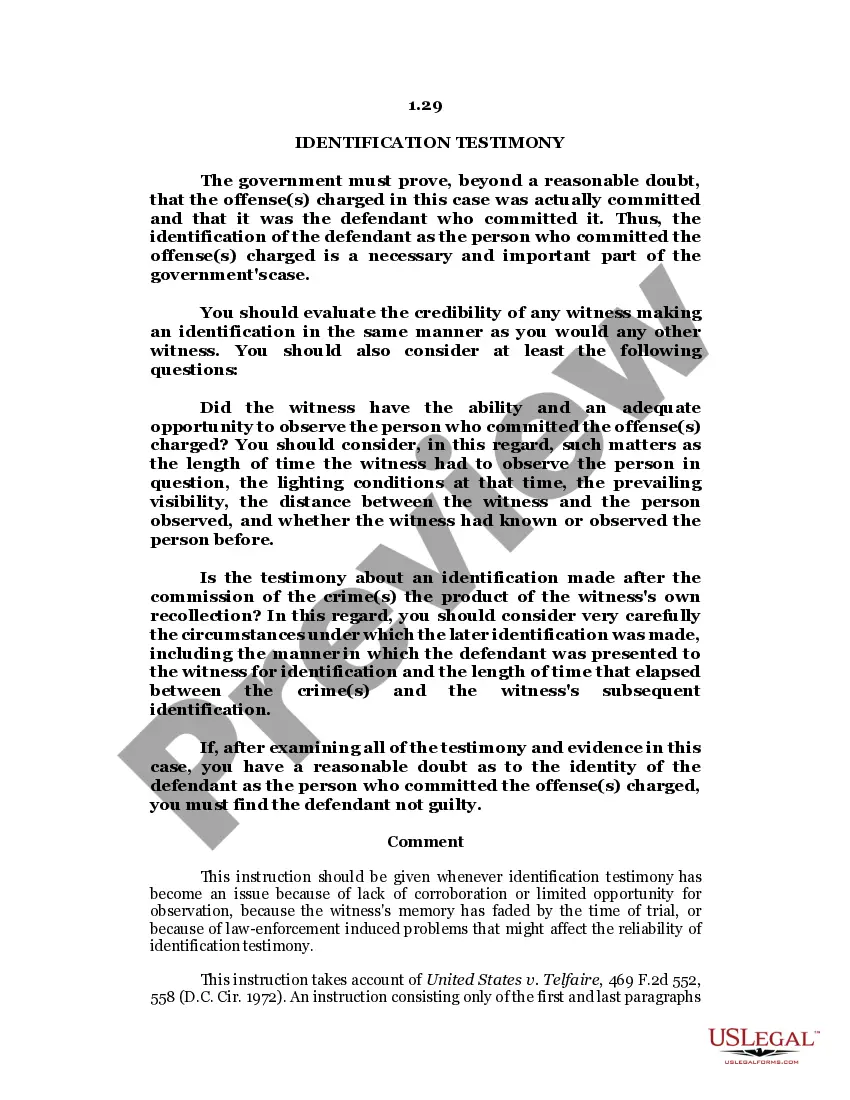
Minnesota Order to Amend Judgment and Decree - based on written stipulation
What this document covers
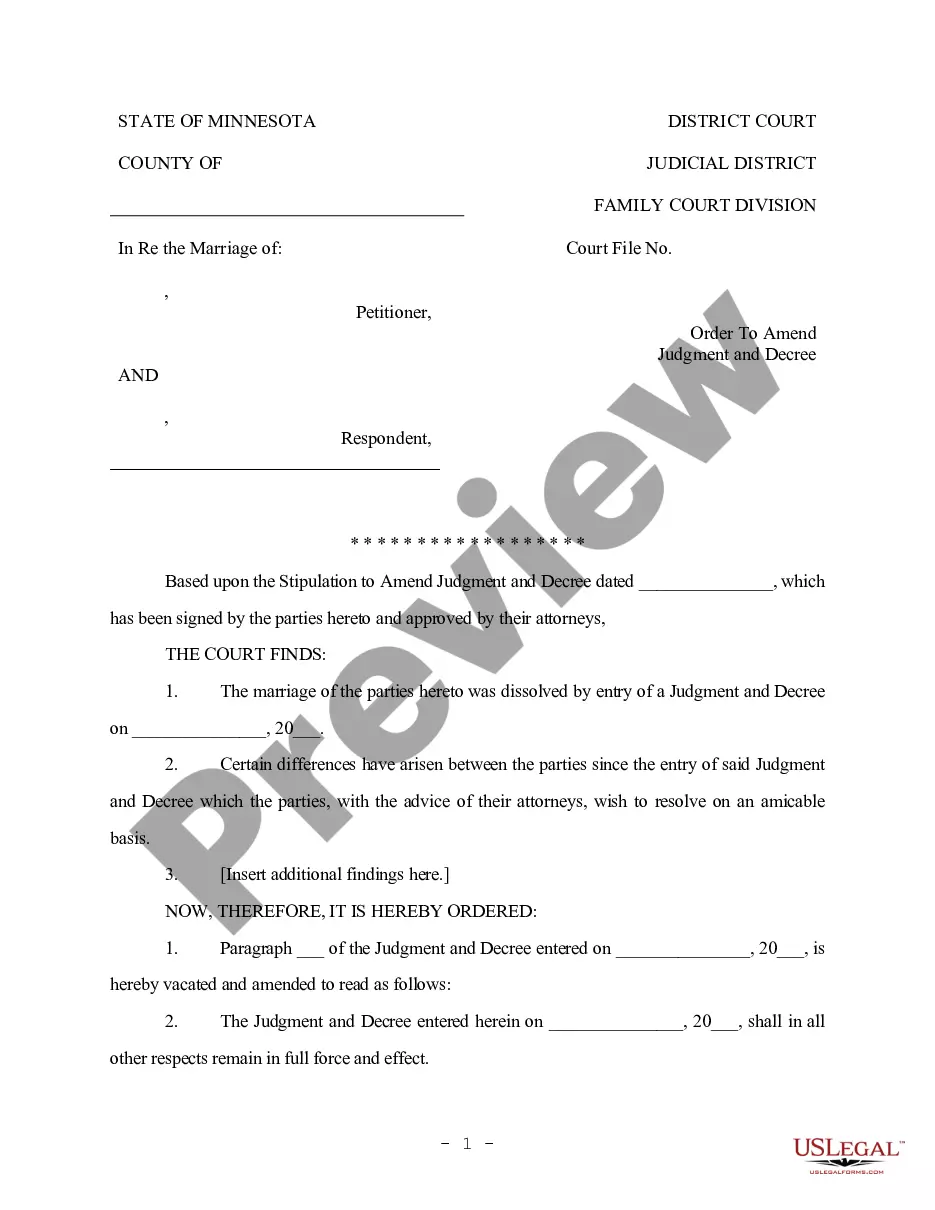
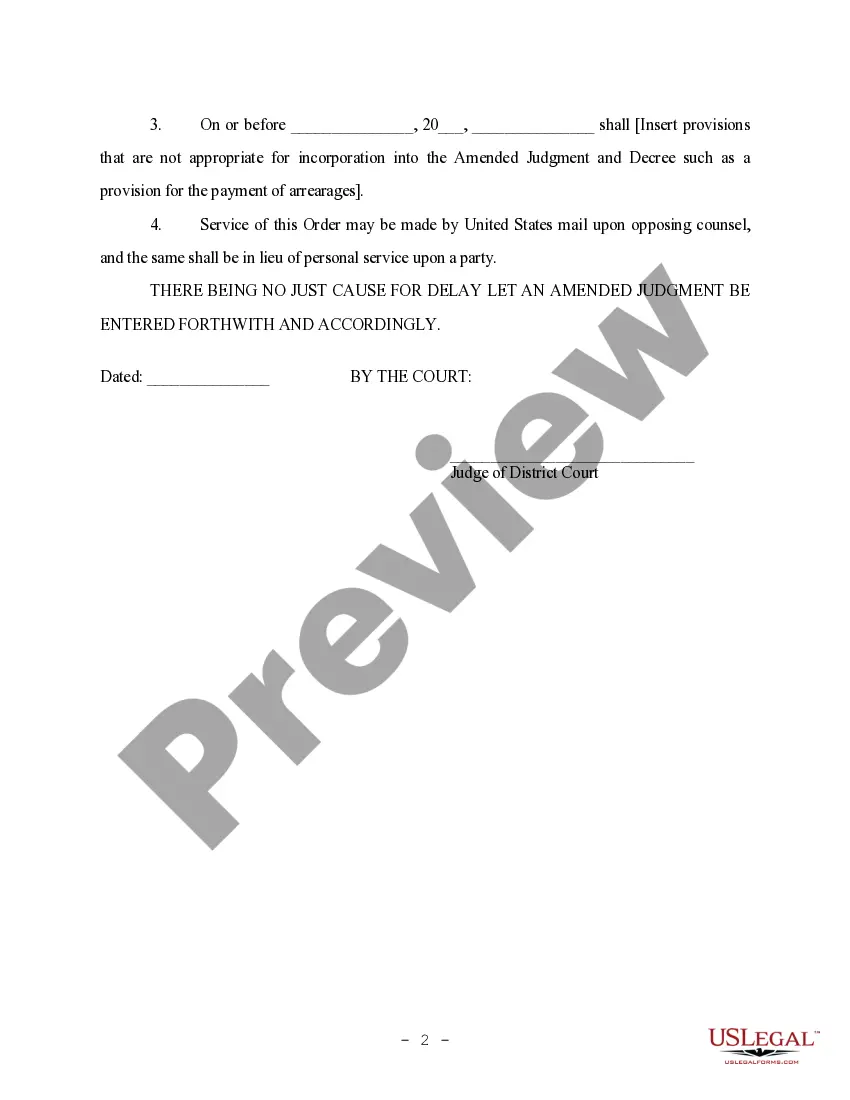
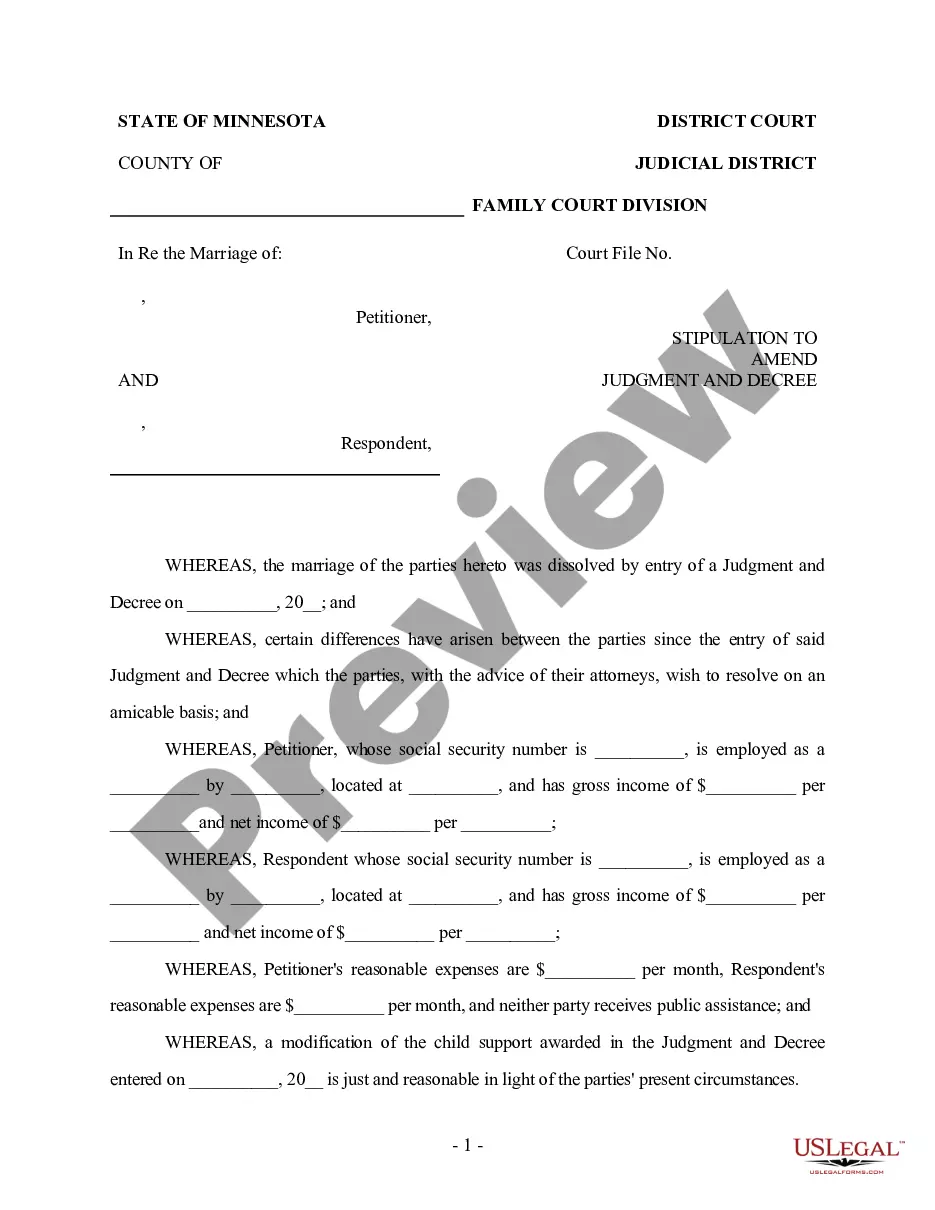
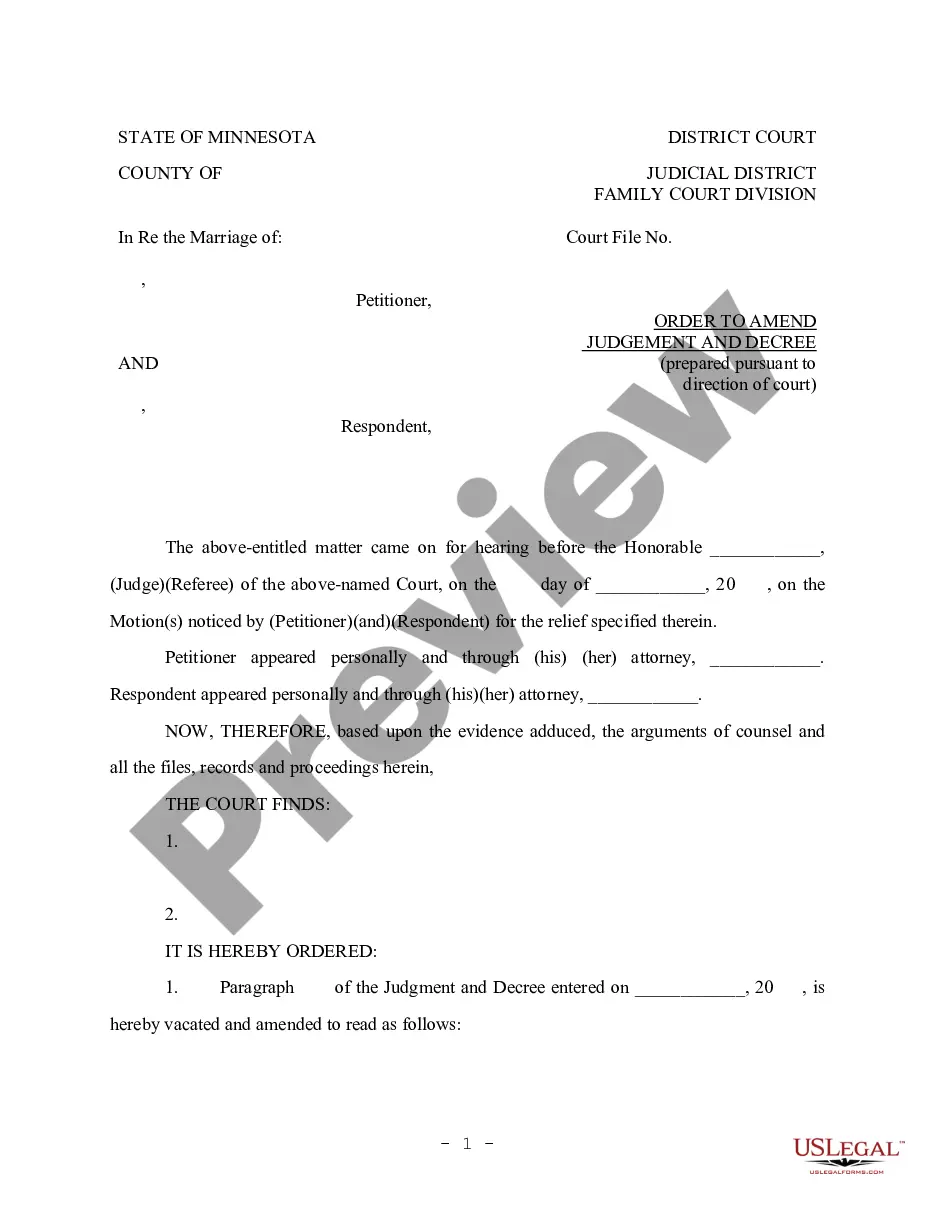
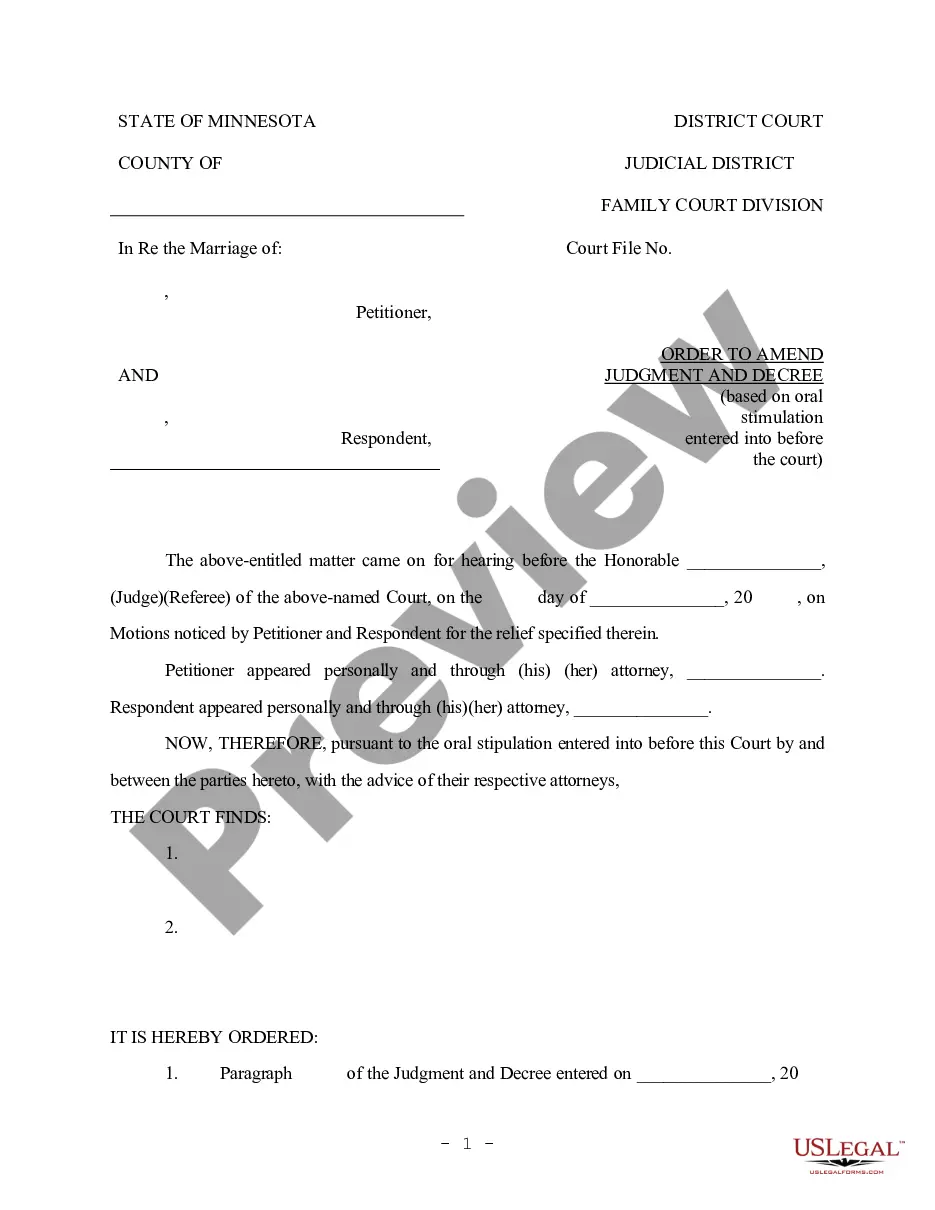
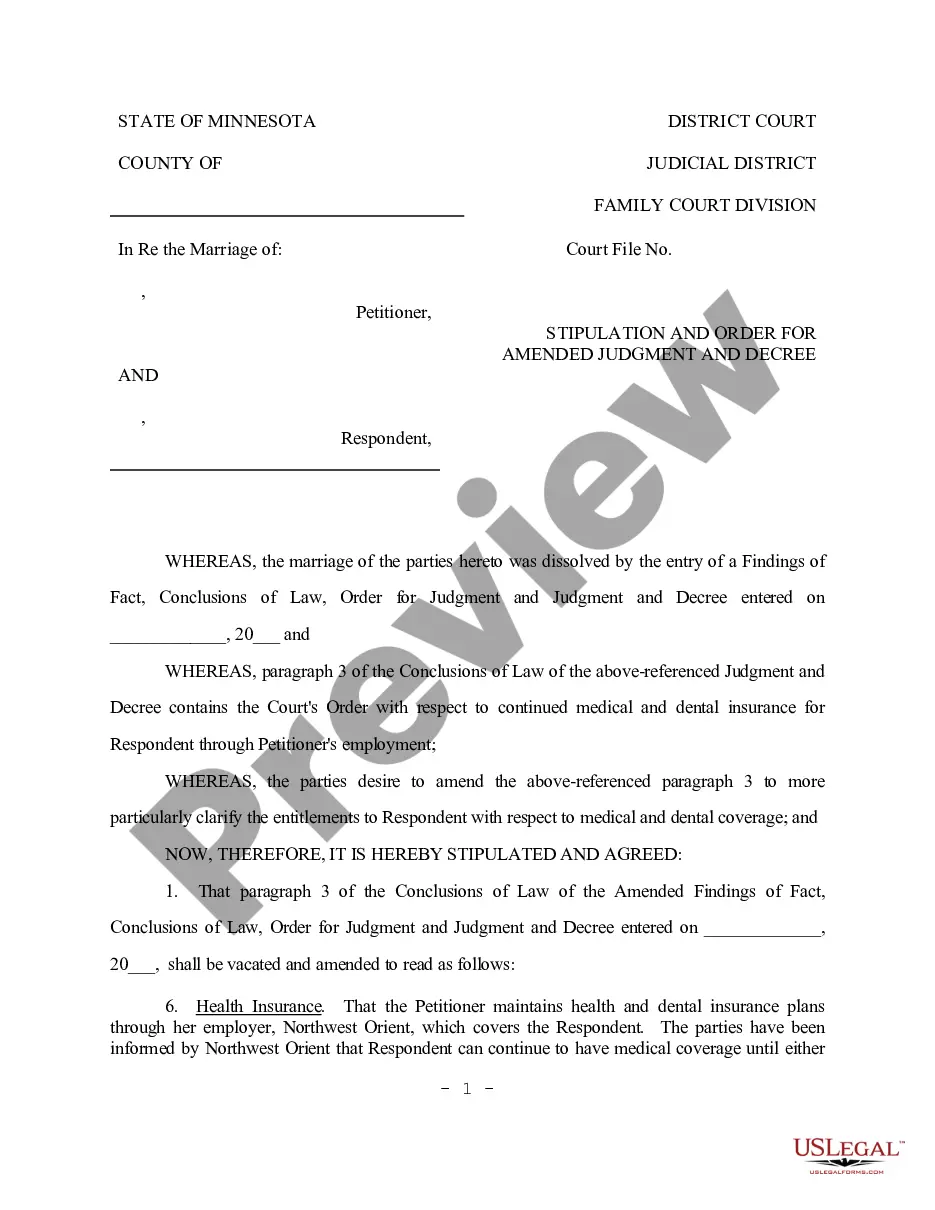
This form, known as the Order to Amend Judgment and Decree based on written stipulation, serves as a legal document to modify a previously entered judgment and decree related to the dissolution of a marriage. It allows parties to resolve differences amicably after a judgment has been issued. This form is distinct as it involves a mutual agreement between parties to amend the original court order without the need for a hearing.
Key components of this form
- The date when the original Judgment and Decree was entered.
- A section for inserting additional findings regarding the parties' current situations.
- Provisions that establish what parts of the original Judgment and Decree are being amended.
- Instructions for serving the amended order to opposing counsel.
Common use cases
This form should be used when parties who have previously divorced seek to modify specific terms of their divorce decree, based on mutual agreement. Common scenarios include changes in child custody arrangements, modifications to spousal support, or updates to property distribution that both parties agree upon after the judgment has been entered.
Who should use this form
- Individuals who have finalized a divorce and wish to amend the terms of the original Judgment and Decree.
- Parties seeking to resolve disputes amicably and collaboratively with their former spouse.
- Those represented by attorneys who can provide advice on the amendments sought.
Instructions for completing this form
- Identify the parties involved and include the date of the original Judgment and Decree.
- Document any changes agreed upon by both parties, specifying what aspects of the original order will be amended.
- Include any additional findings or stipulations that need to be recognized by the court.
- Ensure all necessary dates and required signatures are included for validity.
- File the amended order with the court and serve it to opposing counsel as needed.
Notarization guidance
In most cases, this form does not require notarization. However, some jurisdictions or signing circumstances might. US Legal Forms offers online notarization powered by Notarize, accessible 24/7 for a quick, remote process.
Get your form ready online
Our built-in tools help you complete, sign, share, and store your documents in one place.
Make edits, fill in missing information, and update formatting in US Legal Forms—just like you would in MS Word.
Download a copy, print it, send it by email, or mail it via USPS—whatever works best for your next step.
Sign and collect signatures with our SignNow integration. Send to multiple recipients, set reminders, and more. Go Premium to unlock E-Sign.
If this form requires notarization, complete it online through a secure video call—no need to meet a notary in person or wait for an appointment.
We protect your documents and personal data by following strict security and privacy standards.

Make edits, fill in missing information, and update formatting in US Legal Forms—just like you would in MS Word.

Download a copy, print it, send it by email, or mail it via USPS—whatever works best for your next step.

Sign and collect signatures with our SignNow integration. Send to multiple recipients, set reminders, and more. Go Premium to unlock E-Sign.

If this form requires notarization, complete it online through a secure video call—no need to meet a notary in person or wait for an appointment.

We protect your documents and personal data by following strict security and privacy standards.
Typical mistakes to avoid
- Failing to include the correct date of the original Judgment and Decree.
- Not specifying which paragraphs of the original decree are being amended.
- Missing necessary signatures or dates that could invalidate the order.
- Assuming that personal service is required when mail service is acceptable.
Why complete this form online
- Convenience of downloading and completing the form at your own pace.
- Access to templates drafted by licensed attorneys, ensuring legal accuracy.
- Ability to edit the form as required before finalizing the document.
- Reduce the need for in-person office visits for legal assistance.
Legal use & context
- The form is enforceable as a court order once signed by a judge.
- Changing the terms of a decree can resolve potential disputes amicably between parties.
- Proper completion and filing are essential to ensure legal recognition.
Key takeaways
- This form allows parties to amend a divorce decree through mutual agreement.
- Completing the form correctly is crucial for its legal validity.
- It's a useful tool for parties looking for amicable resolutions post-divorce.
Looking for another form?
Form popularity
FAQ
A stipulation of settlement is not the same as a divorce decree, although they are related. A divorce decree is the final order from the court that officially ends a marriage and outlines the terms of the divorce, while a stipulation of settlement is an agreement between parties regarding specific terms, which may be incorporated into the divorce decree. When seeking a Minnesota Order to Amend Judgment and Decree - based on written stipulation, understanding these distinctions is crucial. US Legal Forms provides guidance and templates to assist you in creating and filing the necessary documents.
A motion to amend judgment is a formal request to the court to change an existing judgment or decree. This motion can arise from various reasons, such as new evidence or a change in circumstances. In Minnesota, this process often involves filing for a Minnesota Order to Amend Judgment and Decree - based on written stipulation. Using the right forms and procedures can simplify this process, and US Legal Forms offers the necessary resources to help you navigate it effectively.
Modifying a divorce decree can vary in difficulty depending on the specific circumstances and the level of agreement between parties. If both spouses are in agreement, the process is generally straightforward. However, if disputes arise, it may require more time and legal assistance. The Minnesota Order to Amend Judgment and Decree - based on written stipulation provides a clear path to make this process easier and more manageable.
The amendment of judgment and decree refers to the legal process of changing a court's final order regarding a divorce or other family law matters. This amendment can address issues like child support, alimony, or custody arrangements. By following the Minnesota Order to Amend Judgment and Decree - based on written stipulation, you can effectively navigate this process and ensure that all necessary changes are properly documented.
An amended petition for divorce is a revised version of the original divorce petition that includes changes or additional information. This amendment is necessary if new circumstances arise or if corrections are needed in the original filing. Utilizing the Minnesota Order to Amend Judgment and Decree - based on written stipulation can help ensure your amended petition is properly formatted and meets all legal requirements.
To amend your divorce decree in Minnesota, you must file a motion to modify the decree with the appropriate court. This motion should include a written stipulation if both parties agree to the changes. The Minnesota Order to Amend Judgment and Decree - based on written stipulation is a helpful resource that provides the necessary forms and guidance to navigate this process smoothly.
To amend a judgment, you typically need to file a motion with the court that originally issued the judgment. This motion must outline the specific changes you are requesting and provide justification for those changes. The Minnesota Order to Amend Judgment and Decree - based on written stipulation can guide you through this process, ensuring that your amendments are made correctly and efficiently.
A petition for modification is a legal request to change an existing court order, often related to divorce or child custody. This petition details the reasons for the changes and must adhere to specific legal standards. In Minnesota, you can utilize the Minnesota Order to Amend Judgment and Decree - based on written stipulation to streamline this process and ensure all modifications are properly filed.
In the context of divorce, a stipulation refers to an agreement between both parties regarding specific terms of the divorce decree. This legally binding document outlines the modifications both spouses have consented to, such as changes to child custody or support obligations. It is integral to the Minnesota Order to Amend Judgment and Decree - based on written stipulation, as it provides clarity and stability for everyone involved.
A petition stipulation or motion to modify the decree of divorce is a formal request to change the terms of your divorce agreement. This process allows both parties to agree on modifications, which can then be submitted to the court for approval. Utilizing the Minnesota Order to Amend Judgment and Decree - based on written stipulation simplifies this process, ensuring that all changes are documented and legally recognized.