Minnesota Order to Amend Judgment and Decree - based on oral stipulation
Overview of this form
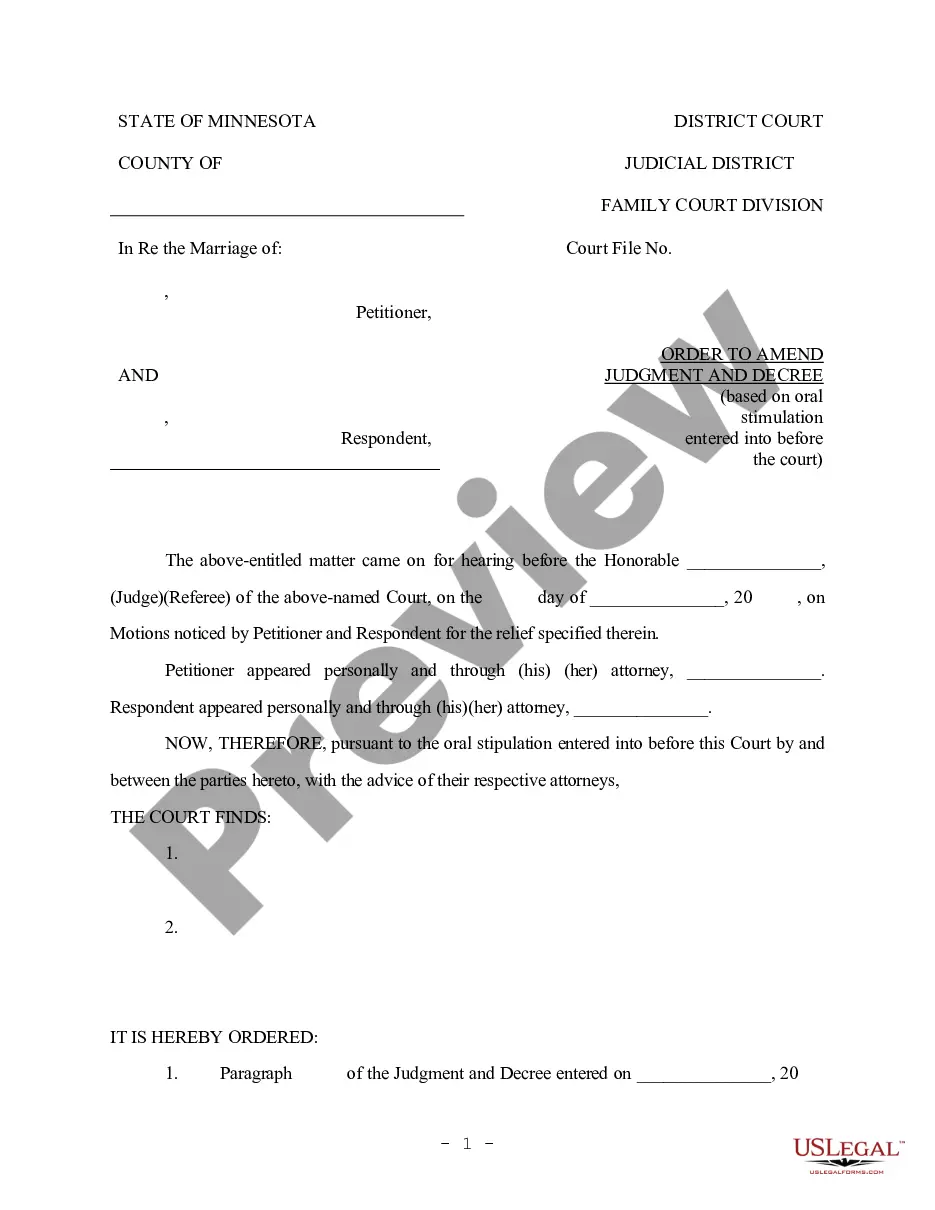
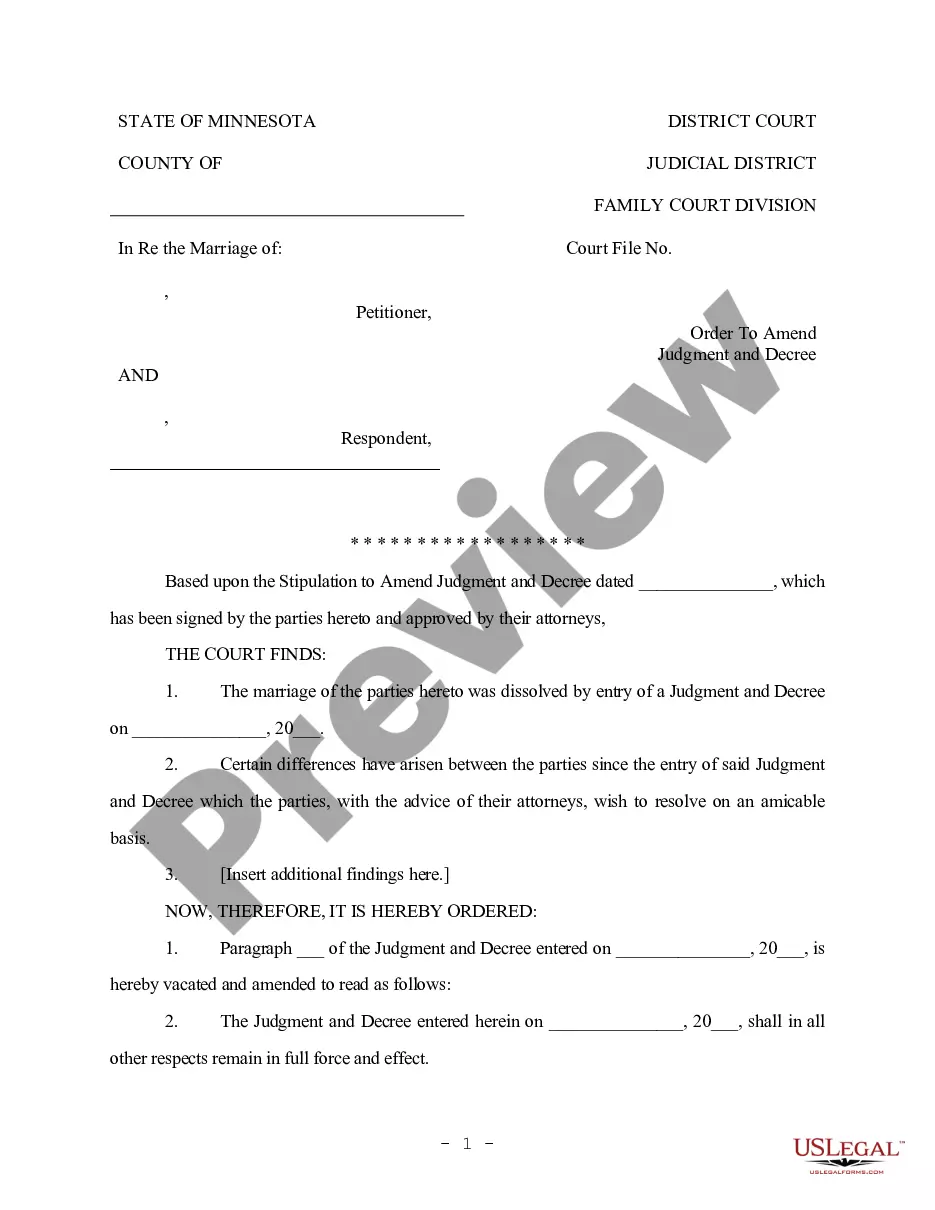
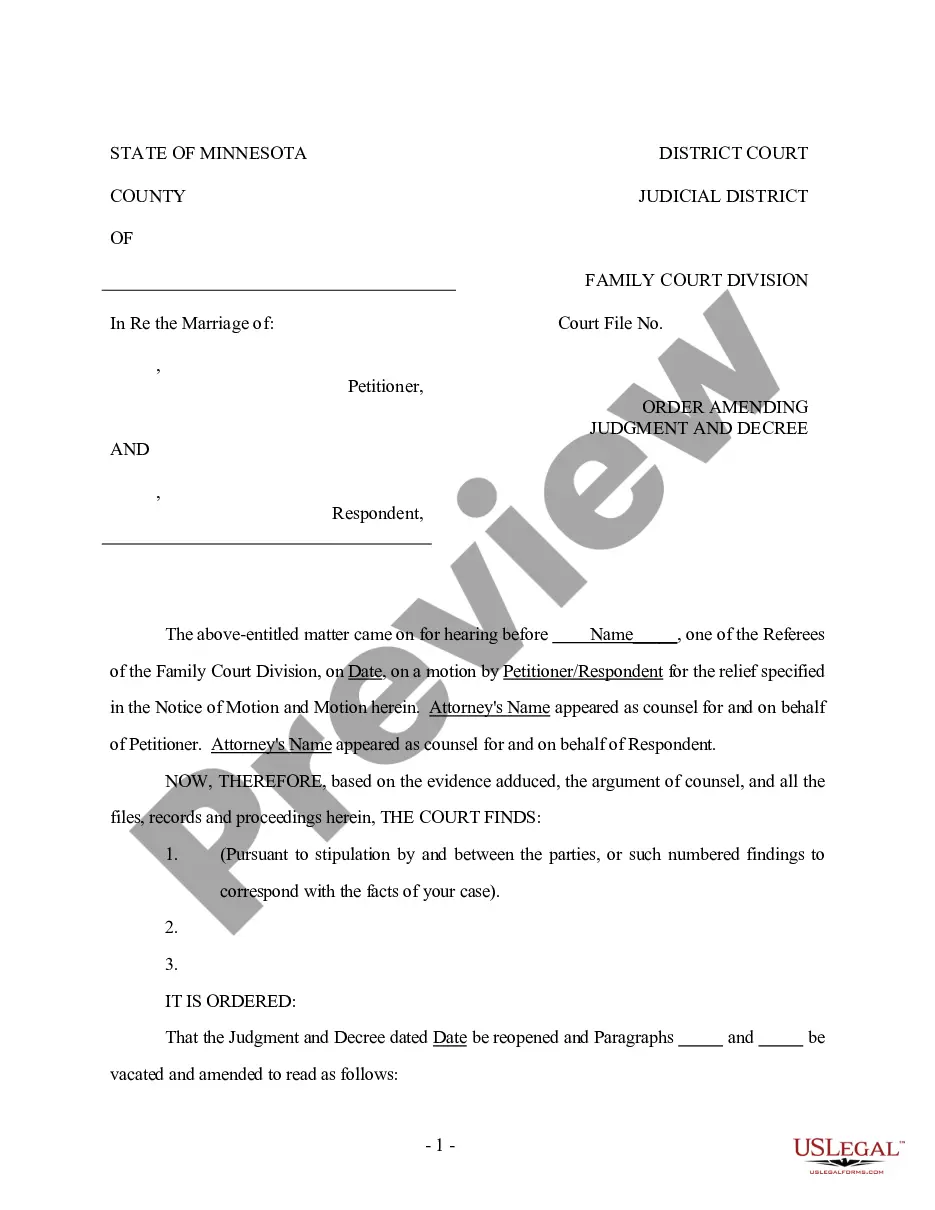
The Order to Amend Judgment and Decree is a legal document that allows parties involved in a court case to formally amend an existing judgment based on an oral agreement. This form differs from other judgment modification forms by specifically reflecting changes that have been verbally stipulated in court. It establishes the amended terms and allows for service to be made via mail rather than requiring personal delivery.
Key components of this form
- Identification of parties involved in the case.
- Verification of the court's findings based on the oral stipulation.
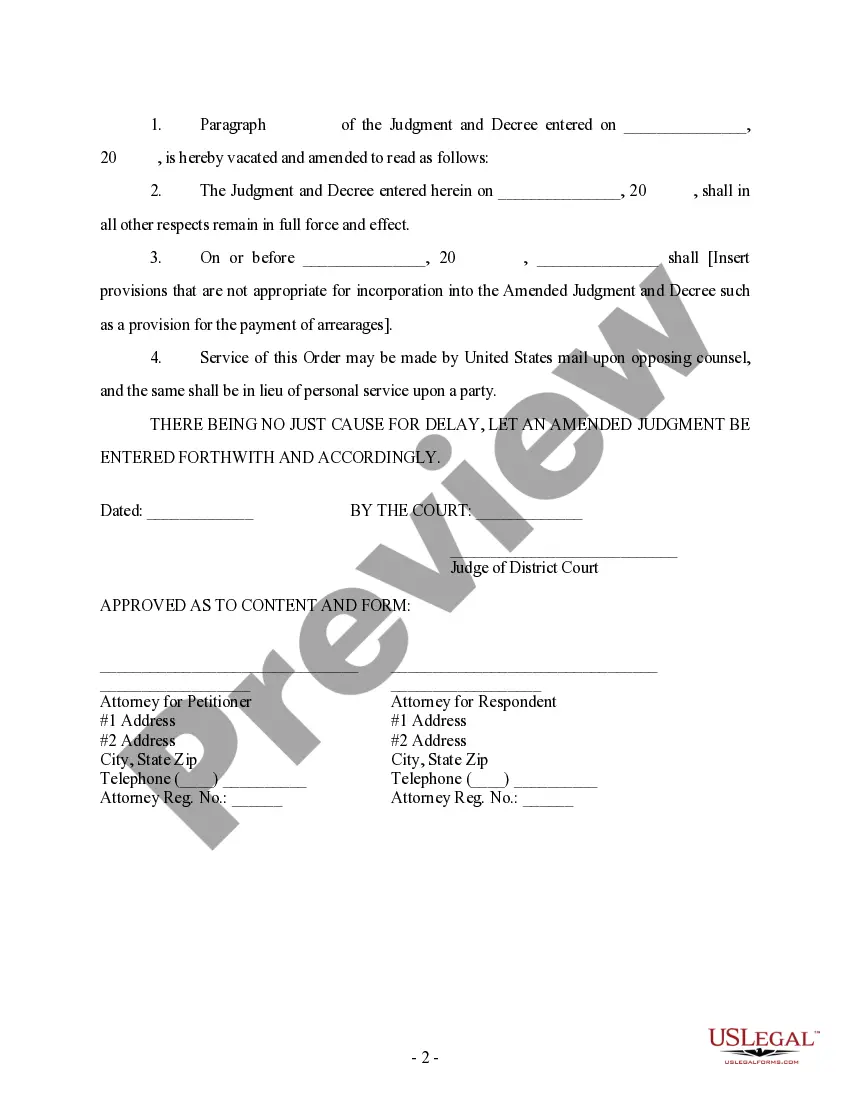
- Service instructions indicating mail can replace personal service.
- Signature line for the Judge of District Court.
- Signature lines for each party's attorney, including their contact information.
When this form is needed
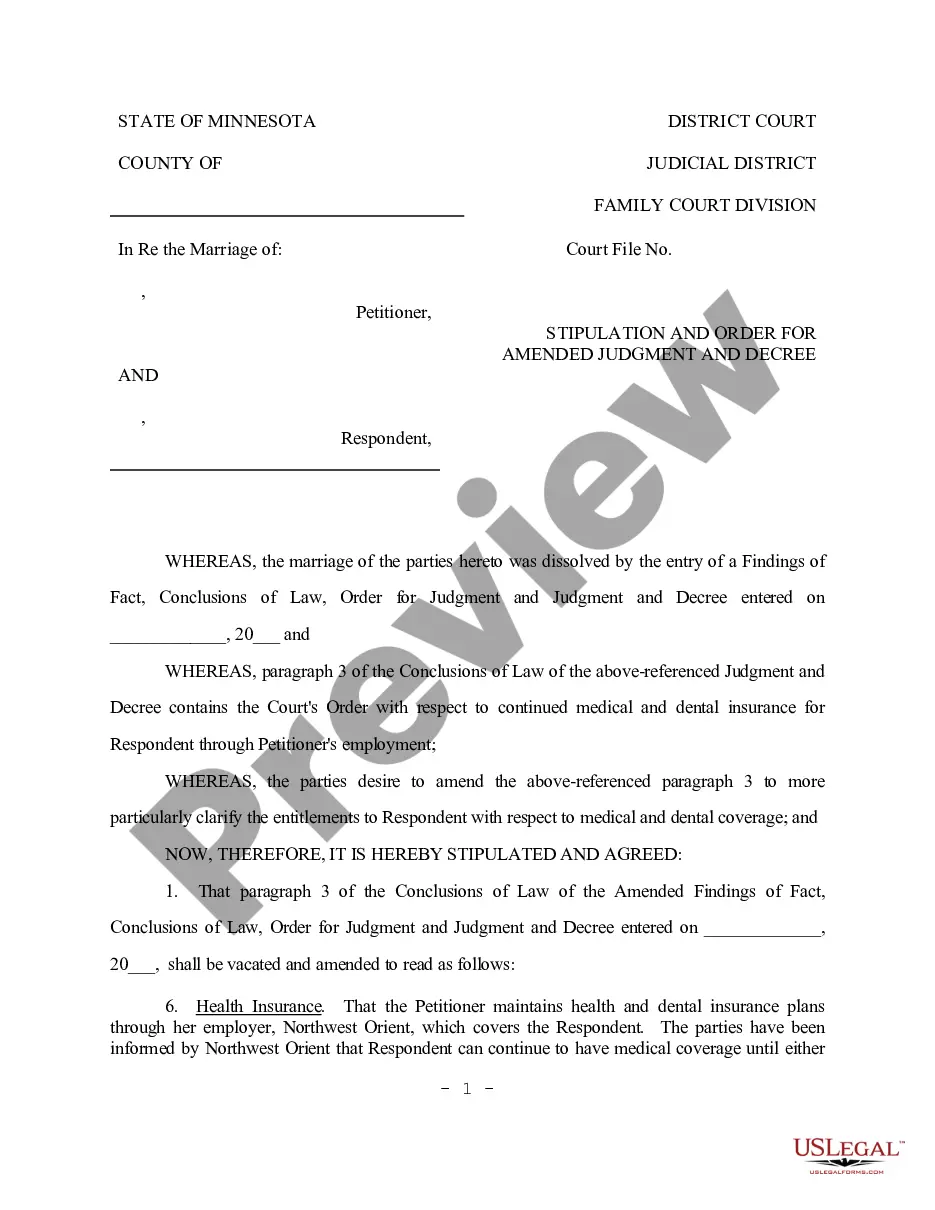
This form is used when parties have reached a verbal agreement to amend terms of a previously issued judgment or decree and wish to formalize these changes through the court. It may be applicable in various family law cases, such as divorce settlements or custody arrangements, where modifications to previous rulings are required without needing to go through a full court hearing.
Who should use this form
- Individuals or parties involved in a legal case who have reached a mutual agreement to amend a judgment.
- Attorneys representing clients in circumstances where a judgment needs to be formally modified.
- Anyone seeking to update court records based on changes agreed upon in court proceedings.
Instructions for completing this form
- Identify all parties involved and their respective attorneys.
- Clearly state the findings of the court regarding the oral stipulation.
- Specify that service of this order can be conducted via United States mail.
- Provide the date on which the order is being issued.
- Obtain the necessary signatures from the Judge and both parties' attorneys.
Notarization requirements for this form
This form does not typically require notarization to be legally valid. However, some jurisdictions or document types may still require it. US Legal Forms provides secure online notarization powered by Notarize, available 24/7 for added convenience.
Get your form ready online
Our built-in tools help you complete, sign, share, and store your documents in one place.
Make edits, fill in missing information, and update formatting in US Legal Forms—just like you would in MS Word.
Download a copy, print it, send it by email, or mail it via USPS—whatever works best for your next step.
Sign and collect signatures with our SignNow integration. Send to multiple recipients, set reminders, and more. Go Premium to unlock E-Sign.
If this form requires notarization, complete it online through a secure video call—no need to meet a notary in person or wait for an appointment.
We protect your documents and personal data by following strict security and privacy standards.

Make edits, fill in missing information, and update formatting in US Legal Forms—just like you would in MS Word.

Download a copy, print it, send it by email, or mail it via USPS—whatever works best for your next step.

Sign and collect signatures with our SignNow integration. Send to multiple recipients, set reminders, and more. Go Premium to unlock E-Sign.

If this form requires notarization, complete it online through a secure video call—no need to meet a notary in person or wait for an appointment.

We protect your documents and personal data by following strict security and privacy standards.
Avoid these common issues
- Failing to include all required party names and attorney information.
- Not accurately reflecting the oral stipulation in the court's findings.
- Omitting the date or signatures from the Judge and attorneys.
Advantages of online completion
- Convenient access to legal forms that can be downloaded and completed at your own pace.
- Editable templates that allow for customization according to specific case details.
- Reliable forms drafted by licensed attorneys, ensuring compliance with current legal standards.
Legal use & context
- The amended judgment becomes part of the official court record.
- Oral stipulations must be clearly documented to be enforceable.
- Ensure compliance with local court rules when filing this order.
What to keep in mind
- The form is essential for documenting changes made to court judgments based on oral agreements.
- Correct completion of the order ensures legal enforceability.
- Filing and serving the order properly is crucial to finalize amendments.
Looking for another form?
Form popularity
FAQ
Yes, a decree can be amended under certain circumstances. In Minnesota, you can request amendments through a formal process, often involving a Minnesota Order to Amend Judgment and Decree - based on oral stipulation if both parties agree. It is essential to follow the correct legal procedures to ensure that the amendments are valid and enforceable.
To add an addendum to a divorce decree, you must draft the new terms and submit them to the court for approval. This process can be straightforward if both parties consent to the changes, often using a Minnesota Order to Amend Judgment and Decree - based on oral stipulation to facilitate the agreement. Engaging with a platform like uslegalforms can help ensure that your addendum meets all legal requirements.
A petition stipulation or motion to modify the decree of divorce is a formal request to change the terms of an existing divorce decree. In Minnesota, this process allows for adjustments to be made based on changes in circumstances, such as income or custody arrangements. Utilizing a Minnesota Order to Amend Judgment and Decree - based on oral stipulation can simplify this process when both parties are in agreement.
To amend your divorce decree in Minnesota, you typically need to file a motion with the court detailing the changes you wish to make. This may involve submitting a Minnesota Order to Amend Judgment and Decree - based on oral stipulation if both parties agree to the modifications. It’s important to ensure that all required documentation is in order and that you adhere to court procedures.
A motion to alter or amend a judgment allows a party to request changes to a court's previous decision. In Minnesota, this process can help address errors or modify terms that may no longer be appropriate. By filing a Minnesota Order to Amend Judgment and Decree - based on oral stipulation, you can seek a more favorable outcome based on new circumstances.
Rule 521 of the Minnesota General Rules of Practice outlines the procedure for amending judgments and decrees in Minnesota. It provides clarity and structure for obtaining a Minnesota Order to Amend Judgment and Decree - based on oral stipulation. Understanding this rule can empower you to navigate the legal system effectively and ensure your rights are upheld.
A motion to amend judgment is a formal request to the court to change or modify an existing judgment. This process is vital for obtaining a Minnesota Order to Amend Judgment and Decree - based on oral stipulation, especially when circumstances change or new evidence arises. Filing this motion can help parties achieve a fair outcome.
A stipulated judgment and decree is a legal agreement between parties that resolves a dispute without going to trial. This agreement allows for a Minnesota Order to Amend Judgment and Decree - based on oral stipulation, making it easier for both parties to agree on terms and reach a resolution. It promotes cooperation and minimizes court time.
In Minnesota, you can request to be excused from jury duty under specific circumstances, such as financial hardship or medical issues. However, refusing jury duty without a valid reason may lead to penalties. It is essential to communicate your concerns to the court and explore options that may allow you to fulfill your civic duty while addressing your situation.
Stipulated findings of fact and decree refer to a formal agreement where both parties accept certain facts and the resulting legal conclusions. This process often leads to a Minnesota Order to Amend Judgment and Decree - based on oral stipulation, simplifying disputes by eliminating the need for extensive litigation. It promotes efficiency and clarity in legal proceedings.