Minnesota Scheduling Information Statement for Filing with Court
Understanding this form
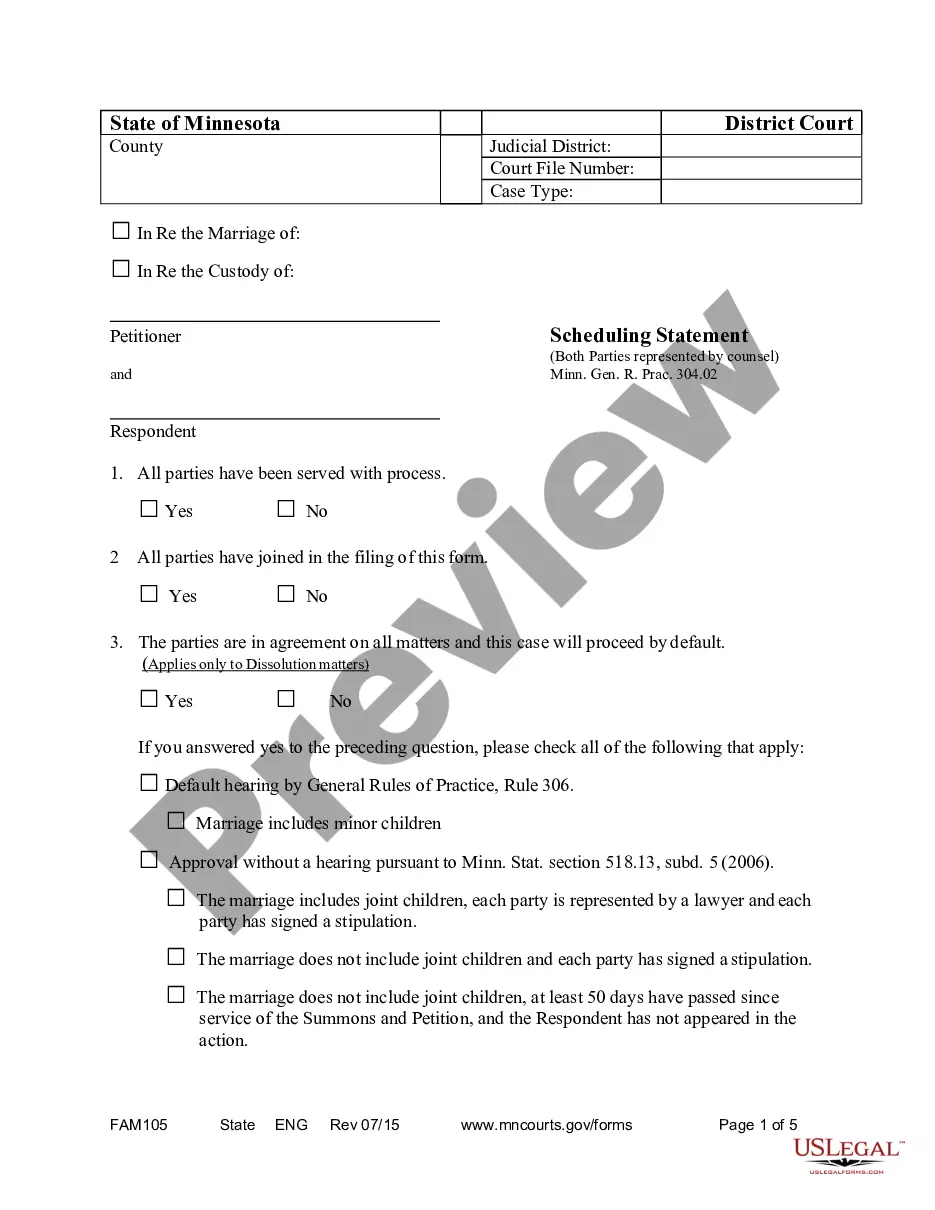
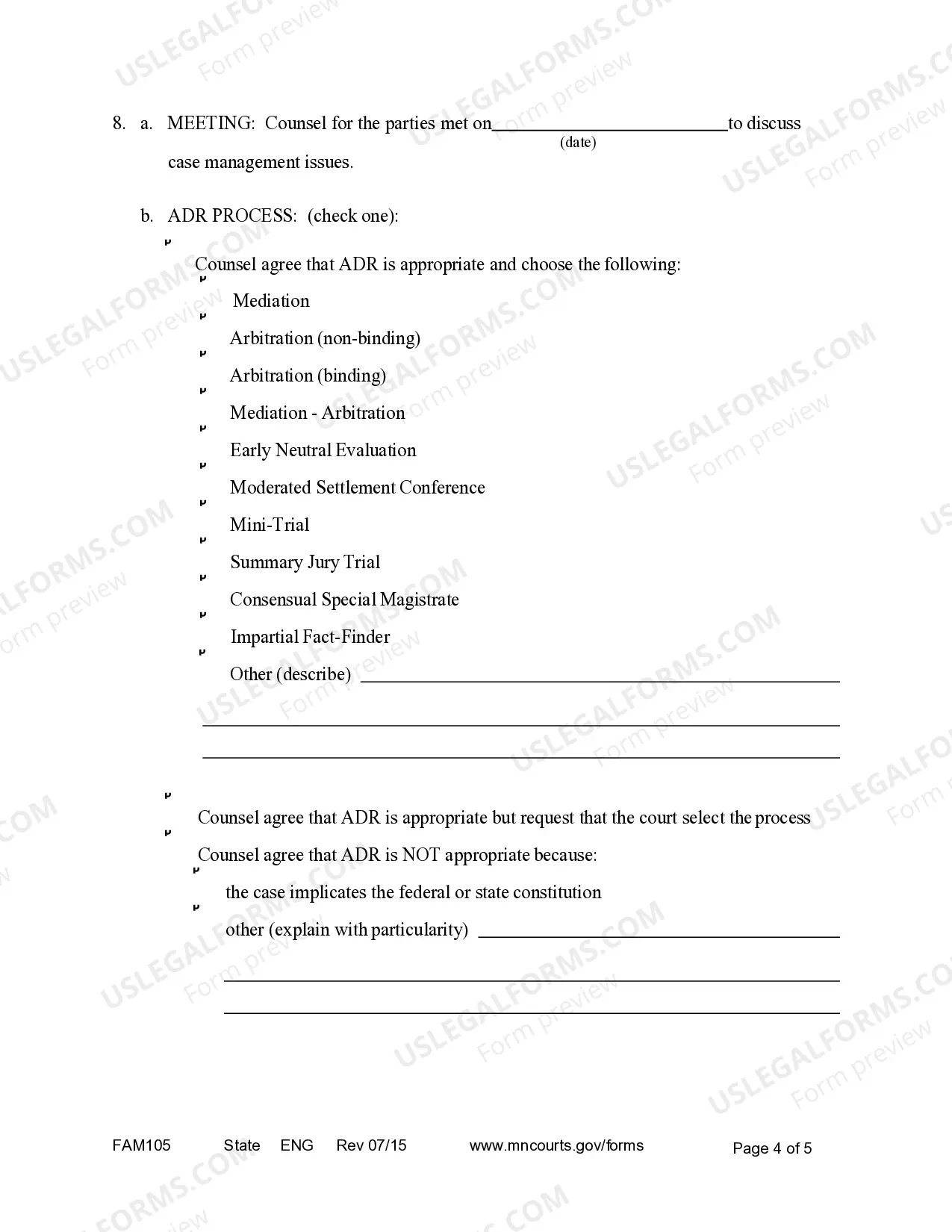
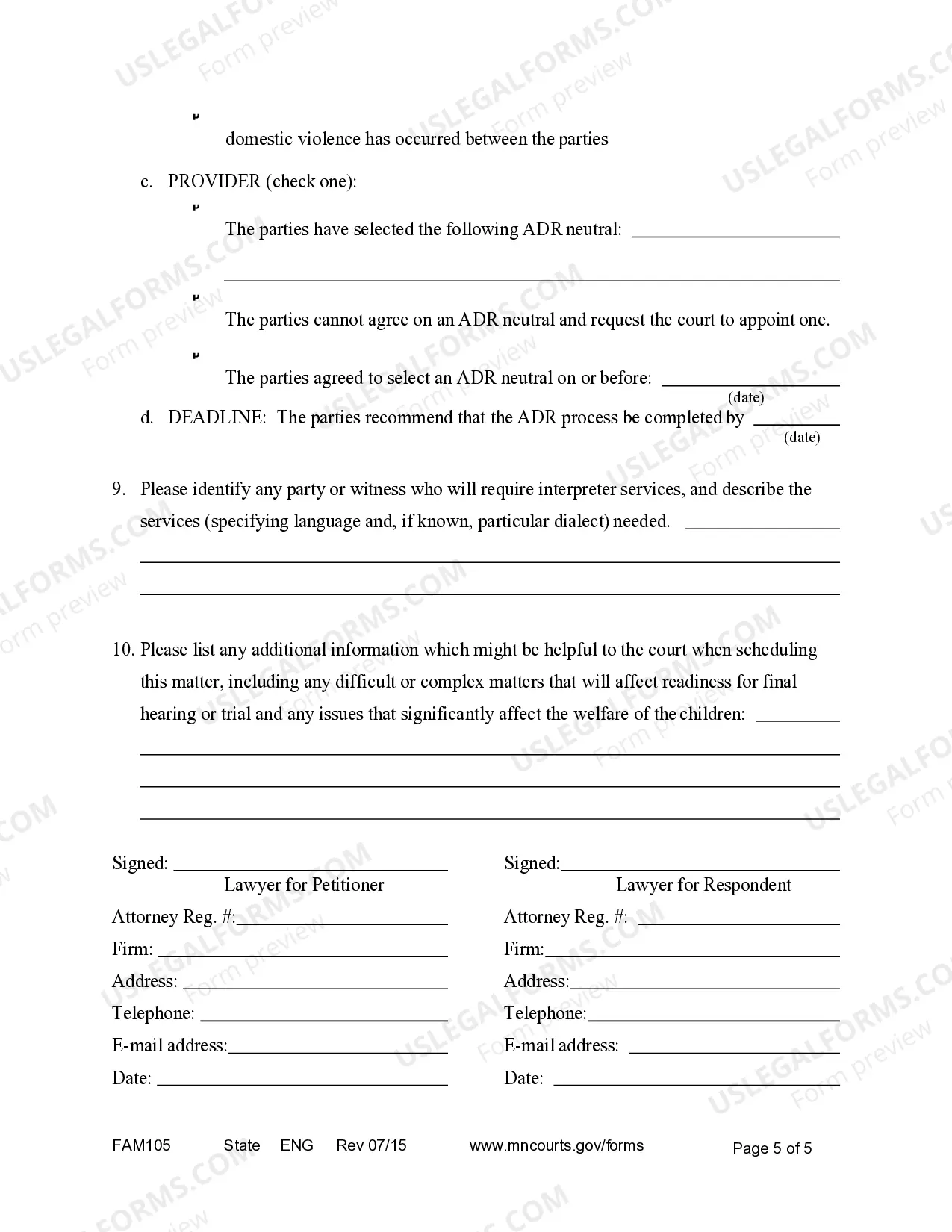
The Scheduling Information Statement for Filing with Court is a legal form used in dissolution proceedings, such as divorce or custody cases. This form outlines key scheduling details and agreements between parties involved in a legal dispute. Unlike other forms, it specifically focuses on deadlines and procedural schedules necessary for court appearances and hearings.
Key components of this form
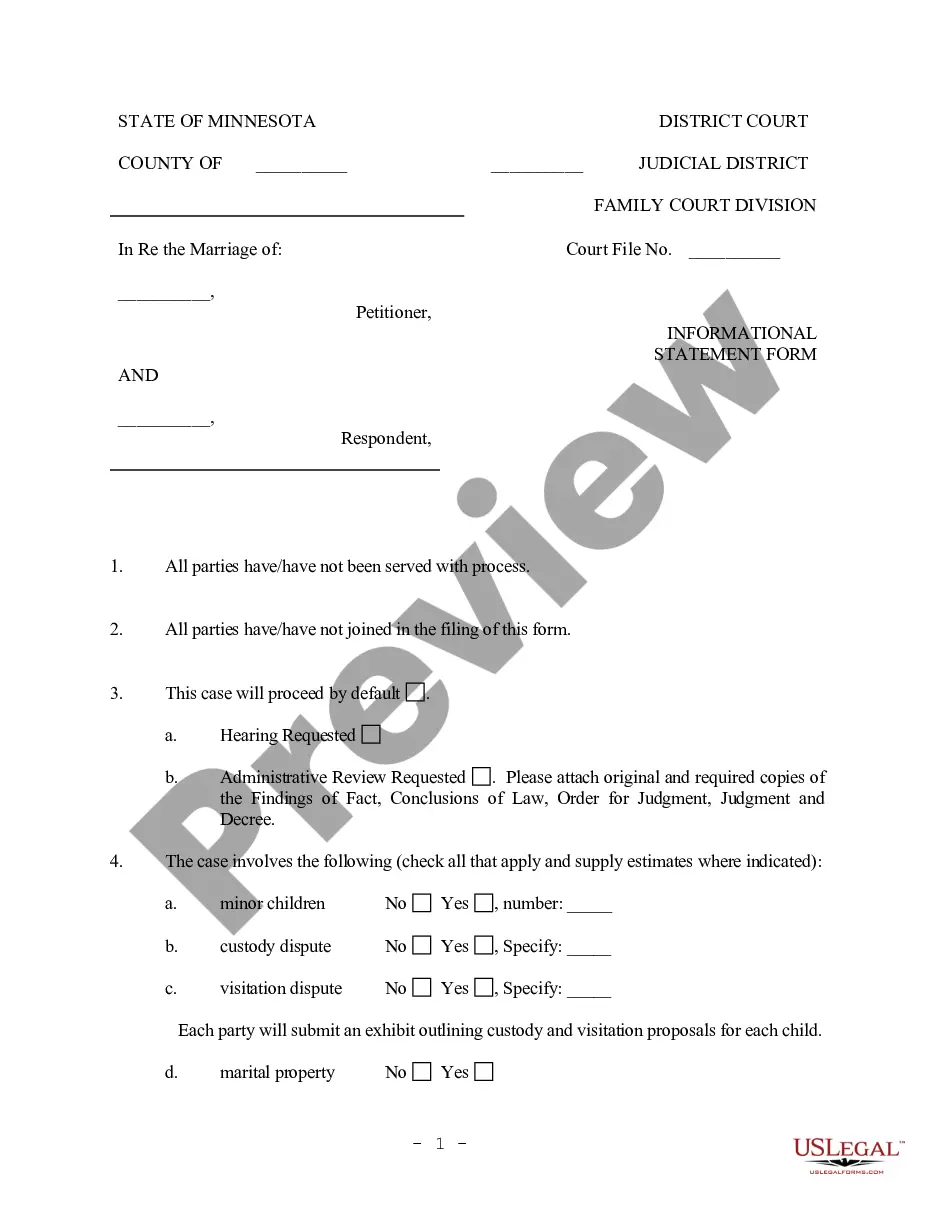
- Identification of the parties involved in the case
- Verification of service of process to all parties
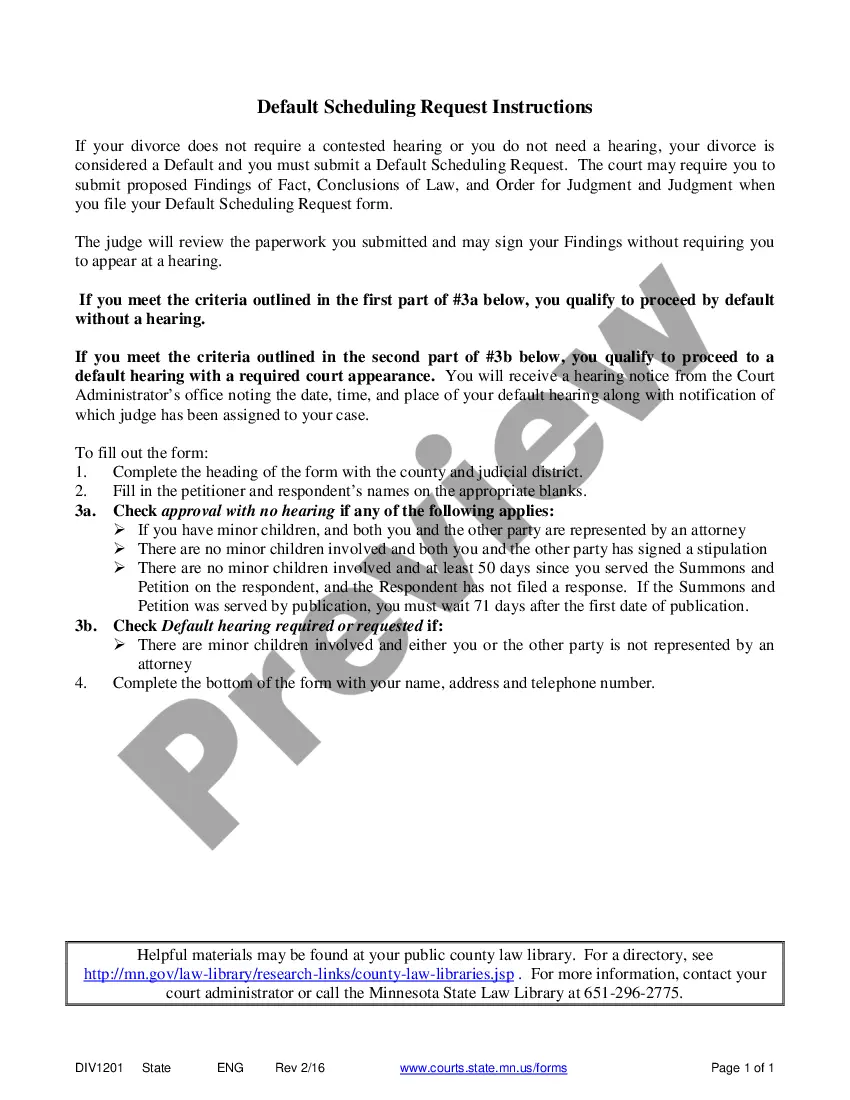
- Agreement on case matters and whether the matter will proceed by default
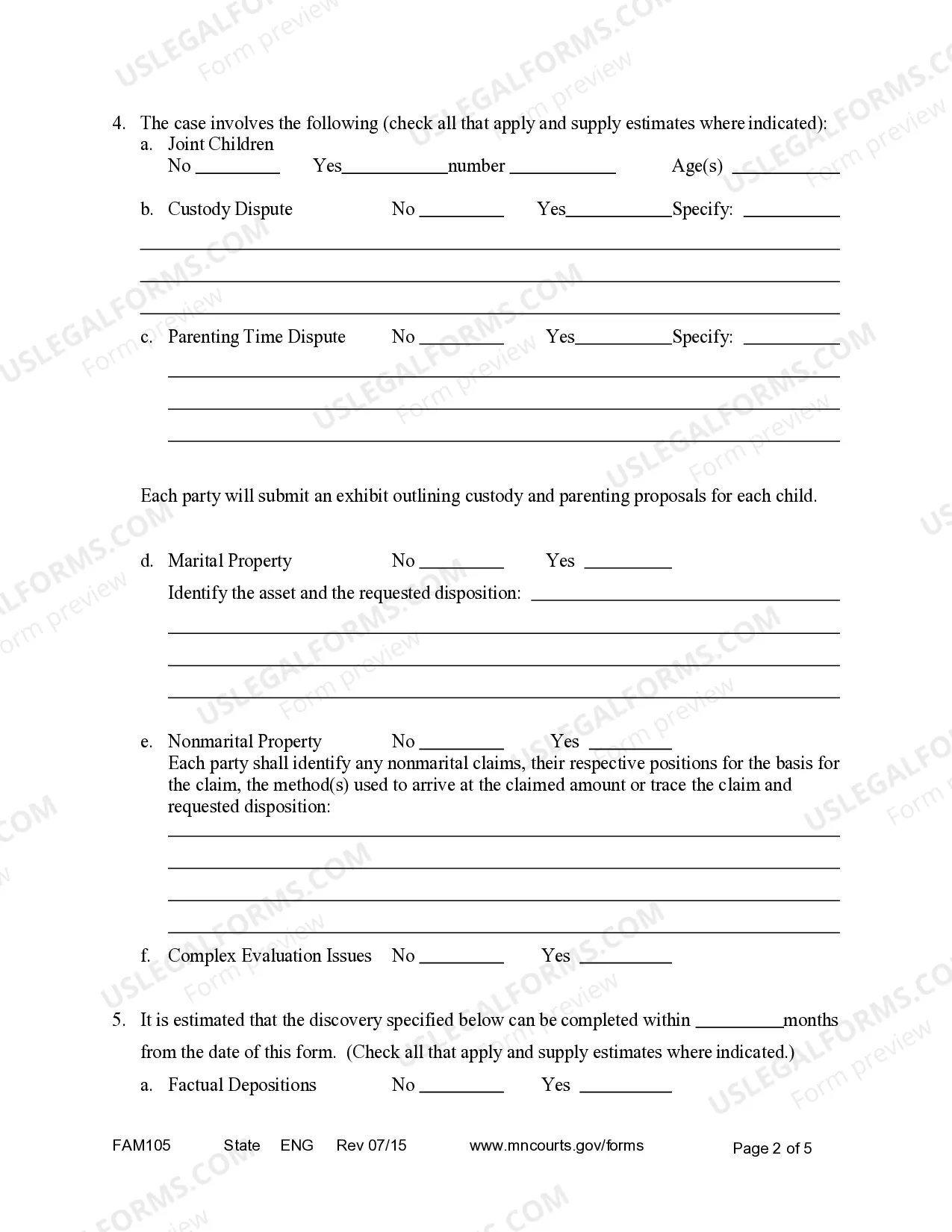
- Details regarding custody, parenting time, and property matters
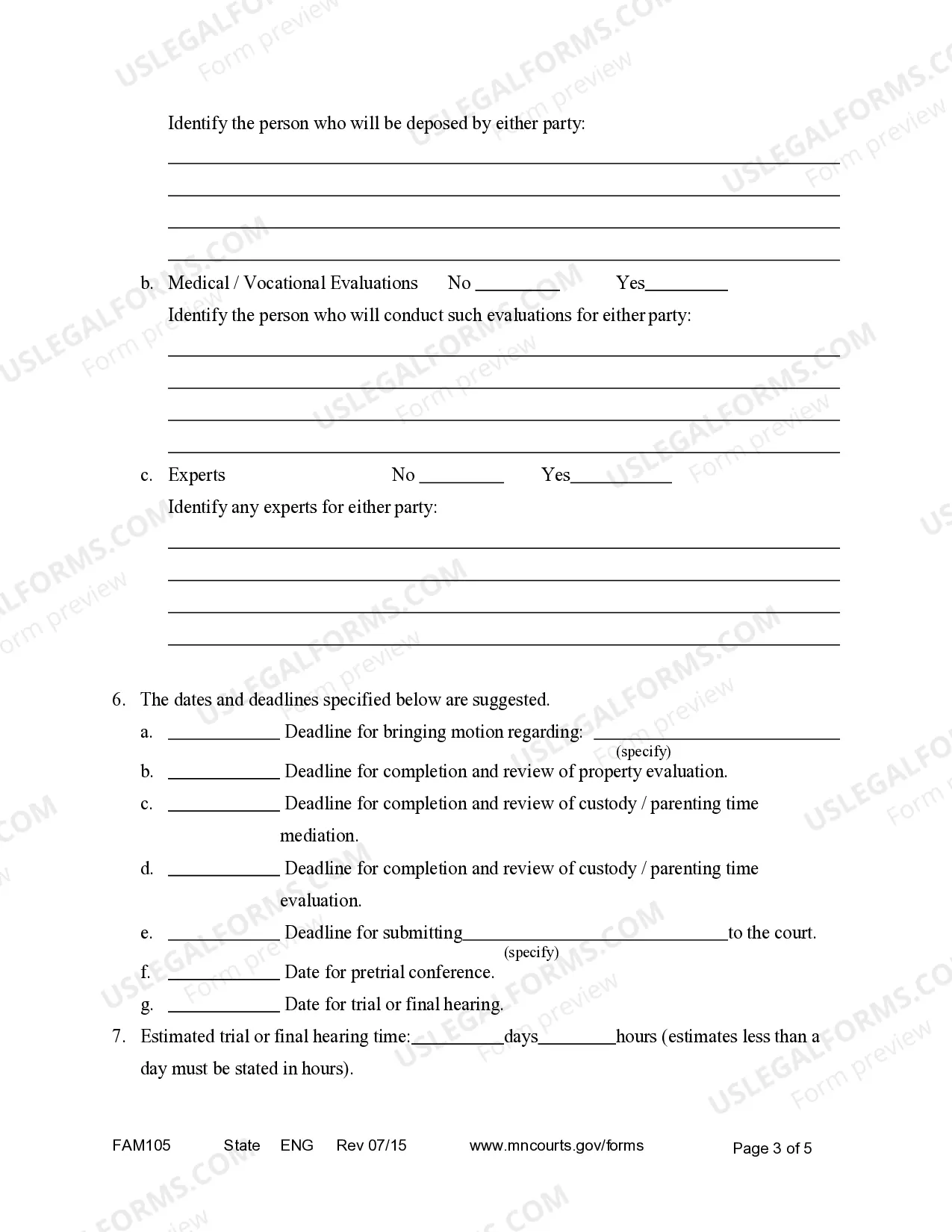
- Proposed deadlines for motions, evaluations, and court hearings

When this form is needed
This form is typically used during a dissolution proceeding when parties need to establish a schedule for court hearings and other important deadlines. It is necessary when parties are negotiating custody, visitation, or property distribution agreements, and when the court requires documentation of these discussions.
Who this form is for
- Individuals who are involved in a dissolution proceeding, such as divorce or custody cases
- Attorneys representing clients in family law disputes
- Legal professionals coordinating pre-trial schedules and motions within the court system
Steps to complete this form
- Begin by entering the names and contact information of all parties involved in the legal matter.
- Indicate whether all parties have been served with process.
- Check any agreements regarding the proceeding and whether the case will go to default.
- Complete sections concerning custody and parenting time proposals, if applicable.
- Detail the proposed deadlines for motions, evaluations, and hearings.
Is notarization required?
This form does not typically require notarization to be legally valid. However, some jurisdictions or document types may still require it. US Legal Forms provides secure online notarization powered by Notarize, available 24/7 for added convenience.
Get your form ready online
Our built-in tools help you complete, sign, share, and store your documents in one place.
Make edits, fill in missing information, and update formatting in US Legal Forms—just like you would in MS Word.
Download a copy, print it, send it by email, or mail it via USPS—whatever works best for your next step.
Sign and collect signatures with our SignNow integration. Send to multiple recipients, set reminders, and more. Go Premium to unlock E-Sign.
If this form requires notarization, complete it online through a secure video call—no need to meet a notary in person or wait for an appointment.
We protect your documents and personal data by following strict security and privacy standards.

Make edits, fill in missing information, and update formatting in US Legal Forms—just like you would in MS Word.

Download a copy, print it, send it by email, or mail it via USPS—whatever works best for your next step.

Sign and collect signatures with our SignNow integration. Send to multiple recipients, set reminders, and more. Go Premium to unlock E-Sign.

If this form requires notarization, complete it online through a secure video call—no need to meet a notary in person or wait for an appointment.

We protect your documents and personal data by following strict security and privacy standards.
Mistakes to watch out for
- Failing to serve all parties before filing, which can delay proceedings.
- Not specifying clear deadlines, resulting in confusion over timelines.
- Leaving sections blank or incomplete, which can lead to court rejections.
Why use this form online
- Convenience of completing the form from any location without needing to visit a lawyer's office.
- Ability to easily edit and fill out the form as your situation evolves.
- Access to expert legal templates drafted by licensed attorneys, ensuring compliance with state laws.
Looking for another form?

Form popularity
FAQ
Appellate case information may be viewed online using the P-MACS case management system. Decisions of the trial courts in Minnesota are not published. To find cases in the trial (district) courts, try the public access to case records system, or contact the court administrator's office.
You write your motion. You file your motion with the court clerk. The court clerk inserts the date and time your motion will be heard by the judge. You serve (mail) your motion to the other side. The other side files a written opposition to your motion with the court.
A "notice of filing" is a separate document that must, at a minimum, notify the recipient what it is that has been filed and the date of filing.104.01, subdivision 1, an appeal from an appealable order must be filed and served within 60 days after service by any party of written notice of the filing of the order.
Hennepin Family Court. Family Court is located in the Family Justice Center (FJC) in downtown Minneapolis, and handles cases such as divorce, domestic abuse, child custody and support, and paternity.
An uncontested divorce in Minnesota can take as little as four weeks, although 60 days more likely. More difficult divorce cases where the parties disagree on many issues can end up taking years. The surest way to get a quick divorce in Minnesota is to not contest it.
To get divorced in MN, at least one of the spouses must be living in MN for a minimum of 180 days (or you or your spouse must be a member of the armed forces and that person must have kept their MN residency), and you must file court forms with the district court in the county where one of the spouses is living.
Prior to submitting motion paperwork, a motion date must be obtained from court administration. Then you must complete a motion form. After completing the motion and your attachments, you must have a copy of the motion and attachments served on the opposing party(ies).
There are court fees to get divorced. You have to pay a filing fee of about $400 to start or respond to a divorce case. There can be other fees if you participate in mediation, have a custody evaluation, or if a guardian ad litem is appointed. These fees change by county.
You can get the forms you need online, or you can go to your local courthouse or law library to request a packet of divorce papers. In Minnesota, the "petitioner" is the party who initiates the divorce, and the "respondent" is the party who receives the petitioner's divorce papers.