Scheduling Report - Civil Trial
About this form
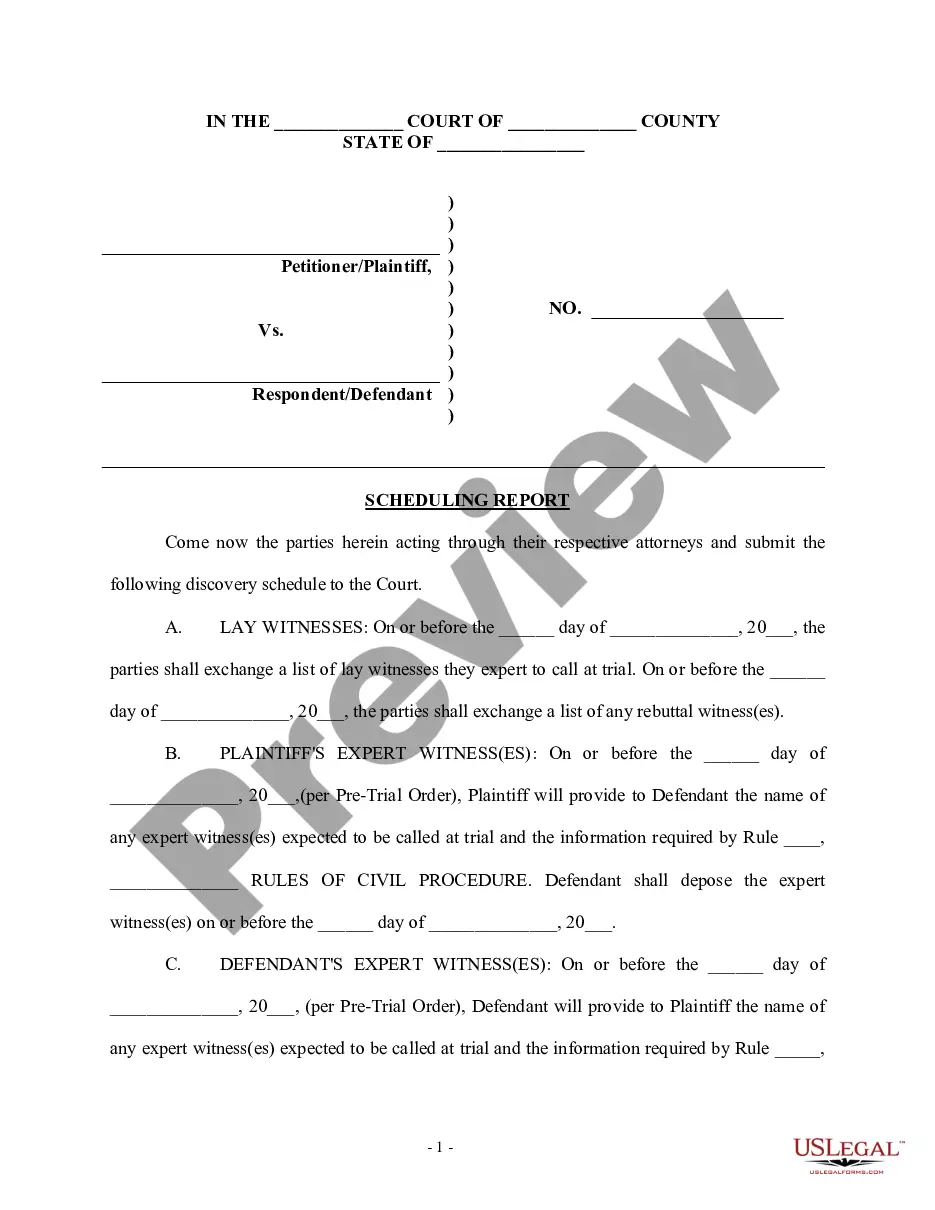
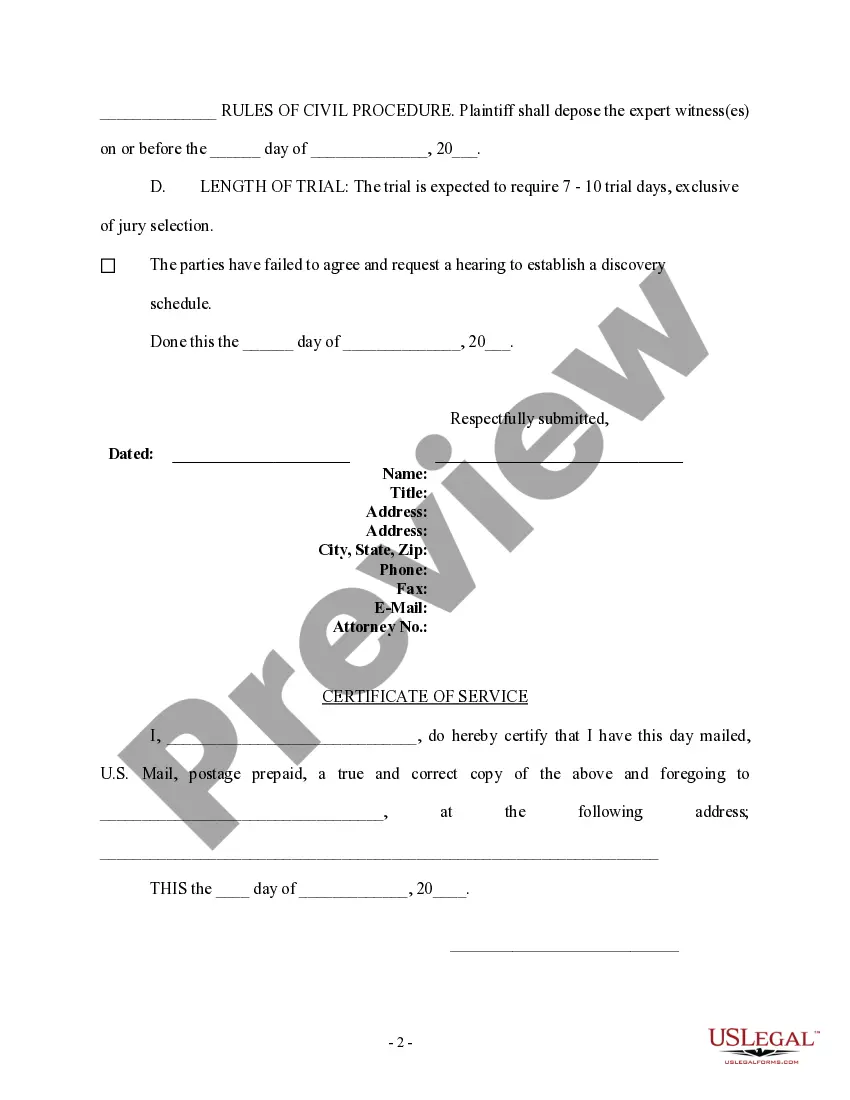
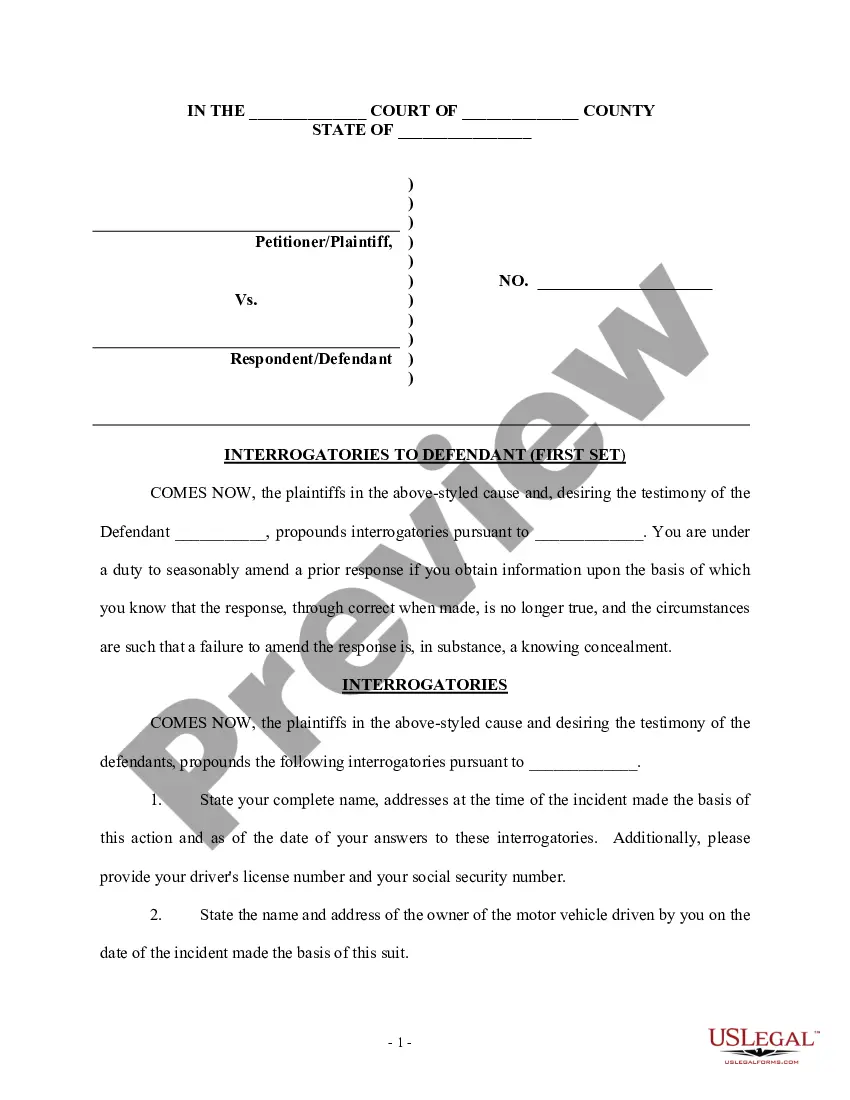
The Scheduling Report - Civil Trial is a legal document that outlines a mutually agreed-upon discovery schedule for civil trials. This form differs from other legal forms by specifically detailing the timeline for expert witness disclosures and depositions, ensuring that both parties adhere to set deadlines prior to trial. It is essential in facilitating clarity and organization in the trial process.
Form components explained
- Plaintiff's expert witness disclosure deadline
- Defendant's expert witness disclosure deadline
- Timeline for expert witness depositions
- Estimated length of the trial
- Certification of service to ensure all parties receive the document
Situations where this form applies
This form should be used when the parties involved in a civil trial need to establish a clear timeline for the exchange of information related to expert witnesses. It is applicable in cases where parties cannot agree on a discovery schedule and require the court's approval to proceed with specific deadlines, ensuring compliance with procedural rules.
Who needs this form
- Litigants involved in a civil trial
- Attorneys representing plaintiffs or defendants
- Individuals seeking to organize trial procedures
- Parties requiring court-approved scheduling for expert witnesses
How to prepare this document
- Enter the names of both parties involved in the case.
- Specify the deadlines for disclosing expert witnesses for both the plaintiff and the defendant.
- Indicate the timeline for depositions of expert witnesses.
- Detail the expected length of the trial.
- Complete the certification of service to confirm that the form has been properly distributed to all parties.
Does this document require notarization?
This form does not typically require notarization to be legally valid. However, some jurisdictions or document types may still require it. US Legal Forms provides secure online notarization powered by Notarize, available 24/7 for added convenience.
Get your form ready online
Our built-in tools help you complete, sign, share, and store your documents in one place.
Make edits, fill in missing information, and update formatting in US Legal Forms—just like you would in MS Word.
Download a copy, print it, send it by email, or mail it via USPS—whatever works best for your next step.
Sign and collect signatures with our SignNow integration. Send to multiple recipients, set reminders, and more. Go Premium to unlock E-Sign.
If this form requires notarization, complete it online through a secure video call—no need to meet a notary in person or wait for an appointment.
We protect your documents and personal data by following strict security and privacy standards.

Make edits, fill in missing information, and update formatting in US Legal Forms—just like you would in MS Word.

Download a copy, print it, send it by email, or mail it via USPS—whatever works best for your next step.

Sign and collect signatures with our SignNow integration. Send to multiple recipients, set reminders, and more. Go Premium to unlock E-Sign.

If this form requires notarization, complete it online through a secure video call—no need to meet a notary in person or wait for an appointment.

We protect your documents and personal data by following strict security and privacy standards.
Mistakes to watch out for
- Failing to accurately fill in the deadlines for expert witness disclosures.
- Not providing sufficient notice for depositions.
- Overlooking the requirement to certify service to all parties involved.
- Assuming the agreed-upon dates can be unilaterally changed without court approval.
Benefits of completing this form online
- Immediate access to a professionally drafted document.
- Edit and customize the form to fit specific case needs.
- No need for in-person visits, saving time and effort.
- Easy downloads and printing options available.
Legal use & context
- This form is legally binding once filed with the court.
- It helps establish a systematic approach to preparing for trial.
- Ensures compliance with local civil rules regarding discovery.
Summary of main points
- The Scheduling Report - Civil Trial facilitates the organization of trial schedules.
- Filling out the form accurately is critical for compliance with court procedures.
- It is beneficial for all parties to have a clear timeline for expert witness disclosures and depositions.
Looking for another form?

Form popularity
FAQ
A scheduling order is a court order designed to manage the flow of a case from the date it is entered through the beginning of trial.
Under the law, a Scheduling conference is mandatory i.e Court cannot hear a Civil case unless both sides have carried out a Scheduling Conference. 5. One advantage of a Scheduling Conference is that it saves Court's time so Court can only focus on issues of disagreement or points of contention.
At the Scheduling Conference, the parties shall be prepared to discuss all aspects of the Adversary Proceeding and the Joint Report including, among other things: a. formulating and simplifying the issues, and eliminating frivolous claims and defenses; b. amending the pleadings if necessary or desirable; c.
The scheduling conference is a hearing involving the parties in a lawsuit and the judge assigned to the case. The scheduling conference usually occurs after an answer or motion to dismiss has been filed with the Court. If the Court sets a scheduling conference, it will send you an order with the date and time.
A scheduling order is a court order designed to manage the flow of a case from the date it is entered through the beginning of trial. The court may enter the order on its own motion, or either party may seek one by motion.
Parties introduce themselves through counsel. Court explains the purpose of the scheduling conference.The defendants lawyer presents the defendants case in brief. Court establishes whether there have been efforts to settle/ Parties are given Opportunity to settle through ADR.
At the conference, the judge and the lawyers can review the evidence and clarify the issues in dispute. If a case hasn't been settled, many courts set a time for an issue conference. The lawyers usually appear at this hearing before a judge without their clients and try to agree on undisputed facts or points of law.
At the Scheduling Conference, the parties shall be prepared to discuss all aspects of the Adversary Proceeding and the Joint Report including, among other things: a. formulating and simplifying the issues, and eliminating frivolous claims and defenses; b. amending the pleadings if necessary or desirable; c.
A meeting of the judge and the lawyers (or unrepresented parties) in a pending legal matter, to determine how the case is progressing. At the status conference, the judge may ask about what discovery has been conducted, whether and how the parties have tried to settle the case, and other pretrial matters.