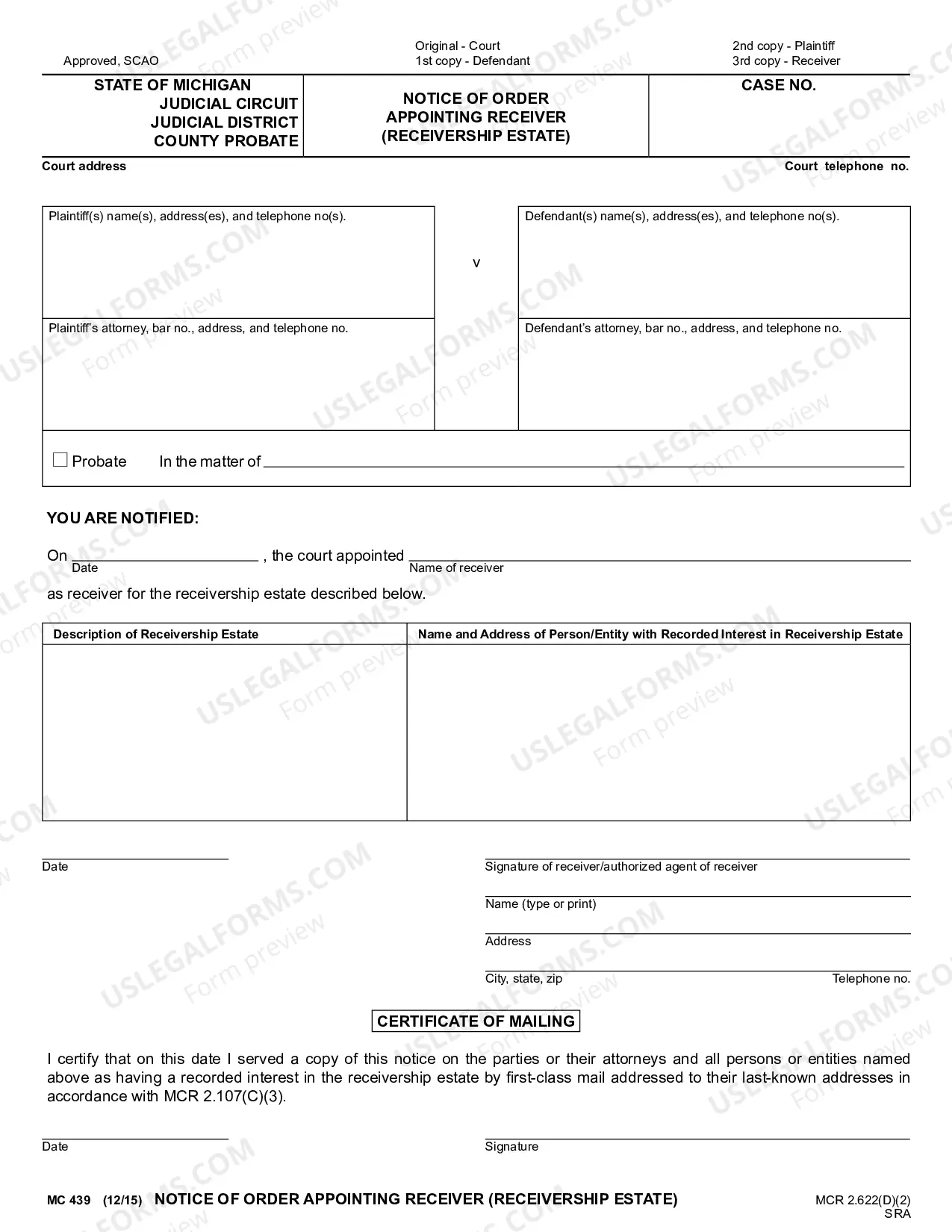
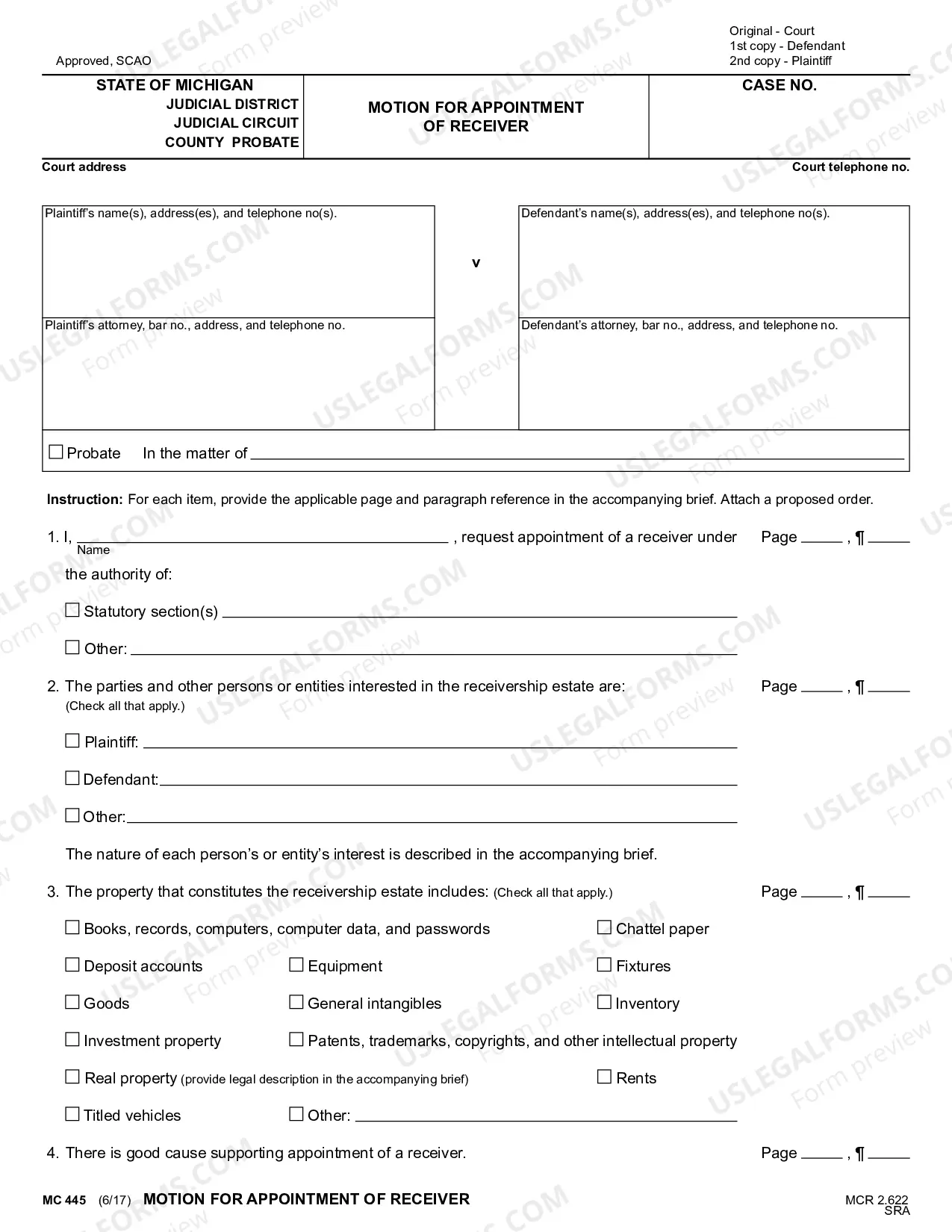
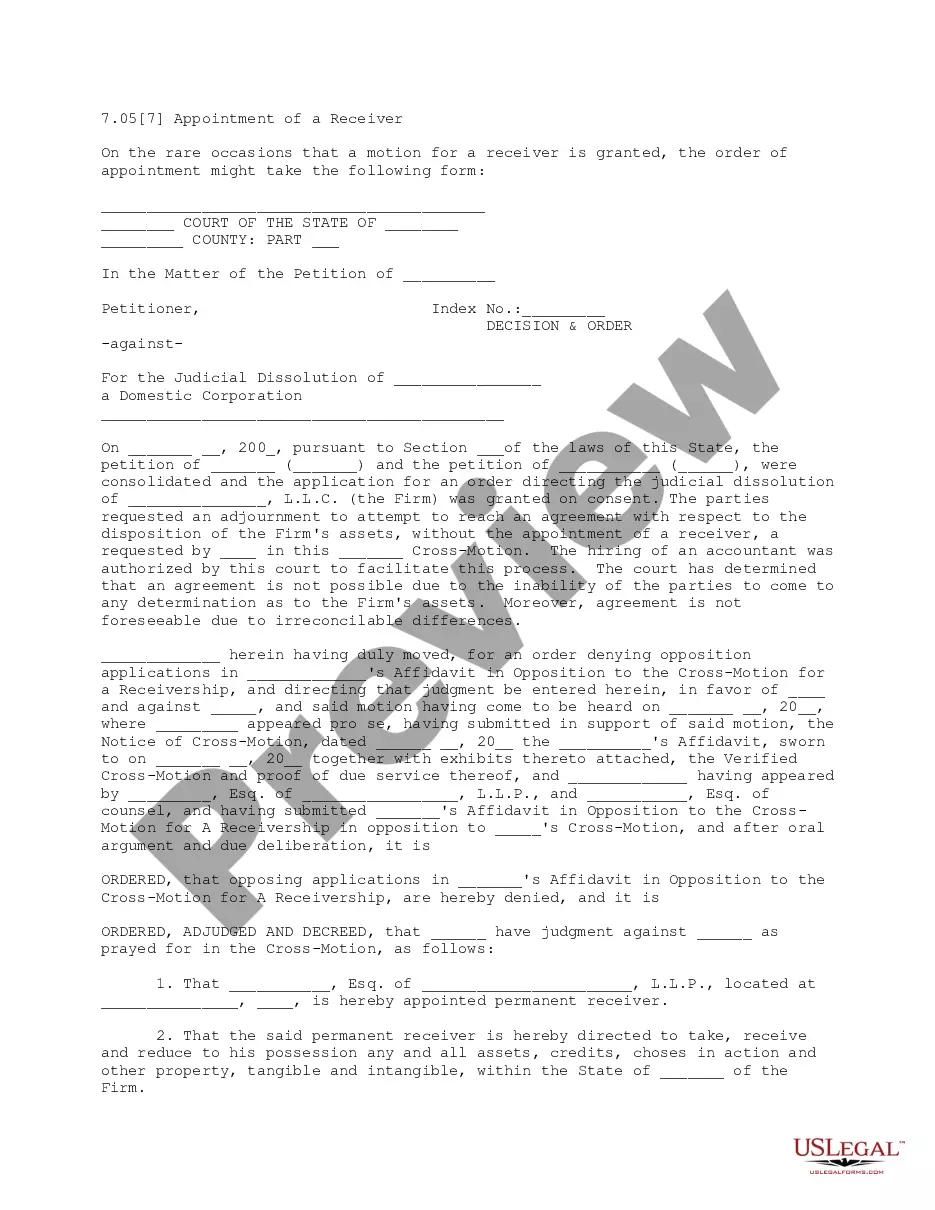
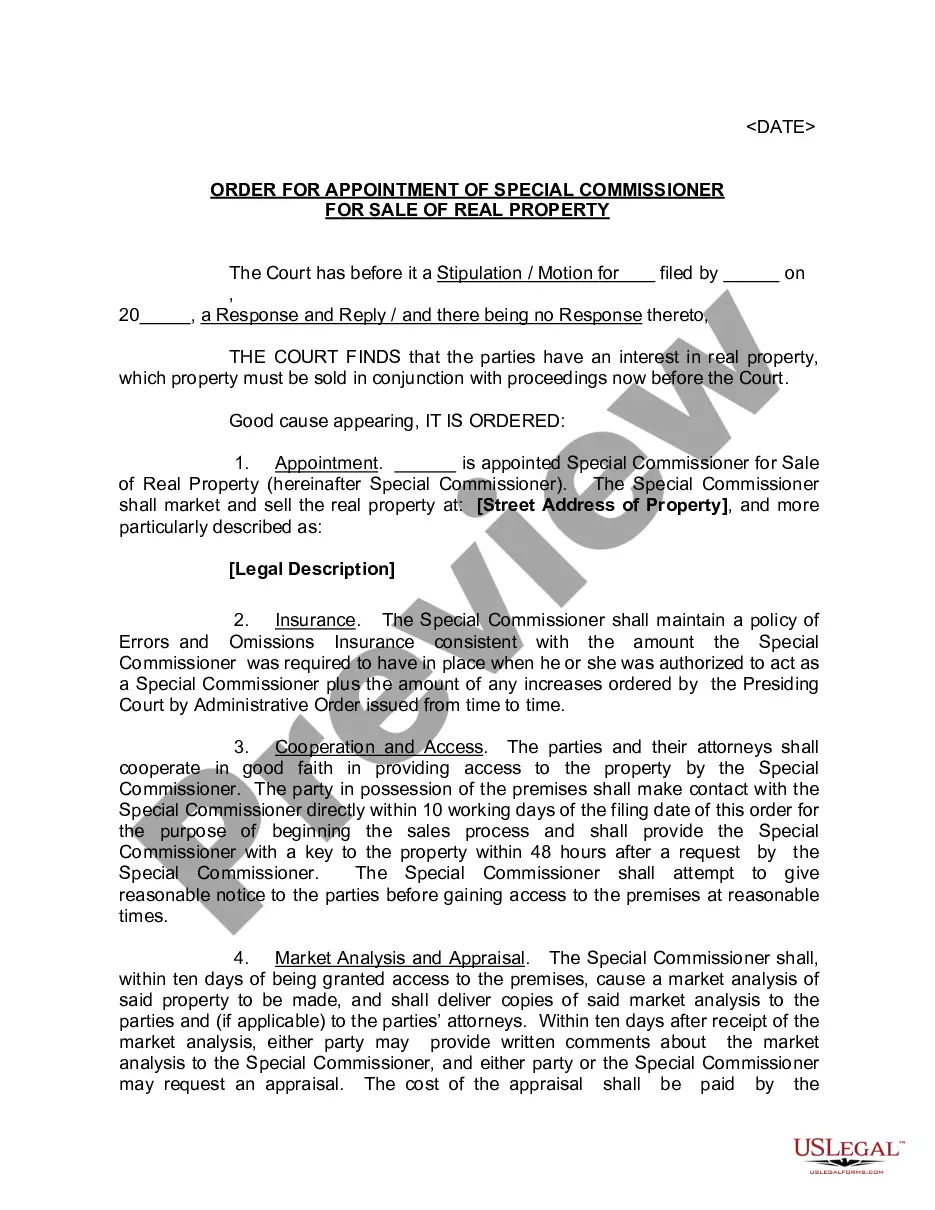
A Michigan Notice of Order Appointing Receiver (Receivership Estate) is a form issued by the court when it decides to appoint a receiver to manage the estate of an individual or business. The receiver is appointed to preserve and protect assets, collect debts, and manage the estate while the court resolves disputes involving the estate. The notice will provide details of the receivership, including the name of the receiver, the estate to be managed, the court order appointing the receiver, and the responsibilities of the receiver. There are two types of Michigan Notice of Order Appointing Receiver (Receivership Estate): a general receivership and a limited receivership. A general receivership is used to manage a debtor’s estate as a whole, while a limited receivership is used to manage specific assets within an estate.
Michigan Notice of Order Appointing Receiver (Receivership Estate)
Description
Get your form ready online
Our built-in tools help you complete, sign, share, and store your documents in one place.
Make edits, fill in missing information, and update formatting in US Legal Forms—just like you would in MS Word.
Download a copy, print it, send it by email, or mail it via USPS—whatever works best for your next step.
Sign and collect signatures with our SignNow integration. Send to multiple recipients, set reminders, and more. Go Premium to unlock E-Sign.
If this form requires notarization, complete it online through a secure video call—no need to meet a notary in person or wait for an appointment.
We protect your documents and personal data by following strict security and privacy standards.

Make edits, fill in missing information, and update formatting in US Legal Forms—just like you would in MS Word.

Download a copy, print it, send it by email, or mail it via USPS—whatever works best for your next step.

Sign and collect signatures with our SignNow integration. Send to multiple recipients, set reminders, and more. Go Premium to unlock E-Sign.

If this form requires notarization, complete it online through a secure video call—no need to meet a notary in person or wait for an appointment.

We protect your documents and personal data by following strict security and privacy standards.
Looking for another form?

How to fill out Michigan Notice Of Order Appointing Receiver (Receivership Estate)?
US Legal Forms is the easiest and most lucrative method to locate suitable legal templates.
It boasts the largest online collection of business and personal legal documents created and validated by attorneys.
Here, you can discover printable and fillable templates that adhere to national and local regulations - just like your Michigan Notice of Order Appointing Receiver (Receivership Estate).
Review the form description or preview the document to ensure you’ve located the one that meets your needs, or search for another option using the search tab above.
Click Buy now when you’re confident about its suitability, and choose the subscription plan you prefer.
- Obtaining your template requires just a few simple actions.
- Users who already possess an account with an active subscription only need to Log In to the site and download the form onto their device.
- Later, they can access it in their profile in the My documents section.
- And here’s how you can acquire a professionally drafted Michigan Notice of Order Appointing Receiver (Receivership Estate) if you are using US Legal Forms for the first time.
Form popularity
FAQ
To appoint a receivership, a party typically files a motion in court requesting the appointment of a receiver, supported by relevant documentation and evidence. The court then reviews the application and can issue a Michigan Notice of Order Appointing Receiver (Receivership Estate) if deemed appropriate. This process ensures that an impartial individual manages the assets involved, safeguarding the interests of all stakeholders. For those navigating this process, US Legal Forms offers valuable templates and guidance to ensure compliance and efficiency.
A Michigan Notice of Order Appointing Receiver (Receivership Estate) is a legal document that officially appoints a receiver to manage assets or property during legal proceedings. This notice outlines the powers granted to the receiver, allowing them to act in the best interests of the involved parties. Understanding this process is vital, as it helps to protect the assets and provides clarity during complex legal situations. Utilizing resources from US Legal Forms can streamline your experience in handling this important legal document.
Yes, a notice to creditors is generally required when a receiver is appointed in Michigan. This notice informs creditors of the receivership, allowing them to submit claims against the estate. Timing and content of the notice are governed by Michigan law, ensuring all interested parties have the opportunity to participate in the process. For assistance managing these notifications, you may consider using the resources available through the uslegalforms platform.
Yes, a receiver must be court-appointed to have legal authority in managing the financial or operational affairs of an estate. This court appointment ensures that the receiver operates under judicial oversight, promoting fairness and accountability. While parties may suggest candidates for receivership, the court ultimately makes the final appointment decision. In a Michigan Notice of Order Appointing Receiver (Receivership Estate), the court outlines the powers and responsibilities granted to the receiver.
The 7 day rule in Michigan court requires parties to respond to certain legal notifications within seven days of receiving them. This rule applies to various court-related communications, including notices concerning receivership matters. Responding promptly is essential as it ensures that your interests are represented during receivership proceedings. Understanding this timeline also helps avoid potential defaults and complications in a Michigan Notice of Order Appointing Receiver (Receivership Estate).
When a receiver is appointed, it signifies that the court has designated an individual or entity to manage a specified asset or business. The receiver acts as a neutral party, ensuring that the interests of all stakeholders are addressed during the receivership process. This arrangement aims to stabilize operations and maximize asset value until the legal issues are resolved. You typically receive a Michigan Notice of Order Appointing Receiver (Receivership Estate) detailing the appointment.
The appointment of a receiver by a court involves submitting a formal request through legal documentation. This request typically outlines the necessity for a receiver, alongside supporting evidence. After filing, the court will assess the merits of the case, potentially scheduling hearings for further clarification. If the court finds sufficient justification, it will issue a Michigan Notice of Order Appointing Receiver (Receivership Estate).
A receiver is appointed through a court order, often initiated by a party involved in a legal dispute. To begin the process, you must file a petition with the court, detailing the reasons for the receiver’s appointment. The court will review the petition and may hold a hearing to evaluate evidence and arguments presented. Once the court grants the request, it issues a Michigan Notice of Order Appointing Receiver (Receivership Estate).
The 7-day order rule in Michigan refers to the requirement that certain court orders—typically regarding payments or actions—must be executed within seven days of issuance. This rule ensures timely responses, particularly in situations involving a Michigan Notice of Order Appointing Receiver (Receivership Estate). Familiarity with this rule can aid parties in receivership to manage their estate effectively and comply with court directives, thus avoiding potential legal complications.
A 7-day demand for payment in Michigan is a formal request sent to a debtor asking for payment of a due amount within seven days. This demand is often used in the context of business transactions and can be crucial before initiating further legal action. In cases involving a Michigan Notice of Order Appointing Receiver (Receivership Estate), understanding this demand helps parties structured in receivership maintain clear communication regarding financial obligations.