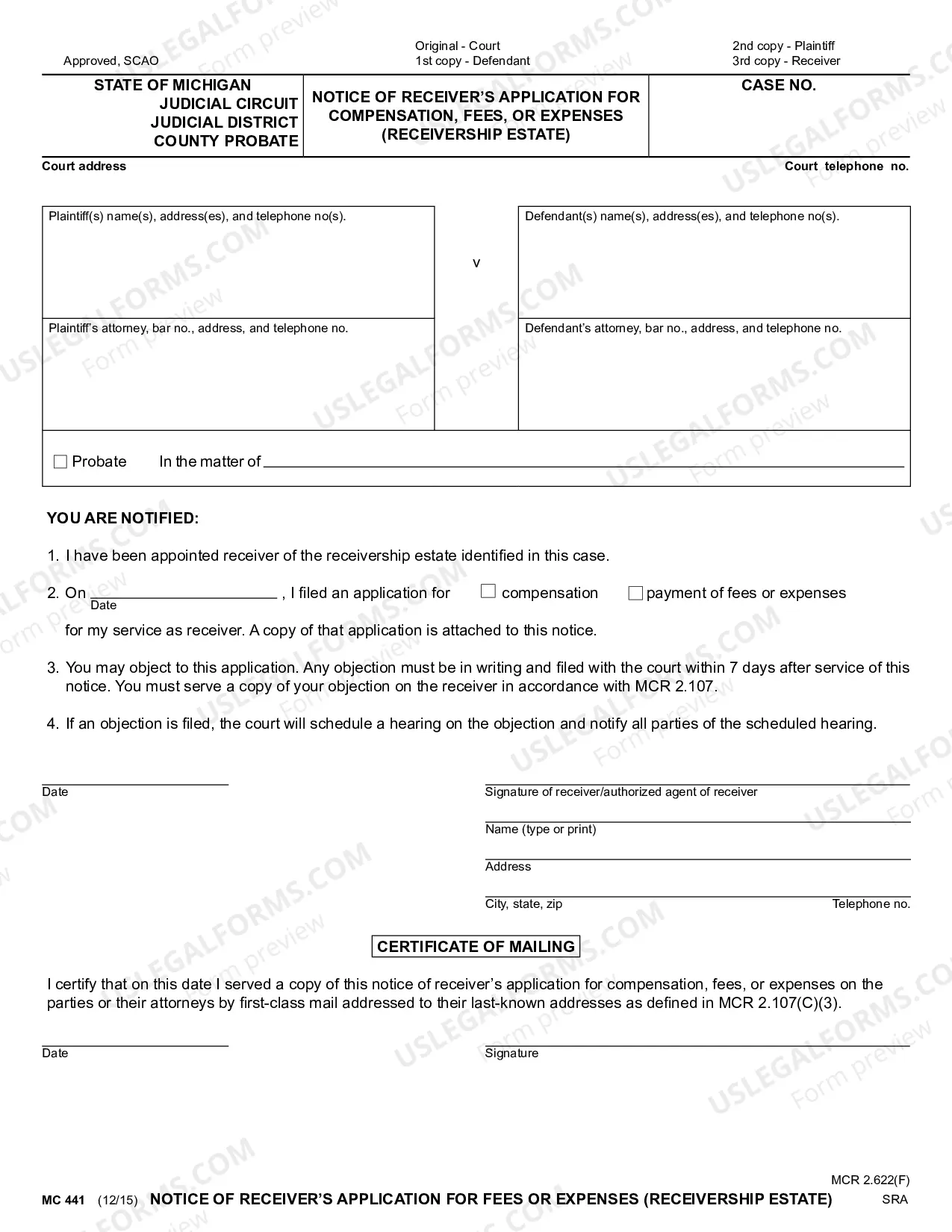
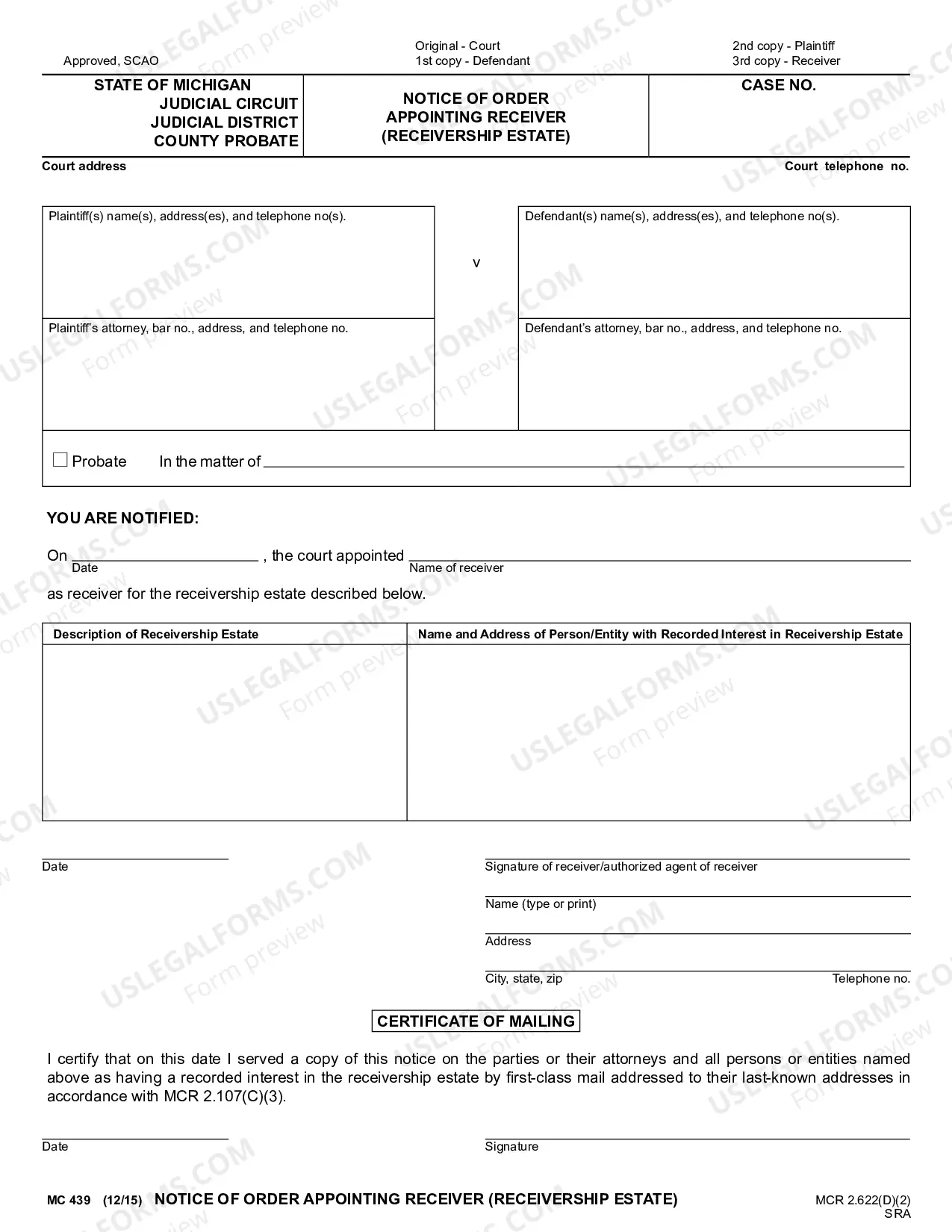
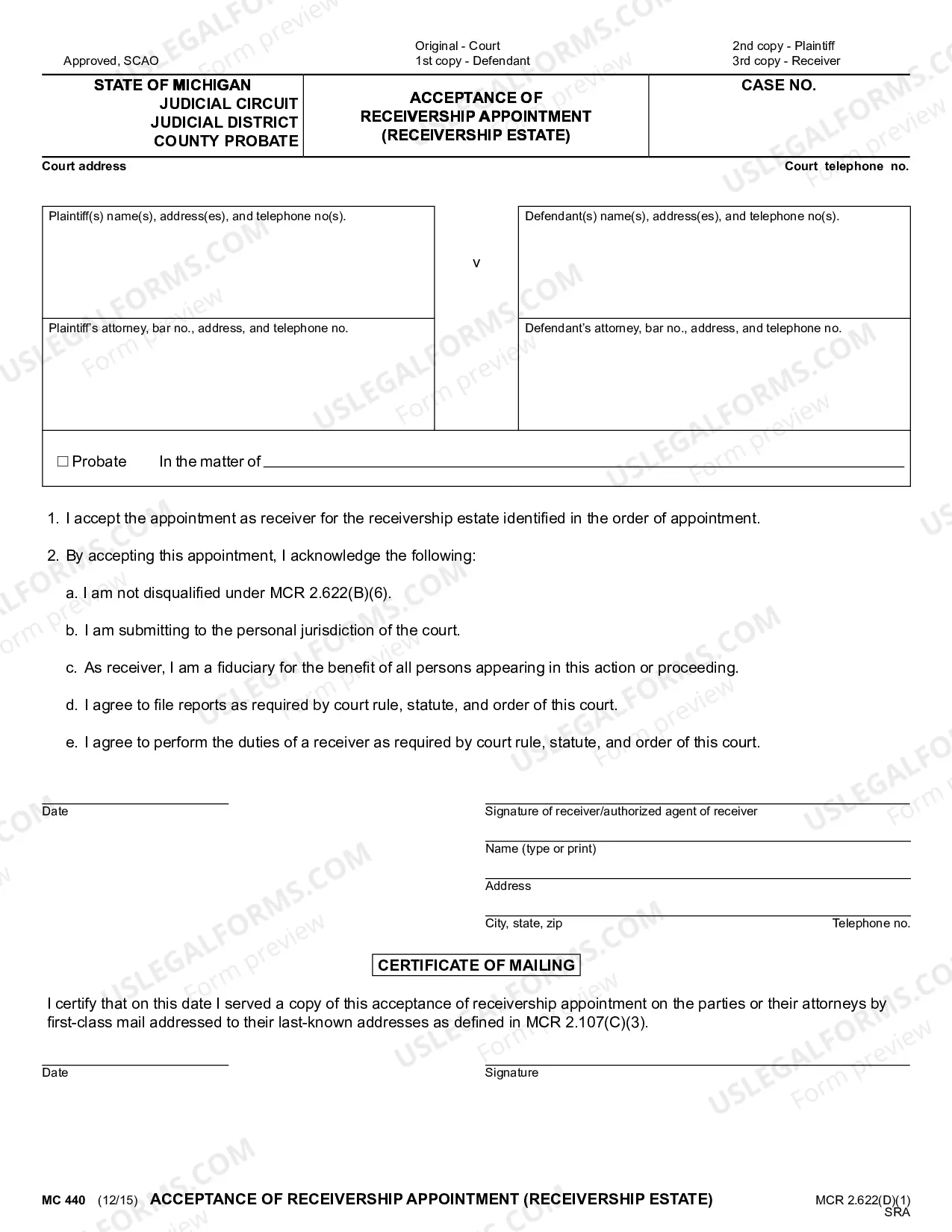
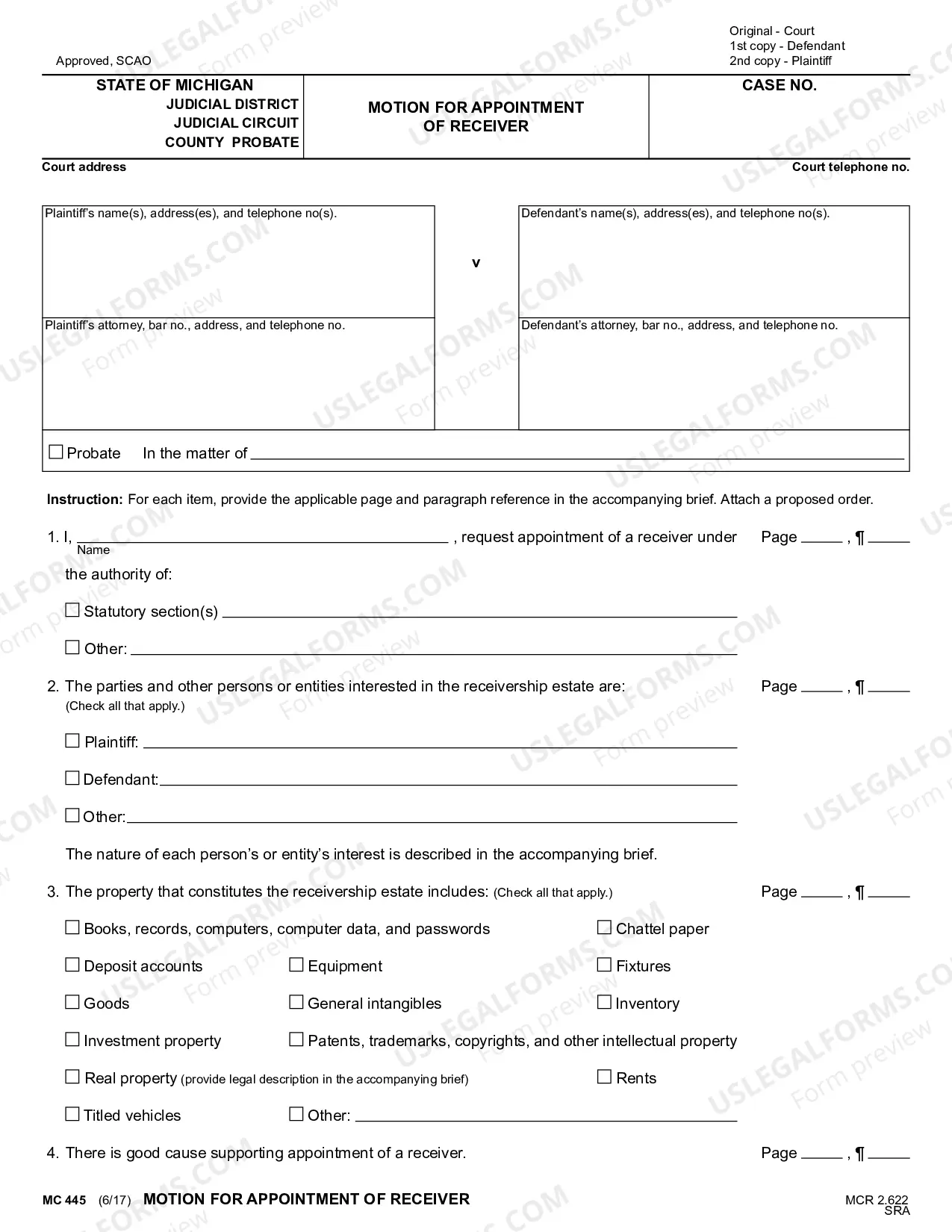
The Michigan Notice of Receiver's Application for Fees or Expenses (Receivership Estate) is a document used to notify creditors of a debtor's estate that a receiver has been appointed to manage the estate and is requesting payment of fees or expenses associated with the receivership. The document is typically filed with the court and must be served on all parties involved. The notice outlines the type of fees and expenses that may be requested, such as attorney fees, accounting fees, court costs, rental fees, employee wages, and other miscellaneous costs. There are two types of Michigan Notice of Receiver's Application for Fees or Expenses (Receivership Estate): 1) Initial Application for Fees or Expenses, and 2) Supplemental Application for Fees or Expenses. The Initial Application is used when a receiver is first appointed and outlines all the initial fees and expenses that the receiver is requesting to be paid from the estate. The Supplemental Application is typically filed when additional fees or expenses have been incurred and must be approved by the court.
Michigan Notice of Receiver's Application for Fees or Expenses (Receivership Estate)
Description
Get your form ready online
Our built-in tools help you complete, sign, share, and store your documents in one place.
Make edits, fill in missing information, and update formatting in US Legal Forms—just like you would in MS Word.
Download a copy, print it, send it by email, or mail it via USPS—whatever works best for your next step.
Sign and collect signatures with our SignNow integration. Send to multiple recipients, set reminders, and more. Go Premium to unlock E-Sign.
If this form requires notarization, complete it online through a secure video call—no need to meet a notary in person or wait for an appointment.
We protect your documents and personal data by following strict security and privacy standards.

Make edits, fill in missing information, and update formatting in US Legal Forms—just like you would in MS Word.

Download a copy, print it, send it by email, or mail it via USPS—whatever works best for your next step.

Sign and collect signatures with our SignNow integration. Send to multiple recipients, set reminders, and more. Go Premium to unlock E-Sign.

If this form requires notarization, complete it online through a secure video call—no need to meet a notary in person or wait for an appointment.

We protect your documents and personal data by following strict security and privacy standards.
Looking for another form?


How to fill out Michigan Notice Of Receiver's Application For Fees Or Expenses (Receivership Estate)?
If you’re seeking a method to correctly finish the Michigan Notice of Receiver's Application for Fees or Expenses (Receivership Estate) without employing a legal expert, then you’re in the perfect spot. US Legal Forms has established itself as the most comprehensive and trustworthy repository of official templates for every personal and business scenario. Every document you discover on our online platform is crafted in accordance with federal and state regulations, ensuring that your paperwork is organized.
Adhere to these straightforward instructions on how to acquire the ready-to-use Michigan Notice of Receiver's Application for Fees or Expenses (Receivership Estate).
Another fantastic aspect of US Legal Forms is that you will never misplace the paperwork you acquired - you can access any of your downloaded templates in the My documents section of your profile whenever you require it.
- Ensure the document you view on the page aligns with your legal circumstances and state laws by reviewing its text description or navigating through the Preview mode.
- Input the document title in the Search tab at the top of the page and select your state from the dropdown to locate another template in case of any discrepancies.
- Repeat the content verification and click Buy now when you are confident in the paperwork's compliance with all requirements.
- Log in to your account and click Download. Register for the service and choose the subscription plan if you do not already have one.
- Utilize your credit card or the PayPal option to acquire your US Legal Forms subscription. The document will be ready for download immediately afterward.
- Select the format in which you wish to receive your Michigan Notice of Receiver's Application for Fees or Expenses (Receivership Estate) and download it by clicking the corresponding button.
- Incorporate your template into an online editor to swiftly complete and sign it or print it out to prepare your hard copy manually.
Form popularity
FAQ
AN ACT to enact the receivership act; to provide for the appointment of receivers to take possession of commercial property of another and to receive, collect, care for, and dispose of the property or proceeds of the property; and to provide remedies related to the receiverships.
The term of the receivership is dependent on the length of the underlying case and can therefore range from a few months to a few years. In some case, the lender will choose to continually extend the foreclosure date in order to allow the property to be sold by the receiver, rather than in a foreclosure.
A receivership in Texas may be installed under rules of equity (?fairness?) or pursuant to a specific statute. Under equity, a receivership must be ?ancillary? to an otherwise apparently valid claim or remedy and to protect or preserve property during the pendency of a lawsuit.
What Happens When a Receiver Is Appointed? Once appointed, the receiver may sell the property and pay out the proceeds to a creditor to satisfy a judgment.
If a business has a secured loan with a creditor and defaults on payment, the creditor may have the right to appoint a receiver to recover their money. The business then goes into receivership when a receiver gains possession of the business's assets and liquidates them to recoup money owed to the secured creditor.
Powers of a Receiver A receiver can maintain a bank account, enter into leases, deeds, and contracts, and engage in any business activity that is deemed necessary and reasonable to ensure the maintenance of the property during the court process.
How long can a receivership last? The court determines the length of the receivership, but it can last up to 180 days. Under recent rules issued by the Texas Supreme Court, if a creditor wants to extend past the 180 days, they must show "good cause" for the extra time.