Assignment of Overriding Royalty Interest for Single Lease - Proportionate reduction
Overview of this form
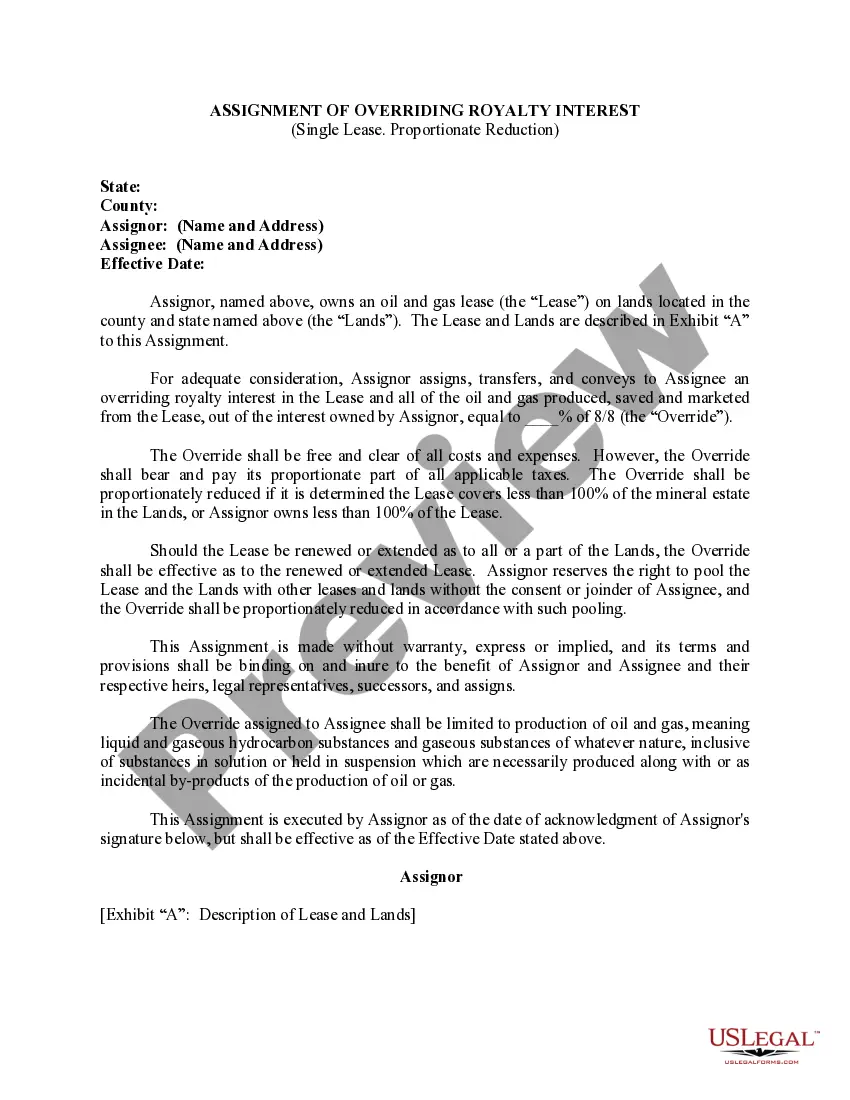
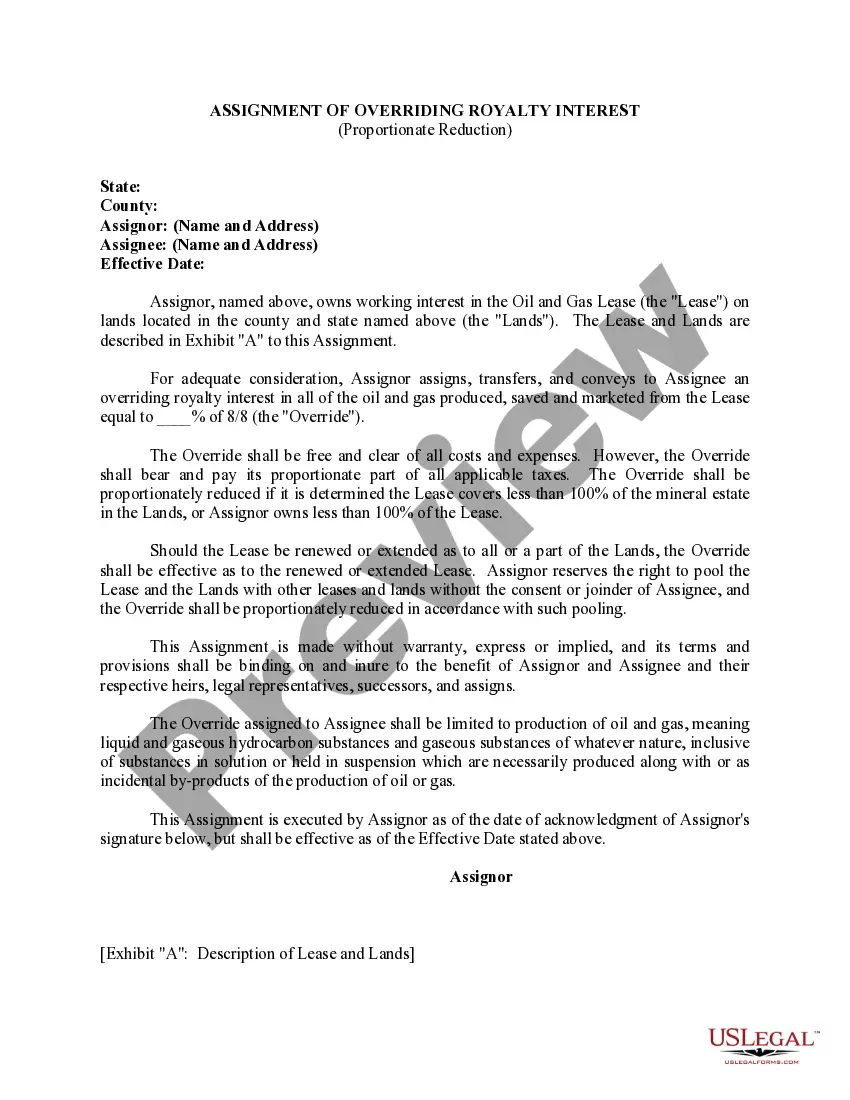
This Assignment of Overriding Royalty Interest for Single Lease - Proportionate Reduction is a legal document used to transfer a portion of an overriding royalty interest in an oil and gas lease. The form outlines the specifics of the interest being assigned, including its proportionate share and responsibilities related to costs and taxes. This form differs from similar documents by highlighting the proportionate reduction clause, which adjusts the overriding interest based on the mineral estate covered by the lease.
Main sections of this form
- Assignor and Assignee details, including name and address
- Effective date of the assignment
- Legal description of the Lease and Lands covered in Exhibit A
- Specification of the percentage of overriding royalty interest being assigned
- Conditions for proportionate reduction based on the mineral estate
- Legal stipulations regarding pooling of the lease and Reserved rights of the Assignor
When this form is needed
This form is used when an individual or entity (the Assignor) wishes to transfer a specific portion of their overriding royalty interest in an oil and gas lease to another party (the Assignee). It is particularly useful in situations where the lease covers less than the entire mineral estate, ensuring that the interest reflects the actual percentage owned. Use this form when negotiating overriding royalties to clarify the terms of the assignment and the proportionate reduction clause.
Intended users of this form
- Landowners or mineral rights owners wishing to assign a portion of their royalty interest
- Investors interested in acquiring overriding royalty interests in oil and gas leases
- Attorneys representing clients in real estate or oil and gas transactions
- Companies involved in oil and gas production who need to manage royalty interests
Completing this form step by step
- Identify the parties involved by entering the names and addresses of the Assignor and Assignee.
- Specify the effective date of the assignment.
- Detail the legal description of the lease and lands in Exhibit A.
- Enter the percentage of overriding royalty interest being assigned.
- Review the clause regarding proportionate reduction to ensure it reflects ownership accurately.
- Verify the signatures of both parties and include the date for acknowledgment.
Does this document require notarization?
This form usually doesn’t need to be notarized. However, local laws or specific transactions may require it. Our online notarization service, powered by Notarize, lets you complete it remotely through a secure video session, available 24/7.
Get your form ready online
Our built-in tools help you complete, sign, share, and store your documents in one place.
Make edits, fill in missing information, and update formatting in US Legal Forms—just like you would in MS Word.
Download a copy, print it, send it by email, or mail it via USPS—whatever works best for your next step.
Sign and collect signatures with our SignNow integration. Send to multiple recipients, set reminders, and more. Go Premium to unlock E-Sign.
If this form requires notarization, complete it online through a secure video call—no need to meet a notary in person or wait for an appointment.
We protect your documents and personal data by following strict security and privacy standards.

Make edits, fill in missing information, and update formatting in US Legal Forms—just like you would in MS Word.

Download a copy, print it, send it by email, or mail it via USPS—whatever works best for your next step.

Sign and collect signatures with our SignNow integration. Send to multiple recipients, set reminders, and more. Go Premium to unlock E-Sign.

If this form requires notarization, complete it online through a secure video call—no need to meet a notary in person or wait for an appointment.

We protect your documents and personal data by following strict security and privacy standards.
Common mistakes
- Failing to accurately describe the Lease and Lands in Exhibit A, which can lead to enforceability issues.
- Not specifying the correct percentage of overriding royalty interest being assigned.
- Overlooking the conditions for proportionate reduction that may impact the assigned interest later.
- Not obtaining necessary signatures or dates, leading to incomplete documentation.
Why use this form online
- Convenient access to the form allows for quick completion and customization.
- Downloadable format enables users to fill the form at their own pace.
- Reliability of attorney-drafted documents ensures peace of mind regarding legal compliance.
- Ability to store completed forms securely for future reference.
Legal use & context
- This form is legally recognized as a valid method of transferring royalty interests in an oil and gas lease.
- Ensure compliance with local laws governing the assignment of such interests to avoid potential disputes.
- Understand the implications of the proportionate reduction to safeguard against unexpected losses in royalty payments.
Main things to remember
- The Assignment of Overriding Royalty Interest allows for the transfer of oil and gas production rights.
- Proper completion of this form can prevent future legal problems related to leasing agreements.
- Be clear about the percentage of interest transferred and the implications of any reductions.
Looking for another form?
Form popularity
FAQ
An overriding royalty interest is the right to receive revenue from the production of oil and gas from a well. The overriding royalty is carved out of the lessee's (operator's) working interest and entitles its owner to a fraction of production.
An overriding royalty interest generally entitles the owner of the interest to a specified share of the oil and gas produced under the terms of the lease. In Texas and in many other oil-producing states, overriding royalty interests are generally treated as interests in real estate.
Overriding Royalty Interest (ORRI) a percentage share of production, or the value derived from production, which is free of all costs of drilling and producing, and is created by the lessee or working interest owner and paid by the lessee or working interest owner.
A gross overriding royalty can be created on a mine which produces a product like petroleum in that it can be sold without alteration of its basic character.The costs of smelting and refining the gold will reduce the proceeds to the mine owner, a percentage of which will be paid as royalty.
The value of an overriding royalty interest is simple to calculate since it is a percent of the working interest lease. The ORRI value is based on production on the acreage leased by the working interest.
Net revenue is the amount that is shared among the property owners. To determine net revenue interest, multiply the royalty interest by the owner's shared interest. For example, if you have a 5/16 royalty, your net royalty interest would be 25% multiplied by 5/16, which equals 7.8125% calculated to four decimal places.