Idaho Organizing your Personal Assets Package
What this form package covers
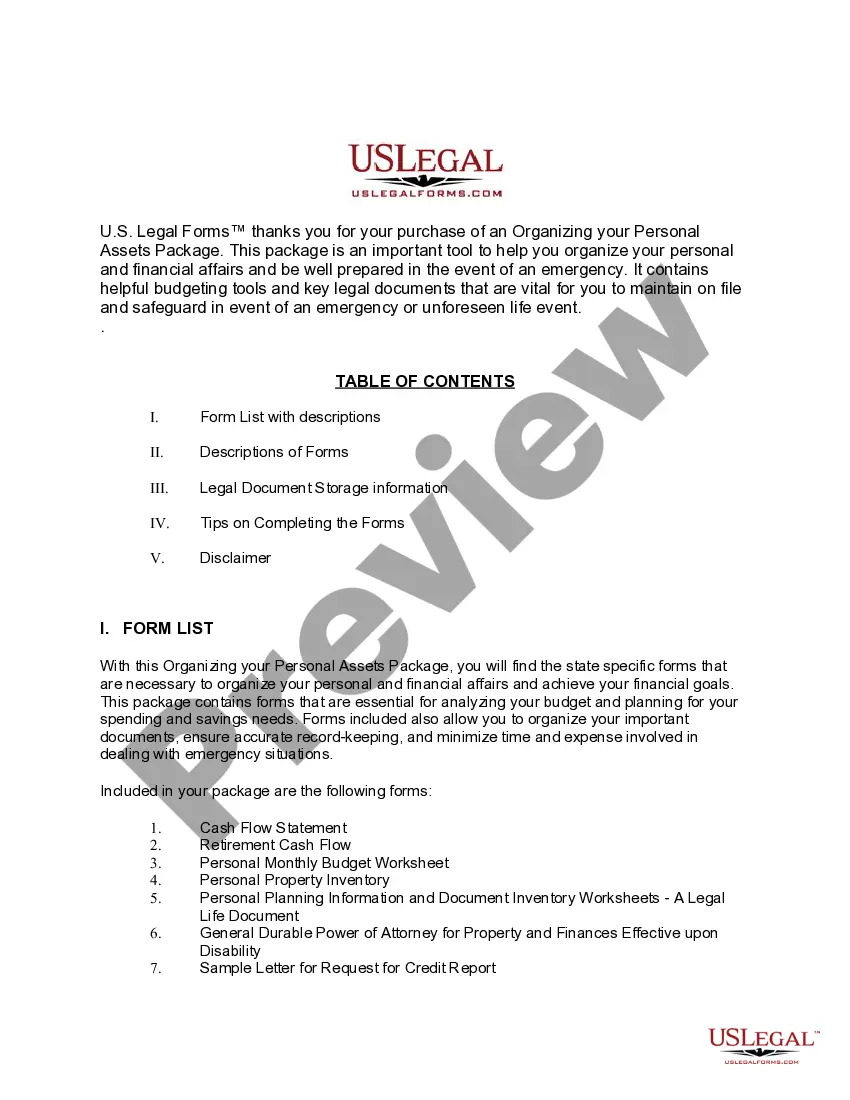
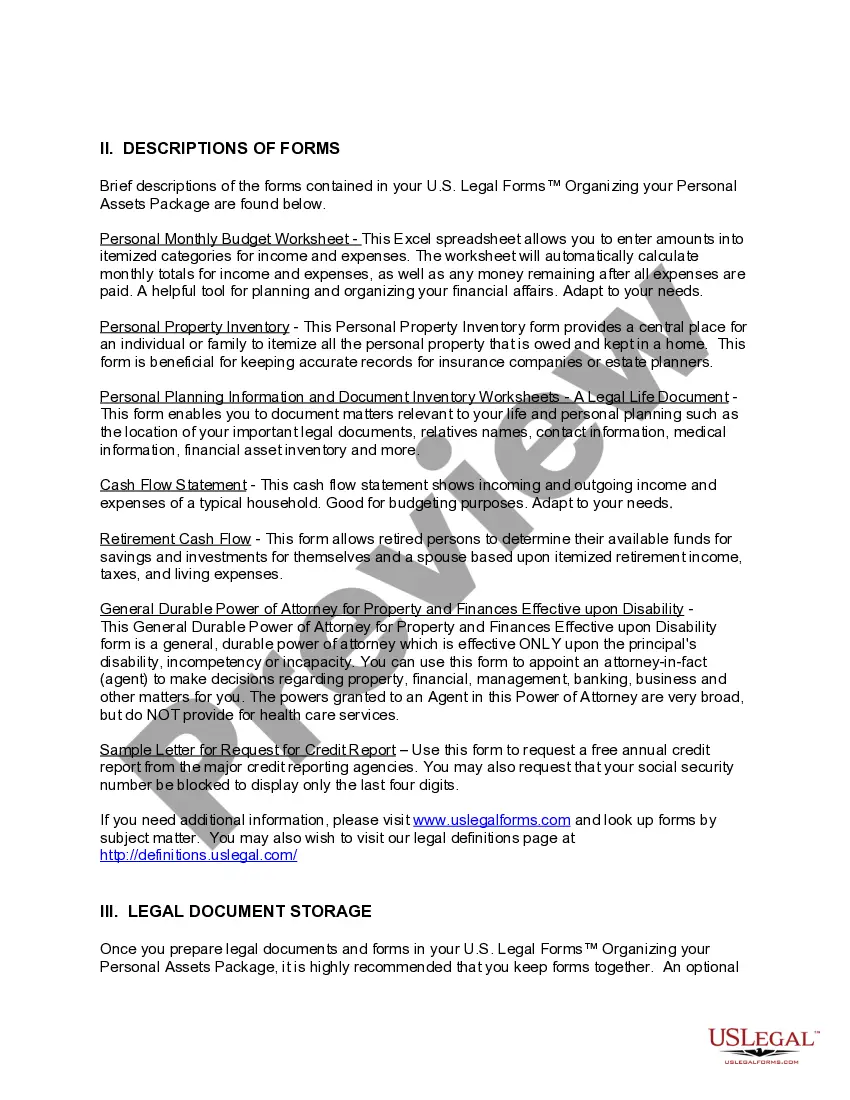
The Idaho Organizing Your Personal Assets Package provides essential legal forms designed to help individuals and families manage their personal and financial affairs effectively. This package includes state-specific forms that enable you to analyze your budget, plan your spending and savings, and organize important documents. Unlike similar packages, this one focuses not only on budgeting but also on ensuring accurate record-keeping for emergencies, making it an invaluable tool for achieving your financial goals.
What’s included in this form package
- General Durable Power of Attorney for Property and Finances or Financial Effective upon Disability
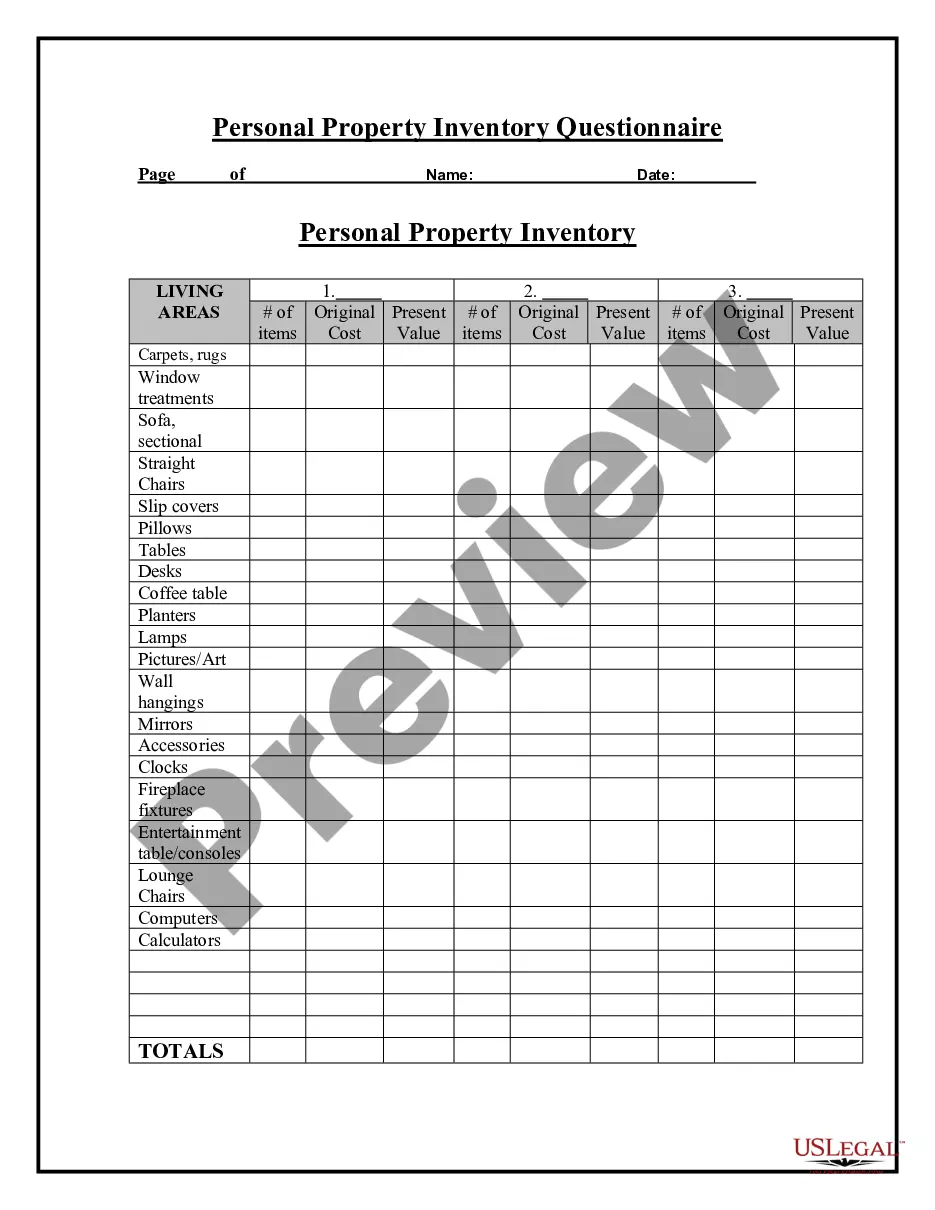
- Personal Property Inventory
- Sample Letter for Request for Free Credit Report Allowed by Federal Law
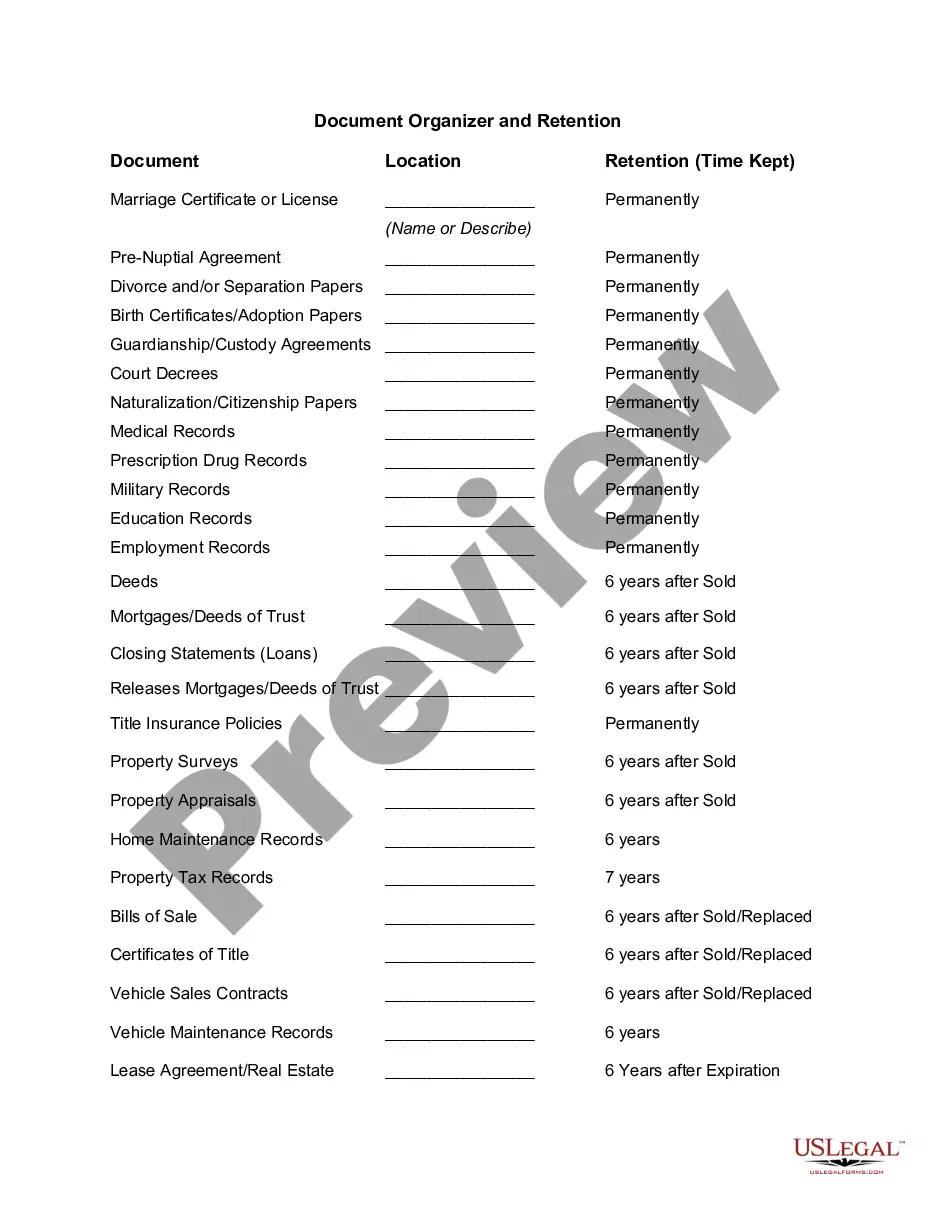
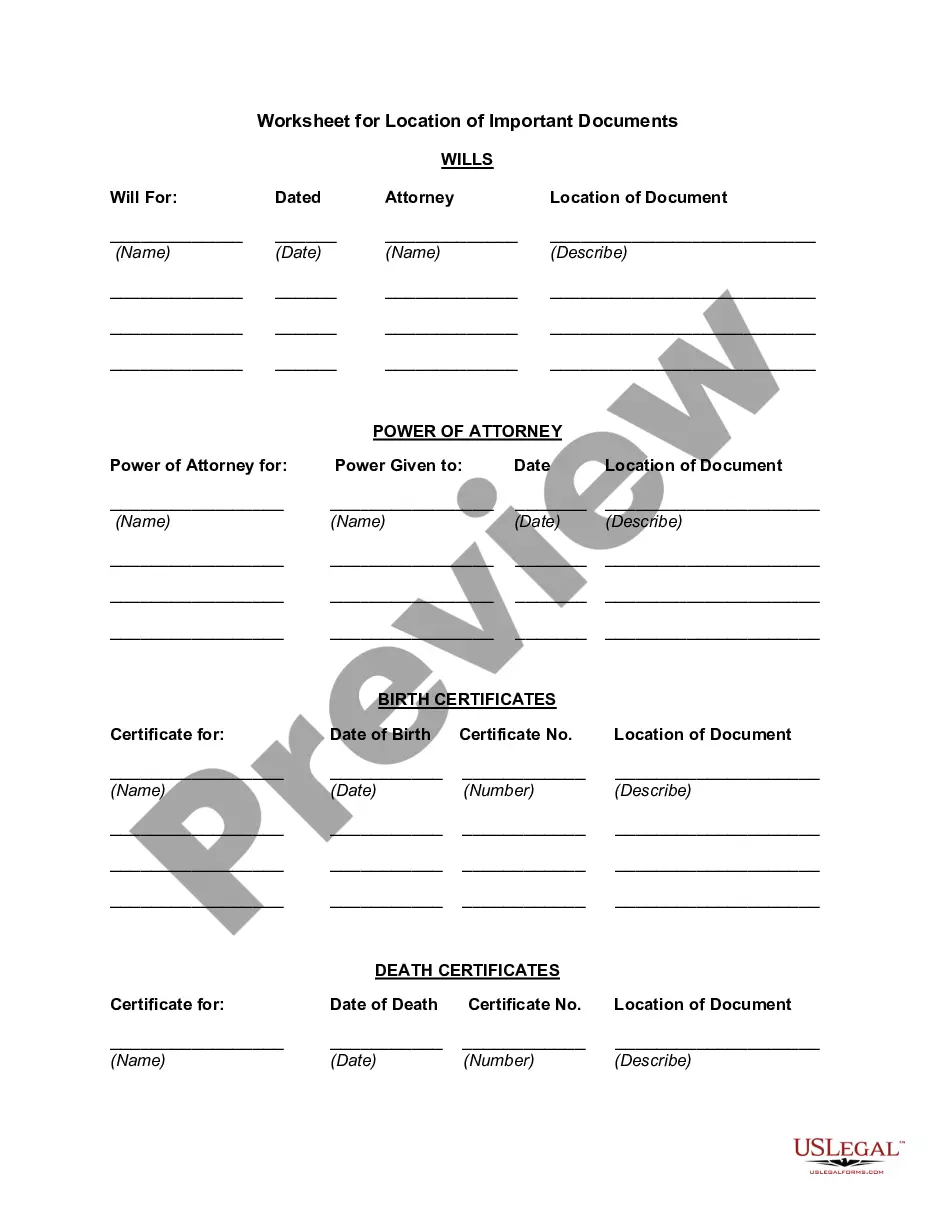
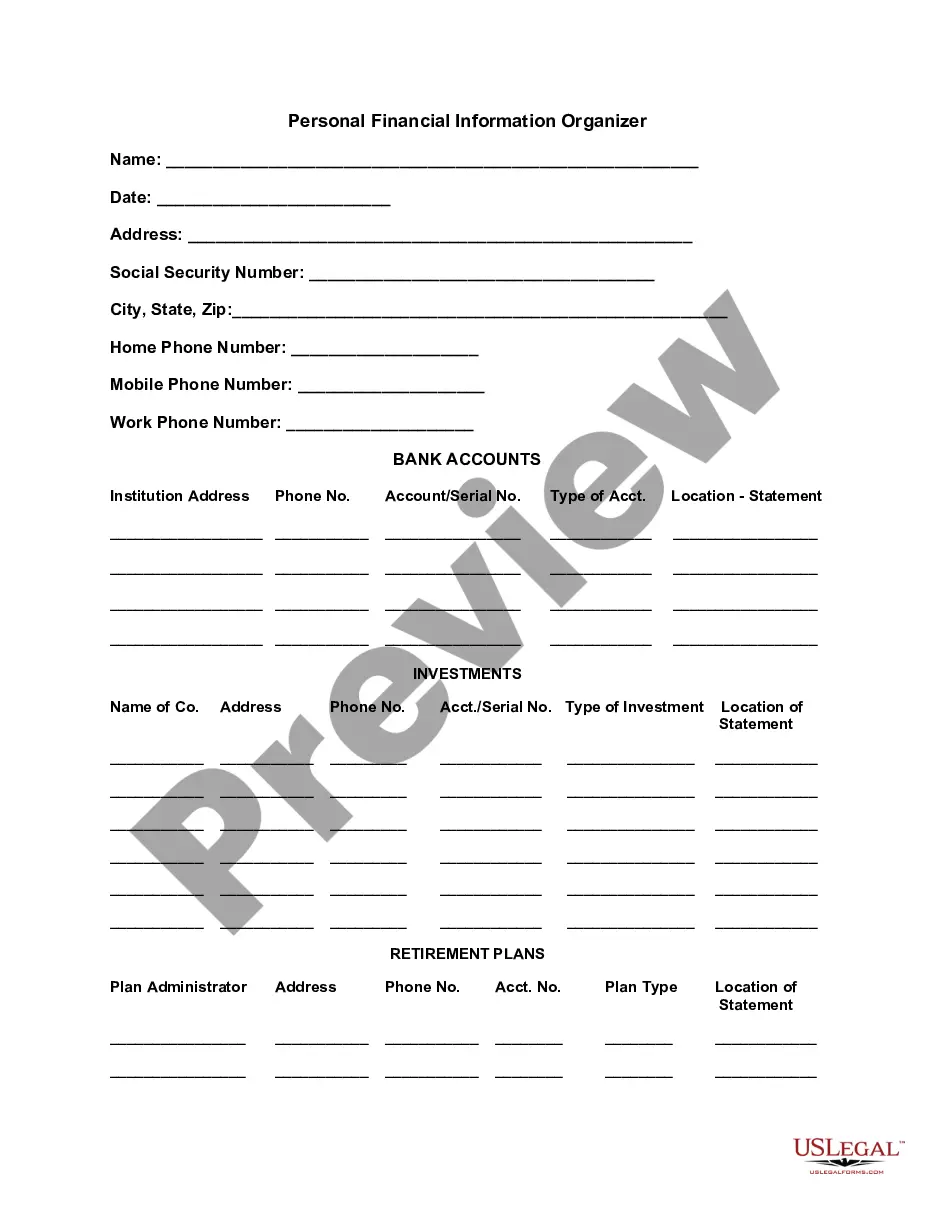
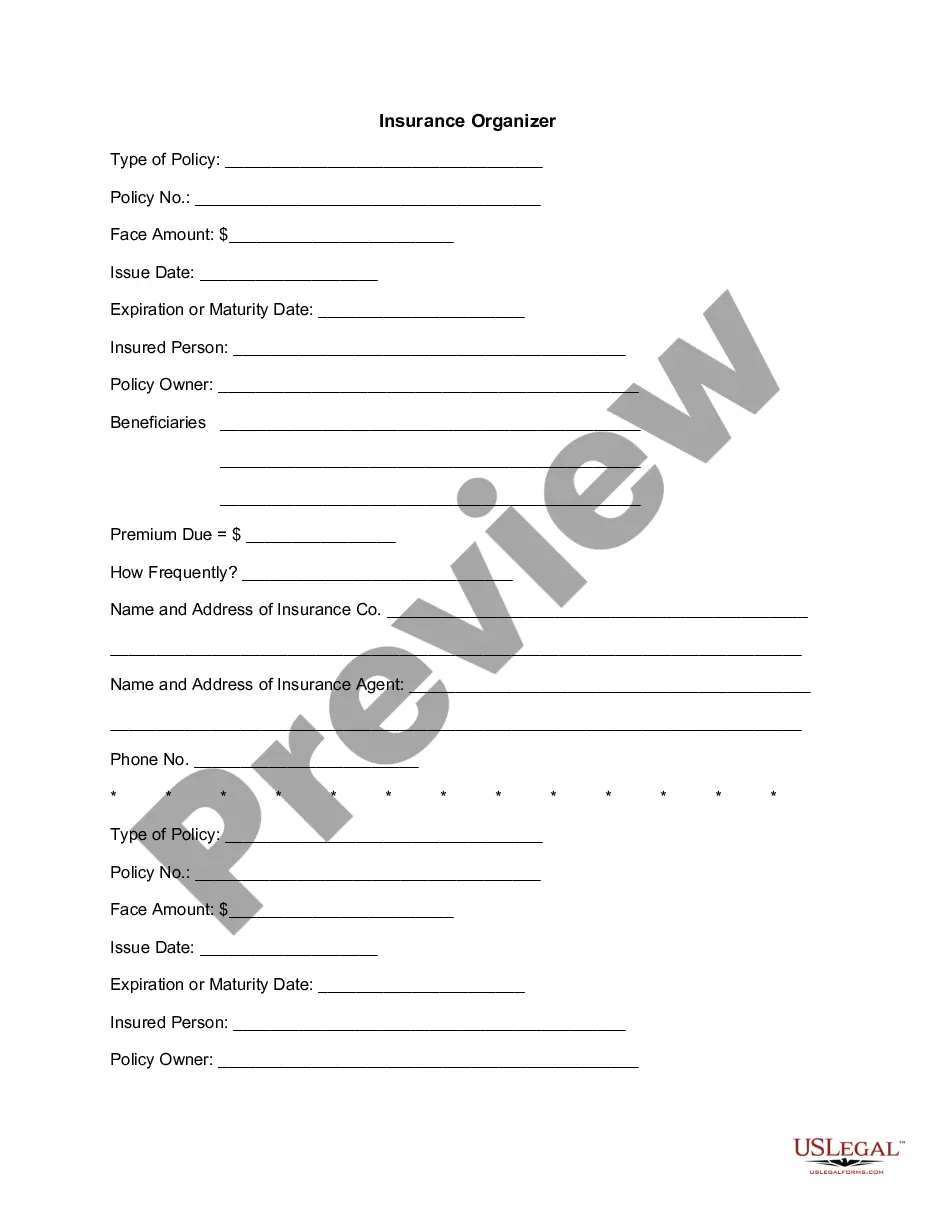
- Personal Planning Information and Document Inventory Worksheets - A Legal Life Document
- Cash Flow Statement
- Retirement Cash Flow
- Personal Monthly Budget Worksheet
When to use this document
This package is particularly useful in the following scenarios:
- You want to assess and improve your budget.
- You're preparing for retirement and need to understand your cash flow.
- You want to organize your personal property and important documents.
- You need to establish a general durable power of attorney for financial matters.
- You wish to request your credit report and ensure your finances are in order.
Who should use this form package
- Individuals looking to better manage their finances.
- Families wanting to keep accurate records of their personal property.
- Retirees needing to organize their retirement income.
- Anyone needing a power of attorney for financial decisions.
- Individuals seeking to request a credit report for personal finance management.
Instructions for completing these forms
- Review all included forms to understand their purpose and how they apply to your situation.
- Gather the necessary information, including financial records and personal documentation.
- Fill out each form, making sure to enter accurate and complete information.
- Store completed forms securely, in a safe location such as a bank safe deposit box or personal home safe.
- Consult a legal professional if you have questions about any of the forms.
Notarization details for included forms
Notarization is required for one or more forms in this package. US Legal Forms provides secure online notarization powered by Notarize, allowing you to complete the process through a verified video call.
Get your form ready online
Our built-in tools help you complete, sign, share, and store your documents in one place.
Make edits, fill in missing information, and update formatting in US Legal Forms—just like you would in MS Word.
Download a copy, print it, send it by email, or mail it via USPS—whatever works best for your next step.
Sign and collect signatures with our SignNow integration. Send to multiple recipients, set reminders, and more. Go Premium to unlock E-Sign.
If this form requires notarization, complete it online through a secure video call—no need to meet a notary in person or wait for an appointment.
We protect your documents and personal data by following strict security and privacy standards.

Make edits, fill in missing information, and update formatting in US Legal Forms—just like you would in MS Word.

Download a copy, print it, send it by email, or mail it via USPS—whatever works best for your next step.

Sign and collect signatures with our SignNow integration. Send to multiple recipients, set reminders, and more. Go Premium to unlock E-Sign.

If this form requires notarization, complete it online through a secure video call—no need to meet a notary in person or wait for an appointment.

We protect your documents and personal data by following strict security and privacy standards.
Common mistakes
- Failing to gather all necessary documentation before starting to complete the forms.
- Leaving sections of the forms blank or incorrectly filled out.
- Not storing completed forms in a secure location.
- Neglecting to review the forms for accuracy after filling them out.
Why complete this package online
- Convenience of downloading and filling out forms from home at your convenience.
- Ability to edit forms easily if any changes are needed.
- Access to attorney-drafted forms, ensuring reliability and compliance with state laws.
Main things to remember
- This package helps organize your personal assets and financial affairs effectively.
- It includes essential forms for budgeting, property inventory, and power of attorney.
- Designed specifically for Idaho residents, ensuring compliance with state law.
Looking for another form?
Form popularity
FAQ
Wives : A wife is entitled to an equal share of her husband's property like other entitled heirs. If there are no sharers, she has full right to the entire property.She is also entitled to maintenance, support and shelter from husband, and if staying in a joint family, from the family.
The duration of payments is determined by a judge in Idaho family court. Alimony length is usually based on length of marriage - one commonly used standard for alimony duration is that 1 year of alimony is paid every three years of marriage (however, this is not always the case in every state or with every judge).
Idaho is a fault and no-fault state. It is not necessary to show that either one of the parties was at fault. One statutory basis for a divorce in Idaho is that there is no reasonable likelihood that the marriage can be preserved and, therefore, the marriage is irretrievably broken.
Since Idaho is a "Community Property" state, all marital property will be divided in a 50-50 fashion according to the court unless agreed to otherwise by the divorcing spouses. This means that everything that is considered "up for grabs" in the divorce will be distributed equally to each spouse.
Equitable distribution is a method of dividing property at the time of divorce. All states except for Arizona, California, Idaho, Louisiana, Nevada, New Mexico, Texas, Washington and Wisconsin follow the principles of equitable distribution.
Because Idaho is a community property state, there is a law that presumes when you are married that all property that you have in the marriage is owned jointly by both you and your spouse. Community property is simply that, property that is owned jointly and equally by both the husband and the wife.
Idaho has community property laws providing that all of the assets and debts a couple acquires during marriage belong equally to both spouses. This means that in a divorce, the division of such propertyor the value of the property awarded to each spousemust also be substantially equal.
Because Idaho is a community property state, there is a law that presumes when you are married that all property that you have in the marriage is owned jointly by both you and your spouse. Community property is simply that, property that is owned jointly and equally by both the husband and the wife.