Arizona Writ of Attachment
What is this form?
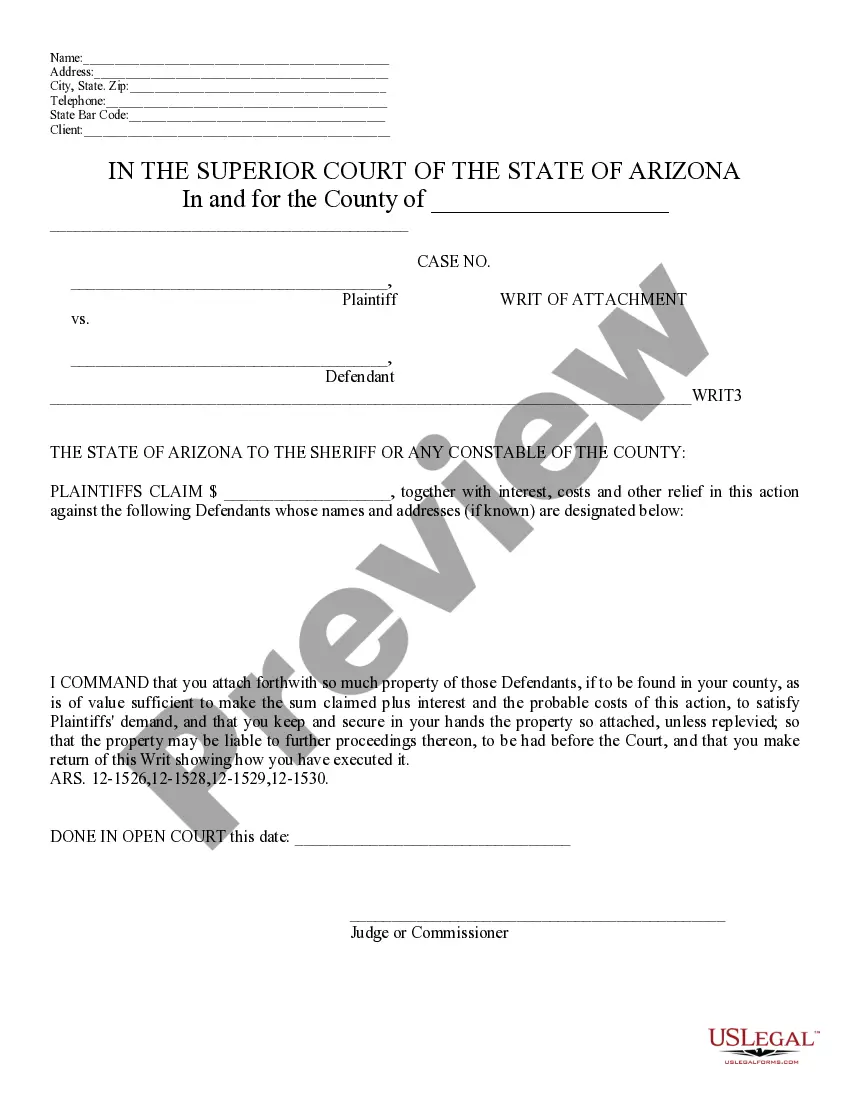
A writ of attachment is a legal document issued by a court that allows the sheriff to seize property owned by a defendant in order to secure a monetary judgment in favor of the plaintiff. This document is crucial in ensuring that the plaintiff can collect what they are owed if the court rules in their favor. Unlike other remedies, such as a lien or a regular judgment, a writ of attachment enables immediate action to seize property before the case is fully resolved.
Form components explained
- Address fields for both parties involved in the case.
- Case number and title of the lawsuit.
- A command to the sheriff to seize the specified property.
- Information on the plaintiff's claim amount, including interest and costs.
- Details regarding the retention and security of the seized property.
- Signature line for a judge or commissioner to validate the writ.
When this form is needed
This form is typically used when a plaintiff has a legal claim against a defendant and seeks assurance that the defendant's assets will be available to satisfy a potential judgment. Common scenarios include situations where the defendant may attempt to sell or hide assets before the court decision is made. It's particularly relevant in cases involving debts, unpaid contracts, or other financial disputes.
Who this form is for
- Individuals or businesses who are plaintiffs in a legal case seeking a monetary judgment.
- Legal representatives acting on behalf of a plaintiff.
- Parties looking to secure assets prior to the resolution of their case.
Steps to complete this form
- Enter the address and contact information for both the plaintiff and defendant.
- Fill in the case number and title at the top of the form.
- Specify the amount the plaintiff is claiming, including interest and costs.
- Provide a detailed description of the property to be attached.
- Have the form signed and dated by a judge or court commissioner to validate it.
Does this form need to be notarized?
In most cases, this form does not require notarization. However, some jurisdictions or signing circumstances might. US Legal Forms offers online notarization powered by Notarize, accessible 24/7 for a quick, remote process.
Get your form ready online
Our built-in tools help you complete, sign, share, and store your documents in one place.
Make edits, fill in missing information, and update formatting in US Legal Forms—just like you would in MS Word.
Download a copy, print it, send it by email, or mail it via USPS—whatever works best for your next step.
Sign and collect signatures with our SignNow integration. Send to multiple recipients, set reminders, and more. Go Premium to unlock E-Sign.
If this form requires notarization, complete it online through a secure video call—no need to meet a notary in person or wait for an appointment.
We protect your documents and personal data by following strict security and privacy standards.

Make edits, fill in missing information, and update formatting in US Legal Forms—just like you would in MS Word.

Download a copy, print it, send it by email, or mail it via USPS—whatever works best for your next step.

Sign and collect signatures with our SignNow integration. Send to multiple recipients, set reminders, and more. Go Premium to unlock E-Sign.

If this form requires notarization, complete it online through a secure video call—no need to meet a notary in person or wait for an appointment.

We protect your documents and personal data by following strict security and privacy standards.
Avoid these common issues
- Failing to accurately describe the property to be attached.
- Leaving out critical information, such as the case number or plaintiffs' claims.
- Not obtaining the necessary signature from a judge or commissioner.
Benefits of using this form online
- Convenient access to the form from any location.
- Easy to edit and customize to suit your specific case needs.
- Reliable, attorney-drafted templates ensure legal compliance.
What to keep in mind
- A writ of attachment secures property to satisfy court judgments.
- It is essential for plaintiffs who want to ensure availability of assets for collection.
- Complete the form accurately to avoid delays or complications in your case.
Looking for another form?





Form popularity
FAQ
A writ of restitution in Arizona enables a landlord to regain possession of rental property after a legal eviction process. Once issued, this writ authorizes law enforcement to remove a tenant from the premises. It serves as an important measure for landlords seeking to reclaim their property and ensure compliance with court orders. If you are navigating similar issues in Arizona, you might also benefit from understanding the Arizona writ of attachment for securing debts.
Common grounds for habeas corpus relief include illegal detention, lack of due process, and ineffective legal representation. A petitioner may argue that their confinement violates constitutional rights or that new evidence casts doubt on their guilt. This writ serves as an essential tool for individuals seeking justice and fairness in legal proceedings. In similar circumstances, exploring the Arizona writ of attachment may provide additional insights into resolving disputes.
Habeas corpus protects individuals by demanding an explanation for their detention. It guarantees that no one can be imprisoned without legal justification. This fundamental right plays a crucial role in maintaining personal freedoms. When dealing with legal matters, it’s useful to also consider how the Arizona writ of attachment can affect financial obligations.
In Arizona, a writ of habeas corpus serves as a protective measure for individuals confined to detention facilities. This legal action allows individuals to seek relief from unlawful restraint and ensures their right to a fair trial. By filing for this writ, detainees can compel the authorities to justify their imprisonment. Understanding legal options like the Arizona writ of attachment may also help in related situations.
A writ of execution in Arizona is an order from the court that allows a creditor to enforce a judgment. This writ enables the seizure of a debtor's property to satisfy a court’s judgment. When a court rules in favor of a creditor, this is a crucial mechanism to recover owed amounts. If you’re involved in a legal case concerning property and debts, the Arizona writ of attachment might also come into play.
The primary purpose of a writ of habeas corpus is to protect individual freedom against unlawful detention. It allows a person to challenge the legality of their imprisonment before a court. This writ ensures that no one can be held without just cause, thereby safeguarding personal liberties. For those navigating legal complexities in Arizona, familiarity with the Arizona writ of attachment can also be important.
A writ of garnishment in Arizona is a legal tool that allows a creditor to collect a debt directly from a third party, typically an employer or a bank. This process helps creditors seize funds or wages owed to a debtor. Essentially, through this writ, creditors can ensure they receive payments that are rightfully theirs. If you are facing issues with collecting debts, understanding the Arizona writ of attachment could also be beneficial.
To obtain a pre-judgment writ of attachment in Arizona, you must demonstrate that you have a valid claim against the defendant and that there is a risk of asset dissipation. This involves providing sufficient evidence to convince the court that your claim is likely to succeed. Additionally, you may need to show that the attachment is necessary to secure the judgment you may receive. For comprehensive guidance on navigating the Arizona Writ of Attachment process, consider using the resources available on the US Legal Forms platform.
Yes, judgments do expire in Arizona. Generally, a judgment is enforceable for a period of 5 years. After this time, you may need to renew the judgment in order to continue collection efforts. US Legal Forms provides helpful tools to remind you of these timelines and to assist you with the renewal process whenever necessary.
The statute of writ of execution in Arizona governs the process of enforcing judgments by allowing a creditor to seize a debtor's property. Under Arizona law, a writ of execution remains valid for 90 days after its issuance. If necessary, you may request an extension of this period to fully enforce the judgment. For assistance in navigating this process and obtaining the correct forms, US Legal Forms is an excellent resource.