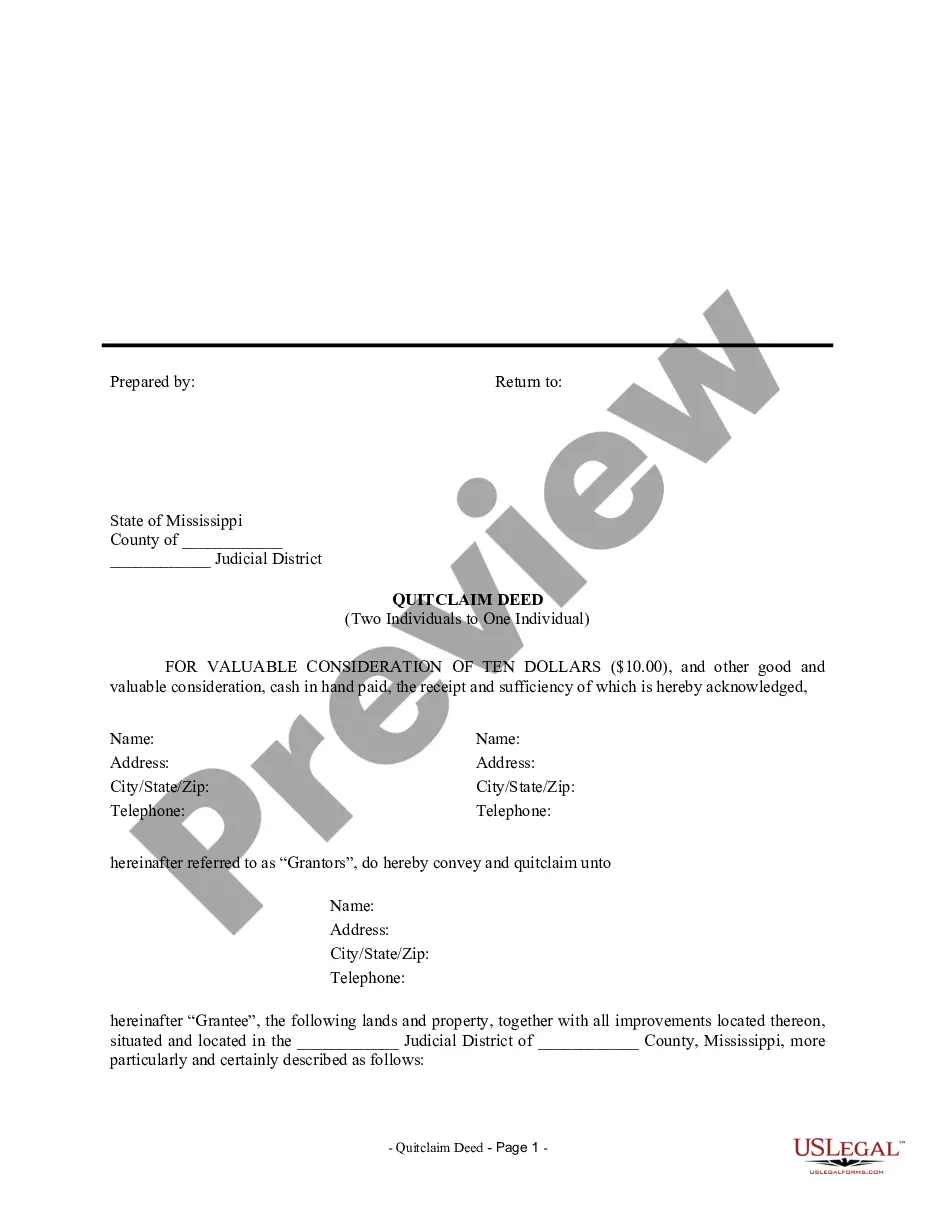
Louisiana Motion to Fix Case for Trial, with Certificate of Readiness for Trial
What this document covers
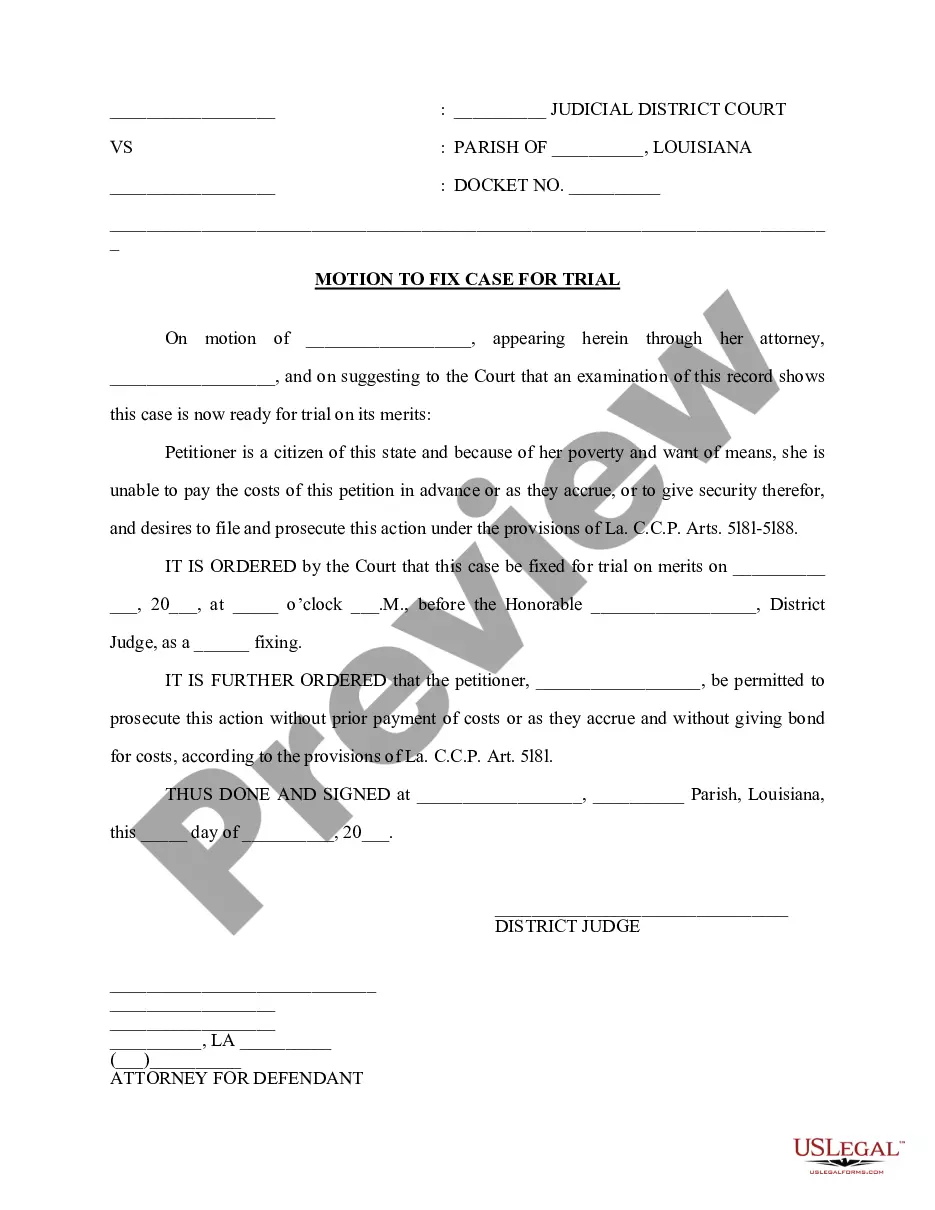
The Motion to Fix Case for Trial, with Certificate of Readiness for Trial is a legal document used in civil cases. This motion allows a party, particularly one facing financial hardship, to pursue their case without having to pay the associated costs in advance. This form also requests that the court schedule the case for trial on its merits, streamlining the legal process for those who may not have the financial means to cover upfront legal expenses.
Main sections of this form
- Petitioner Information: Details about the party filing the motion, including their legal representation.
- Declaration of Poverty: A statement confirming the petitioner's inability to pay court costs due to financial hardship.
- Request for Trial Date: Specifies the requested date and time for the trial to occur.
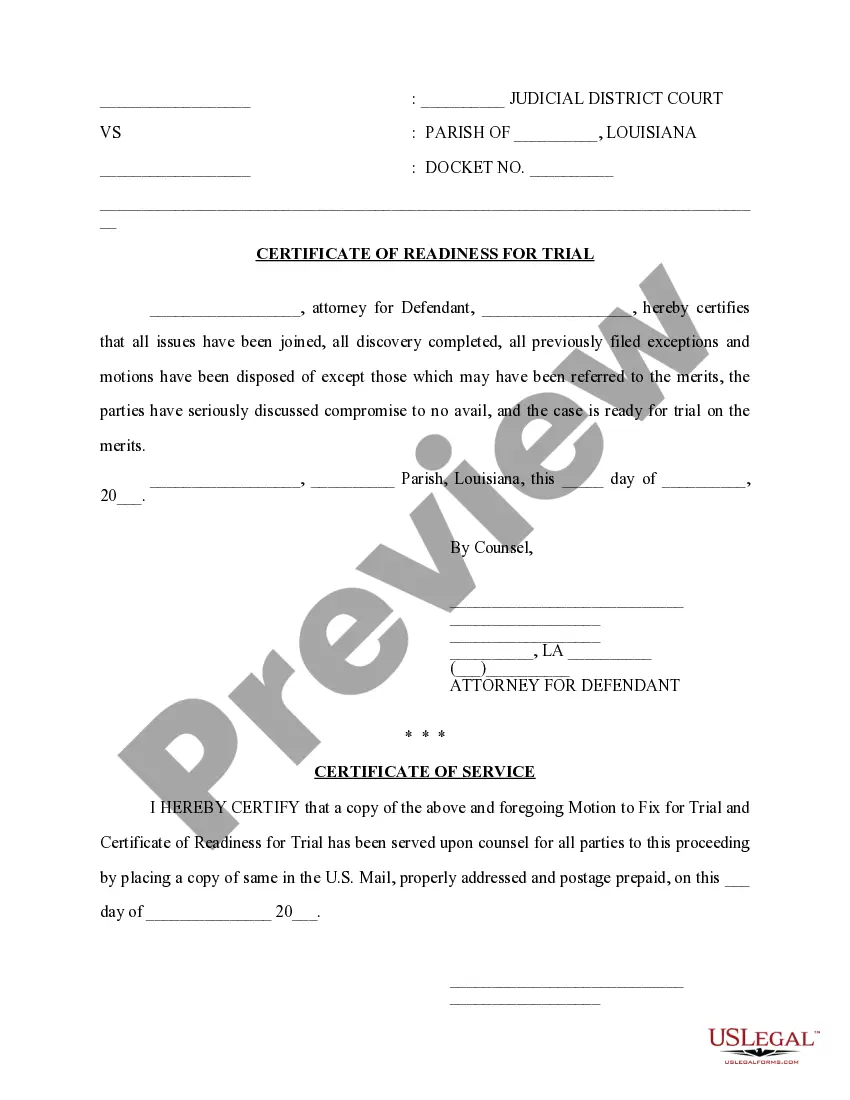
- Certificate of Readiness: Confirms that all preliminary matters, such as discovery and motions, have been completed.
- Order by the Court: An official court order granting the motion for trial scheduling and waiving of costs.
When this form is needed
This form is typically used when an individual or organization has initiated a civil lawsuit but lacks the financial resources to pay court costs as the case progresses. It is appropriate when the petitioner feels the case is ready for trial and seeks to ensure that their financial situation does not prevent them from pursuing justice in court.
Who can use this document
- Individuals who have initiated a civil case and are experiencing financial difficulties.
- Parties who believe their case is prepared for trial and want to avoid delays due to financial constraints.
- Legal representatives filing motions on behalf of clients who meet the financial eligibility criteria.
How to prepare this document
- Identify the parties involved, including the petitioner and the attorney.
- Complete the declaration of poverty to justify the request for costs to be waived.
- Specify the desired trial date and time in the provided sections.
- Ensure all relevant sections for the Certificate of Readiness are filled out to affirm that the case is ready for trial.
- Attach the Certificate of Service to confirm that all involved parties have been notified.
Is notarization required?
This form does not typically require notarization unless specified by local law. However, it is recommended to check local court requirements for any additional steps.
Get your form ready online
Our built-in tools help you complete, sign, share, and store your documents in one place.
Make edits, fill in missing information, and update formatting in US Legal Forms—just like you would in MS Word.
Download a copy, print it, send it by email, or mail it via USPS—whatever works best for your next step.
Sign and collect signatures with our SignNow integration. Send to multiple recipients, set reminders, and more. Go Premium to unlock E-Sign.
If this form requires notarization, complete it online through a secure video call—no need to meet a notary in person or wait for an appointment.
We protect your documents and personal data by following strict security and privacy standards.

Make edits, fill in missing information, and update formatting in US Legal Forms—just like you would in MS Word.

Download a copy, print it, send it by email, or mail it via USPS—whatever works best for your next step.

Sign and collect signatures with our SignNow integration. Send to multiple recipients, set reminders, and more. Go Premium to unlock E-Sign.

If this form requires notarization, complete it online through a secure video call—no need to meet a notary in person or wait for an appointment.

We protect your documents and personal data by following strict security and privacy standards.
Typical mistakes to avoid
- Failing to provide accurate financial information in the declaration of poverty.
- Not confirming the completion of all necessary pre-trial procedures before submitting the motion.
- Leaving out signatures from the attorney and the party involved, which can invalidate the submission.
Why use this form online
- Convenience of filling out the form from anywhere at any time.
- Immediate access to downloadable templates drafted by licensed attorneys.
- Ability to edit and customize the form before submission to the court.
Legal use & context
- This form is legally binding once approved by the court.
- It enables individuals who are financially disadvantaged to access the court system.
- In Louisiana, it affirms the courtâs recognition of the petitionerâs rights to a fair trial despite economic challenges.
Looking for another form?

Form popularity
FAQ
A Pretrial Conference is an informal hearing where both the defense and the prosecution meet with the judge and discuss case status. It is often referred to as a readiness conference because the parties must tell the judge whether they are ready for trial or whether more time is needed.
A trial readiness conference, often known as a pretrial conference or settlement conference, is a court proceeding where the defense counsel and prosecutor discuss the facts of a criminal case and either agree to resolve the case or not.
A trial setting conference is a court hearing aimed to determined whether or not the parties are ready to proceed to trial. If so, the court will set the date for trial.
Voir Dire. Voir Dire is a fancy French word used to name jury selection. Opening Statement. After the jury is empaneled, the trial will begin with opening statements. State's Case in Chief. After the opening statements the state is required to present its case. The Defense Case. State's Rebuttal. Closing Arguments. Verdict.
A Pretrial Conference is an informal hearing where both the defense and the prosecution meet with the judge and discuss case status. It is often referred to as a readiness conference because the parties must tell the judge whether they are ready for trial or whether more time is needed.
Readiness Hearings The court will hold a readiness hearing, known in some cases as an omnibus hearing, sometime between a few weeks to a few days before the scheduled trial date. The purpose of this hearing is to address or resolve pre-trial motions, review discovery, and take care of any other pre-trial matters.
Step 1: Arraignment. The first step in a criminal case is a court appearance called an arraignment, in which the charges against the defendant are read before a judge. Step 2: Preliminary Hearing. Step 3: 2nd Arraignment (Superior Court) Step 4: Pretrial Hearing & Motions. Step 5: Jury Trial.
A trial setting conference is a hearing where the court expects each spouse's lawyer to explain the case's status, what issues have resolved or may soon resolve and whether the case is ready for trial.