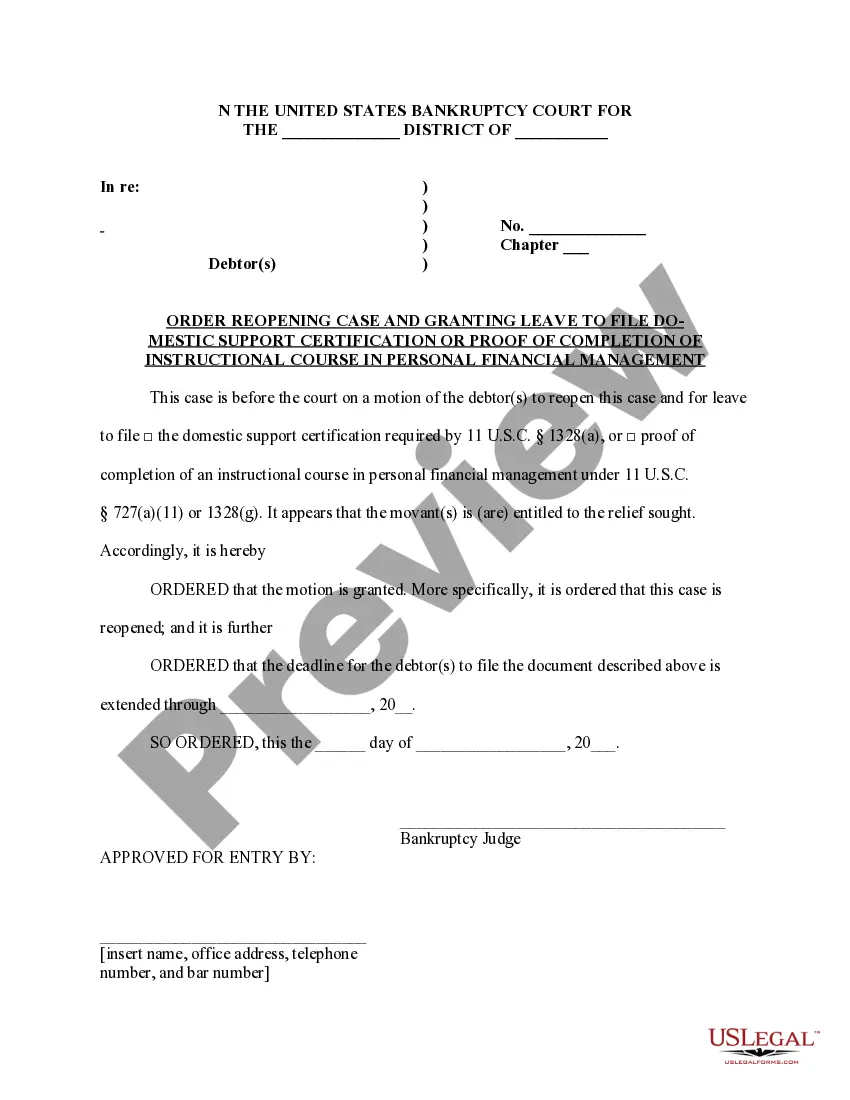
Motion to reopen case and for leave to file domestic support certification or proof of completion of instructional course in personal financial management
Understanding this form
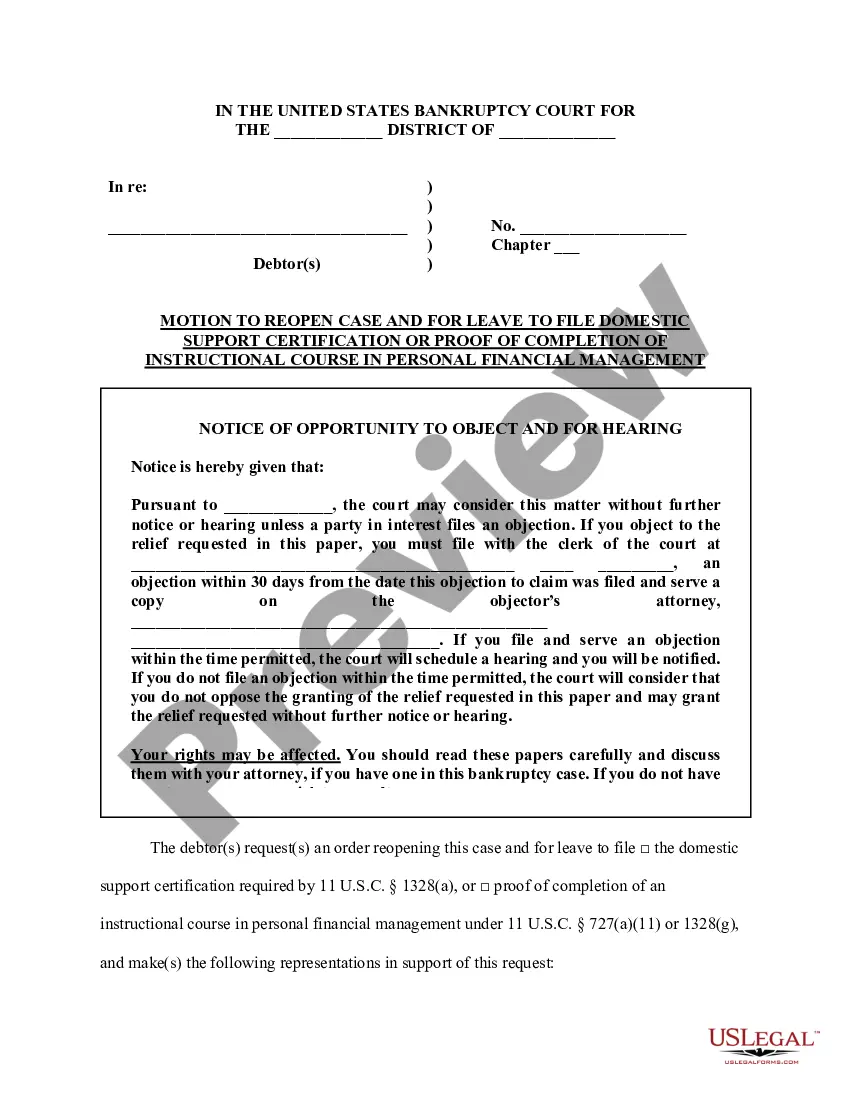
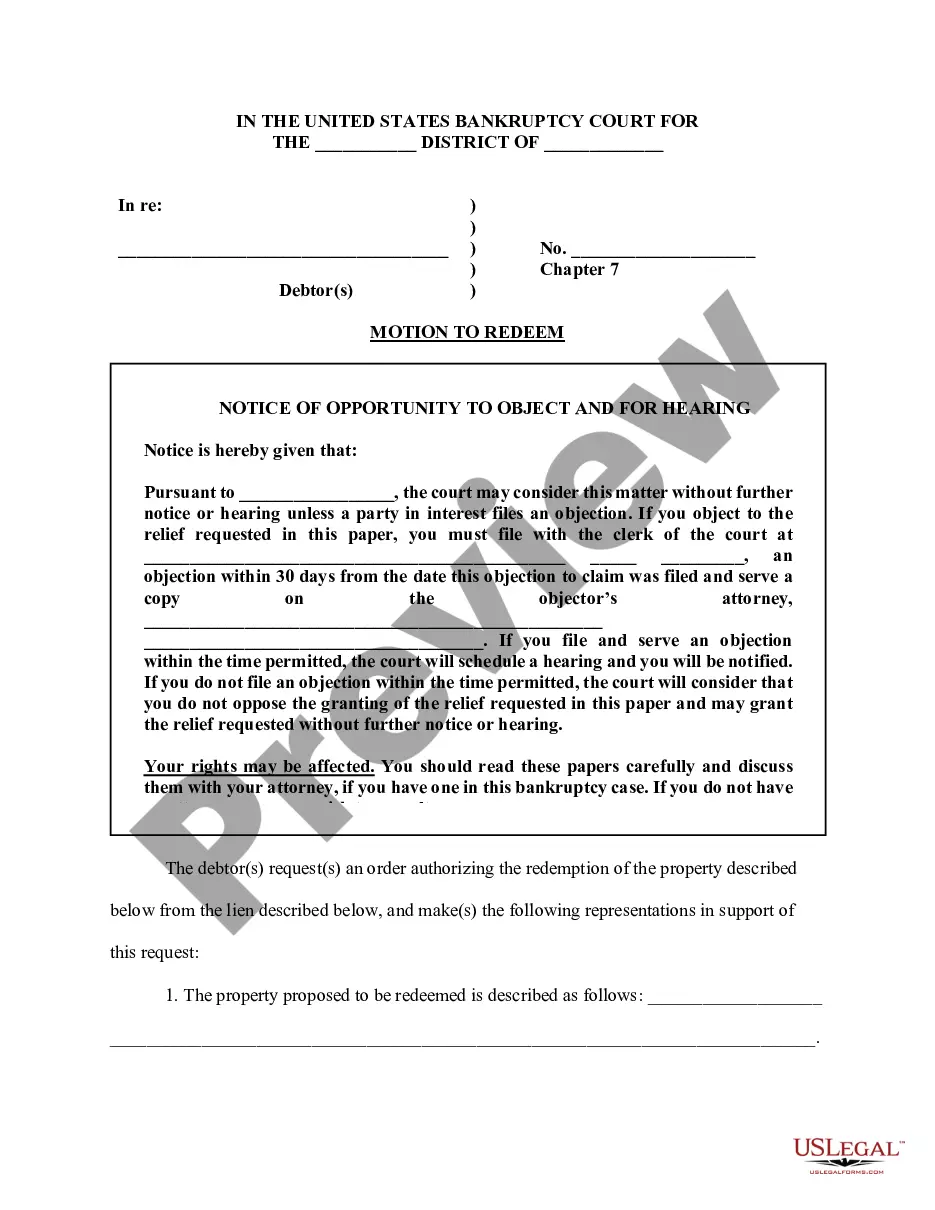
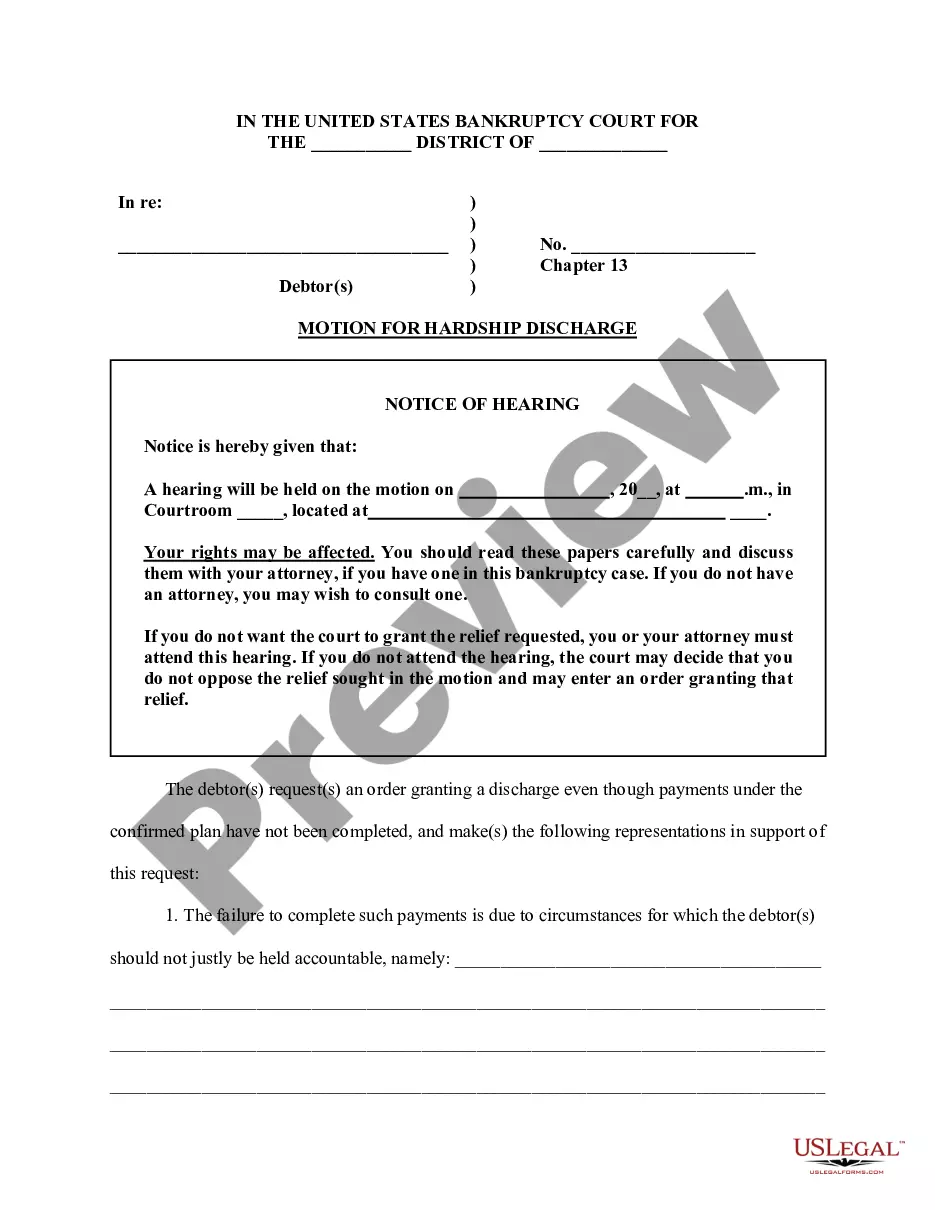
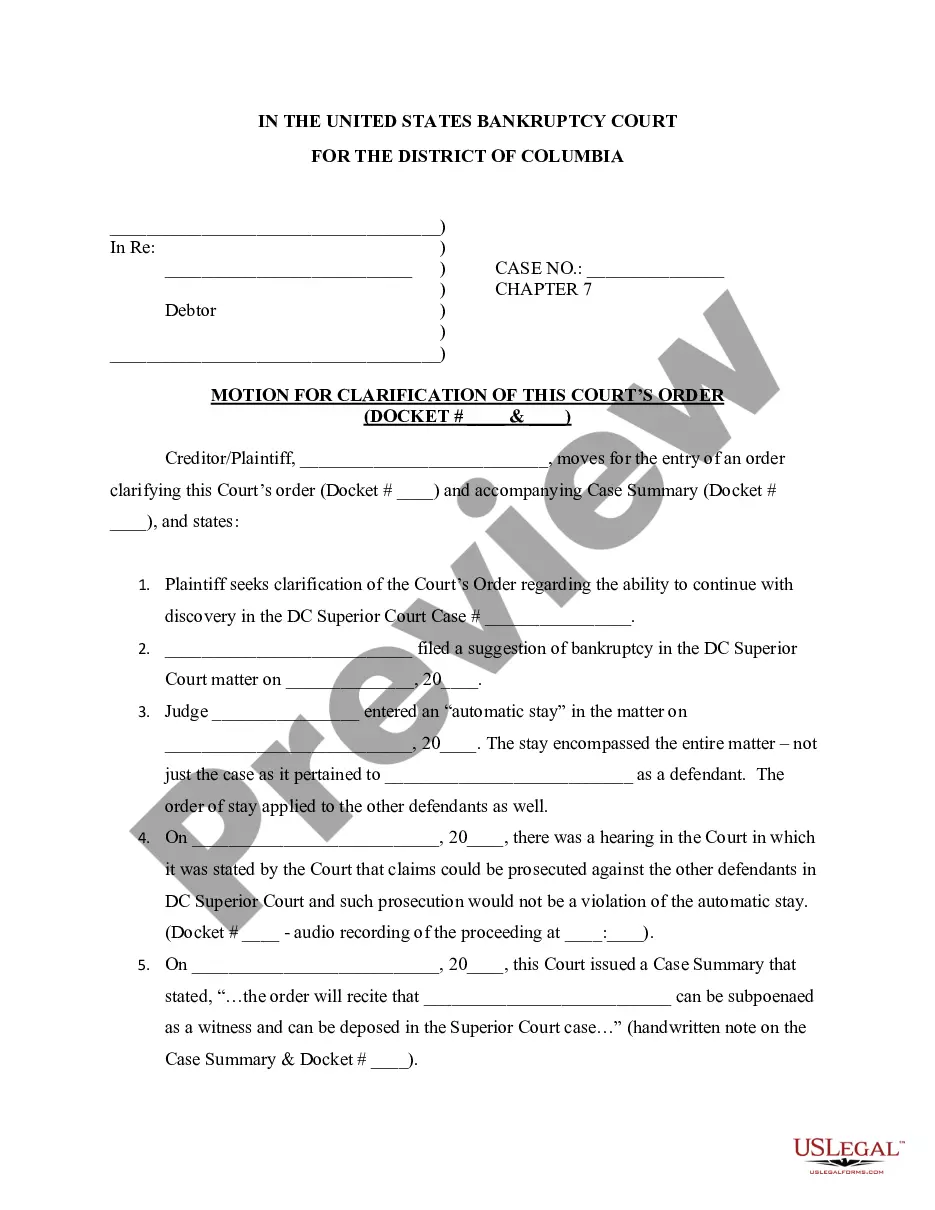
The motion to reopen case and for leave to file domestic support certification or proof of completion of instructional course in personal financial management is a legal document used in bankruptcy proceedings. This form allows debtors to request the reopening of their bankruptcy case, specifically to submit missing documents such as a domestic support certification or proof of completing a financial management course. It is essential for ensuring compliance with bankruptcy requirements, differentiating this motion from more general motions for reopening a case.
What’s included in this form
- Caption: Identifies the court and case details.
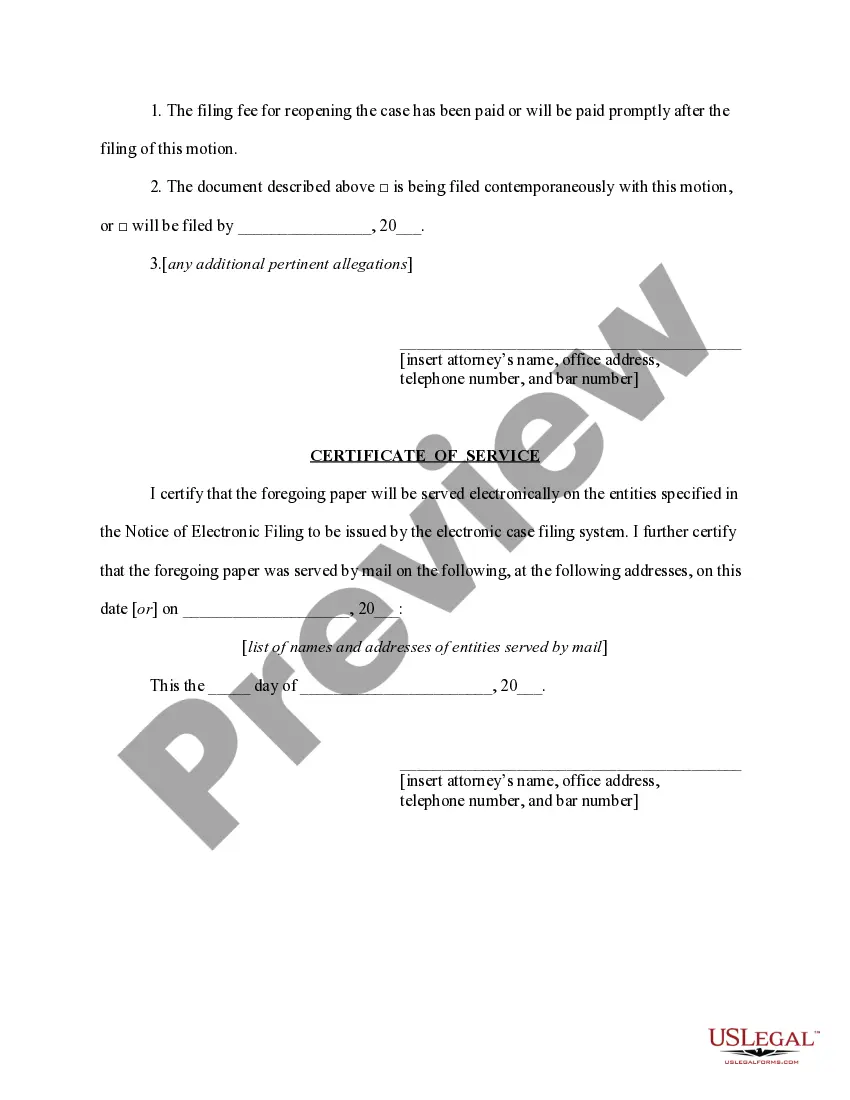
- Motion Request: Specifies the reason for reopening the case and the documents to be filed.
- Notice of Objection: Informs parties of their rights to object to the motion.
- Certificate of Service: Confirms the motion has been served to relevant parties.
- Attorney Details: Includes the attorney's name, address, and contact information.
Common use cases
This form should be used when a debtor needs to reopen their bankruptcy case to submit a necessary document that was not filed during the original proceedings. Common scenarios include when a debtor has completed a required financial management course or needs to submit a domestic support certification to meet the conditions for discharge under bankruptcy law.
Who this form is for
- Individuals who have previously filed for bankruptcy and need to address specific documentation requirements.
- Debtors seeking to comply with court rules regarding domestic support obligations.
- People who have completed educational mandated courses related to financial management after their bankruptcy filing.
How to prepare this document
- Enter the court information, including the district and case number at the top of the form.
- Clearly state the request to reopen the case and specify the document you intend to file.
- Indicate whether the filing fee has been paid or will be paid after submitting the motion.
- Provide additional details or allegations that support your request.
- Complete the certificate of service to document how and when the motion was delivered to necessary parties.
Does this form need to be notarized?
This form does not typically require notarization to be legally valid. However, some jurisdictions or document types may still require it. US Legal Forms provides secure online notarization powered by Notarize, available 24/7 for added convenience.
Get your form ready online
Our built-in tools help you complete, sign, share, and store your documents in one place.
Make edits, fill in missing information, and update formatting in US Legal Forms—just like you would in MS Word.
Download a copy, print it, send it by email, or mail it via USPS—whatever works best for your next step.
Sign and collect signatures with our SignNow integration. Send to multiple recipients, set reminders, and more. Go Premium to unlock E-Sign.
If this form requires notarization, complete it online through a secure video call—no need to meet a notary in person or wait for an appointment.
We protect your documents and personal data by following strict security and privacy standards.

Make edits, fill in missing information, and update formatting in US Legal Forms—just like you would in MS Word.

Download a copy, print it, send it by email, or mail it via USPS—whatever works best for your next step.

Sign and collect signatures with our SignNow integration. Send to multiple recipients, set reminders, and more. Go Premium to unlock E-Sign.

If this form requires notarization, complete it online through a secure video call—no need to meet a notary in person or wait for an appointment.

We protect your documents and personal data by following strict security and privacy standards.
Mistakes to watch out for
- Failing to file the motion within the required time frame after identifying the need to reopen the case.
- Omitting critical details, such as the case number or court information.
- Not paying the requisite filing fee or forgetting to state its payment status.
Benefits of using this form online
- Convenience of downloading and filling out the form at your own pace.
- Editability allows you to make changes quickly without starting over.
- Reliable access to professionally drafted templates that meet legal standards.
Looking for another form?
Form popularity
FAQ
Definitions of make a motion. verb. propose formally; in a debate or parliamentary meeting. synonyms: move go, move. have a turn; make one's move in a game.
A motion is an application to the court made by the prosecutor or defense attorney, requesting that the court make a decision on a certain issue before the trial begins. The motion can affect the trial, courtroom, defendants, evidence, or testimony. Only judges decide the outcome of motions.
For example, a party can make a motion to ask to allow him or her not to give the other side the discovery that was asked for. If a party thinks that a subpoena asks for documents that have nothing to do with the case, or asks for too much information, the party can make a motion to quash the subpoena.
A pending motion is a request made to a court, either in writing or orally, asking for a specific ruling or order. It is a motion that has been filed but has not yet been decided upon by the court.
Motion. n. a formal request made to a judge for an order or judgment.
Motions. Motions are not pleadings but are requests for the judge to make a legal ruling. Some of the most common pre-trial motions include: Motion to Discover. A motion by which one party seeks to gain information from the adverse party.
A motion is an application to the court made by the prosecutor or defense attorney, requesting that the court make a decision on a certain issue before the trial begins. The motion can affect the trial, courtroom, defendants, evidence, or testimony. Only judges decide the outcome of motions.
We can define motion as the change of position of an object with respect to time. A book falling off a table, water flowing from the tap, rattling windows, etc., all exhibit motion. Even the air that we breathe exhibits motion!