Louisiana Motion to Fix Case
About this form
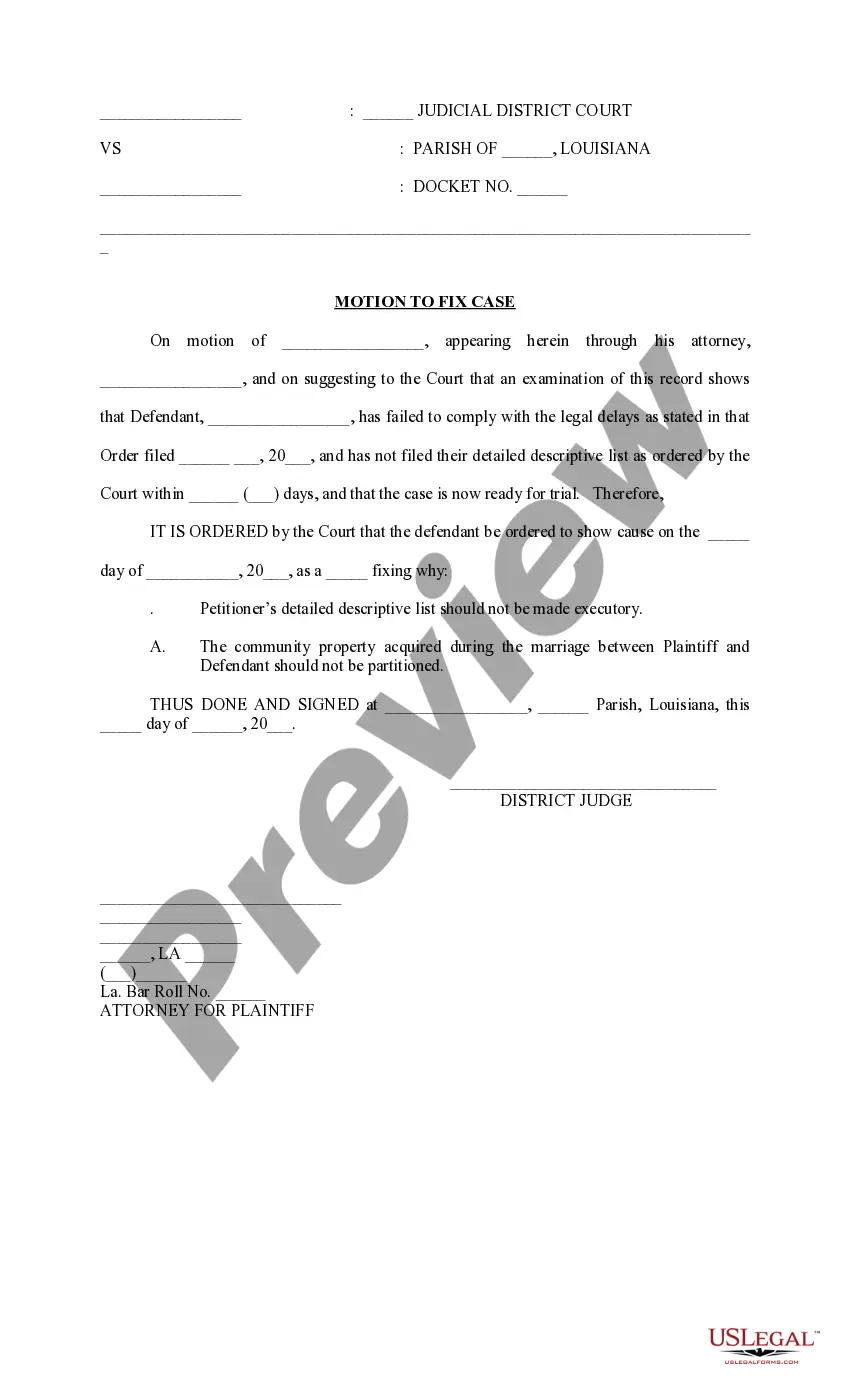
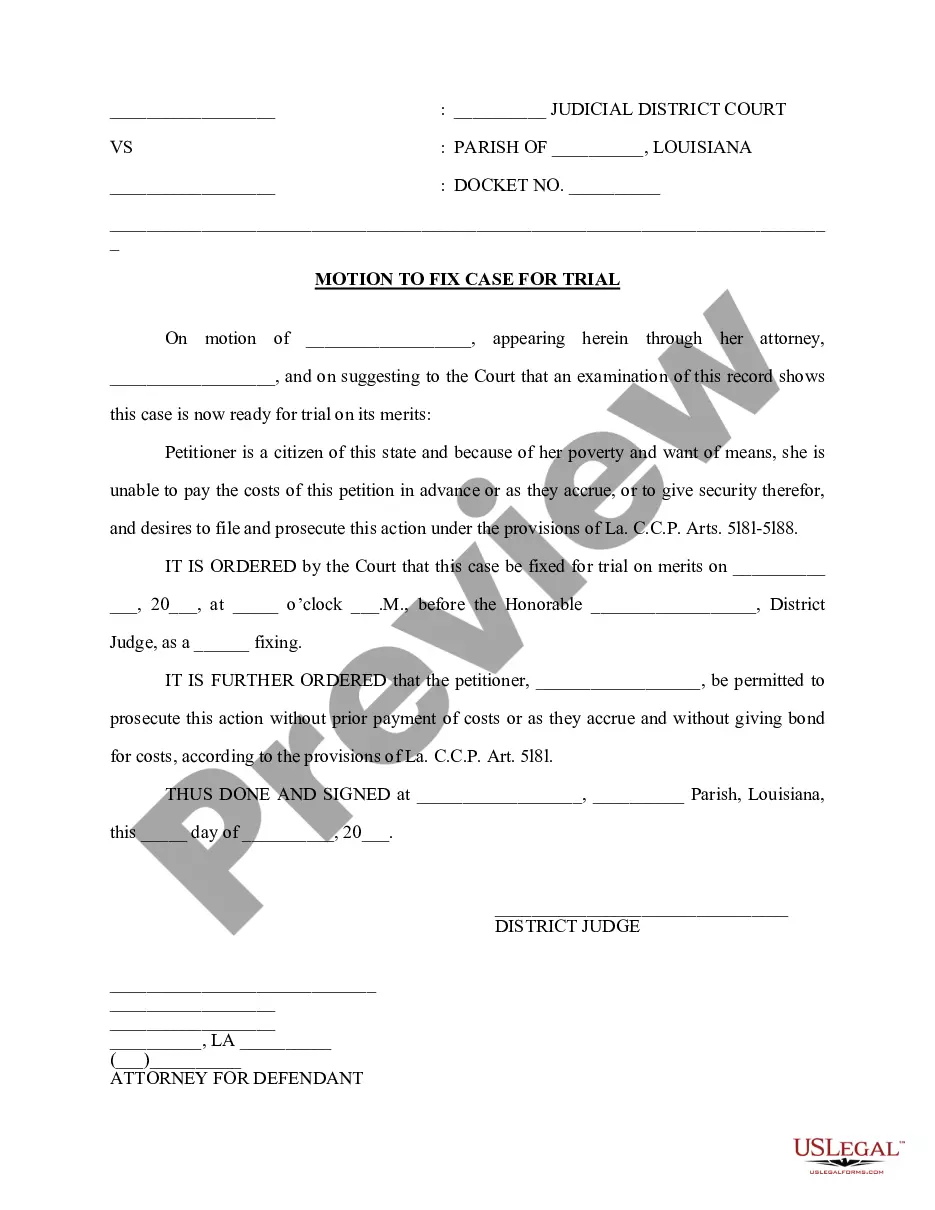
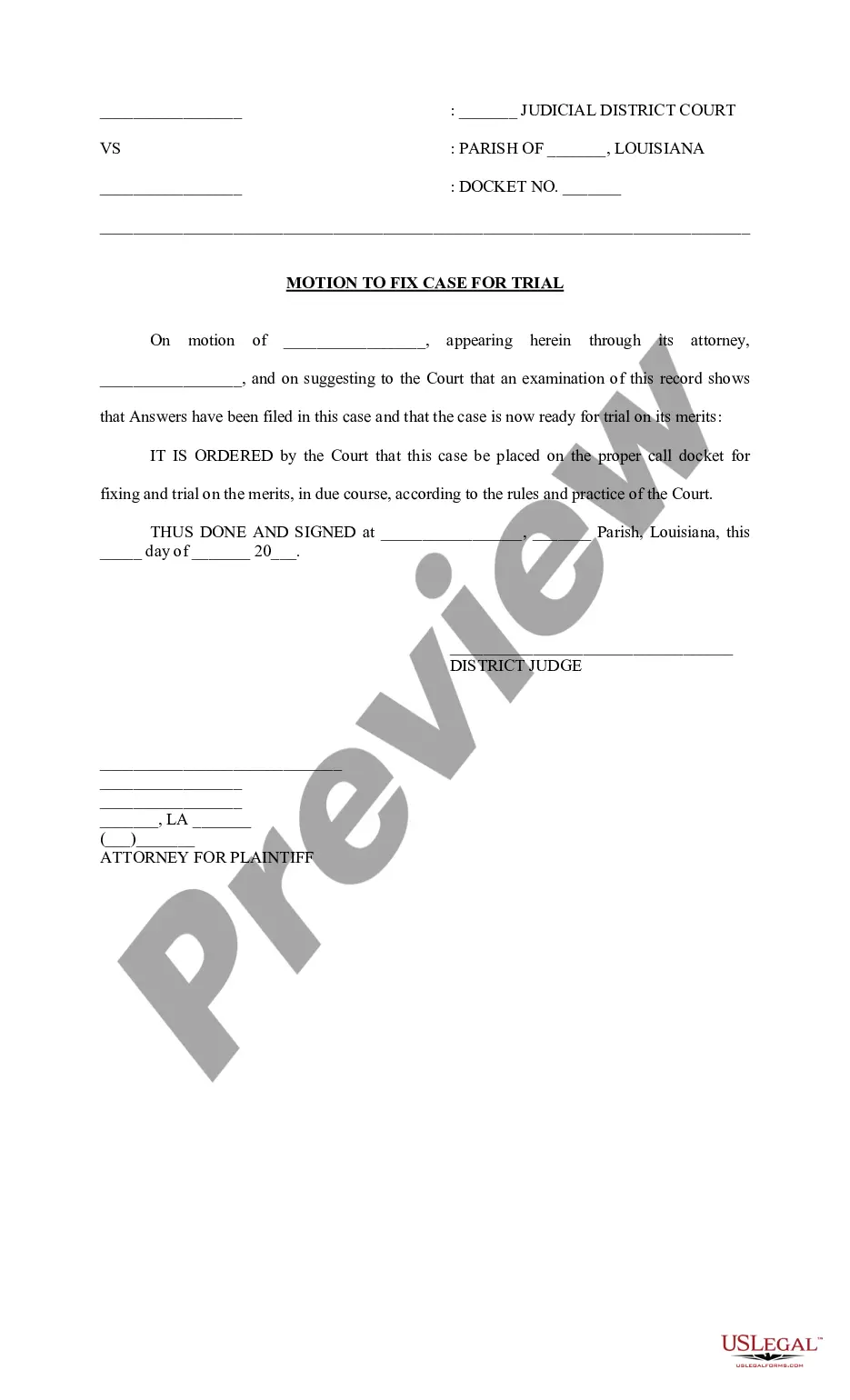
The Motion to Fix Case is a legal document used in divorce proceedings when one party has not complied with court orders regarding timeframes for submitting required documents. This form allows the petitioner to request that the court establish a date by which the defendant must comply or face potential legal consequences. Unlike other motions, this form specifically addresses delays in providing a detailed descriptive list of community property, facilitating the case's readiness for trial.
Key parts of this document
- Parties involved: Identification of the petitioner and defendant.
- Details of non-compliance: Specifics on the failure to meet court-ordered deadlines.
- Order for cause: A request for the defendant to explain why compliance should not be enforced.
- Trial readiness declaration: Confirmation that the case is ready for trial.
- Community property partitioning: Mention of the community property that may be divided.
Situations where this form applies
This form is typically used when the defendant in a divorce case fails to submit required documentation, such as a detailed descriptive list of community property, within the specified timeframe established by the court. It can also be applied when the petitioner believes sufficient legal grounds exist to move the case forward to trial due to the defendant's lack of compliance.
Who can use this document
- Petitioners in a divorce case who need to address the defendant's non-compliance.
- Individuals seeking to expedite their divorce proceedings due to delays from the other party.
- Attorneys representing clients in divorce actions who require a formal motion to resolve compliance issues.
How to complete this form
- Identify the parties: Fill in the names of the petitioner and defendant.
- Detail compliance failures: Specify the dates and nature of the non-compliance by the defendant.
- Enter the court date: Set the date for the defendant to show cause why the motion should not proceed.
- Sign the motion: Both the petitioner and the attorney should sign the form before submission.
Notarization guidance
This form does not typically require notarization unless specified by local law. However, it is important to check with the local court for any specific requirements regarding notarization in your jurisdiction.
Get your form ready online
Our built-in tools help you complete, sign, share, and store your documents in one place.
Make edits, fill in missing information, and update formatting in US Legal Forms—just like you would in MS Word.
Download a copy, print it, send it by email, or mail it via USPS—whatever works best for your next step.
Sign and collect signatures with our SignNow integration. Send to multiple recipients, set reminders, and more. Go Premium to unlock E-Sign.
If this form requires notarization, complete it online through a secure video call—no need to meet a notary in person or wait for an appointment.
We protect your documents and personal data by following strict security and privacy standards.

Make edits, fill in missing information, and update formatting in US Legal Forms—just like you would in MS Word.

Download a copy, print it, send it by email, or mail it via USPS—whatever works best for your next step.

Sign and collect signatures with our SignNow integration. Send to multiple recipients, set reminders, and more. Go Premium to unlock E-Sign.

If this form requires notarization, complete it online through a secure video call—no need to meet a notary in person or wait for an appointment.

We protect your documents and personal data by following strict security and privacy standards.
Common mistakes
- Failing to accurately identify all parties involved in the case.
- Omitting specific details about the defendantâs non-compliance.
- Not including the correct court dates or deadlines.
- Neglecting to sign the motion or have an attorney sign where necessary.
Advantages of online completion
- Immediate access to downloadable templates drafted by licensed attorneys.
- Ease of editing to suit individual case details.
- Ability to save and print the form for submission to the court without delays.
- Cost-effective alternative to hiring a lawyer for simple motions.
Looking for another form?
Form popularity
FAQ
A motion to amend a Judgment in Louisiana allows a party to request changes to a court's final ruling. This motion is significant if new evidence arises or if there is a perceived error in the original judgment. It ensures that legal outcomes are fair and accurate. If you're considering this action, a Louisiana Motion to Fix Case might be your next step.
A notice of motion is a written application to the Court after a case has started asking the Court to make an order about something. A notice of motion can be used for a number of reasons, including seeking directions or clarification on matters in dispute or asking for the adjournment of a hearing.
21 provides that misjoinder of parties is not ground for dismissal of an action, and that parties may be dropped or added by court order on motion of any party or of the court's own initiative at any stage in the action and on such terms as are just.
In effect, in both kinds of cases, the lawyer asks the judge to direct a verdict for the defendant. The judge will either grant or deny the motion. If it is granted, the case is over and the defendant wins. If the motion is denied, as it usually is, the defense is given the opportunity to present its evidence.
An order to show cause is a type of court order that requires one or more of the parties to a case to justify, explain, or prove something to the court. Courts commonly use orders to show cause when the judge needs more information before deciding whether or not to issue an order requested by one of the parties.
Effect of a Rule 12 Motion - Absent a court order setting a different time, a Rule 12 motion extends the time to file a responsive pleading until 14 days after the court's denial of the motion or deferral to trial or, if more definite statement ordered, 14 days after service of the more definite statement. FED.
An application to the court for an order and notice of any hearing thereon, not presented during a hearing or trial, must be served upon all other parties not less than three days before the time specified for the hearing, unless otherwise provided by these rules or shortened by the court.
A "motion" is simply a formal request to a court that it do something or decide an issue in favor of the party that asks for it. "Granted" means the court agreed with the request, and did or decided in favor of the requester.
The rule to show cause provided in Civil Code Article 102 shall allege proper service of the initial petition for divorce, that the requisite period of time, in accordance with Article 103.1, or more has elapsed since that service, and that the spouses have lived separate and apart continuously for the requisite period
A motion is an application to the court made by the prosecutor or defense attorney, requesting that the court make a decision on a certain issue before the trial begins. The motion can affect the trial, courtroom, defendants, evidence, or testimony. Only judges decide the outcome of motions.