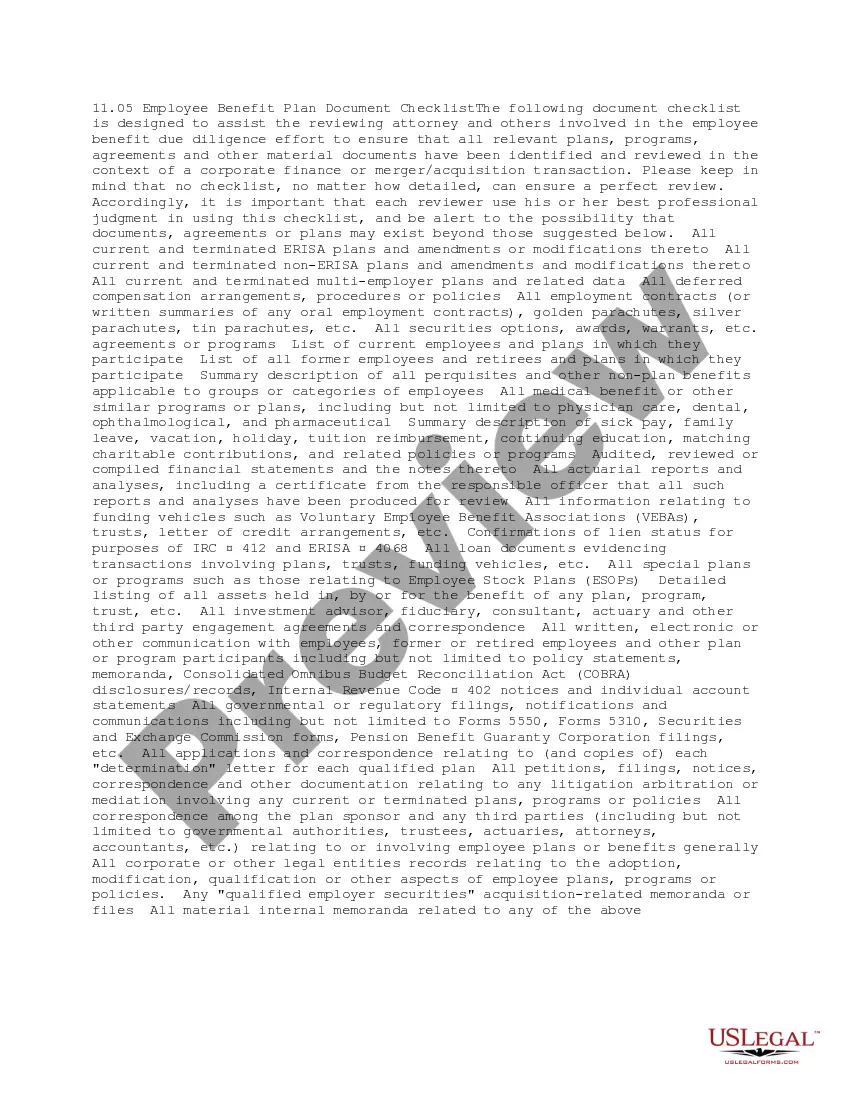
Employee Benefit Plan Document Checklist
Overview of this form
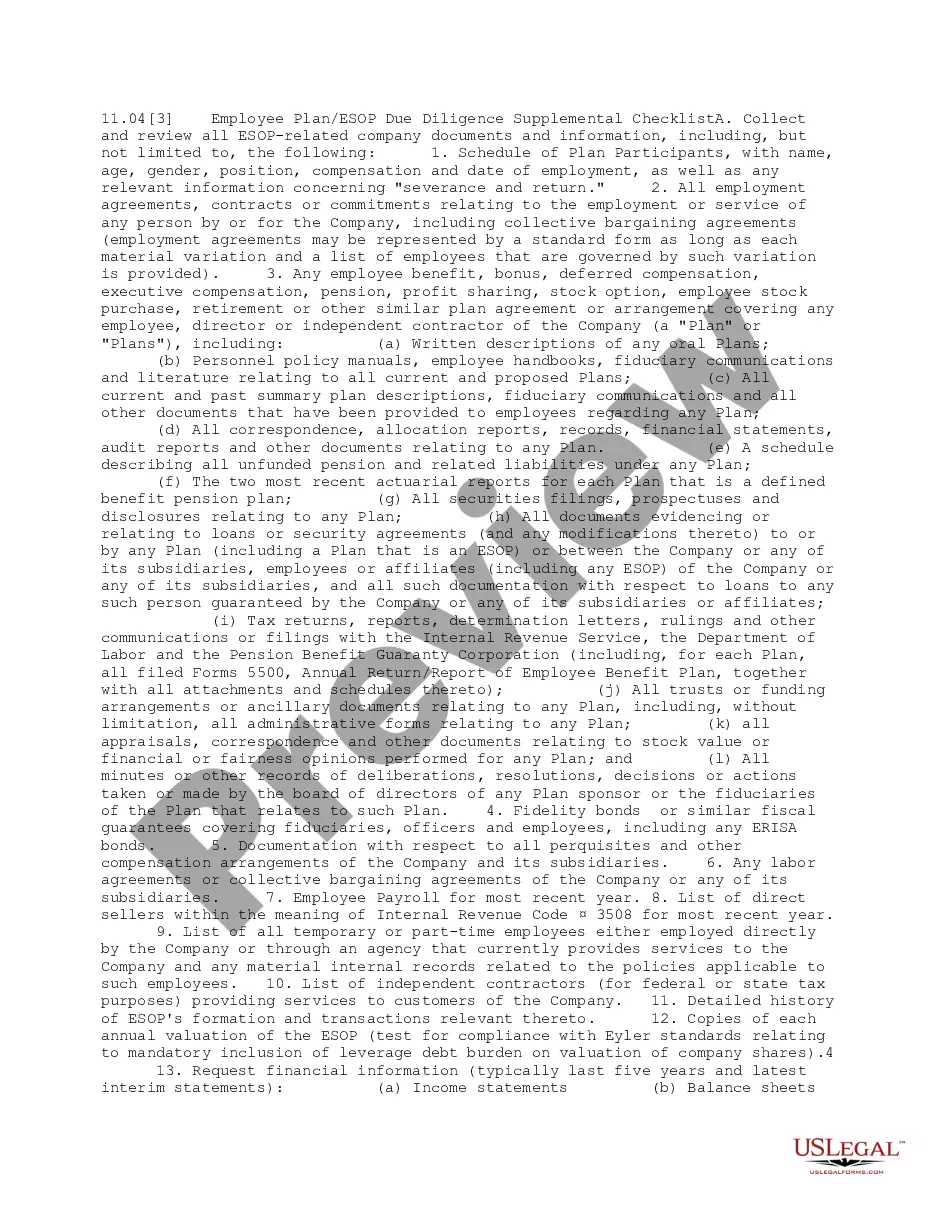
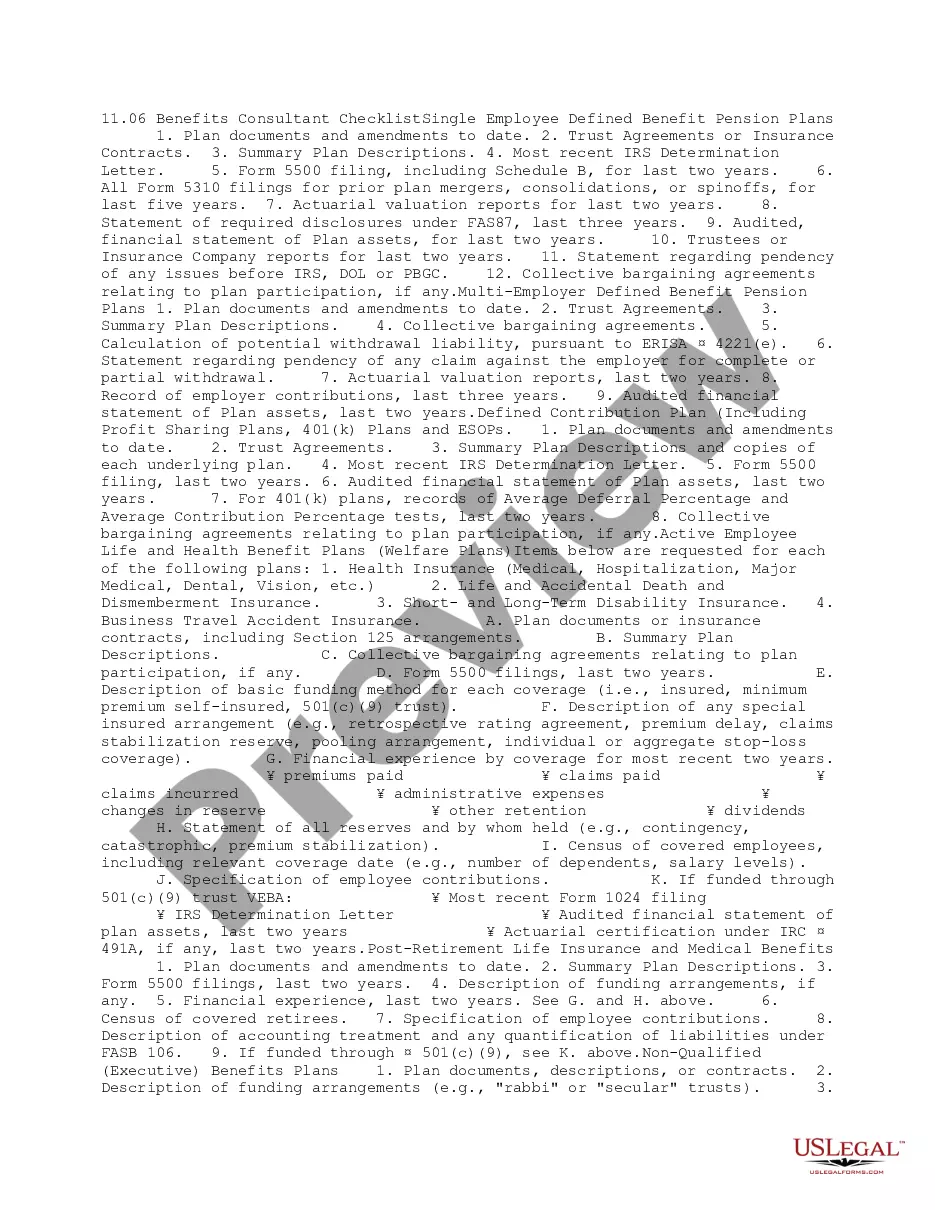
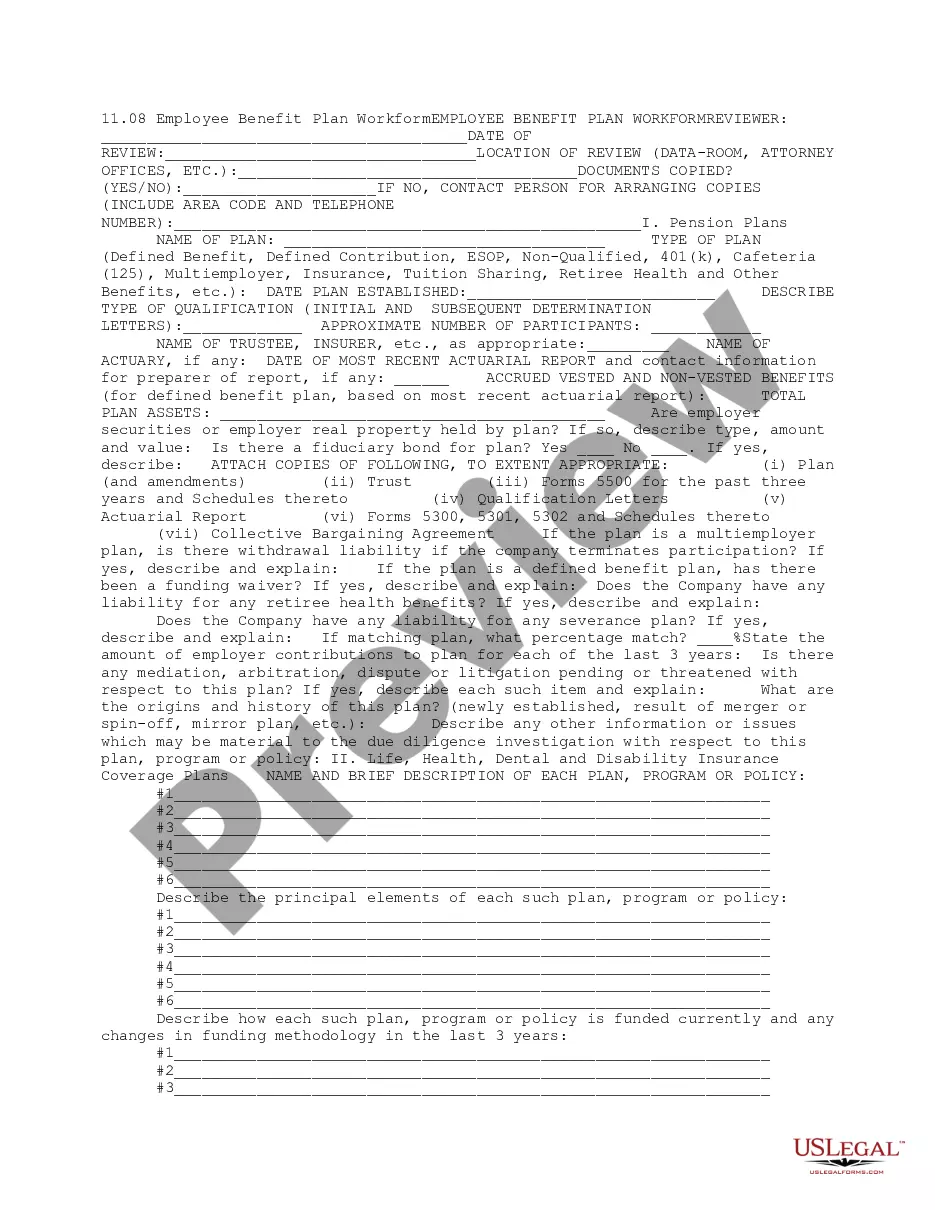
The Employee Benefit Plan Document Checklist is a comprehensive guide designed to assist attorneys and other professionals in conducting due diligence when reviewing employee benefit plans during corporate finance transactions, such as mergers or acquisitions. This checklist helps ensure that all relevant plans and documents are identified and analyzed, making it a crucial tool for legal compliance and risk management. Unlike standard forms that may focus on a single type of document or plan, this checklist encompasses a wide range of materials to facilitate a thorough review process.
Key components of this form
- All current and terminated ERISA plans and their amendments
- All current and terminated non-ERISA plans and their amendments
- Documents related to deferred compensation arrangements
- Employment contracts and variations like golden parachute agreements
- Summary descriptions of non-plan benefits and perquisites
- Audited financial statements related to employee benefits
- Actuarial reports and analyses
When to use this document
This checklist should be used in situations where a company is undergoing a corporate transaction involving employee benefits. It is particularly useful during mergers, acquisitions, or when evaluating the benefits offered to employees, ensuring that all necessary documents and plans are included in the review process. Utilizing this checklist can help prevent compliance issues and provide clarity during legal evaluations.
Who can use this document
- Corporate attorneys involved in mergers or acquisitions
- Human resources professionals overseeing employee benefits
- Compliance officers ensuring regulatory adherence
- Financial analysts involved in due diligence reviews
How to prepare this document
- Gather all current and terminated employee benefit plans and agreements.
- Review each listed document against the provided checklist to ensure completeness.
- Document any additional plans or agreements that may not appear on the checklist.
- Ensure all required financial and actuarial reports are included for review.
- Compile summary descriptions of non-plan benefits and administrative policies.
Is notarization required?
This form does not typically require notarization to be legally valid. However, some jurisdictions or document types may still require it. US Legal Forms provides secure online notarization powered by Notarize, available 24/7 for added convenience.
Get your form ready online
Our built-in tools help you complete, sign, share, and store your documents in one place.
Make edits, fill in missing information, and update formatting in US Legal Forms—just like you would in MS Word.
Download a copy, print it, send it by email, or mail it via USPS—whatever works best for your next step.
Sign and collect signatures with our SignNow integration. Send to multiple recipients, set reminders, and more. Go Premium to unlock E-Sign.
If this form requires notarization, complete it online through a secure video call—no need to meet a notary in person or wait for an appointment.
We protect your documents and personal data by following strict security and privacy standards.

Make edits, fill in missing information, and update formatting in US Legal Forms—just like you would in MS Word.

Download a copy, print it, send it by email, or mail it via USPS—whatever works best for your next step.

Sign and collect signatures with our SignNow integration. Send to multiple recipients, set reminders, and more. Go Premium to unlock E-Sign.

If this form requires notarization, complete it online through a secure video call—no need to meet a notary in person or wait for an appointment.

We protect your documents and personal data by following strict security and privacy standards.
Common mistakes to avoid
- Overlooking terminated plans that may still have liabilities.
- Failing to include amendments or modifications to existing plans.
- Not verifying the completeness of correspondence with employees about plans.
- Ignoring state-specific regulations that may affect compliance.
- Neglecting to gather all required actuarial reports.
Why use this form online
- Convenient access to a downloadable, ready-to-use checklist.
- Easy to edit and customize the form according to specific needs.
- Reliable templates created by licensed attorneys, ensuring legal compliance.
- Quick turnaround for completing due diligence in transactions.
Legal use & context
This checklist serves as a valuable tool in ensuring compliance with federal and state employee benefit regulations. By using this document, companies can mitigate risks associated with employee benefit liabilities during corporate transactions.
What to keep in mind
- The checklist is essential for thorough review in mergers and acquisitions.
- It helps identify and evaluate all relevant employee benefit documents.
- Users should remain aware of both ERISA and non-ERISA plan requirements.
Looking for another form?
Form popularity
FAQ
The summary plan description (SPD) is simply a summary of the plan document required to be written in such a way that the participants of the benefits plan can easily understand it. Unlike the plan document, the SPD is required to be distributed to plan participants.Plan amendments must be made to both documents.
A Summary Plan Description (SPD) is a document that employers must give free to employees who participate in Employee Retirement Income Security Act-covered retirement plans or health benefit plans. The SPD is a detailed guide to the benefits the program provides and how the plan works.
Choose the Required Health Care Benefits First. Select Low Cost Voluntary Benefit Options. Be Generous with Financial Benefits. Invest in the Success of Your People. Provide More Work Life Balance.
The most common benefits are medical, disability, and life insurance; retirement benefits; paid time off; and fringe benefits. Benefits can be quite valuable.
What is it? An SBC is a summary about a medical health plan's benefits and coverage. It lists what the plan covers and what you pay for covered services. Insurance carriers are required to provide an SBC for any job-based health plan.
Paid time off such as PTO, sick days, and vacation days. Health insurance. Life insurance. Dental insurance. Vision insurance. Retirement benefits or accounts. Healthcare spending or reimbursement accounts, such as HSAs, FSAs, and HRAs. Long term disability insurance.
The plan document is a written document that describes the participant's rights, benefits, and obligations within the plan, as well as the plan's terms and conditions for administering the plan. The plan document should include the Trust Agreement (if applicable) and Insurance Contract(s).
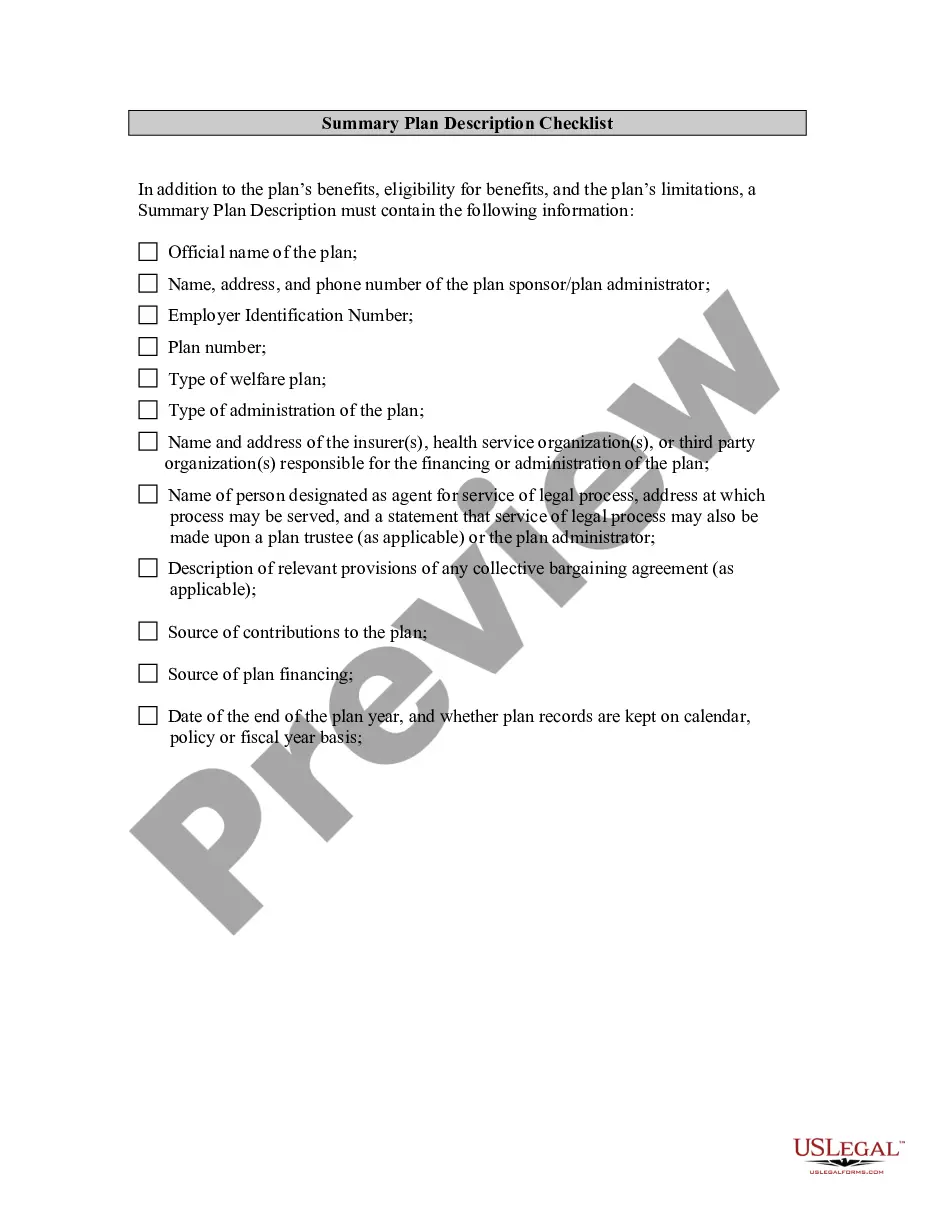
One of the most important documents participants are entitled to receive automatically when becoming a participant of an ERISA-covered retirement or health benefit plan or a beneficiary receiving benefits under such a plan, is a summary of the plan, called the summary plan description or SPD.
As the name implies, a defined benefit plan focuses on the ultimate benefits paid out. Your employer promises to pay you a certain amount at retirement and is responsible for making sure that there are enough funds in the plan to eventually pay out this amount, even if plan investments don't perform well.