Employee Benefit Plan Workform
About this form
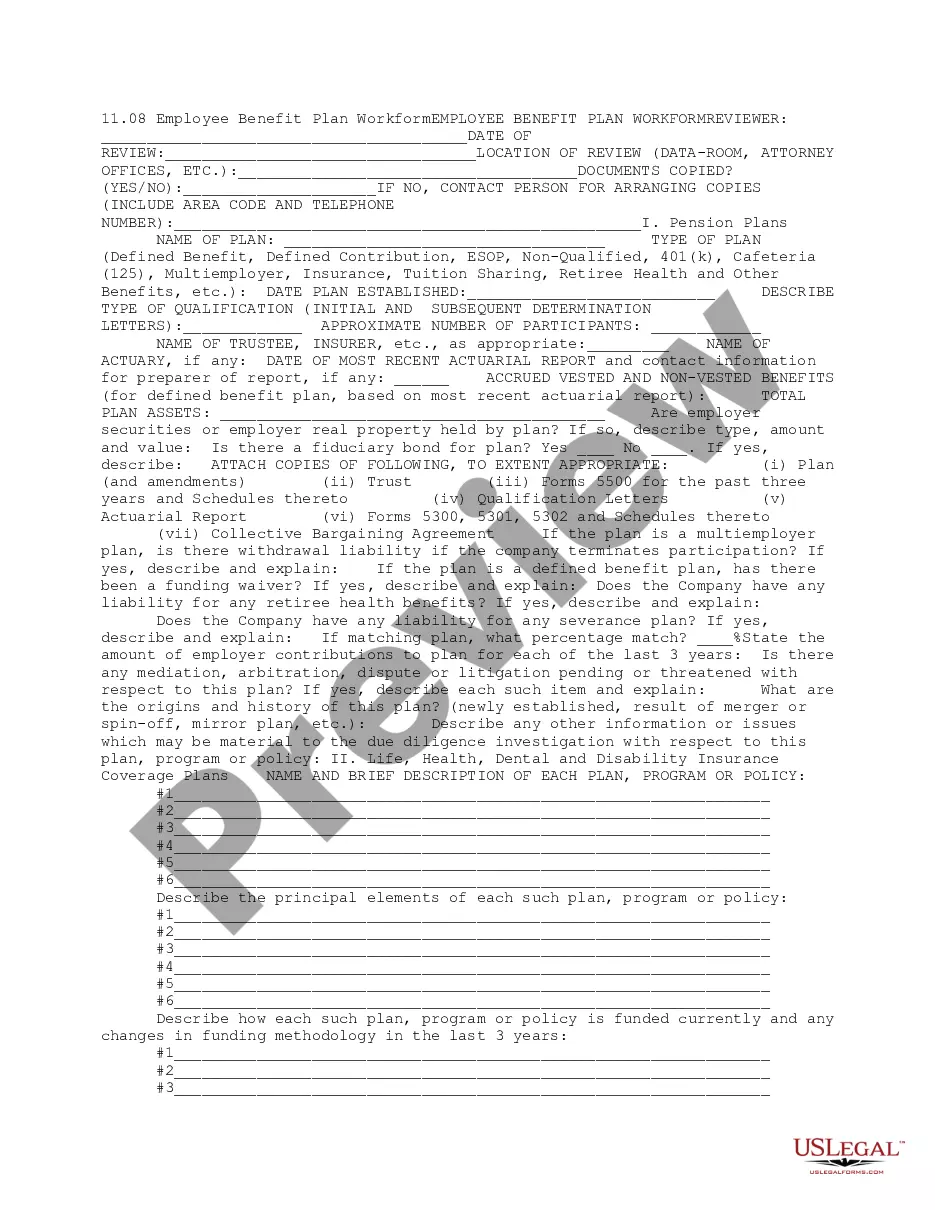
The Employee Benefit Plan Workform is a comprehensive document used for reviewing and analyzing employee benefit plans within an organization. This form provides structured fields for detailing various aspects of pension plans, insurance coverage, and executive compensation, ensuring all critical information is captured for due diligence. Unlike other benefit forms, this workform focuses specifically on gathering detailed information necessary for assessments and compliance related to employee benefits.
What’s included in this form
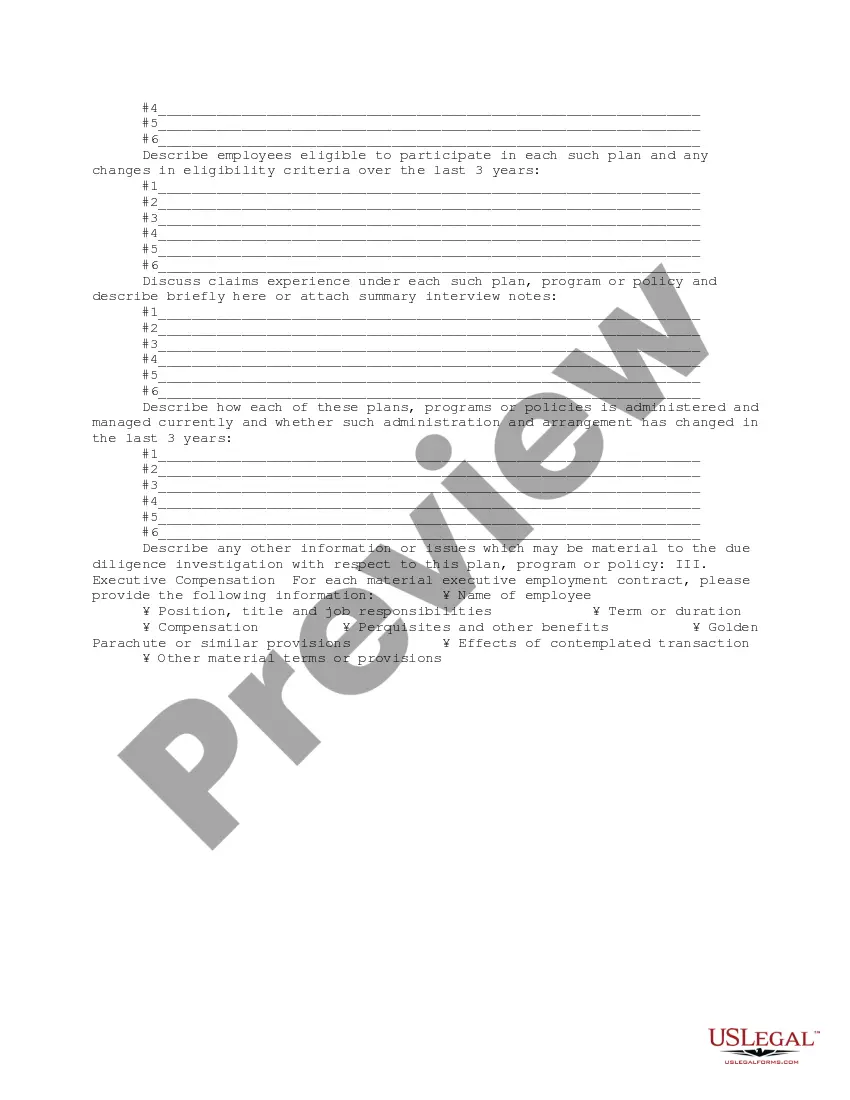
- Pension plans: Information on plan name, type, establishment date, and qualified status.
- Life, health, dental, and disability coverage: Details on each plan's description and eligibility.
- Executive compensation: Specifics about executive contracts, including compensation and benefits.
- Plan administration: Information on how each benefit plan is managed and any recent changes.
- Compliance elements: A section for attachments of legal documents and reports pertinent to the plans.



Situations where this form applies
This form should be used during benefit plan reviews, particularly when evaluating existing employee benefits for mergers, acquisitions, or organizational changes. It is also essential when conducting regular compliance audits or preparing for negotiations surrounding employee compensation and benefits packages.
Who should use this form
- Human resource professionals responsible for managing employee benefits.
- Financial analysts assessing the financial implications of employee benefit plans.
- Legal teams conducting due diligence in corporate transactions.
- Executives overseeing compliance with employee compensation regulations.
- Consultants advising organizations on employee benefits strategy.
How to prepare this document
- Gather all necessary documentation relating to the employee benefit plans.
- Fill in the specific details for each plan listed, including names, types, and participant information.
- Attach relevant legal documents as outlined in the specified sections of the form.
- Review the completed form for accuracy and completeness.
- Submit the form to relevant stakeholders for review and action.
Notarization requirements for this form
In most cases, this form does not require notarization. However, some jurisdictions or signing circumstances might. US Legal Forms offers online notarization powered by Notarize, accessible 24/7 for a quick, remote process.
Get your form ready online
Our built-in tools help you complete, sign, share, and store your documents in one place.
Make edits, fill in missing information, and update formatting in US Legal Forms—just like you would in MS Word.
Download a copy, print it, send it by email, or mail it via USPS—whatever works best for your next step.
Sign and collect signatures with our SignNow integration. Send to multiple recipients, set reminders, and more. Go Premium to unlock E-Sign.
If this form requires notarization, complete it online through a secure video call—no need to meet a notary in person or wait for an appointment.
We protect your documents and personal data by following strict security and privacy standards.

Make edits, fill in missing information, and update formatting in US Legal Forms—just like you would in MS Word.

Download a copy, print it, send it by email, or mail it via USPS—whatever works best for your next step.

Sign and collect signatures with our SignNow integration. Send to multiple recipients, set reminders, and more. Go Premium to unlock E-Sign.

If this form requires notarization, complete it online through a secure video call—no need to meet a notary in person or wait for an appointment.

We protect your documents and personal data by following strict security and privacy standards.
Common mistakes to avoid
- Failing to provide complete participant information for each plan.
- Not attaching necessary documents required for compliance validation.
- Overlooking recent changes in eligibility or funding methodology.
- Not reviewing for compliance with state-specific regulations.
Why complete this form online
- Convenience of filling out the form from anywhere at any time.
- Editability allows for easy updates and changes to information as needed.
- Reliable access to templates designed by licensed attorneys.
- Instant downloads save time in acquiring necessary documentation.
Legal use & context
- This form is used in contexts where comprehensive documentation of employee benefit plans is required by law or policy.
- Ensures compliance with IRS and ERISA regulations governing employee benefit plans.
- Helpful in evaluations related to mergers or corporate restructuring, providing transparency and accountability.
Looking for another form?


Form popularity
FAQ
General Employee Benefit Coverage Limits. Understand Medical and Voluntary Plan Rules. Get Information on Company Matched Retirement Plans. Learn About the Paid Time Off Benefits.
Calculating the benefit load the ratio of perks to salary received by an employee helps a business effectively plan. Find the benefit load by adding the total annual costs of all employees' perks and divide it by all employees' annual salaries to determine a ratio that ratio is your company's benefits load.
Starting salary, including benefits package. comparative salary and cost-of-living information. vacation and other leave-with-pay time. salary review schedule. signing bonus, if offered. relocation stipend. spousal/partner assistance in locating a new position.
Health Insurance. Paid Time Off (PTO) Short-Term Disability Insurance. Long-Term Disability Insurance. Dental Insurance. Vision Insurance. Life Insurance.
Start from scratch. Create a job description for each position. Determine the appropriate amount of compensation. Factor in overtime. Identify the benefits and incentives that you will provide. Detail your decisions in a document.
Total compensation is equal to the salary plus the value of the employee benefits package. The average benefits package is over 30% of an employee's compensation. So for example, on a $55,000 salary, more than $16,500 is spent (on average) on the benefits package, for total compensation of at least $71,500.
What is the cost share? What is covered? How extensive is the health care provider network? What is the plan type? How much are deductibles, co-pays, co-insurance, and premiums? What benefits do you and your employees absolutely need? What is the reputation of the insurance company?
Salary, plus any bonuses or commissions. Paid holiday, vacation and sick days. Medical, dental and vision insurance. 401(k) or another retirement savings plan.
Choose the Required Health Care Benefits First. Select Low Cost Voluntary Benefit Options. Be Generous with Financial Benefits. Invest in the Success of Your People. Provide More Work Life Balance.