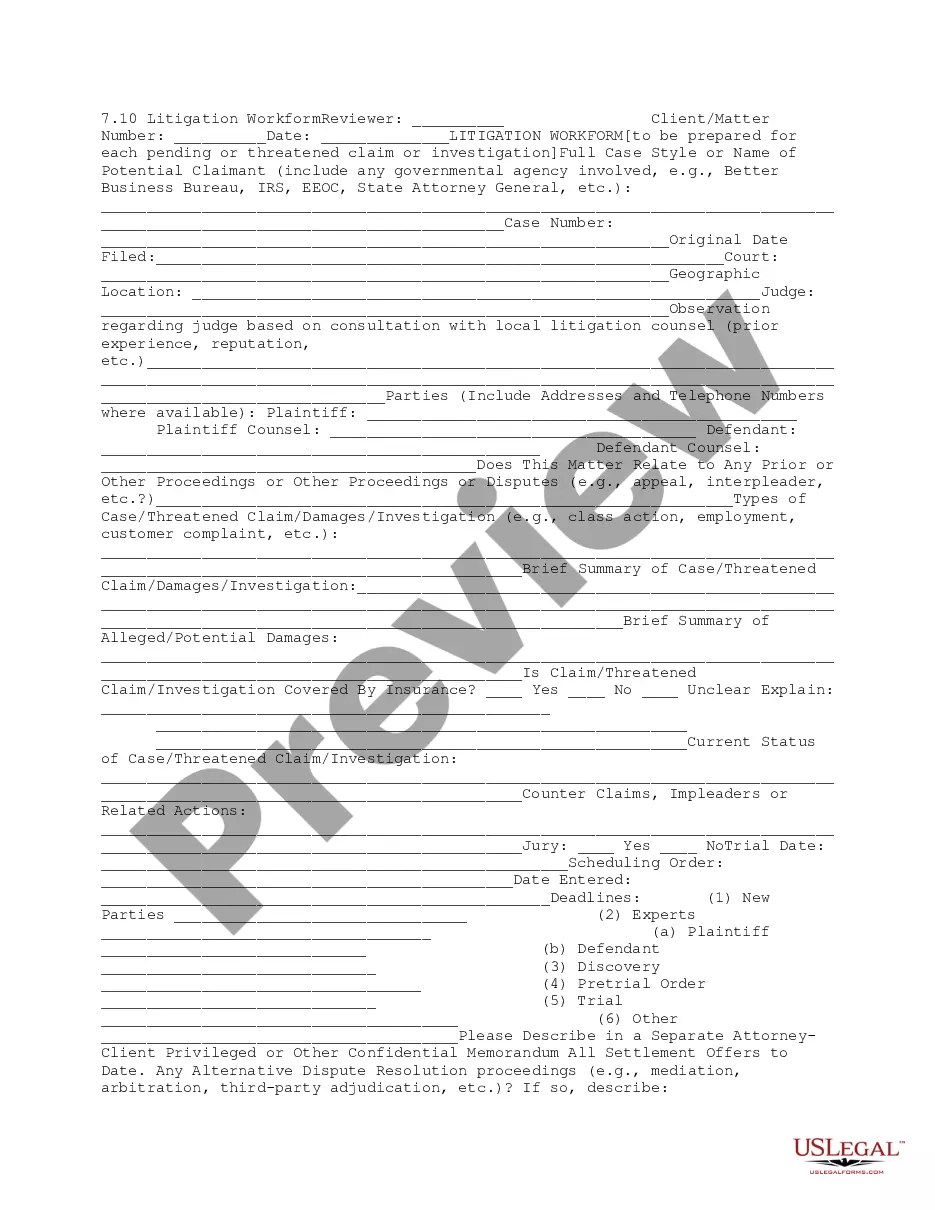
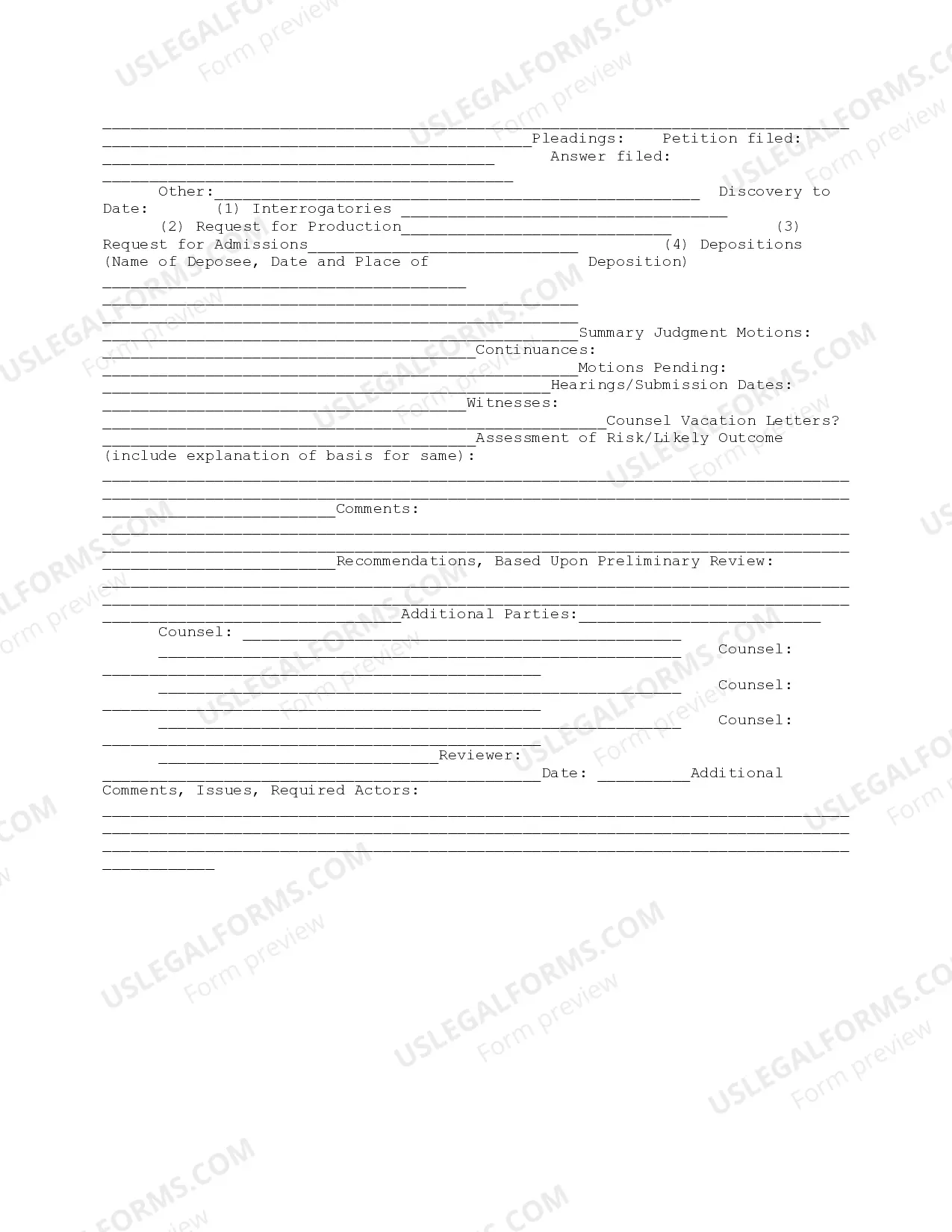
Litigation Workform
About this form
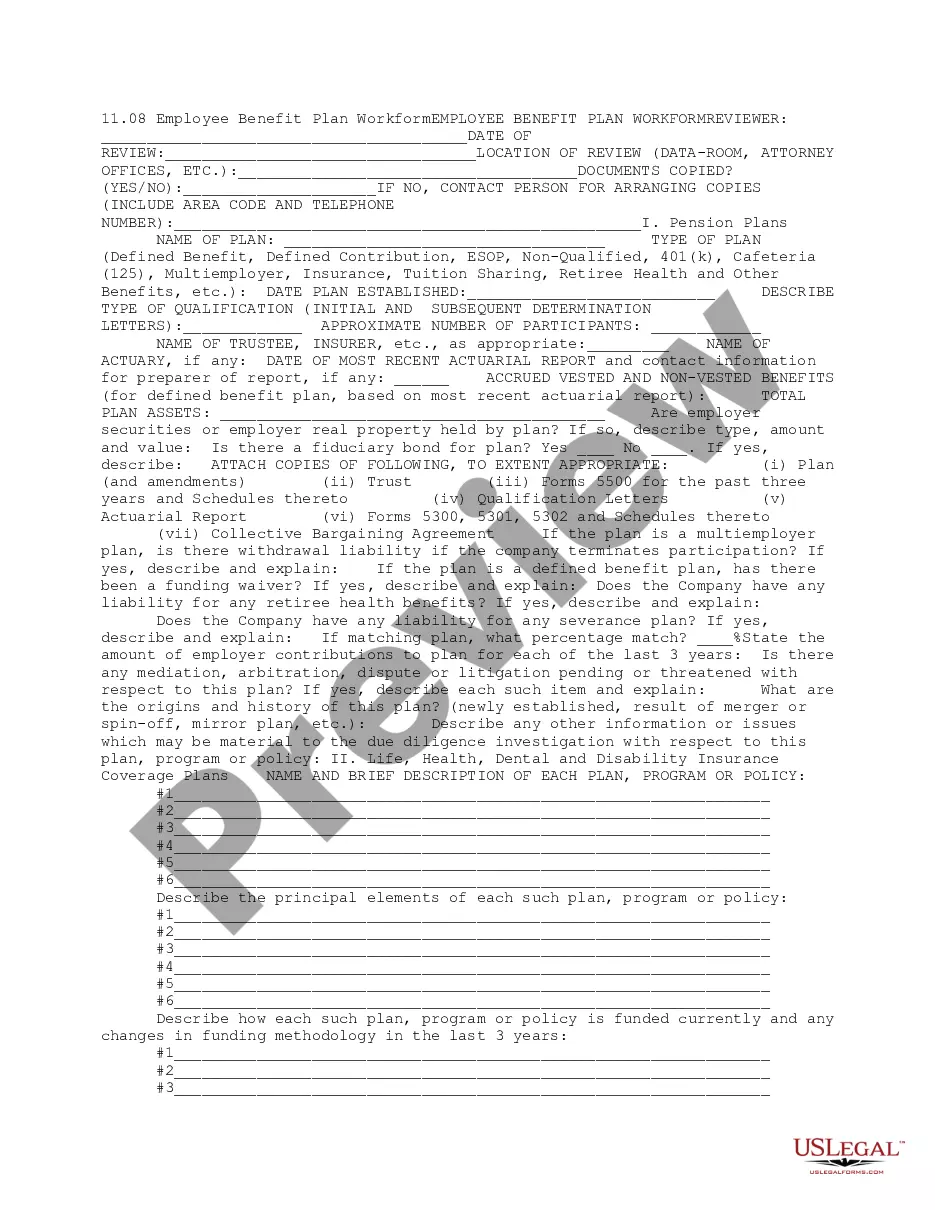
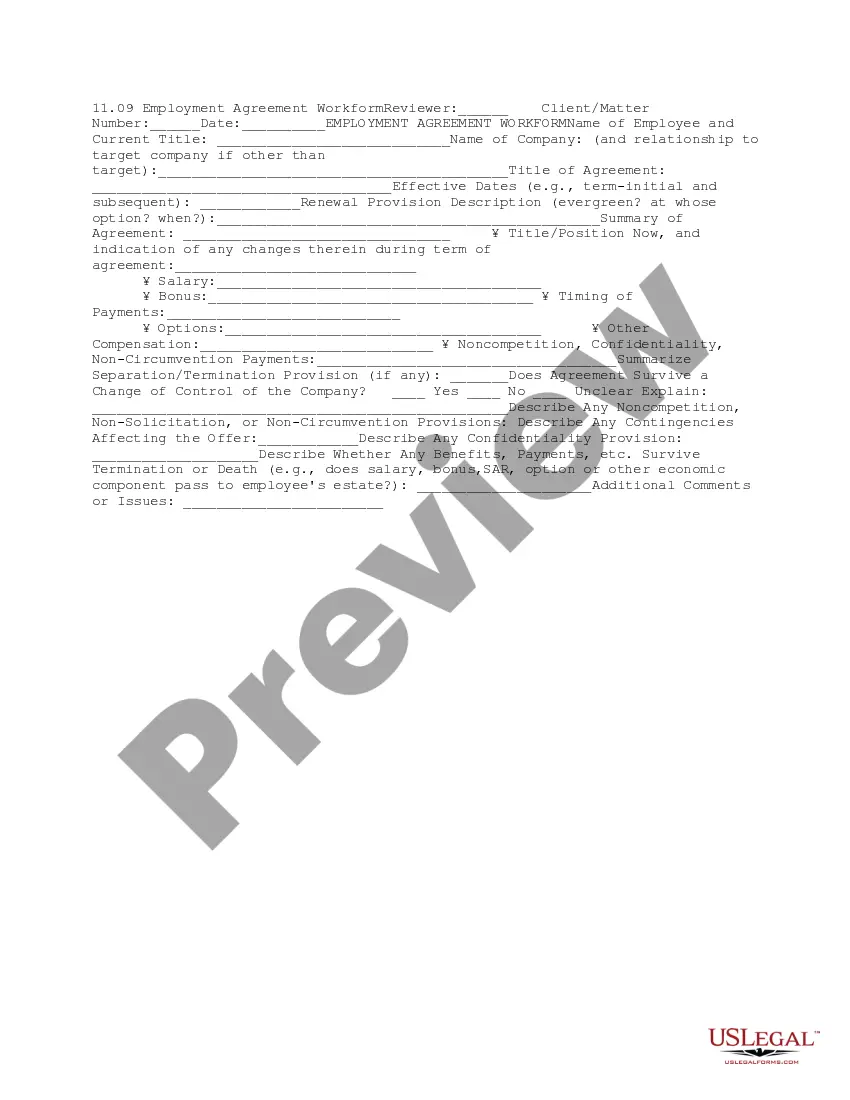
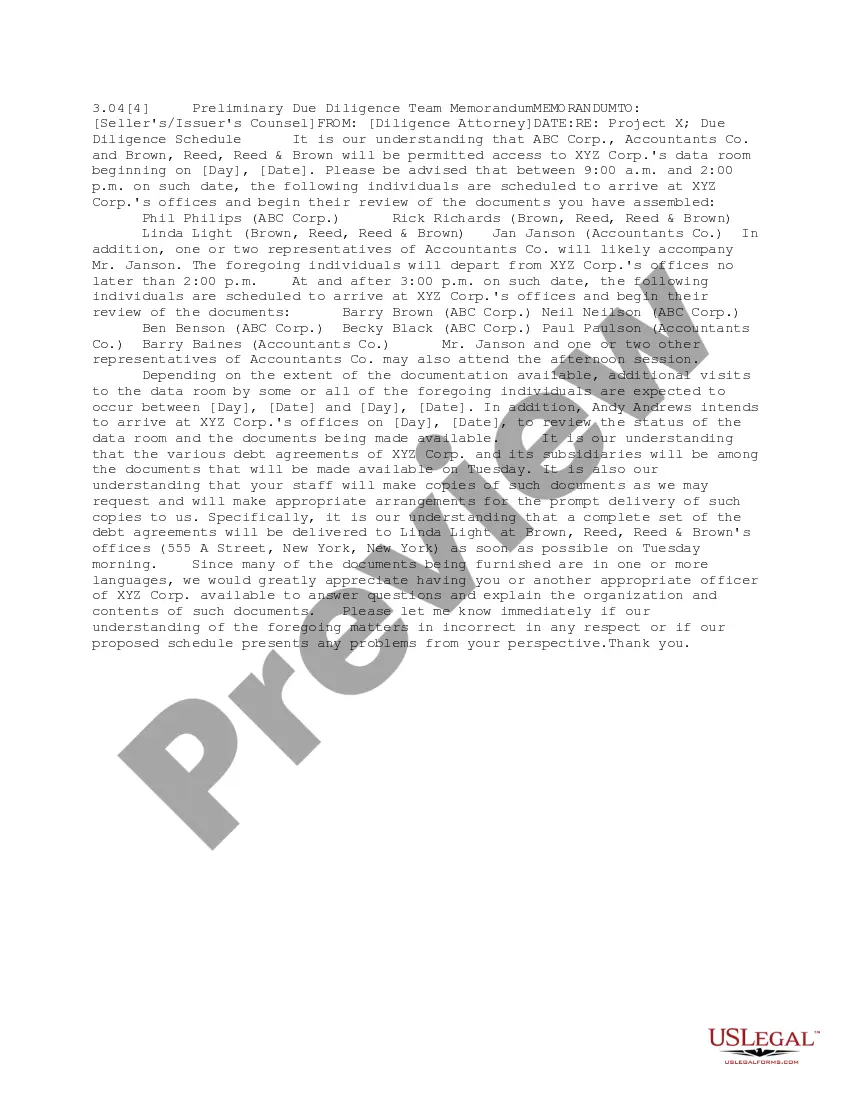
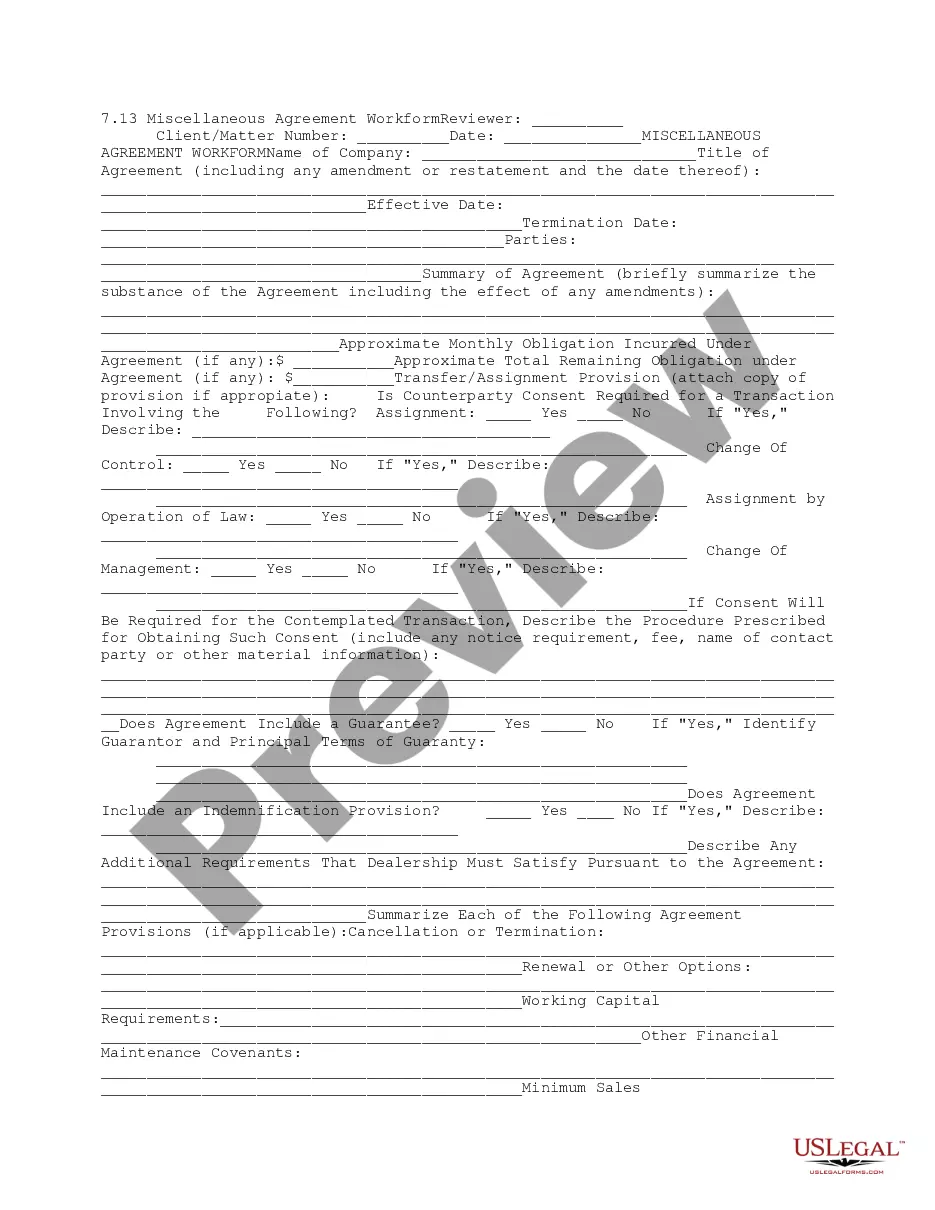
The Litigation Workform is a due diligence template used for documenting each pending or threatened claim or investigation against a business. This form assists in organizing crucial case details, which is particularly important during business transactions or disputes. It serves a distinct purpose compared to other legal forms by focusing specifically on ongoing or potential litigation and associated risks.
Key components of this form
- Reviewer and Client/Matter Number
- Full Case Style or Name of Potential Claimant
- Case Number and Original Date Filed
- Current Status of Case/Threatened Claim/Investigation
- Summary of Alleged/Potential Damages
- Assessment of Risk and Likely Outcome
When to use this form
This form should be used when a company faces pending or threatened litigation. It is crucial in situations such as business negotiations, contract disputes, employment issues, or regulatory investigations where documenting the claims and the status of the litigation is necessary for legal and business decision-making.
Who can use this document
- Business managers overseeing legal matters
- Corporate legal teams
- Attorneys representing businesses in litigation
- Compliance officers conducting due diligence
- Executives involved in risk management
How to prepare this document
- Begin by filling in the reviewer and client/matter number at the top of the form.
- Document the full case style or name of the potential claimant, including relevant governmental agencies.
- Enter the case number, original date filed, and court information.
- Summarize the current status of the litigation, including types of claims and potential damages.
- Include observations about the judge and any relevant counterclaims or related actions.
Notarization guidance
This form usually doesn’t need to be notarized. However, local laws or specific transactions may require it. Our online notarization service, powered by Notarize, lets you complete it remotely through a secure video session, available 24/7.
Get your form ready online
Our built-in tools help you complete, sign, share, and store your documents in one place.
Make edits, fill in missing information, and update formatting in US Legal Forms—just like you would in MS Word.
Download a copy, print it, send it by email, or mail it via USPS—whatever works best for your next step.
Sign and collect signatures with our SignNow integration. Send to multiple recipients, set reminders, and more. Go Premium to unlock E-Sign.
If this form requires notarization, complete it online through a secure video call—no need to meet a notary in person or wait for an appointment.
We protect your documents and personal data by following strict security and privacy standards.

Make edits, fill in missing information, and update formatting in US Legal Forms—just like you would in MS Word.

Download a copy, print it, send it by email, or mail it via USPS—whatever works best for your next step.

Sign and collect signatures with our SignNow integration. Send to multiple recipients, set reminders, and more. Go Premium to unlock E-Sign.

If this form requires notarization, complete it online through a secure video call—no need to meet a notary in person or wait for an appointment.

We protect your documents and personal data by following strict security and privacy standards.
Avoid these common issues
- Failing to update the current status of the case regularly.
- Omitting essential details about the parties involved.
- Not documenting prior related proceedings accurately.
- Leaving out potential damages or relevant claims.
- Not consulting with local litigation counsel for insights on the judge.
Advantages of online completion
- Convenient access on any device for quick updates and documentation.
- Editability allows for real-time adjustments as the case progresses.
- Reliability in having a structured format that captures all essential litigation details.
Legal use & context
- The Litigation Workform serves as a critical organizational tool in legal contexts.
- Completing this form accurately can help in preparing for court hearings and negotiations.
- This document may be subject to discovery in litigation, so confidentiality should be considered.
Summary of main points
- The Litigation Workform is essential for managing upcoming legal claims or investigations effectively.
- Completing the form accurately aids in tracking the progress of cases and preparing for discussions with legal counsel.
- Consult local laws to ensure compliance and address any case-specific requirements.
Looking for another form?

Form popularity
FAQ
What is the form MC 031 for? In its essence, the document is a blank application form, which is filled out by a party (attorney, respondent, petitioner, defendant, plaintiff) going through the court proceedings with the purpose of providing additional information to the trial.
1 attorney answer The MC-030 for is fairly easy. You can do one of two things. You can write on the the first page. Start under the words "DECLARATION." Then, date where it says "Date:" and sign where it says "Signature of Declarant" Your friend will be...
#1: Follow the California Rules of Court DECLARATIONS HAVE A 10 PAGE LIMIT #2: Use Your Own Words, Write Clearly, and Get to the Point. #3: Avoid Inflammatory Language and Don't Bash the Other Party. #4: Include Only Truthful Information That You Have Personal Knowledge of.
Name and complete address of sender. Complete address and name of receiver. Item description (if there are several different products in the same package, note them all separately) Quantity of items. Value of each item.
Your name must start on line 1. The Court name and location must start on line 8. The caption of the case must start on line 11. You must have a footer with the title of the document. After the caption (the box with the name of the Plaintiff/Respondent) you can use the space as needed, using double spacing.
MC-030 is a declaration which you can file without attaching it to another form. MC-031 is a declaration which you have to attach to another form in order to file it. Both are used to state your version of the events.
200b200b200b200bthe defendant's name. the correct street address for the defendant (not a post office box) dates and events for your claim. the details of what you are claiming including the amount of money claimed.
Transitive verb. 1 : to decide and settle in a court of law litigate a claim. 2 archaic : dispute.
Litigation is the term used to describe proceedings initiated between two opposing parties to enforce or defend a legal right. Litigation is typically settled by agreement between the parties, but may also be heard and decided by a jury or judge in court.