Miscellaneous Agreement Workform
About this form
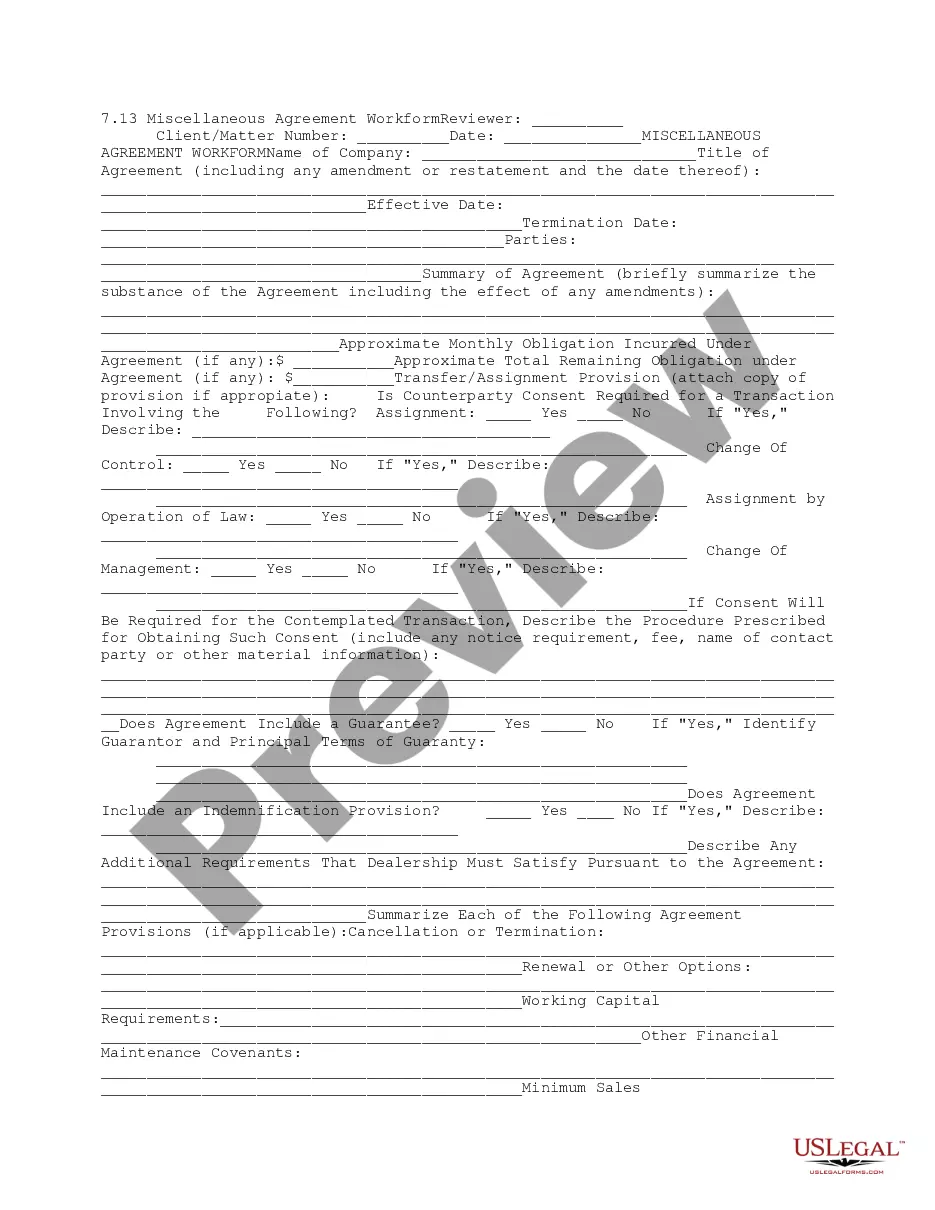
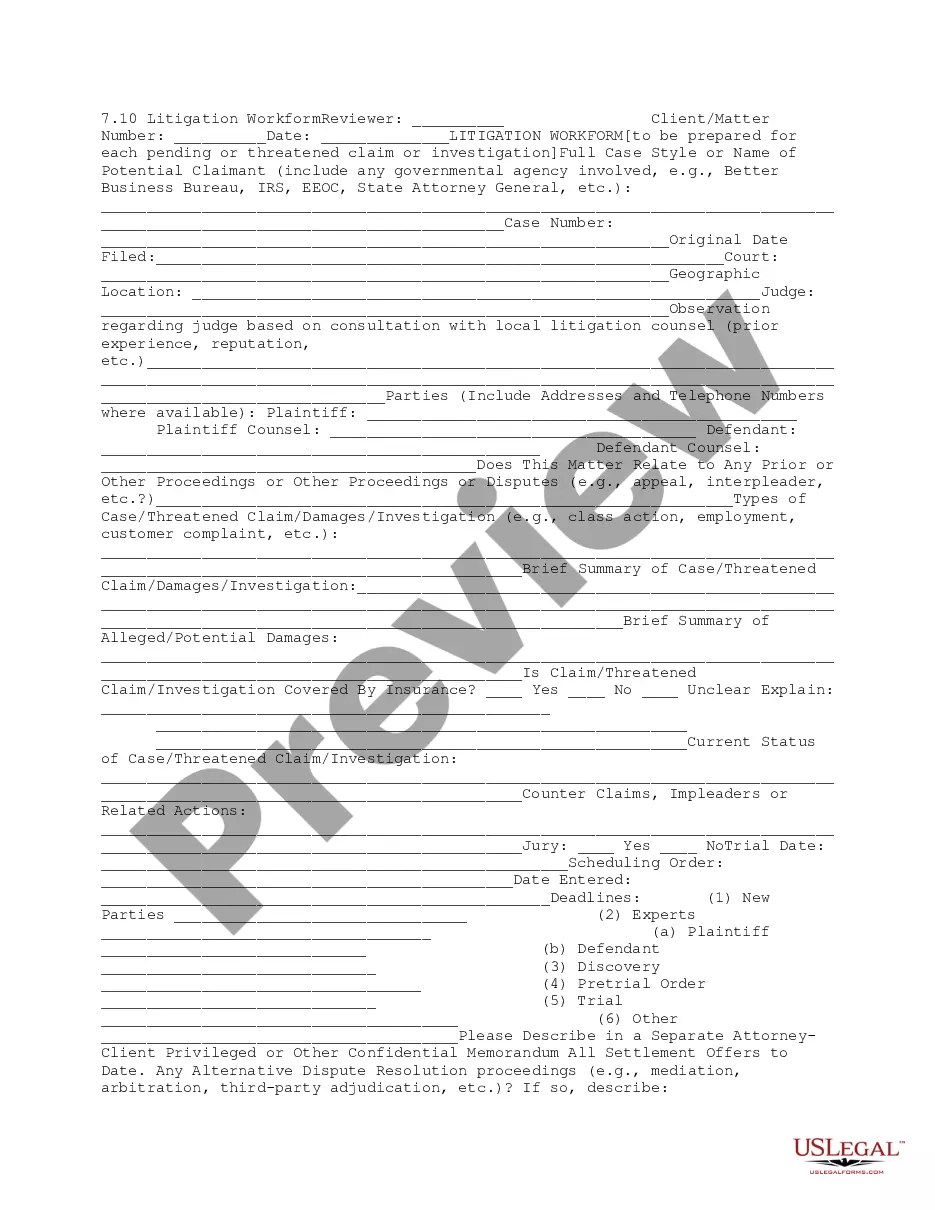
The Miscellaneous Agreement Workform is a legal document used to summarize various business agreements and their key provisions. It helps parties maintain clarity on the terms and obligations involved in such agreements, making it easier to manage business transactions. This form differs from other agreement templates by its comprehensive approach to capturing details about miscellaneous agreements, including amendments and specific stipulations.
Key parts of this document
- Reviewer and client/matter identification fields
- Name and title of the company and agreement
- Effective and termination dates
- Detailed summary of the agreement and its amendments
- Approximate monthly and total financial obligations under the agreement
- Transfer or assignment provision requirements
- Indemnification and guarantee provisions
- Additional requirements and considerations


When this form is needed
You should use the Miscellaneous Agreement Workform when entering into or reviewing business agreements that do not necessarily fit into standard contract types. This form is particularly useful when assessing the implications of amendments to existing agreements, determining obligations under the contract, or when evaluating transfer and assignment provisions that may affect future business operations.
Who can use this document
- Business owners looking to formalize agreements with other parties.
- Legal professionals who need to summarize behalf agreements and relay important points.
- Anyone involved in a business transaction requiring clarity on agreement terms and conditions.
- Individuals or entities considering changes to existing agreements.
Steps to complete this form
- Identify and enter the names of the reviewer and client matter number.
- Clearly state the name of the company and the title of the agreement.
- Fill in the effective and termination dates applicable to the agreement.
- Summarize the agreement, including any significant amendments.
- Detail any financial obligations incurred under the agreement.
- Include any pertinent provisions regarding assignment and changes in control or management.
Notarization guidance
This form does not typically require notarization to be legally valid. However, some jurisdictions or document types may still require it. US Legal Forms provides secure online notarization powered by Notarize, available 24/7 for added convenience.
Get your form ready online
Our built-in tools help you complete, sign, share, and store your documents in one place.
Make edits, fill in missing information, and update formatting in US Legal Forms—just like you would in MS Word.
Download a copy, print it, send it by email, or mail it via USPS—whatever works best for your next step.
Sign and collect signatures with our SignNow integration. Send to multiple recipients, set reminders, and more. Go Premium to unlock E-Sign.
If this form requires notarization, complete it online through a secure video call—no need to meet a notary in person or wait for an appointment.
We protect your documents and personal data by following strict security and privacy standards.

Make edits, fill in missing information, and update formatting in US Legal Forms—just like you would in MS Word.

Download a copy, print it, send it by email, or mail it via USPS—whatever works best for your next step.

Sign and collect signatures with our SignNow integration. Send to multiple recipients, set reminders, and more. Go Premium to unlock E-Sign.

If this form requires notarization, complete it online through a secure video call—no need to meet a notary in person or wait for an appointment.

We protect your documents and personal data by following strict security and privacy standards.
Common mistakes
- Failing to accurately summarize the agreement and its amendments.
- Omitting key financial obligations or terms and conditions.
- Not clarifying transfer and assignment provisions.
- Leaving out required consent procedures for third-party transactions.
Benefits of using this form online
- Convenience of downloading and completing the form at your own pace.
- Editability allows for easy customization to fit specific agreements.
- Access to templates drafted by licensed attorneys ensures legal reliability.
Looking for another form?
Form popularity
FAQ
The most obvious disadvantage to working on a 1099 basis is when you have to file your income tax return, but no withholding has been done by your employer. If you have not made quarterly tax estimates, you will owe thousands of dollars every April.
An independent contractor agreement is a document that an employer uses to hire a freelancer for a specific job. By extension, it distinguishes the independent contractor from an employee of the business for legal and tax purposes.
You can hire 1099 workers for specific projects, but you can't control when or how they complete their jobs. You're not responsible for covering their Medicare and Social Security taxes, and you won't provide them with the same benefits as you would for a W2 worker.
The IRS requires contractors to fill out a Form W-9, request for Taxpayer Identification Number and Certification, which you should keep on file for at least four years after the hiring. This form is used to request the correct name and Taxpayer Identification Number, or TIN, of the worker or their entity.
An independent contractor agreement, also known as a '1099 agreement', is a contract between a client willing to pay for the performance of services by a contractor.In most cases, the contractor is paid on a per-job basis and not by the hour, unless, the contractor is a lawyer, accountant, or equivalent.
The general rule is that an individual is an independent contractor if the payer has the right to control or direct only the result of the work and not what will be done and how it will be done. The earnings of a person who is working as an independent contractor are subject to Self-Employment Tax.
If you paid someone who is not your employee, such as a subcontractor, attorney or accountant $600 or more for services provided during the year, a Form 1099-NEC needs to be completed, and a copy of 1099-NEC must be provided to the independent contractor by January 31 of the year following payment.
1099 Contractors and Freelancers The IRS taxes 1099 contractors as self-employed. If you made more than $400, you need to pay self-employment tax. Self-employment taxes total roughly 15.3%, which includes Medicare and Social Security taxes. Your income tax bracket determines how much you should save for income tax.
1099 Worker Defined A 1099 worker is one that is not considered an employee. Rather, this type of worker is usually referred to as a freelancer, independent contractor or other self-employed worker that completes particular jobs or assignments.