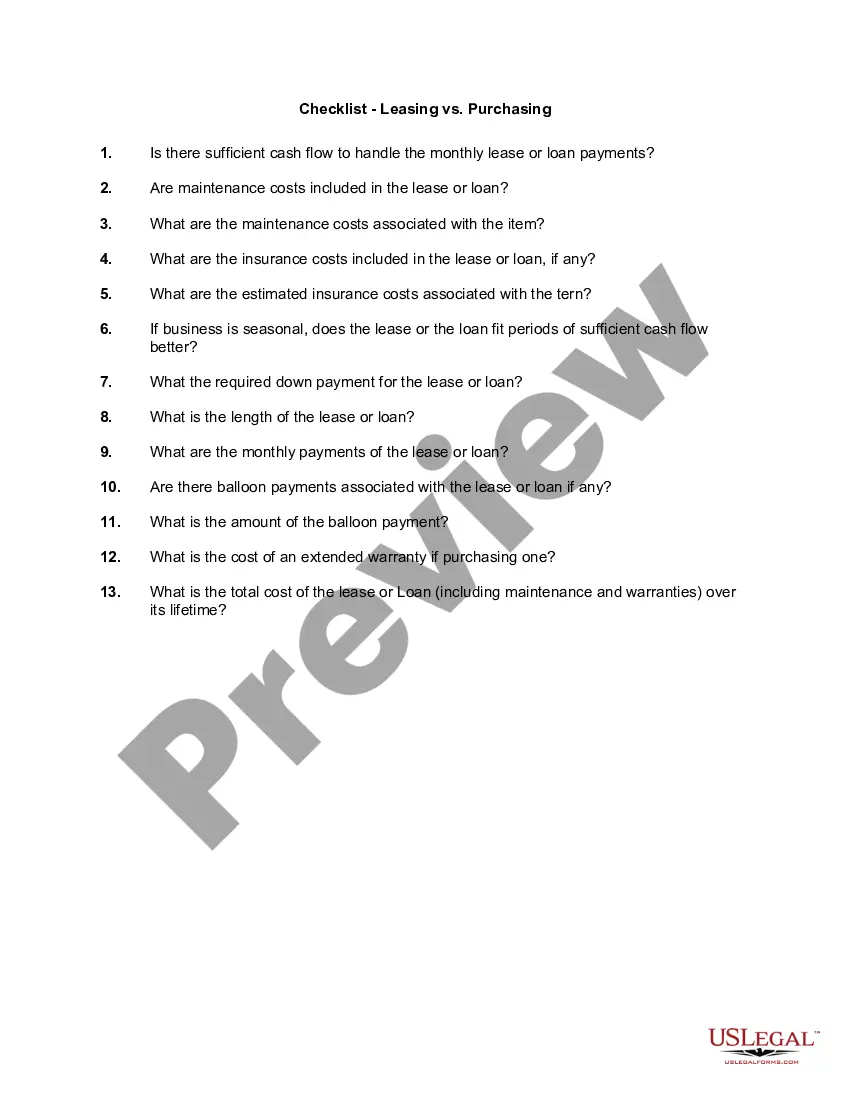
Checklist - Leasing vs. Purchasing
What this document covers
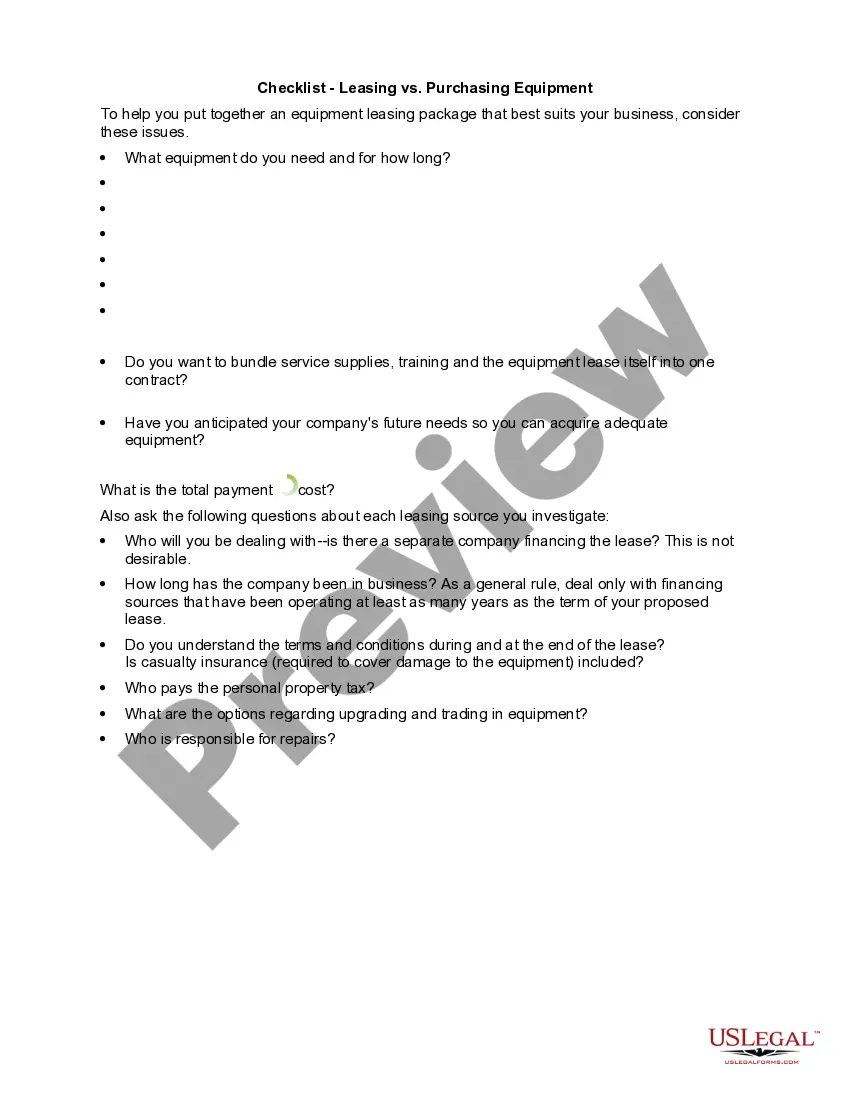
This checklist - leasing vs. purchasing is a tool designed to help individuals and businesses evaluate whether leasing or purchasing equipment is the better financial decision. It simplifies complex decision-making by providing a structured approach to compare costs and benefits associated with both options. Unlike standard lease agreements or purchase contracts, this checklist focuses specifically on assessing the viability of each approach.
Key components of this form
- Cash flow analysis for lease or loan payments
- Inclusion of maintenance costs in the lease or loan
- Insurance costs evaluation for both options
- Evaluation of seasonal business cash flow
- Down payment requirements for leasing or purchasing
- Length of the lease or loan term
- Monthly payment assessments for both options
- Consideration of balloon payments
- Total cost comparison over the lease or loan lifetime
When this form is needed
This checklist is useful in situations where a business or individual must decide between leasing or purchasing equipment. It is beneficial during budget planning for new projects, when assessing the financial impact on cash flow, or when comparing long-term costs for assets such as machinery, vehicles, or technology. Use this checklist to ensure informed decision-making tailored to your financial needs.
Who should use this form
- Business owners evaluating equipment acquisition options
- Individuals considering major purchases that require financing
- Financial advisors assisting clients in making informed choices
- Accountants managing budgets related to capital investments
- Entrepreneurs starting a business that needs essential equipment
How to complete this form
- Review your current cash flow and calculate available amounts for lease or loan payments.
- Identify whether maintenance costs are included in the lease or loan agreement.
- Estimate additional maintenance and insurance costs associated with the equipment.
- Assess how the business's seasonal cash flow impacts the decision between lease or purchase.
- Complete all fields related to down payments, terms, monthly payments, and potential balloon payments.
- Gather total cost estimates for leasing or loan over its duration, aiming for a comprehensive financial analysis.
Does this form need to be notarized?
This form usually doesn’t need to be notarized. However, local laws or specific transactions may require it. Our online notarization service, powered by Notarize, lets you complete it remotely through a secure video session, available 24/7.
Get your form ready online
Our built-in tools help you complete, sign, share, and store your documents in one place.
Make edits, fill in missing information, and update formatting in US Legal Forms—just like you would in MS Word.
Download a copy, print it, send it by email, or mail it via USPS—whatever works best for your next step.
Sign and collect signatures with our SignNow integration. Send to multiple recipients, set reminders, and more. Go Premium to unlock E-Sign.
If this form requires notarization, complete it online through a secure video call—no need to meet a notary in person or wait for an appointment.
We protect your documents and personal data by following strict security and privacy standards.

Make edits, fill in missing information, and update formatting in US Legal Forms—just like you would in MS Word.

Download a copy, print it, send it by email, or mail it via USPS—whatever works best for your next step.

Sign and collect signatures with our SignNow integration. Send to multiple recipients, set reminders, and more. Go Premium to unlock E-Sign.

If this form requires notarization, complete it online through a secure video call—no need to meet a notary in person or wait for an appointment.

We protect your documents and personal data by following strict security and privacy standards.
Avoid these common issues
- Not accounting for total lifetime costs, including maintenance and warranties.
- Overlooking the impact of cash flow on loan repayment abilities during seasonal downturns.
- Failing to compare similar equipment or terms between leasing and purchasing.
- Ignoring potential balloon payments that can significantly affect financial planning.
- Assuming all leases include maintenance when it may be excluded.
Benefits of using this form online
- Convenient access to a customizable checklist format tailored to your needs.
- Easy download for quick use and reference in decision-making discussions.
- Ensures that all relevant factors are considered, offering a reliable method to compare financial options.
- Includes guidance to help users with little financial expertise understand key concepts.
Legal use & context
- The checklist serves as a supportive document in the decision-making process.
- It does not constitute a legally binding agreement but aids in evaluating options.
- Always consult a legal professional for advice specific to your situation.
Quick recap
- The Checklist - Leasing vs. Purchasing is a valuable tool for financial decision-making.
- Understanding cash flow and total costs is crucial for informed choices.
- Utilize the checklist to compare leasing and purchasing options effectively.
Looking for another form?
Form popularity
FAQ
On the surface, leasing can be more appealing than buying. Monthly payments are usually lower because you're not paying back any principal. Instead, you're just borrowing and repaying the difference between the car's value when new and the car's residualits expected value when the lease endsplus finance charges.
The primary deduction difference between the purchase or lease of the vehicle is the amount of taxes you pay.Generally, you can deduct this tax on a vehicle you purchase for business use. With the lease of a vehicle, you typically pay tax on the lease as part of the monthly payment, but this is tax-deductible as well.
It does come down to the variables; whether you lease or buy, the CO2 emissions and your personal tax rate (basic, or higher rates). It is often more tax efficient to just buy the car personally and claim the Mileage allowance which is 45p per mile for the first 10,000 miles and 25p thereafter.
Leases are usually easier to obtain and have more flexible terms than loans for buying equipment. This can be a significant advantage if you have bad credit or need to negotiate a longer payment plan to lower your costs. Easier to upgrade equipment. Leasing allows businesses to address the problem of obsolescence.
The primary deduction difference between the purchase or lease of the vehicle is the amount of taxes you pay.Generally, you can deduct this tax on a vehicle you purchase for business use. With the lease of a vehicle, you typically pay tax on the lease as part of the monthly payment, but this is tax-deductible as well.
Leasing capital equipment: Lowers upfront costs, compared to buying equipment outright. Reduces the chance that your company gets stuck with obsolete equipment, if your contract specifies upgrades. Transfers the cost of equipment maintenance to the leasing company, again according to the terms of your contract.
Leasing a home requires only a security deposit and first and last month's rent, depending on the lease agreement. You'll pay significantly less money to enter into a lease agreement than it is to buy a home, because buying often requires a substantial down payment.
If you lease a car that you use in your business, you can deduct your car expenses using the standard mileage rate or the actual expense method.You can't deduct any portion of your lease payments if you use the standard mileage rate.
The higher the original value of the car, the greater the amount. As the price goes up on the car, leasing usually becomes more preferable. But don't forget if you purchased the vehicle, you can also deduct the interest on the vehicle's loan based on the percentage of business use.