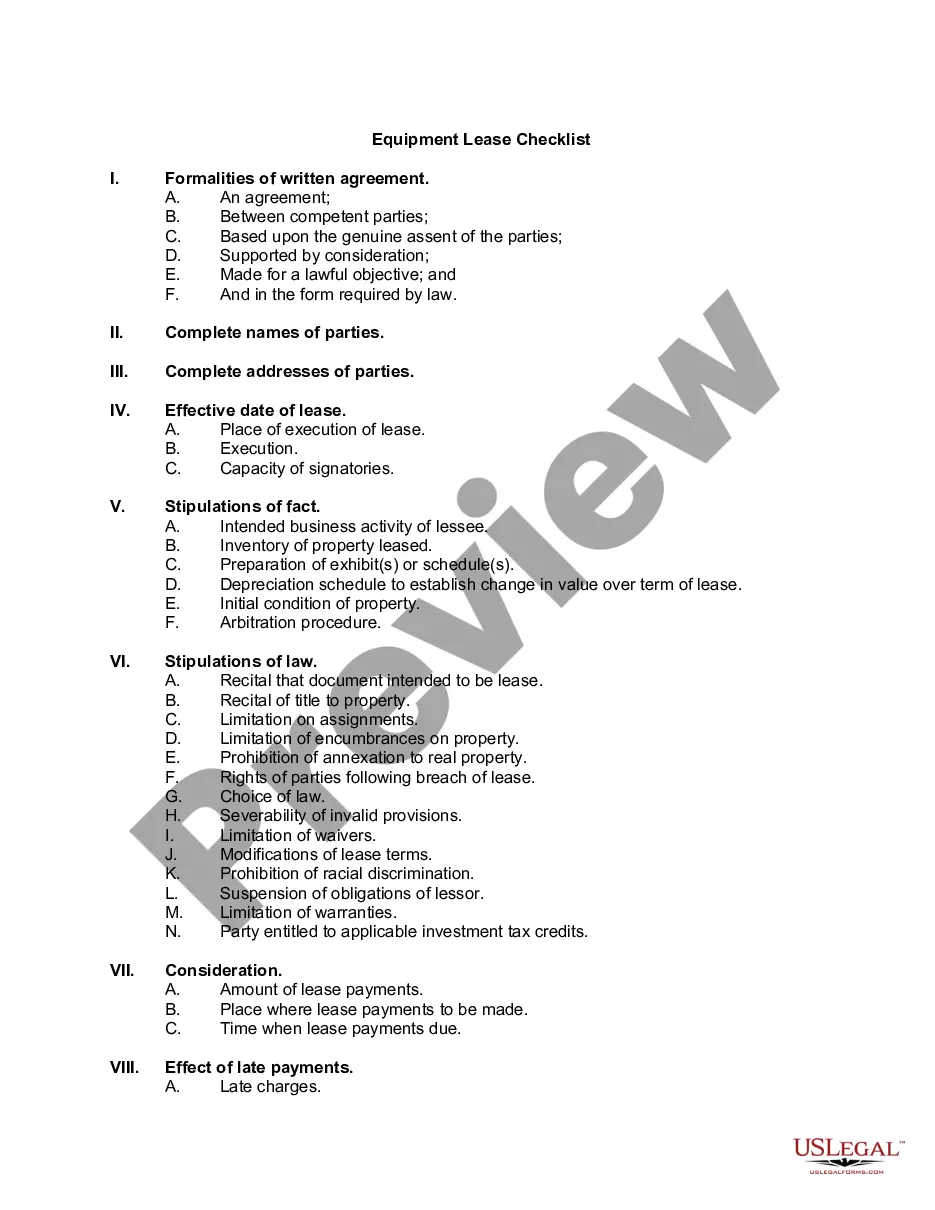
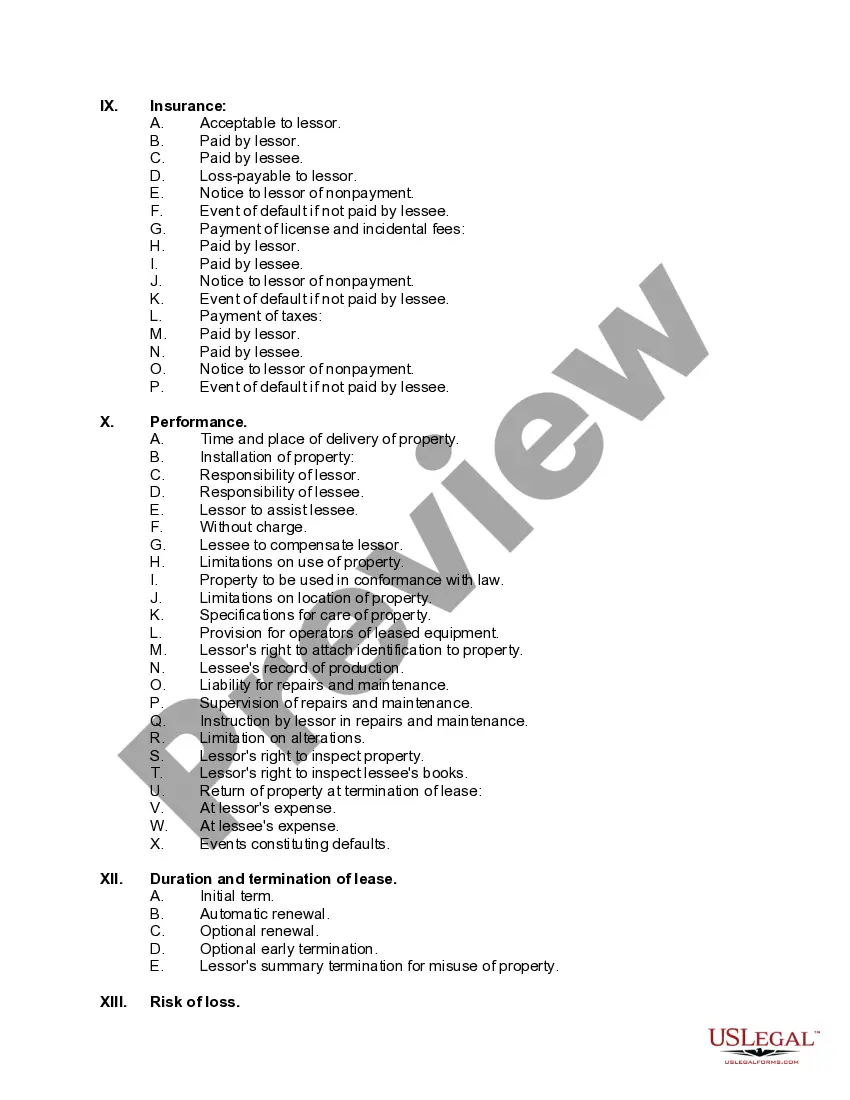
Equipment Lease Checklist
Understanding this form
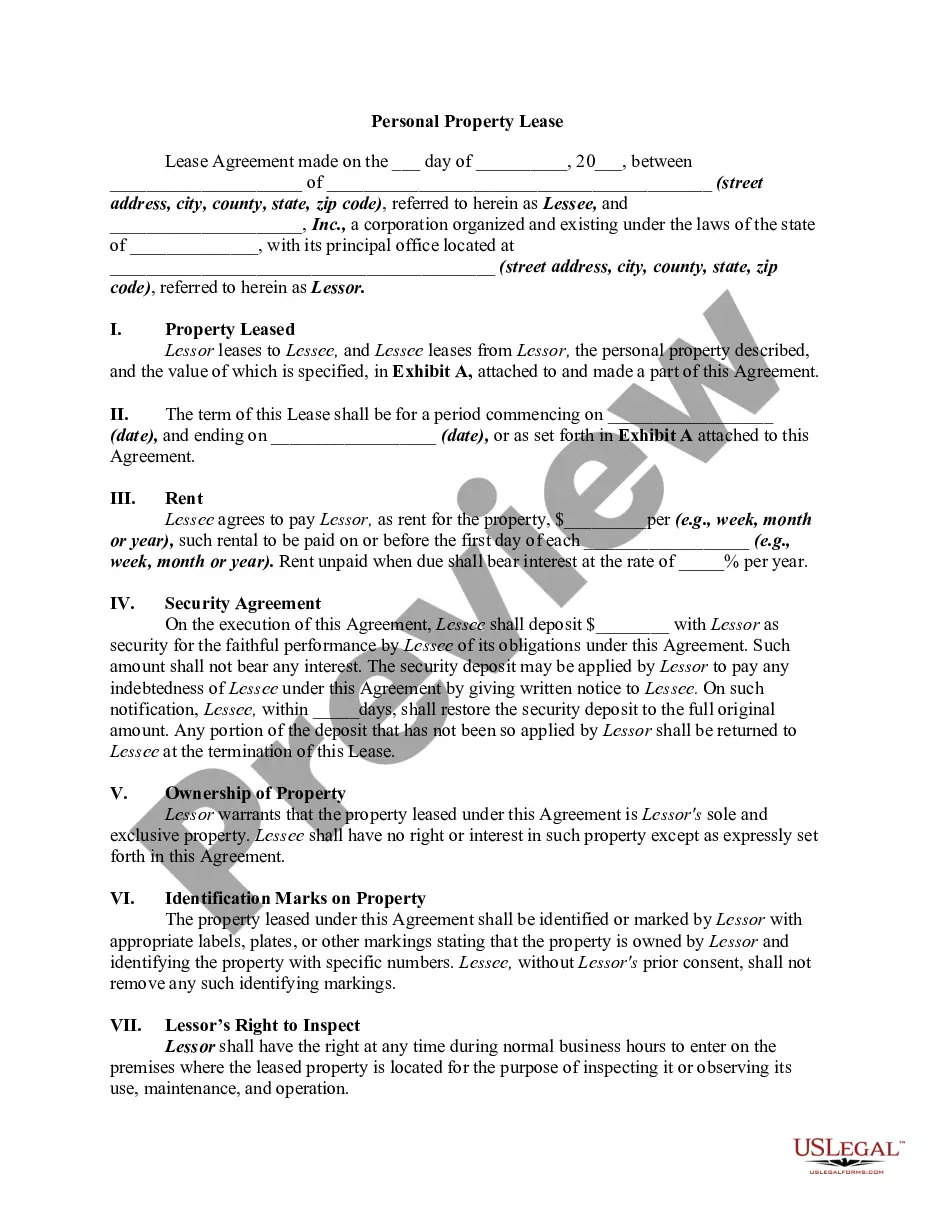
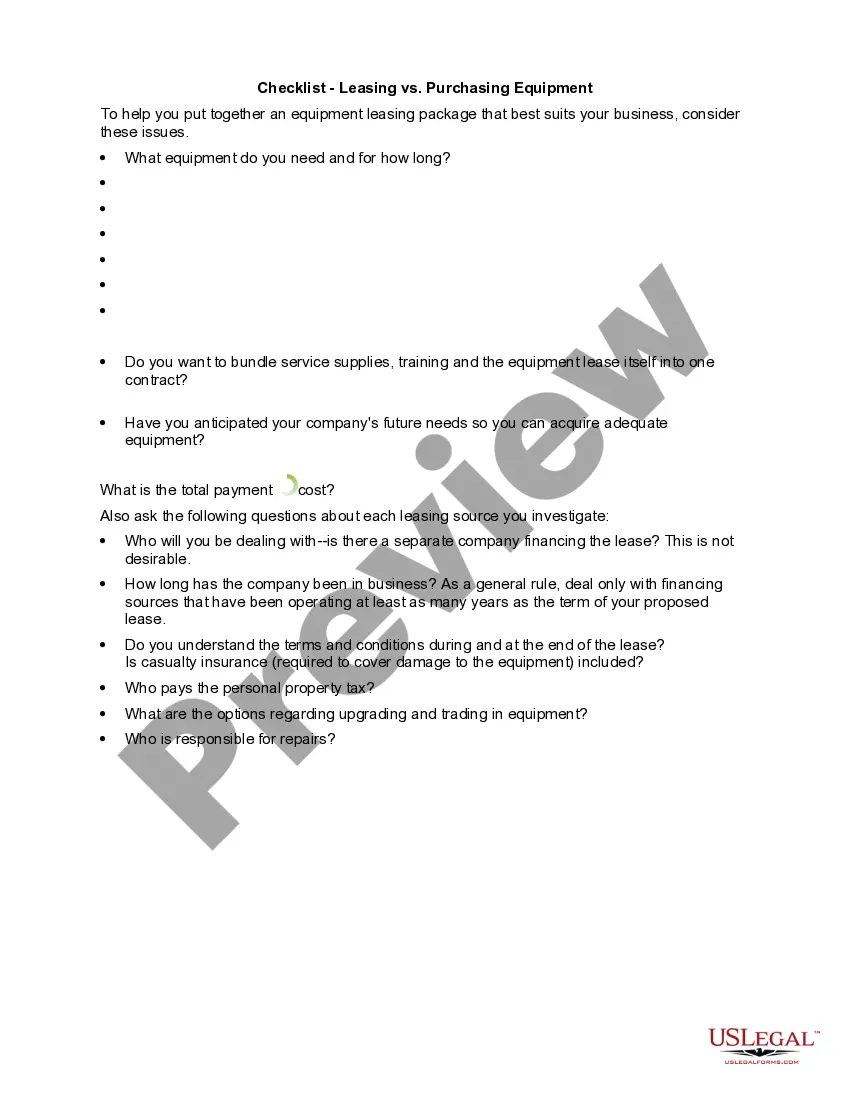
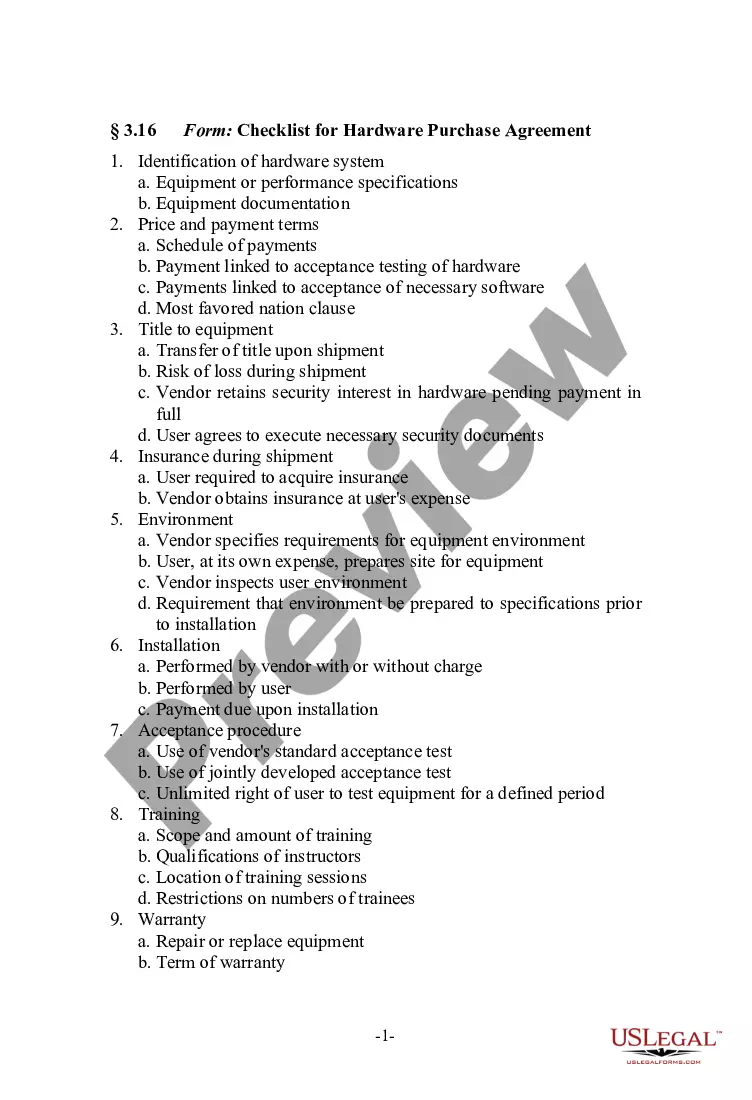
The Equipment Lease Checklist is a document designed to guide parties in drafting a lease agreement for personal property or equipment. This checklist outlines the essential elements to include in a lease, helping to ensure legal compliance and clarity between the lessor and lessee. Unlike other forms that may cover general leases, this specific checklist focuses exclusively on equipment leases and the relevant legal stipulations that govern them.
What’s included in this form
- Formalities of the written agreement, including agreement details, parties' competency, and lawful objectives.
- Complete names and addresses of both parties involved.
- Effective date of the lease and conditions for execution.
- Provisions for property details, including intended use and maintenance responsibilities.
- Risk of loss and liability clauses for damages.
- Duration and termination clauses, including renewal options and early termination rights.
Common use cases
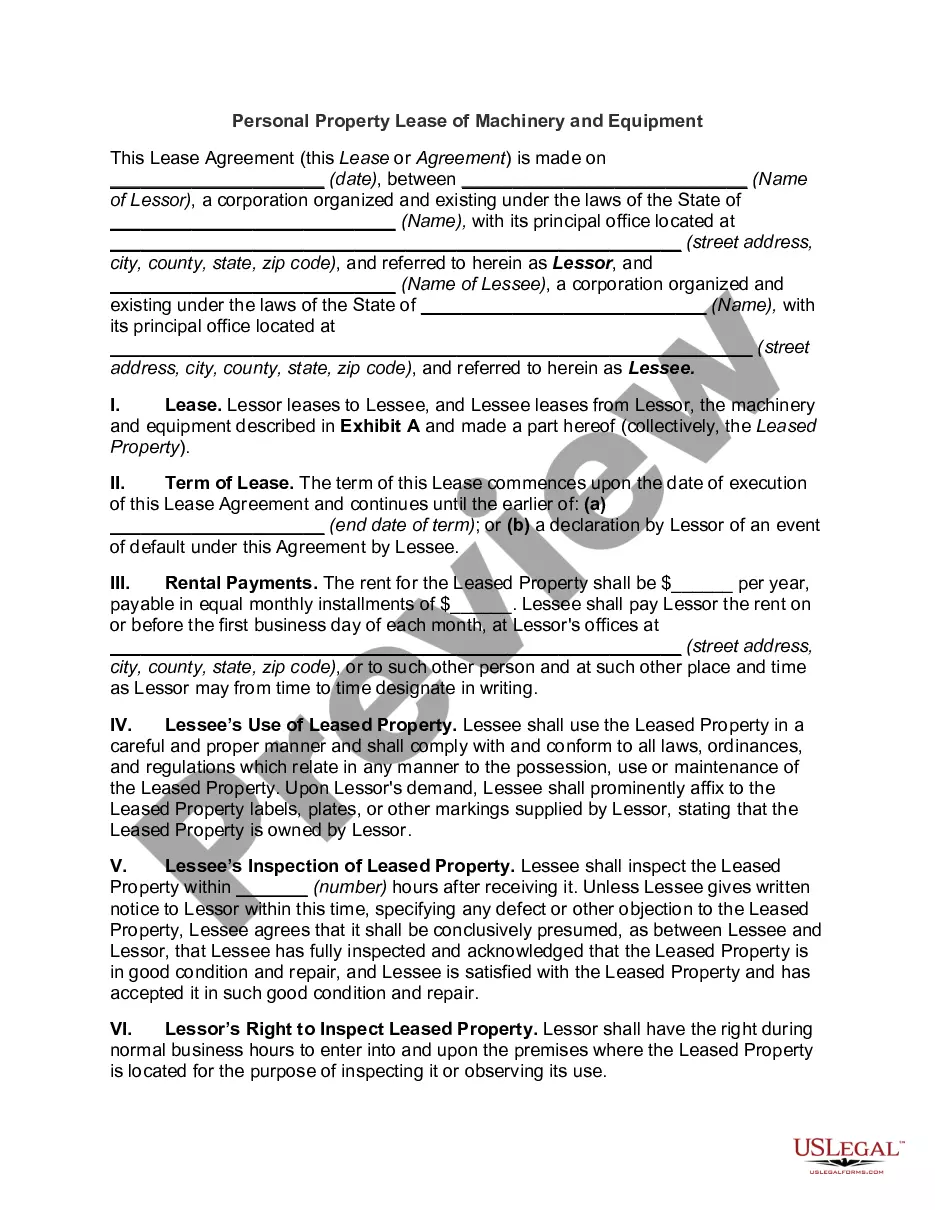
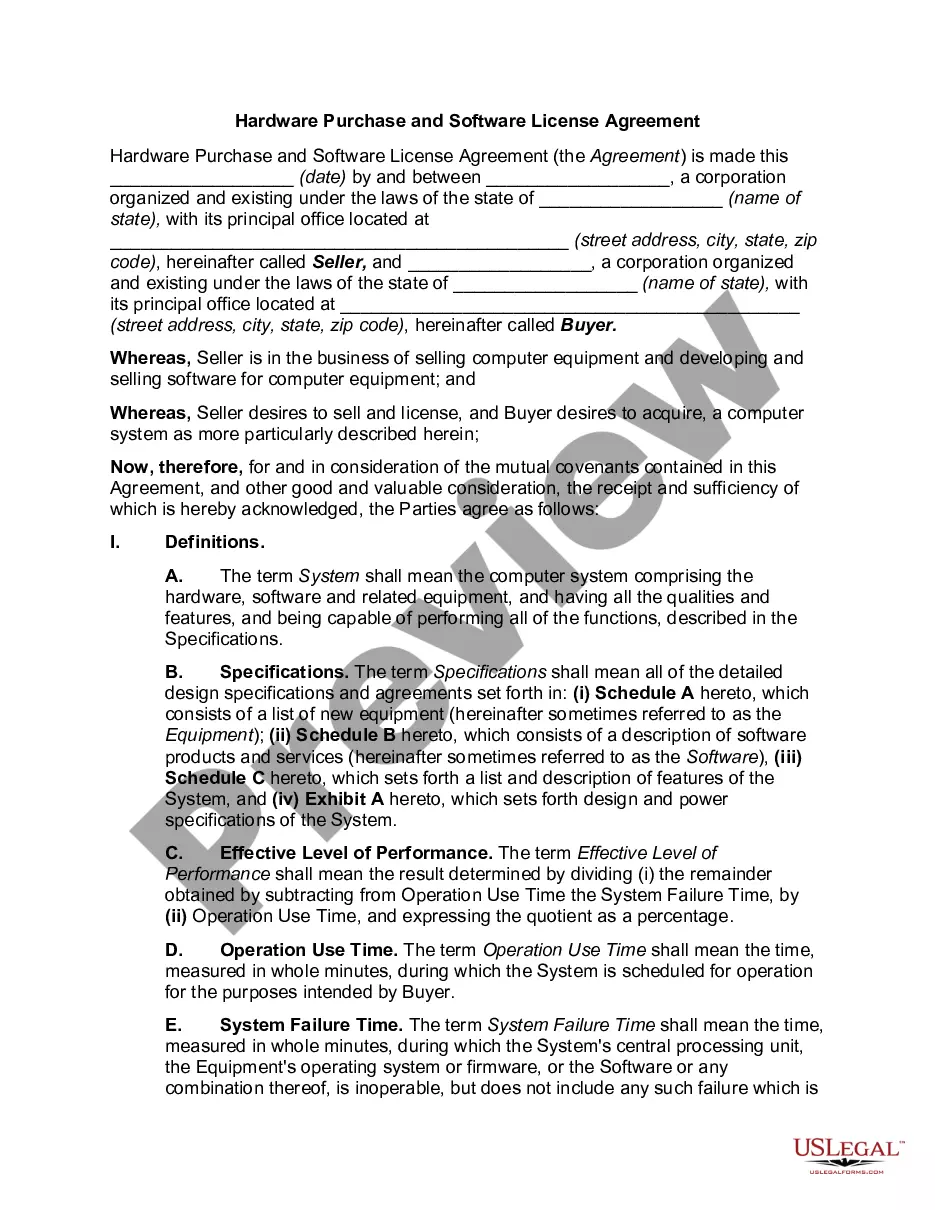
This form is used when one party (the lessor) allows another party (the lessee) to use equipment for a specified period in exchange for payment. It is particularly useful when formalizing the terms of an equipment lease to avoid potential disputes regarding usage, maintenance, and liability. Businesses engaged in leasing heavy machinery, office equipment, or specialized tools may require this checklist to ensure all legal aspects are addressed before finalizing the lease.
Who should use this form
- Business owners looking to lease equipment to clients or vendors.
- Individuals renting equipment for personal use or events.
- Legal professionals drafting or reviewing equipment lease agreements.
- Entrepreneurs starting a business that involves leasing equipment.
How to complete this form
- Identify the parties involved by providing their full names and addresses.
- Specify the effective date of the lease and the conditions under which it is executed.
- List all items of equipment being leased along with their current condition and intended use.
- Incorporate necessary legal stipulations, such as limitations and responsibilities of both parties.
- Include clauses regarding payment terms, risk of loss, and termination conditions.
Is notarization required?
Notarization is generally not required for this form. However, certain states or situations might demand it. You can complete notarization online through US Legal Forms, powered by Notarize, using a verified video call available anytime.
Get your form ready online
Our built-in tools help you complete, sign, share, and store your documents in one place.
Make edits, fill in missing information, and update formatting in US Legal Forms—just like you would in MS Word.
Download a copy, print it, send it by email, or mail it via USPS—whatever works best for your next step.
Sign and collect signatures with our SignNow integration. Send to multiple recipients, set reminders, and more. Go Premium to unlock E-Sign.
If this form requires notarization, complete it online through a secure video call—no need to meet a notary in person or wait for an appointment.
We protect your documents and personal data by following strict security and privacy standards.

Make edits, fill in missing information, and update formatting in US Legal Forms—just like you would in MS Word.

Download a copy, print it, send it by email, or mail it via USPS—whatever works best for your next step.

Sign and collect signatures with our SignNow integration. Send to multiple recipients, set reminders, and more. Go Premium to unlock E-Sign.

If this form requires notarization, complete it online through a secure video call—no need to meet a notary in person or wait for an appointment.

We protect your documents and personal data by following strict security and privacy standards.
Mistakes to watch out for
- Failing to clearly specify the terms of use for the equipment.
- Not including provisions for maintenance and repair responsibilities.
- Overlooking local laws that may affect the lease agreement.
- Neglecting to include consequences for late payments or defaults.
- Inadequately defining the duration and renewal terms of the lease.
Why complete this form online
- Convenient access to templates and checklists that simplify the leasing process.
- Editable forms allow users to tailor agreements to their specific needs.
- Reliability from templates crafted by licensed attorneys, ensuring legal compliance.
- Instant downloads allow users to start their leasing process without delays.
Legal use & context
- Compliance with common law of bailments or Article 2A of the Uniform Commercial Code.
- Ensure enforceability by meeting state-specific legal standards.
- Protection against disputes by clearly defining rights and obligations.
Key takeaways
- The Equipment Lease Checklist is fundamental for drafting valid lease agreements.
- It includes key components to ensure all legal obligations are met.
- This checklist is useful for both individuals and businesses entering leases.
- Always verify local legal requirements to avoid issues.
Looking for another form?
Form popularity
FAQ
ESSENTIAL ELEMENTS OF A VALID LEASE AGREEMENT. Competent Parties. Legal Purpose. Statute of Frauds. Reversionary Right. Property Description. Mutual Assent (Offer and Acceptance) Consideration.
Create Other Current Liability account for the loan/lease payable. Create Fixed Asset account for Computer Equipment. You must use a General Journal Entry, as taxes cannot be entered from the register. On the first line, enter the Computer Equipment asset account and enter the total loan amount as a Debit.
Name the parties. A simple rental agreement form needs to name the parties signing the lease and where they live. Describe the premises. Define the term of the lease. Set how much rent is owed. Assign a security deposit amount. Finalize the lease.
Names of all tenants. Limits on occupancy. Term of the tenancy. Rent. Deposits and fees. Repairs and maintenance. Entry to rental property. Restrictions on tenant illegal activity.
Inspect the Property and Record Any Current Damages. Know What's Included in the Rent. Can You Make Adjustments and Customizations? Clearly Understand the Terms Within the Agreement and Anticipate Problems. Communicate with Your Landlord About Your Expectations.
An equipment lease agreement is a contractual agreement where the lessor, who is the owner of the equipment, allows the lessee to use the equipment for a specified period in exchange for periodic payments. The subject of the lease may be vehicles, factory machines, or any other equipment. PP&E is impacted by Capex,.
For example, if a lease payment were for a total of $1,000 and $120 of that amount were for interest expense, then the entry would be a debit of $880 to the capital lease liability account, a debit of $120 to the interest expense account, and a credit of $1,000 to the accounts payable account.
Unlike an outright purchase or equipment secured through a standard loan, equipment under an operating lease cannot be listed as capital. It's accounted for as a rental expense. This provides two specific financial advantages: Equipment is not recorded as an asset or liability.
Accounting Treatment Of Leased Asset The lease payments also include interest, and the lessee needs to record it separately. For instance, if in a lease payment of $1000, $200 is for the interest expense, then $800 would be a debit to the capital lease liability account and $200 to the interest account.