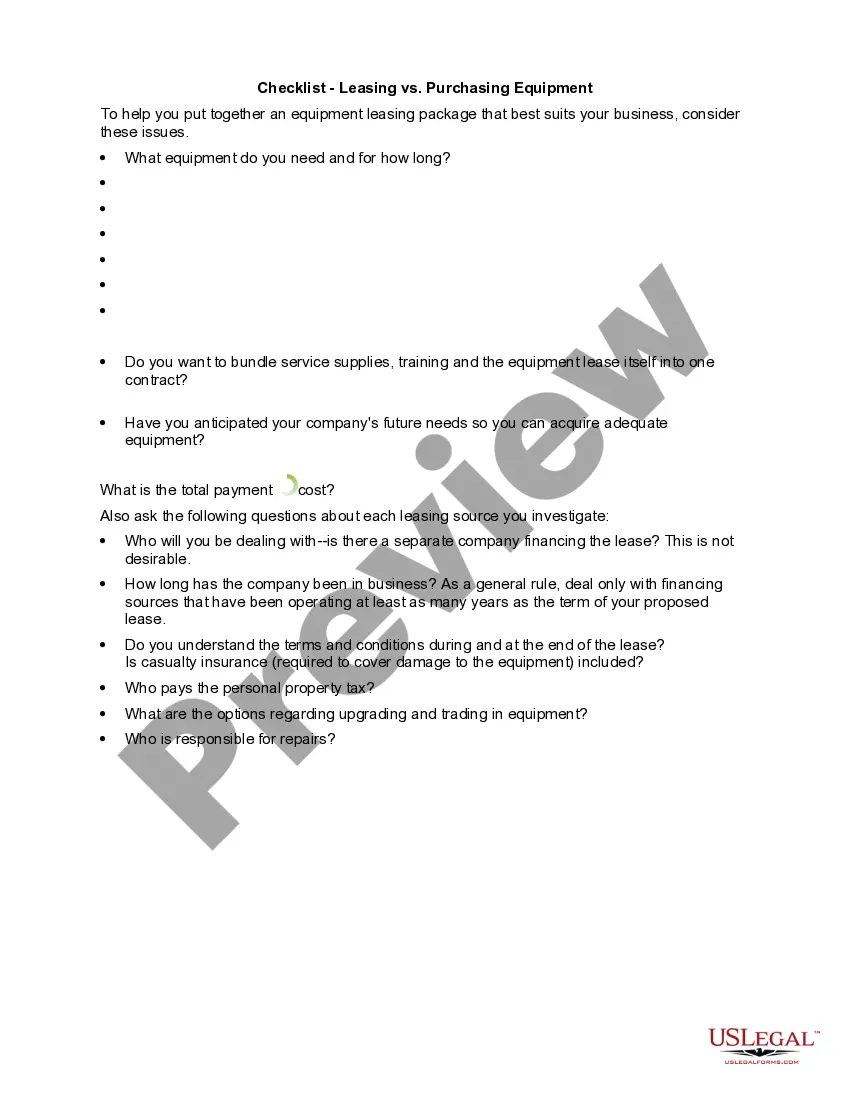
Checklist - Leasing vs. Purchasing Equipment
What this document covers
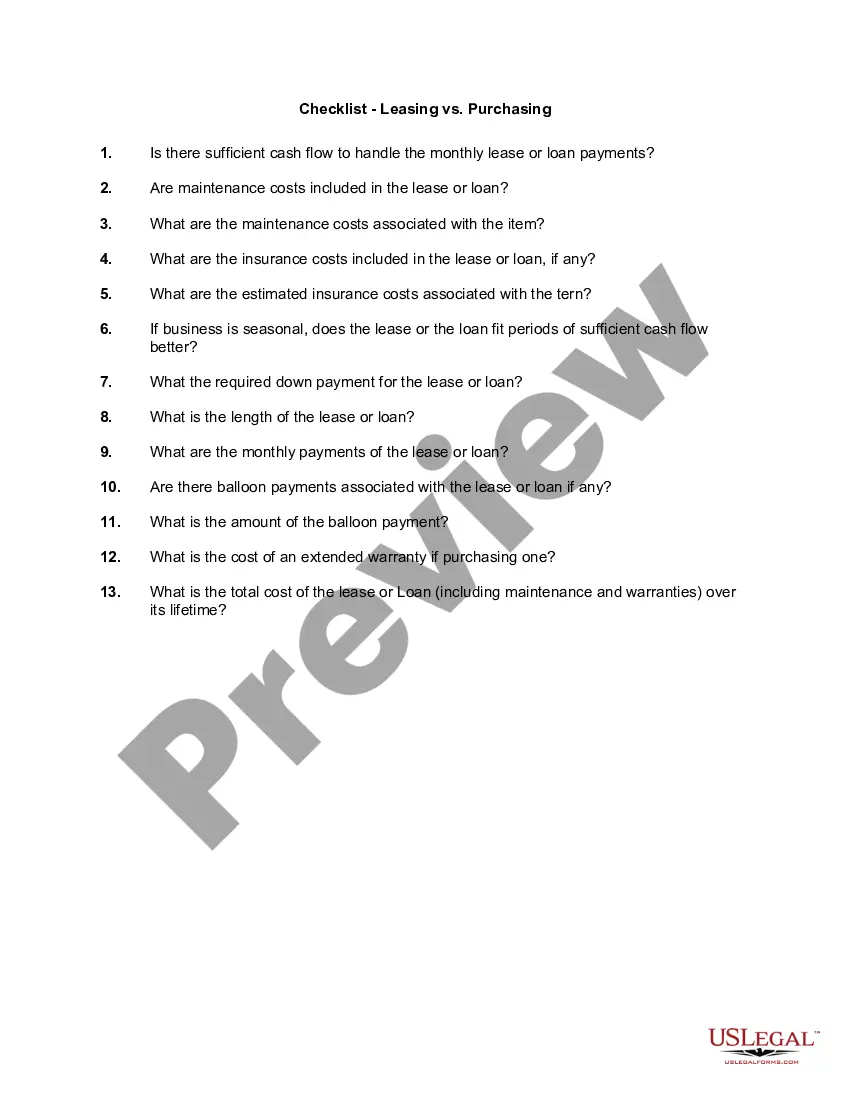
The Checklist - Leasing vs. Purchasing Equipment is a tool designed to assist businesses in evaluating whether to lease or buy equipment. This checklist helps you systematically compare the costs and benefits associated with each option, enabling more informed decisions tailored to your specific business needs. Unlike standard leasing agreements, this form focuses on a comprehensive analysis of various factors to consider when acquiring equipment.
Form components explained
- Identification of needed equipment and duration of use.
- Options for bundling services, supplies, and training with the lease.
- Assessment of future business needs for adequate equipment acquisition.
- Investigation of total cost implications for leasing and purchasing.
- Review of terms and conditions related to repairs, taxes, and insurance.
- Evaluation of upgrading and trading in equipment options.
When to use this document
This checklist should be used when your business is considering acquiring equipment, whether through leasing or purchasing. It is particularly useful in the following scenarios: when upgrading technology; evaluating costs for new equipment while managing cash flow; determining financial commitments for specialized machinery; and when assessing different financing options in light of your company's changing needs.
Who needs this form
- Business owners looking to acquire new equipment.
- Financial managers assessing the cost implications of equipment acquisition.
- Startups evaluating equipment needs in the early stages of business.
- Companies undergoing transitions that might affect equipment usage.
How to prepare this document
- Identify the equipment you need and specify the duration for which you'll require it.
- Determine if you want to include additional services, supplies, or training in your leasing contract.
- Project your company's future needs to ensure you secure the right type of equipment.
- Calculate the total costs involved in both leasing and purchasing options.
- Research each leasing source's terms and conditions, especially regarding repairs and insurance.
Does this form need to be notarized?
Notarization is not commonly needed for this form. However, certain documents or local rules may make it necessary. Our notarization service, powered by Notarize, allows you to finalize it securely online anytime, day or night.
Get your form ready online
Our built-in tools help you complete, sign, share, and store your documents in one place.
Make edits, fill in missing information, and update formatting in US Legal Forms—just like you would in MS Word.
Download a copy, print it, send it by email, or mail it via USPS—whatever works best for your next step.
Sign and collect signatures with our SignNow integration. Send to multiple recipients, set reminders, and more. Go Premium to unlock E-Sign.
If this form requires notarization, complete it online through a secure video call—no need to meet a notary in person or wait for an appointment.
We protect your documents and personal data by following strict security and privacy standards.

Make edits, fill in missing information, and update formatting in US Legal Forms—just like you would in MS Word.

Download a copy, print it, send it by email, or mail it via USPS—whatever works best for your next step.

Sign and collect signatures with our SignNow integration. Send to multiple recipients, set reminders, and more. Go Premium to unlock E-Sign.

If this form requires notarization, complete it online through a secure video call—no need to meet a notary in person or wait for an appointment.

We protect your documents and personal data by following strict security and privacy standards.
Typical mistakes to avoid
- Not thoroughly understanding the lease terms before signing.
- Failing to evaluate future equipment needs which may lead to additional costs.
- Overlooking additional fees associated with leasing agreements.
- Not considering tax implications of leasing versus buying.
- Ignoring the importance of understanding equipment maintenance responsibilities.
Benefits of completing this form online
- Convenient access to the checklist anytime and anywhere.
- Easy to edit and customize for your specific business needs.
- Reliable guidance drafted by licensed attorneys.
- Quick downloads that save time compared to traditional form acquisition methods.
Legal use & context
- This form serves as a guideline and comparison tool, not a legally binding contract.
- Proper use of the checklist can help protect your business from unforeseen financial liabilities.
- Understanding the terms of leasing agreements can reduce risks associated with equipment acquisition.
What to keep in mind
- Using the checklist can clarify whether leasing or purchasing is more beneficial for your business.
- Evaluate all costs and potential future needs before committing to a leasing agreement.
- Ensure you understand the terms of any lease agreement, including responsibilities for repairs and insurance.
Looking for another form?


Form popularity
FAQ
The major drawback of leasing is that you don't acquire any equity in the vehicle. It's a bit like renting an apartment. You make monthly payments but have no ownership claim to the property once the lease expires. In this case, it means you can't sell the car or trade it in to reduce the cost of your next vehicle.
Assets being leased are not recorded on the company's balance sheet; they are expensed on the income statement. So, they affect both operating and net income.
If equipment lasts only one or two years or you constantly need to upgrade it, you may want to lease. But if it lasts 10 or 12 years and needs very little maintenance, buying could be better. If you have solid cash flow, buying equipment may be best because it typically comes with a lower overall cost of ownership.
A lessee must capitalize a leased asset if the lease contract entered into satisfies at least one of the four criteria published by the Financial Accounting Standards Board (FASB). An asset should be capitalized if:The lease runs for 75% or more of the asset's useful life.
The equipment account is debited by the present value of the minimum lease payments and the lease liability account is the difference between the value of the equipment and cash paid at the beginning of the year. Depreciation expense must be recorded for the equipment that is leased.
+ Total up front costs (down payment + other fees) + Lost interest. + Outstanding loan balance at time lease expires. - Market value of vehicle at time lease expires. = Net cost of buying.
The equipment account is debited by the present value of the minimum lease payments and the lease liability account is the difference between the value of the equipment and cash paid at the beginning of the year. Depreciation expense must be recorded for the equipment that is leased.
Leasing capital equipment: Lowers upfront costs, compared to buying equipment outright. Reduces the chance that your company gets stuck with obsolete equipment, if your contract specifies upgrades. Transfers the cost of equipment maintenance to the leasing company, again according to the terms of your contract.
Unlike an outright purchase or equipment secured through a standard loan, equipment under an operating lease cannot be listed as capital. It's accounted for as a rental expense. This provides two specific financial advantages: Equipment is not recorded as an asset or liability.