Retirement Benefits Plan
Overview of this form
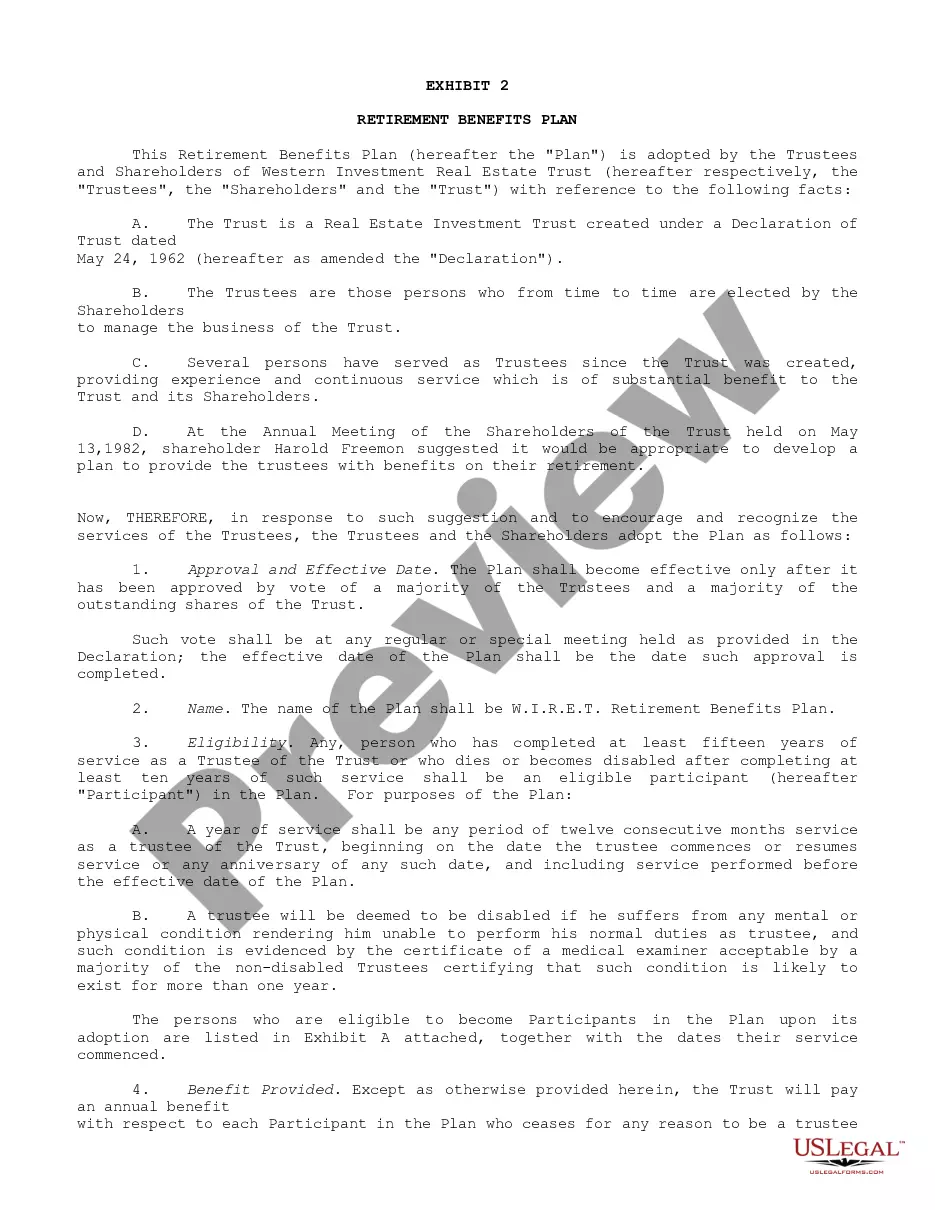
The Retirement Benefits Plan is a legal document that outlines the provisions for retirement benefits provided to trustees and officers of a trust after they have served for a specified number of years. This plan is particularly designed for those who have dedicated 15 or more years of service, calculating benefits based on a percentage of their average annual compensation during their final service years. This plan distinguishes itself from other retirement plans by its specific eligibility criteria and the tiered benefits structure based on years of service.
What’s included in this form
- Approval and Effective Date: The plan becomes effective only after a majority vote by trustees and shareholders.
- Eligibility: Participants must have at least fifteen years of service as trustees, with specific provisions for disability or death after ten years of service.
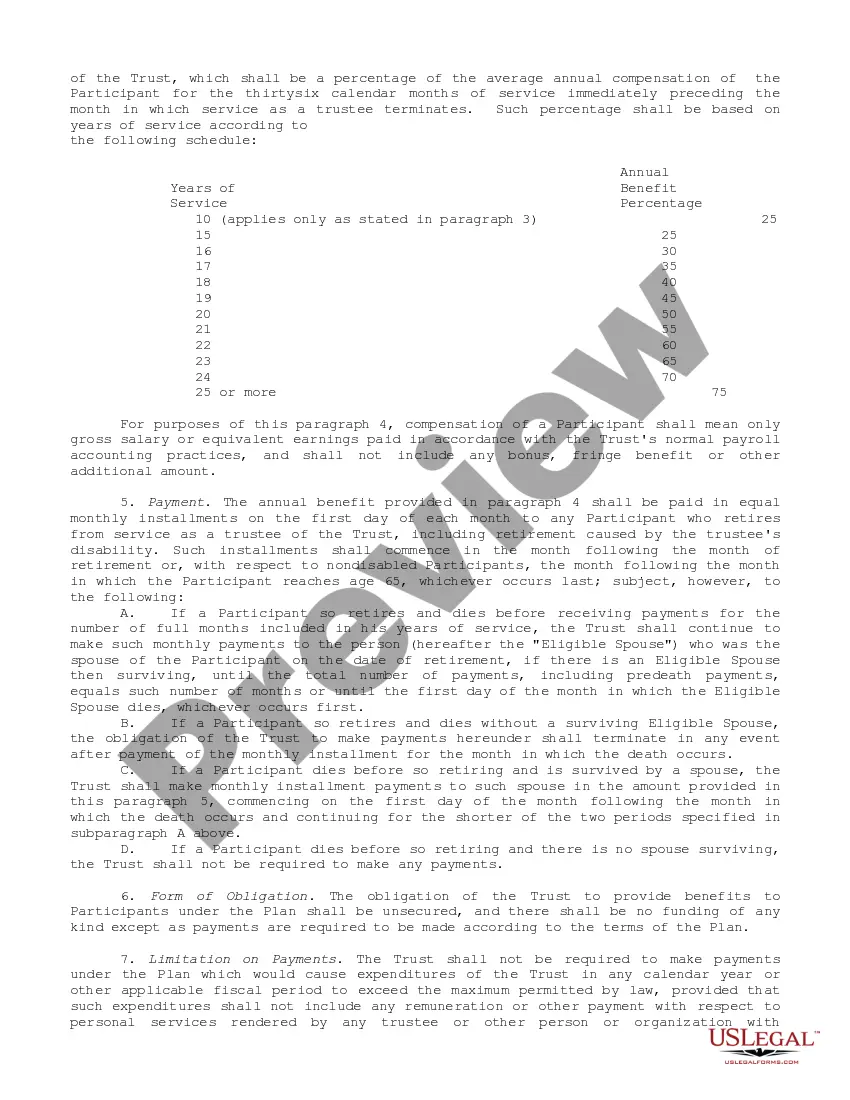
- Benefit Calculation: Annual benefits are calculated based on years of service, ranging from twenty-five percent for fifteen years of service to seventy-five percent for twenty-five or more years.
- Payment Structure: Benefits are paid in equal monthly installments, with rules governing payments to spouses or estates upon a participant's death.
- Administration: The plan is administered by the trustees, who have the authority to set rules and oversee plan operations.



When this form is needed
This form is used when a trust wishes to establish a formal retirement benefits plan for its trustees and officers. It is particularly relevant when a trust recognizes the need to reward the long-term service of its trustees and aims to provide a secure financial benefit upon their retirement. Additionally, this plan may be adopted in anticipation of a trustee's retirement or in response to shareholder suggestions for enhancing trustee compensation.
Who can use this document
- Trusts and organizations looking to implement a retirement benefits plan for their trustees and officers.
- Shareholders of a trust wanting to ensure their trustees are compensated fairly for years of service.
- Trustees with lengthy service who are nearing retirement and would benefit from a structured retirement plan.
Completing this form step by step
- Gather necessary information regarding the trust, including the names of trustees and the number of years of service.
- Complete the eligibility section by identifying participants who meet the 15-year service requirement.
- Calculate the annual benefit for each eligible trustee based on their average compensation during the final three years of service.
- Ensure proper voting by trustees and shareholders to approve the plan.
- Document the effective date and any necessary provisions for payment upon retirement or death.
Notarization requirements for this form
This form does not typically require notarization unless specified by local law. However, ensuring the form is properly executed per the trust's governing documents is essential for its validity.
Get your form ready online
Our built-in tools help you complete, sign, share, and store your documents in one place.
Make edits, fill in missing information, and update formatting in US Legal Forms—just like you would in MS Word.
Download a copy, print it, send it by email, or mail it via USPS—whatever works best for your next step.
Sign and collect signatures with our SignNow integration. Send to multiple recipients, set reminders, and more. Go Premium to unlock E-Sign.
If this form requires notarization, complete it online through a secure video call—no need to meet a notary in person or wait for an appointment.
We protect your documents and personal data by following strict security and privacy standards.

Make edits, fill in missing information, and update formatting in US Legal Forms—just like you would in MS Word.

Download a copy, print it, send it by email, or mail it via USPS—whatever works best for your next step.

Sign and collect signatures with our SignNow integration. Send to multiple recipients, set reminders, and more. Go Premium to unlock E-Sign.

If this form requires notarization, complete it online through a secure video call—no need to meet a notary in person or wait for an appointment.

We protect your documents and personal data by following strict security and privacy standards.
Common mistakes to avoid
- Failing to accurately calculate the average annual compensation.
- Not including all eligible participants in the plan documentation.
- Omitting the voting process required for plan approval.
Why complete this form online
- Convenient access to legally vetted form templates drafted by licensed attorneys.
- Edit the form as needed to fit specific trust situations or requirements.
- Reliable storage and management of completed documents for future reference.
Legal use & context
- The Retirement Benefits Plan is legally binding once approved by the required majority.
- Benefits are guaranteed as per the planâs terms unless amendments or termination occur.
- This plan helps in complying with relevant labor laws and tax regulations related to retirement benefits.
What to keep in mind
- The Retirement Benefits Plan provides a structured retirement benefit for long-serving trustees.
- Number of years of service determines the percentage of average annual compensation awarded.
- Proper completion and approval of the form are crucial for legal validity.
Looking for another form?
Form popularity
FAQ
For self-employed workers, setting up a retirement plan is a do-it-yourself job. There are four available plans tailored for the self-employed: one-participant 401(k), SEP IRA, SIMPLE IRA, and Keogh plan. Health savings plans (HSAs) and traditional and Roth IRAs are two more supplemental options.
If you were born between 1943 and 1954, your full retirement age is 66. If your birth year is 1960 or after, your normal retirement age is 67. Anyone born between 1955 and 1959 has a normal retirement age between 66 and 67 that is, 66 plus a certain number of months.
How do you sign up for Social Security? You can apply for retirement benefits online at www.ssa.gov, or call our toll-free number. Or you can make an appointment with a local Social Security office to apply in person.
How Early Can I Apply? Apply four months before you want your Social Security retirement benefits to start. If you want your benefits to start at age 62, you can apply at age 61 and 9 months.
You'd then receive your first Social Security check four months laterthe month after your 62nd birthday. While it typically takes several weeks to process a new application, some may be approved in the same month that you apply.
Social Security benefits are paid monthly, starting in the month after the birthday at which you attain full retirement age (which is currently 66 and will gradually rise to 67 over the next several years).
Your Social Security card or a record of your number. Your original birth certificate, a copy certified by the issuing agency, or other proof of your age. If you were not born in the U.S., proof of U.S. citizenship or lawful alien status.
You can put the money into a retirement account that's offered by your employer, such as a 401(k) or 403(b) plan. You can put the money into a tax-advantaged retirement account of your own, such as an IRA.
Following the recommendation on the Social Security website, you file online three months before you want your benefit to start, that is, on or before May 10th. Again, no matter what the actual date of your birth is, your benefit can begin in August.