Acknowledgment of Paternity with Declaration that Child Shall Share in Father's Estate
Understanding this form
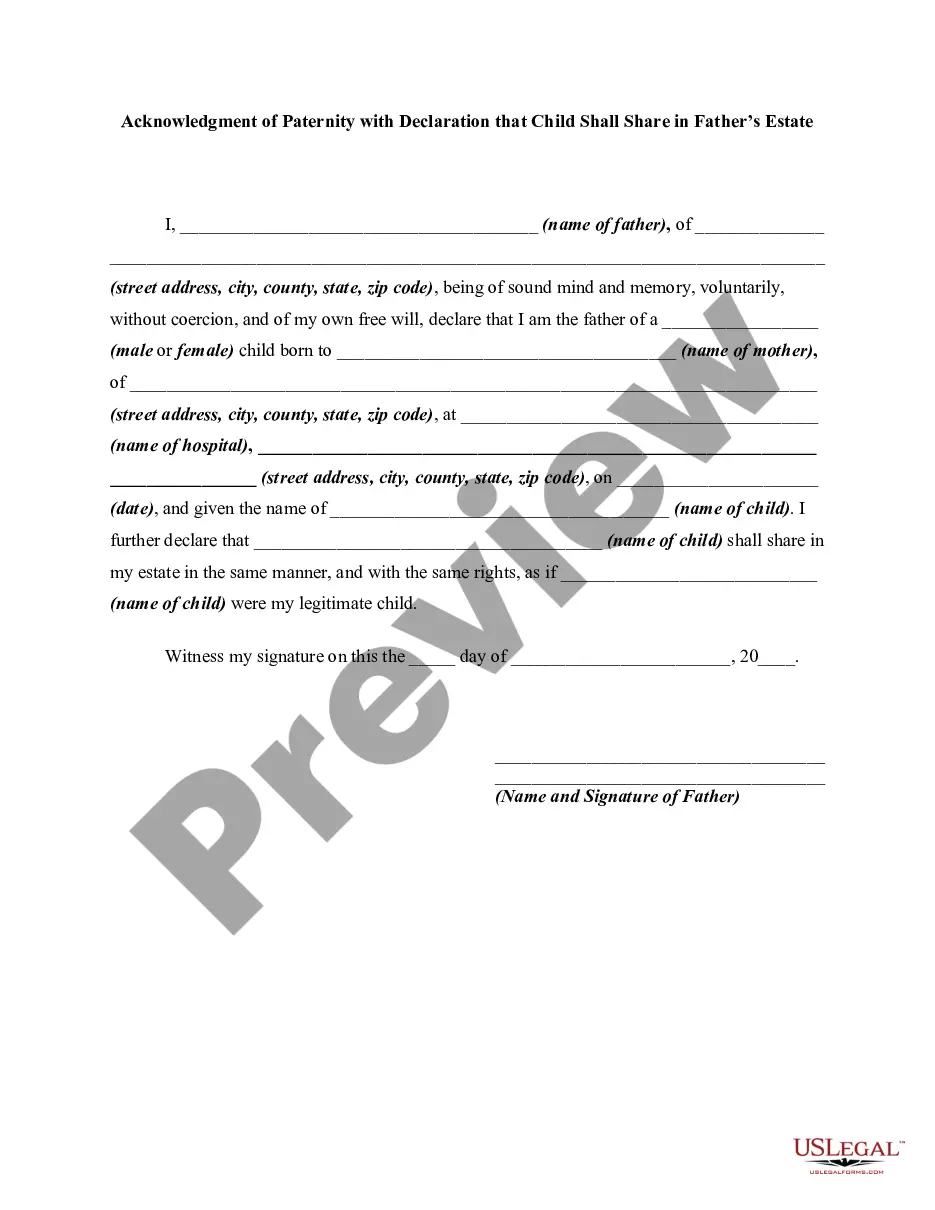
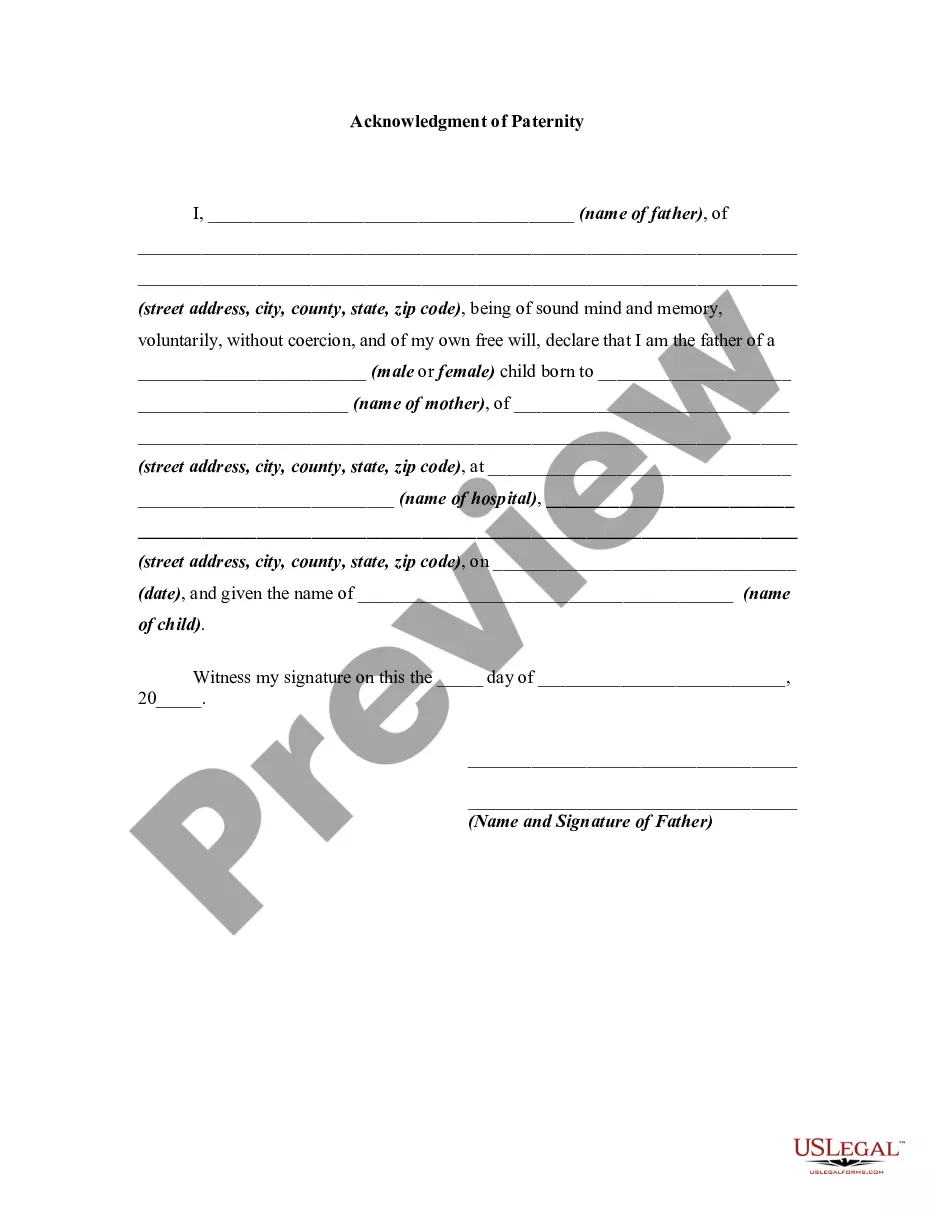
The Acknowledgment of Paternity with Declaration that Child Shall Share in Father's Estate is a legal document that establishes the paternity of a child born to unmarried parents. This form ensures that the child receives the same legal rights and inheritance privileges as a legitimate child, addressing any discrepancies in recognition by local laws. By completing this form, the father formally acknowledges his paternity and stipulates that the child will have a claim to his estate, serving to secure the child's legal status and rights.
What’s included in this form
- Name and contact information of the father.
- Name and details of the child's mother.
- Child's gender and name.
- Date and place of the child's birth.
- Declaration of the father's acknowledgment of paternity.
- Statement regarding the child's rights to share in the father's estate.
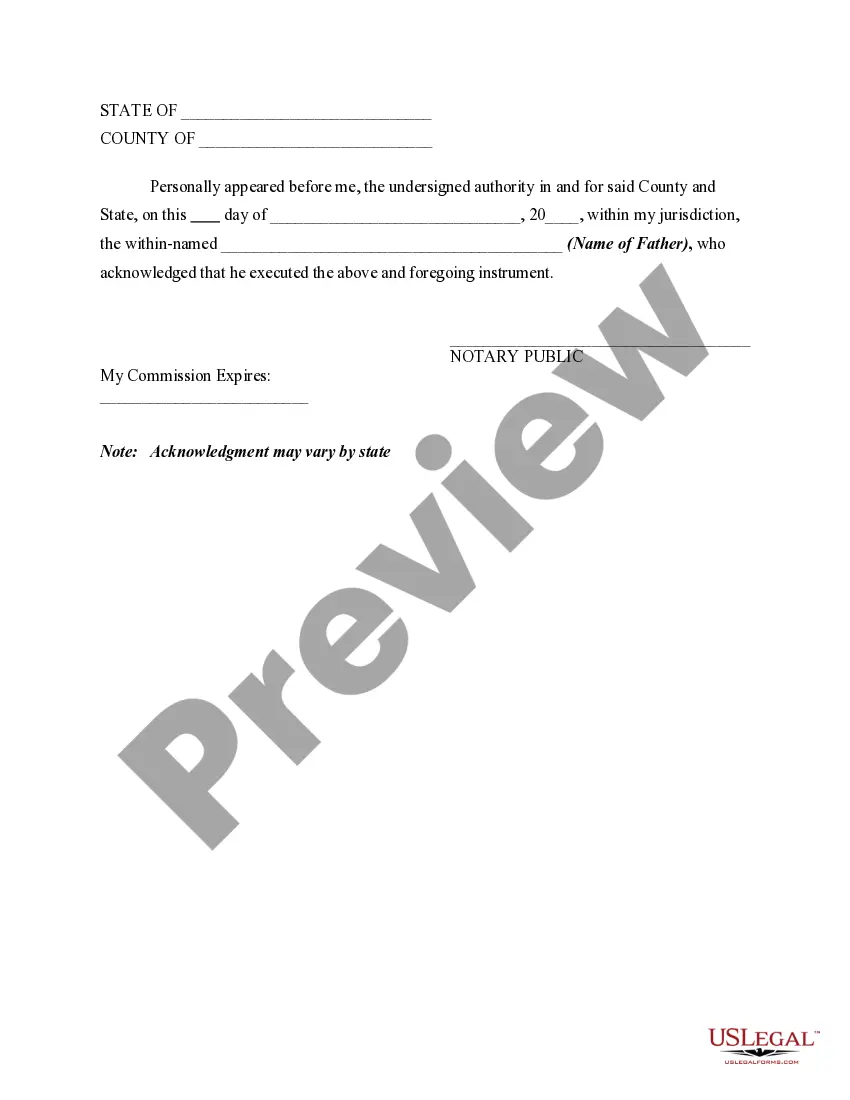
- Signature of the father and notary acknowledgment.
When to use this document
This form is typically used when an unmarried father wishes to legally acknowledge his child and ensure that the child has rights to his estate. It is appropriate in situations where the parents have not been married, and there is a need to formalize paternity for inheritance purposes, social security benefits, or other legal rights that legitimate children possess.
Who this form is for
- Unmarried fathers seeking to establish legal paternity.
- Fathers who want to ensure their child has equal rights to their estate.
- Parents who need a formal acknowledgment of paternity for legal or financial reasons.
How to prepare this document
- Enter the father's full name and contact information.
- Provide the mother's full name and address.
- Specify the child's name and gender.
- Record the date of birth and location of birth (hospital name and address).
- Read and sign the declaration of paternity.
- Have the document notarized, including the notary's acknowledgment.
Does this document require notarization?
This document requires notarization to meet legal standards. US Legal Forms provides secure online notarization powered by Notarize, allowing you to complete the process through a verified video call, available 24/7.
Get your form ready online
Our built-in tools help you complete, sign, share, and store your documents in one place.
Make edits, fill in missing information, and update formatting in US Legal Forms—just like you would in MS Word.
Download a copy, print it, send it by email, or mail it via USPS—whatever works best for your next step.
Sign and collect signatures with our SignNow integration. Send to multiple recipients, set reminders, and more. Go Premium to unlock E-Sign.
If this form requires notarization, complete it online through a secure video call—no need to meet a notary in person or wait for an appointment.
We protect your documents and personal data by following strict security and privacy standards.

Make edits, fill in missing information, and update formatting in US Legal Forms—just like you would in MS Word.

Download a copy, print it, send it by email, or mail it via USPS—whatever works best for your next step.

Sign and collect signatures with our SignNow integration. Send to multiple recipients, set reminders, and more. Go Premium to unlock E-Sign.

If this form requires notarization, complete it online through a secure video call—no need to meet a notary in person or wait for an appointment.

We protect your documents and personal data by following strict security and privacy standards.
Mistakes to watch out for
- Failing to include accurate information for the child or parents.
- Not having the document properly notarized when required.
- Omitting the declaration regarding inheritance rights.
- Not keeping a copy of the completed form for personal records.
Benefits of completing this form online
- Convenient access for immediate download and completion.
- Editability allows customization to fit your specific circumstances.
- Reliable templates crafted by licensed attorneys to ensure legal compliance.
Key takeaways
- The Acknowledgment of Paternity establishes legal recognition for the child from an unmarried father.
- This form ensures the child shares in the father's estate, similar to legitimate children.
- Fathers should ensure the form is completed accurately and notarized for validity.
Looking for another form?
Form popularity
FAQ
For births that took place in New York City, mail or take the original Acknowledgment of Parentage to the registrar at the New York City Department of Health and Mental Hygiene, Office of Vital Records, Attention: Corrections Unit Room 144, 125 Worth Street CN-4, New York, NY 10013-4089.
The mother and father can sign an Acknowledgment of Paternity form. This form is usually filled out at the hospital when the child is born but is also available in the local child support office and local birth registrar.Both parents shouldn't have any doubts about who the biological father is or other concerns.
Signing a voluntary declaration of parentage or paternity, OR. Getting a court order (either on your own or with the help of the Local Child Support Agency).
An acknowledgment of paternity will require some basic information including the child's full name, mother's full name, and father's full name. The father's date of birth, address, and Social Security number are also needed. The AOP must be signed and notarized by both parents.
Establishing paternity ensures a father's legal rights and various rights and privileges for their children, such as rights to inheritance, father's medical and life insurance benefits, and Social Security and veterans' benefits, plus access to paternal family health history.
For example, in a paternity fraud case, the judge may hold a person in contempt for lying or falsifying information about the paternity test. When this occurs, the judge may issue a contempt order, which can result in criminal charges.
Birth certificate. If a birth certificate declares the father and he signs it, this is a legally binding qualification of paternity. DNA test. Court order.
An action to establish paternity could be brought after the death of the alleged father; A clear and convincing evidence standard was applied to such action; and. Evidence was not legally insufficient and the trial court erred in this finding.
If a mother refuses to determine paternity for legal reasons, a court can order a paternity test be carried out. A mother has to give her consent for children to have a DNA test but the court can override any refusal if it considers it's in the child's best interest for the sample to be taken.