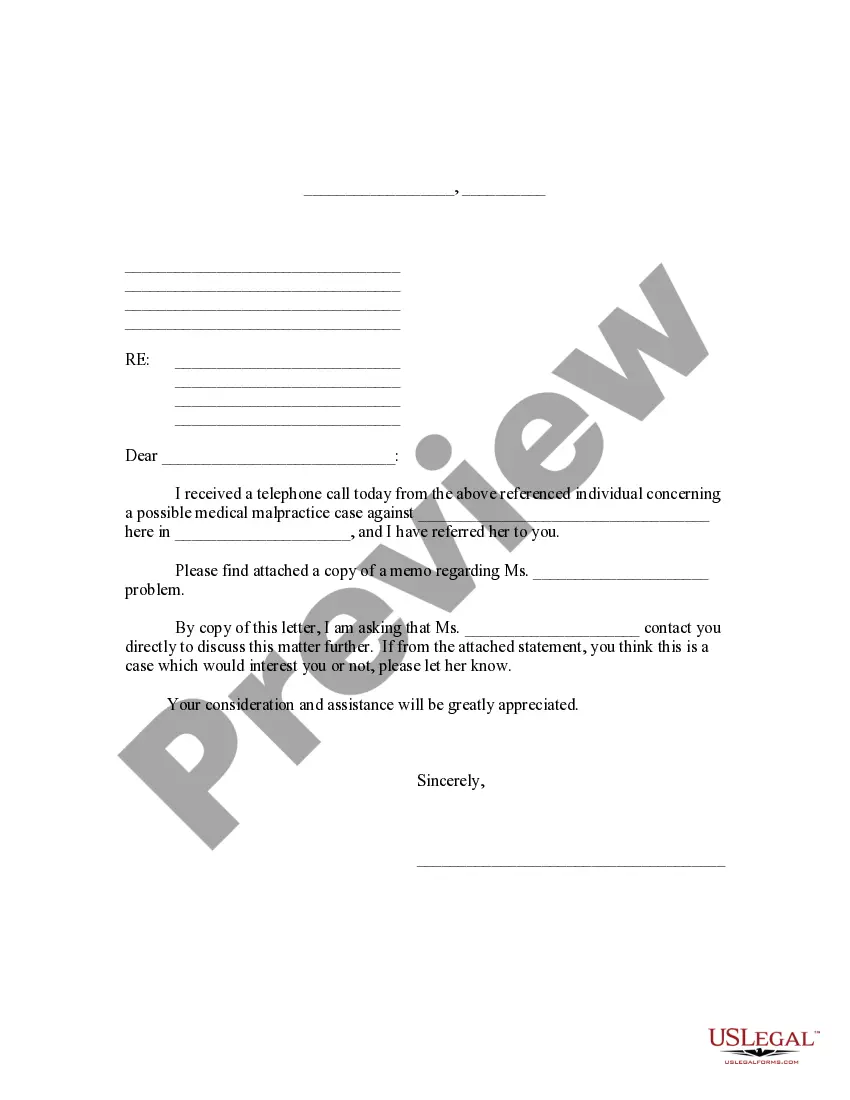
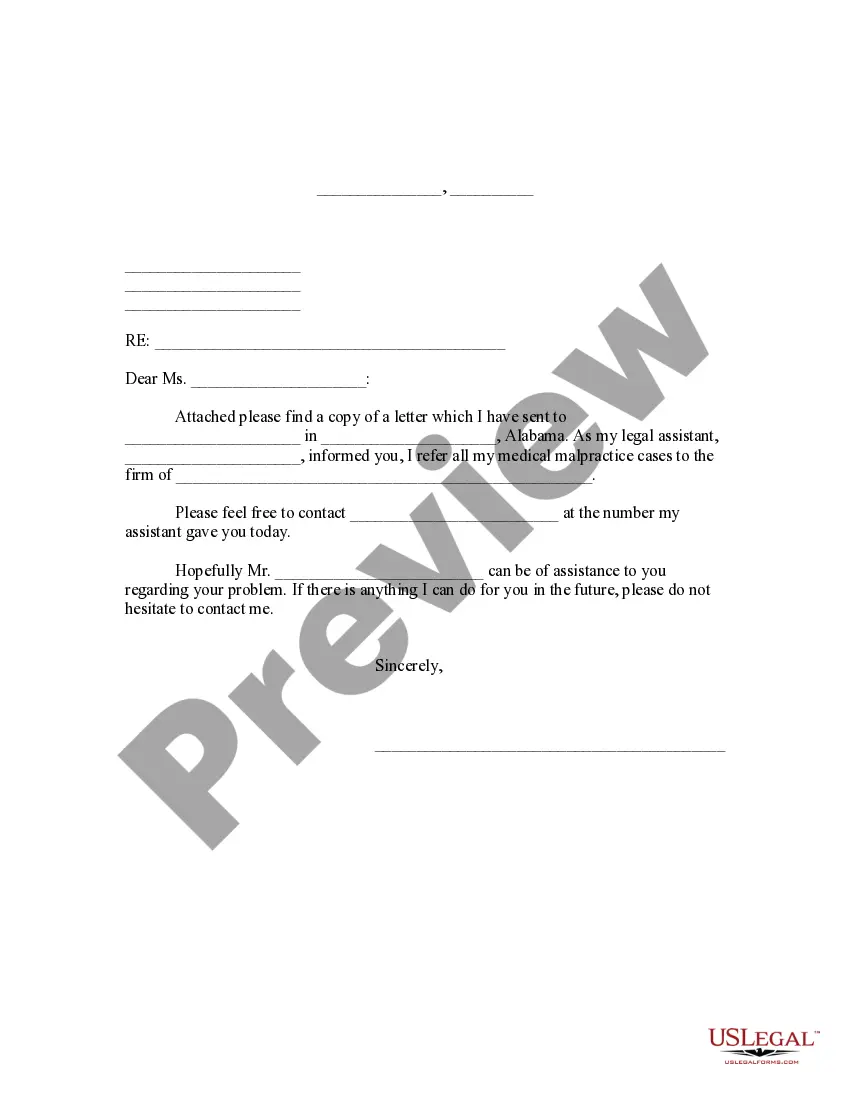
Alabama Letter from attorney to referred attorney sending case info
What is this form?
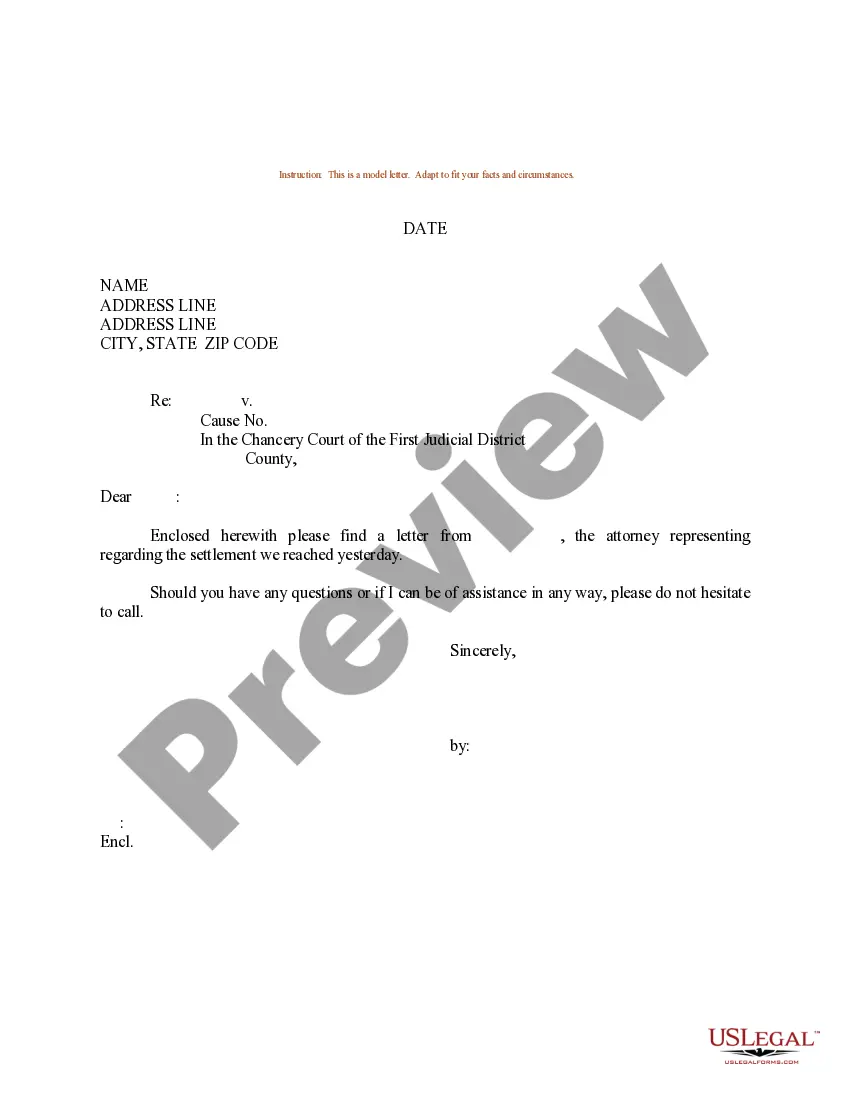
This form is a cover letter from an attorney to a referred attorney, providing case information for a medical malpractice claim. It facilitates communication between legal professionals regarding a case and outlines the necessary details for further discussion. Unlike general correspondence, this letter is specifically structured to share legal case details and ensure a smooth transition of information between attorneys.
Key parts of this document
- Parties involved: Identifies the referring attorney and the referred attorney.
- Case information: Provides details about the medical malpractice claim and the individual involved.
- Memo attachment reference: Indicates the inclusion of a detailed memo concerning the case.
- Request for follow-up: Encourages the referred attorney to communicate directly with the individual regarding the case.
- Closing statement: Thanks the referred attorney for their assistance and consideration.
When to use this form
Intended users of this form
- Attorneys who need to refer a client to another legal professional.
- Legal assistants tasked with preparing correspondence for attorneys.
- Law firms handling medical malpractice cases and looking for structured referral processes.
How to prepare this document
- Identify the parties: Enter the names of the referring attorney and the referred attorney.
- Provide case details: Fill in the individualâs name and the name of the medical professional or institution involved.
- Attach the memo: Ensure a detailed memo regarding the case is included with the letter.
- Request client contact: State that the client should contact the referred attorney directly.
- Sign the letter: Include the referring attorney's signature at the end of the document.
Is notarization required?
This form does not typically require notarization unless specified by local law. It's important to check local regulations to ensure compliance.
Get your form ready online
Our built-in tools help you complete, sign, share, and store your documents in one place.
Make edits, fill in missing information, and update formatting in US Legal Forms—just like you would in MS Word.
Download a copy, print it, send it by email, or mail it via USPS—whatever works best for your next step.
Sign and collect signatures with our SignNow integration. Send to multiple recipients, set reminders, and more. Go Premium to unlock E-Sign.
If this form requires notarization, complete it online through a secure video call—no need to meet a notary in person or wait for an appointment.
We protect your documents and personal data by following strict security and privacy standards.

Make edits, fill in missing information, and update formatting in US Legal Forms—just like you would in MS Word.

Download a copy, print it, send it by email, or mail it via USPS—whatever works best for your next step.

Sign and collect signatures with our SignNow integration. Send to multiple recipients, set reminders, and more. Go Premium to unlock E-Sign.

If this form requires notarization, complete it online through a secure video call—no need to meet a notary in person or wait for an appointment.

We protect your documents and personal data by following strict security and privacy standards.
Avoid these common issues
- Failing to attach the necessary memo or case details.
- Not including the correct contact information for the referred attorney.
- Overlooking the need to clearly state the nature of the case.
- Using jargon that may confuse the recipient attorney or client.
Why complete this form online
- Convenience to fill out and download from anywhere at any time.
- Editable format allows for customization according to specific needs.
- Reliability of using a template drafted by licensed attorneys.
Looking for another form?
Form popularity
FAQ
In correspondence, begin with a proper title and last name of the attorney, avoiding first names unless invited. For instance, use 'Dear Mr. Smith' or 'Dear Ms. Johnson.' This formal structure is crucial, particularly when conveying information like the Alabama Letter from attorney to referred attorney sending case info, ensuring clarity and respect in your communication.
The proper way to call an attorney is to use their title, such as 'Attorney' or 'Counselor,' followed by their last name. This formal approach demonstrates respect and professionalism. Whenever discussing formal matters, particularly the Alabama Letter from attorney to referred attorney sending case info, addressing them correctly fosters effective communication.
In general, lawyers are not addressed as 'Dr.' unless they hold a doctorate in an unrelated field. Lawyers often seek acknowledgment of their professional credentials but go by 'Mr.' or 'Ms.' in most legal correspondence. Ensure understanding of these distinctions when discussing documents like the Alabama Letter from attorney to referred attorney sending case info.
Attorneys typically prefer to be addressed by their professional titles. Use 'Mr.' or 'Ms.' followed by their last name unless you know they hold a specific title like 'Esquire.' It shows respect and maintains professionalism, especially in communications about the Alabama Letter from attorney to referred attorney sending case info.
To write a professional email to a lawyer, start with a clear subject line that summarizes your message. Begin with a formal greeting, using the attorney's last name preceded by a title. State your purpose concisely and include relevant details about the Alabama Letter from attorney to referred attorney sending case info. Close with a courteous sign-off.
Writing a legal letter of representation requires a clear introduction explaining your role as the representative. Include details about the client and the matter at hand for which you are representing them. Conclude with your contact information and a professional closing. Having an Alabama Letter from attorney to referred attorney sending case info handy can provide the needed structure and professionalism for this document.
To write a simple power of attorney letter, start with a title indicating it is a power of attorney. Clearly state the names of the principal and the agent, followed by a description of the powers granted. End with a date and signature from both parties. Utilizing templates from uslegalforms can simplify the process, ensuring that your document remains compliant with Alabama laws.
When signing as power of attorney, write your name followed by 'power of attorney for Principal's Name'. This signature denotes your authority to act on behalf of that individual. For instance, if you are signing on behalf of John Smith, you would sign as 'Your Name, Attorney-in-Fact for John Smith'. Such clarity confirms your role when completing tasks or signing documents.
Yes, you can write your own power of attorney letter as long as it meets your state's legal requirements. Be sure to include essential elements such as your name, the agent's name, and the specific powers you are granting. It’s crucial to review your state laws and consider using resources from platforms like uslegalforms for templates and guidance. This approach enhances the validity of your document.
The easiest way to create a power of attorney is by using a template or legal service that provides guidance. Platforms like uslegalforms have useful resources that simplify this process. Generally, include the principal's name, the agent's name, and the specific powers granted. This streamlines the process, ensuring you meet legal requirements successfully.