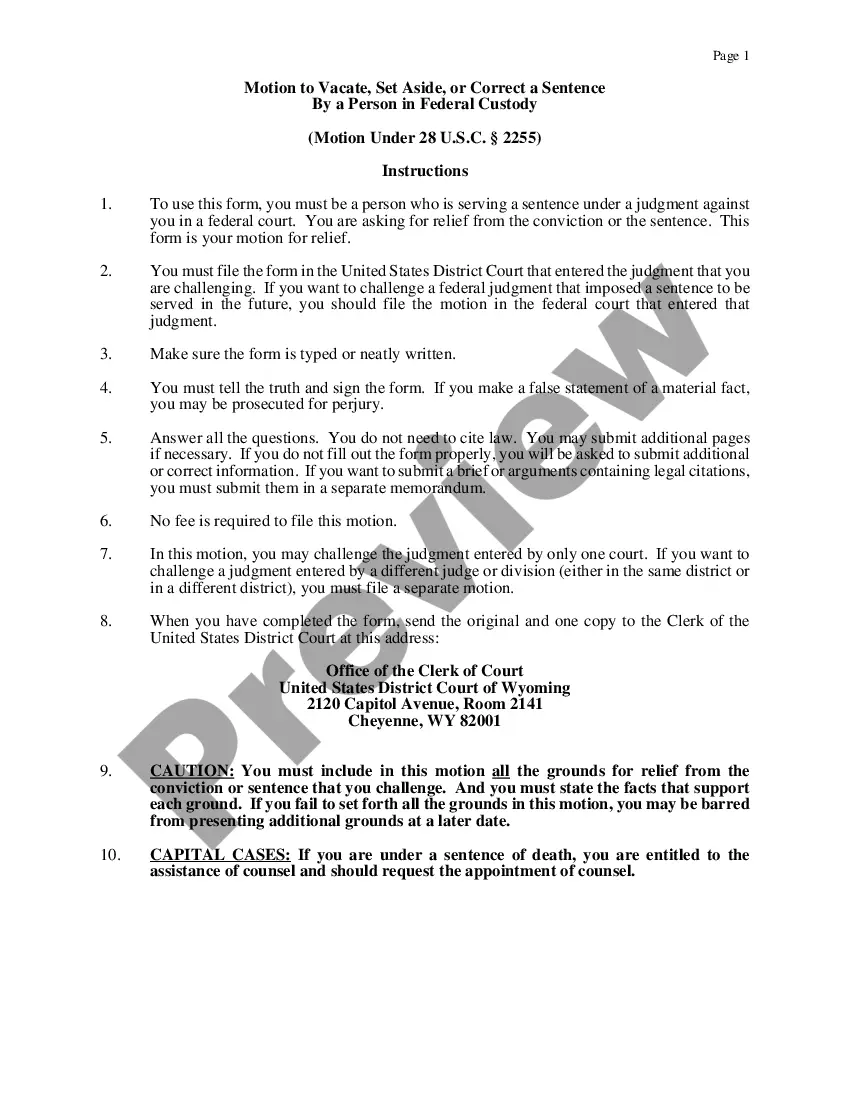
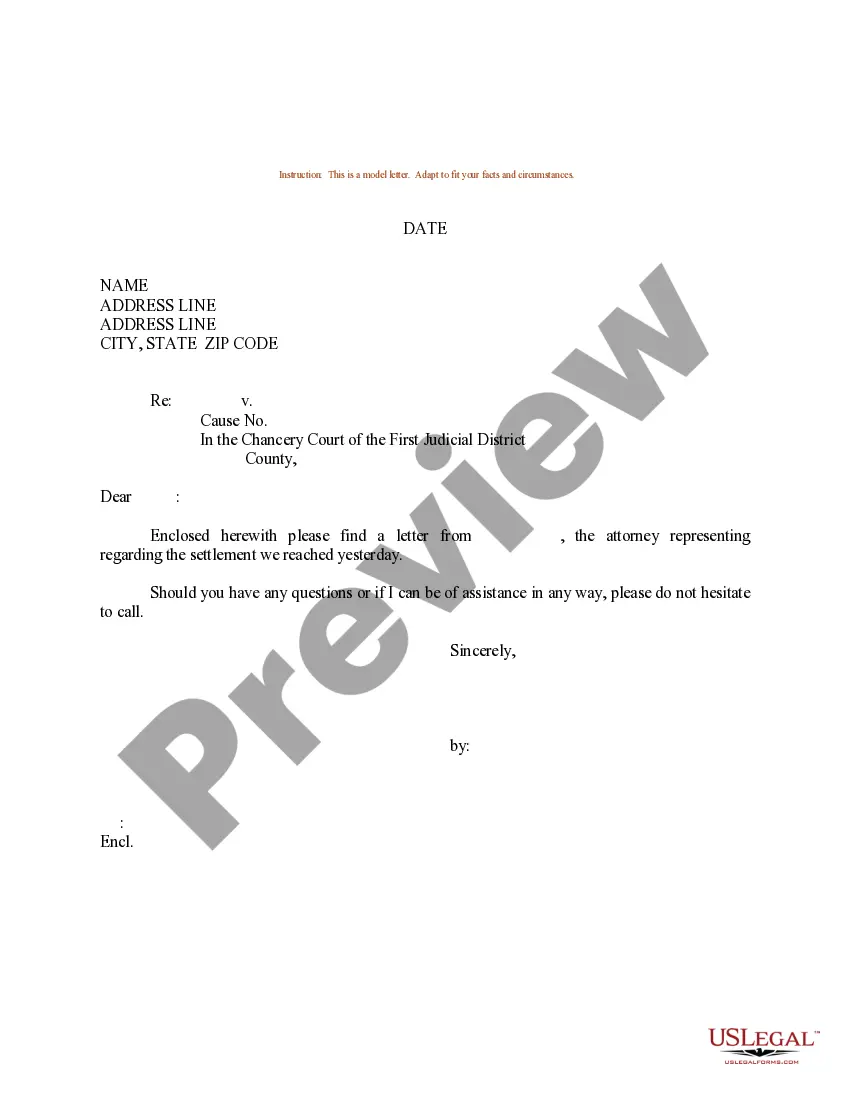
Sample Letter regarding Legal Representation
What is this form?
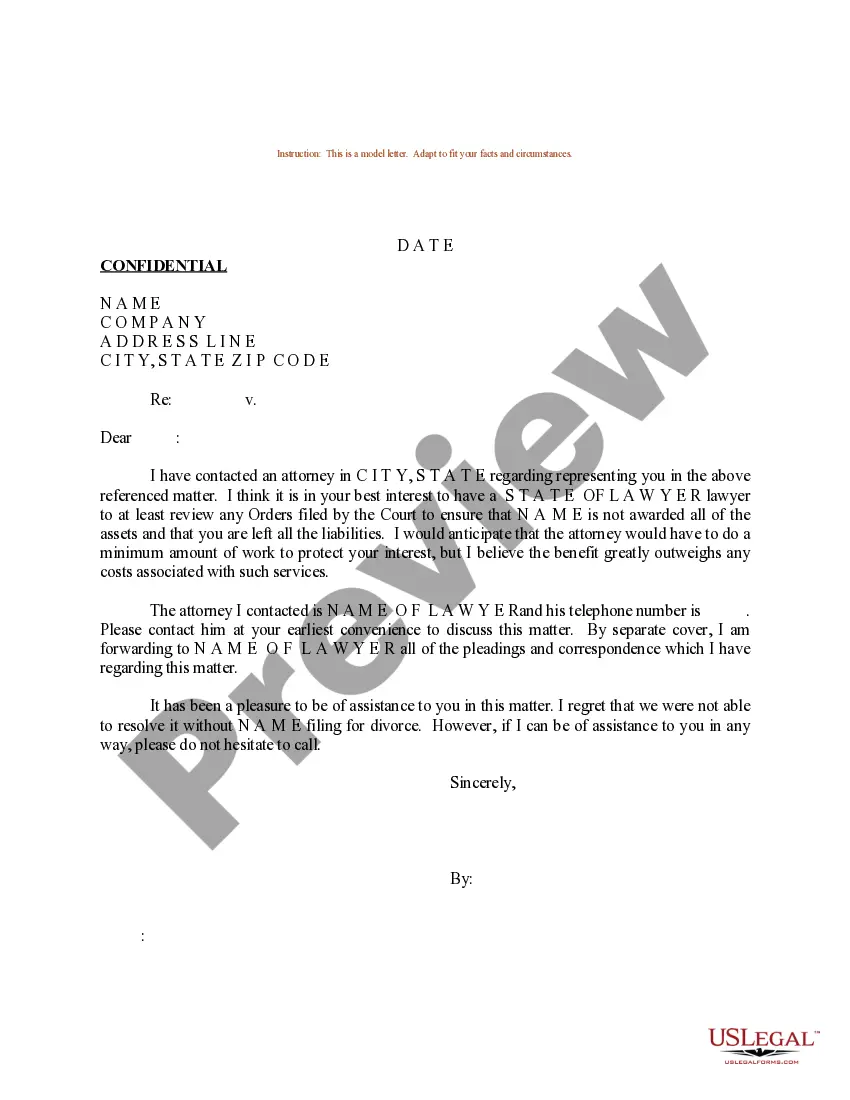
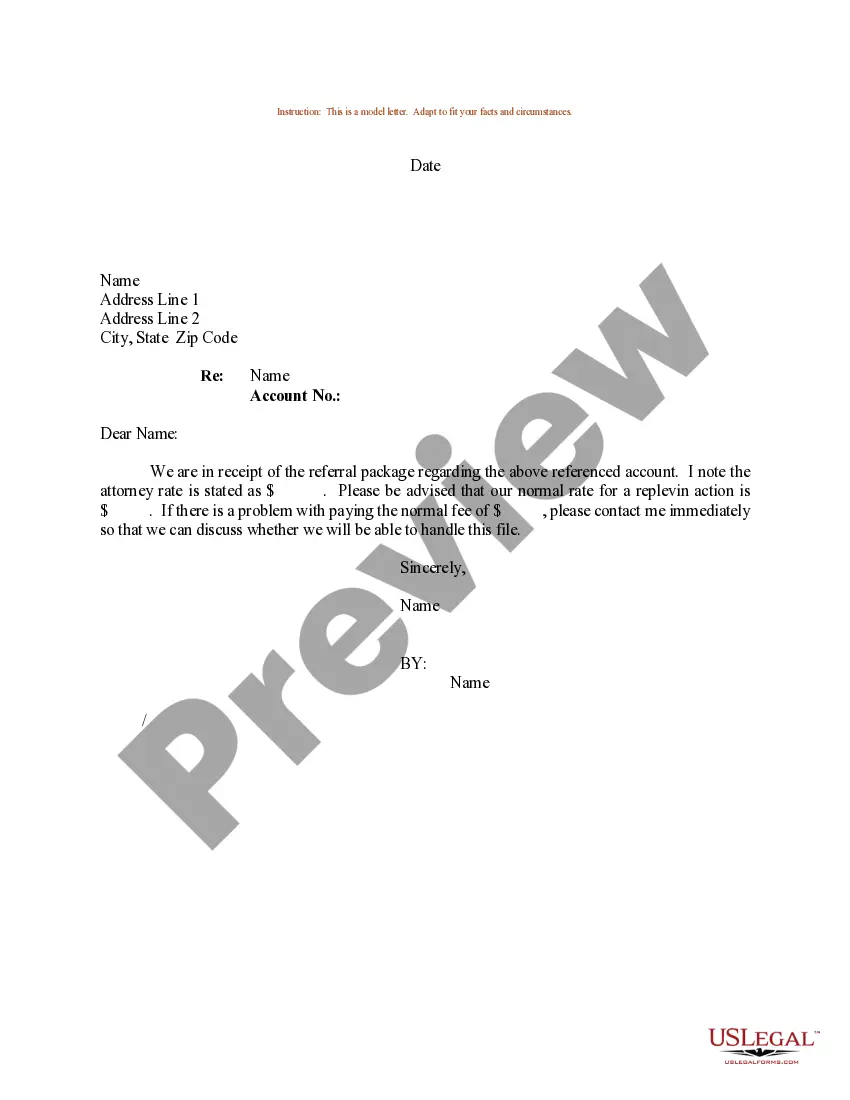
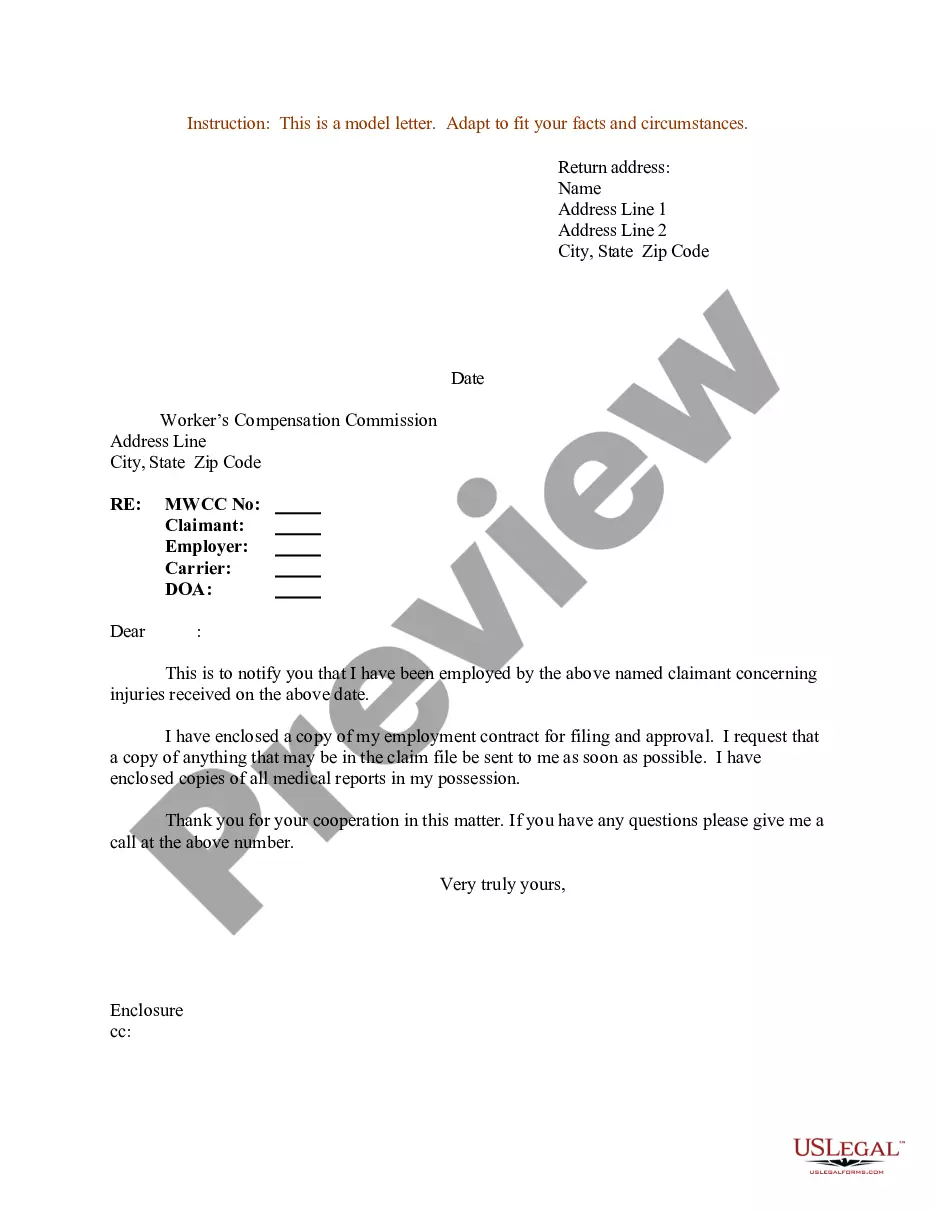
This Sample Letter regarding Legal Representation is a template used by attorneys to communicate settlement discussion results to clients. The form includes essential paperwork and offers a straightforward format for attorneys to inform clients about negotiations in their cases. This letter differs from other forms by providing a specific focus on informing clients about settlement matters rather than general communications or other legal notifications.
Key components of this form
- Date field to indicate when the letter is written.
- Clientâs name and address to personalize the correspondence.
- Attorney's name and contact information for direct communication.
- A section detailing the results of the settlement discussion.
- A space for additional relevant paperwork enclosure notes.
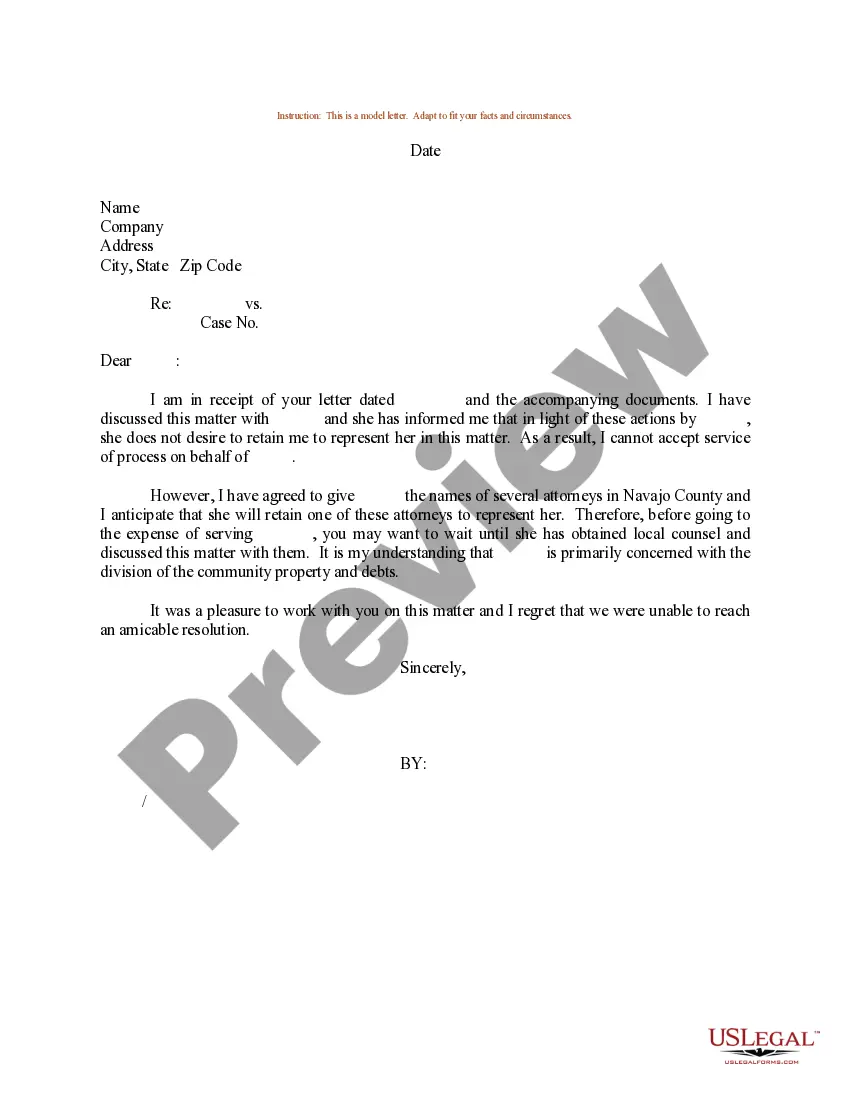
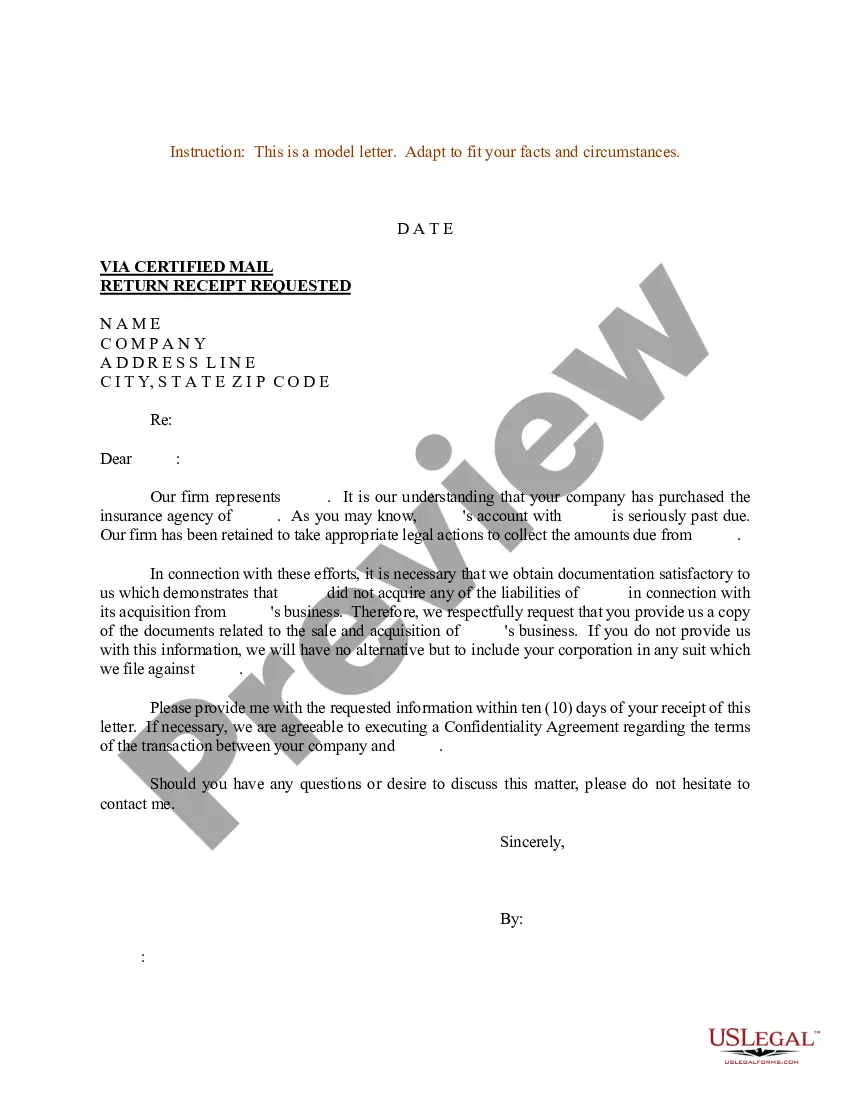
Common use cases
This form is typically used when an attorney needs to update a client about the outcomes of settlement negotiations with another attorney. It is particularly useful after negotiations have concluded, ensuring that the client is informed about their options and any relevant paperwork associated with the discussions.
Intended users of this form
- Attorneys representing clients in settlement negotiations.
- Clients who are awaiting updates on settlement discussions from their attorneys.
- Legal professionals needing a structured format for correspondence regarding settlements.
How to prepare this document
- Enter the date the letter is being sent at the top of the document.
- Clearly fill in the clientâs name and address in the specified fields.
- Add your name and contact details as the attorney responsible.
- Summarize the results of the settlement discussions accurately and clearly.
- Include any additional paperwork that the client needs to review or sign.
Does this form need to be notarized?
This form does not typically require notarization unless specified by local law. It is essential to check jurisdiction-specific requirements to ensure compliance.
Get your form ready online
Our built-in tools help you complete, sign, share, and store your documents in one place.
Make edits, fill in missing information, and update formatting in US Legal Forms—just like you would in MS Word.
Download a copy, print it, send it by email, or mail it via USPS—whatever works best for your next step.
Sign and collect signatures with our SignNow integration. Send to multiple recipients, set reminders, and more. Go Premium to unlock E-Sign.
If this form requires notarization, complete it online through a secure video call—no need to meet a notary in person or wait for an appointment.
We protect your documents and personal data by following strict security and privacy standards.

Make edits, fill in missing information, and update formatting in US Legal Forms—just like you would in MS Word.

Download a copy, print it, send it by email, or mail it via USPS—whatever works best for your next step.

Sign and collect signatures with our SignNow integration. Send to multiple recipients, set reminders, and more. Go Premium to unlock E-Sign.

If this form requires notarization, complete it online through a secure video call—no need to meet a notary in person or wait for an appointment.

We protect your documents and personal data by following strict security and privacy standards.
Common mistakes
- Failing to include the clientâs complete address, which can delay communication.
- Not summarizing the settlement discussions clearly, leading to client confusion.
- Forgetting to attach relevant paperwork that may impact the client's decision-making.
Advantages of online completion
- Convenience of immediate access and download from anywhere.
- Editability allows attorneys to customize the letter as needed for different clients.
- Reliability of a professionally drafted template that meets legal standards.
Main things to remember
- The Sample Letter regarding Legal Representation keeps clients informed about settlement discussions.
- Clear communication in this form helps prevent misunderstandings between clients and attorneys.
- Customization options make it adaptable to specific needs and jurisdictions.
Looking for another form?
Form popularity
FAQ
An attorney letter of representation is correspondence, usually a letter, sent by the victim's attorney to the defendant or an insurance company advising that the victim is represented by an attorney.
An attorney's letter is a formal business letter sent by a certified public accountant (CPA) to a client's attorney. The attorney's letter verifies the information sent by the management of a company pertaining to pending litigation of the company.
It can begin with the word Dear followed by the person's name or the word To. Include a date at the top of the letter. Begin the letter with a brief introduction. Keep the introduction pleasant and conversational. Thank the client for using your firm and indicate the reason for the letter.
I authorize you to represent my lawsuit in the court on the 12th of June and proceed with the case until it has been resolved. As discussed with you in our meeting, I am defending myself against Mr. XYZ who has filed a case of human rights violation against me. I have attached the necessary documents with the letter.
Date. The very part of the letter is Date. From. One should write the sender's name and address after mentioning the date. To. Below the sender's details, one should write the receiver's name and address. Subject. Salutation. Content or Body of the Letter. Opening Part. Main Part.
First, you can hire a new attorney and ask the new attorney to contact the former attorney and inform the former attorney of his or her termination. Second, you can write a letter to the attorney informing the attorney that you are terminating the attorney client relationship.
An attorney letter of representation is a document sent from a lawyer (lawyer) to an adverse party (party) advising that party that the lawyer represents a specific person, persons or business. A letter of representation is an initial correspondence to begin seeking damages or the resolution of a matter.
You can simply ask the Court to dismiss your attorney. You have a constitutional right to counsel, but you can waive that right and, unless the court determines that you are incompetent, you have the right to represent yourself.
The opening paragraph states the legal issue the letter is addressing followed by the facts, a discussion of the law as it applies to the facts and a conclusion which is essentially the advice to the client. Often attorneys include headings to lead the client through this process to arrive at the same conclusion.