Response to Motion for Judgment Notwithstanding the Verdict, or in the Alternative, for a New Trial
Overview of this form
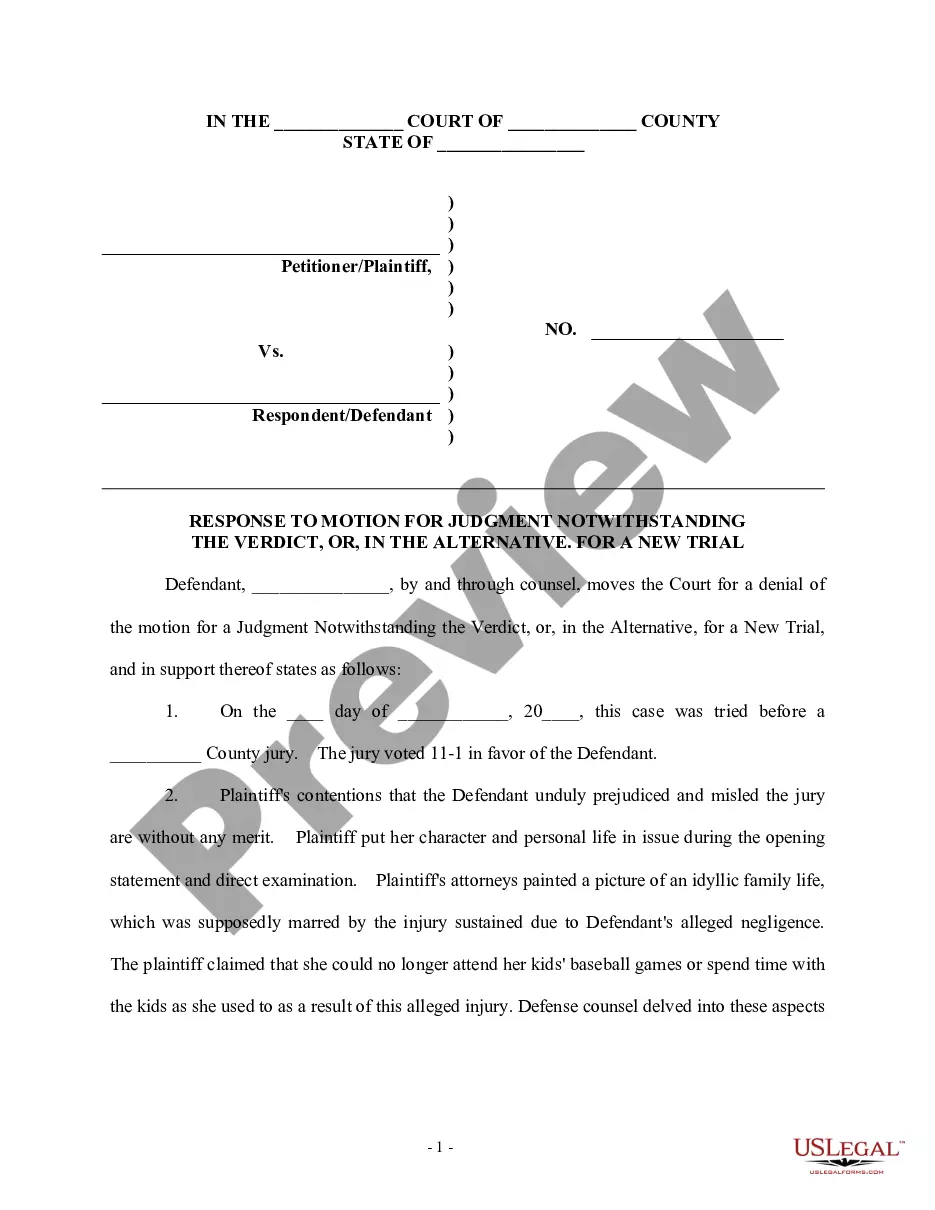
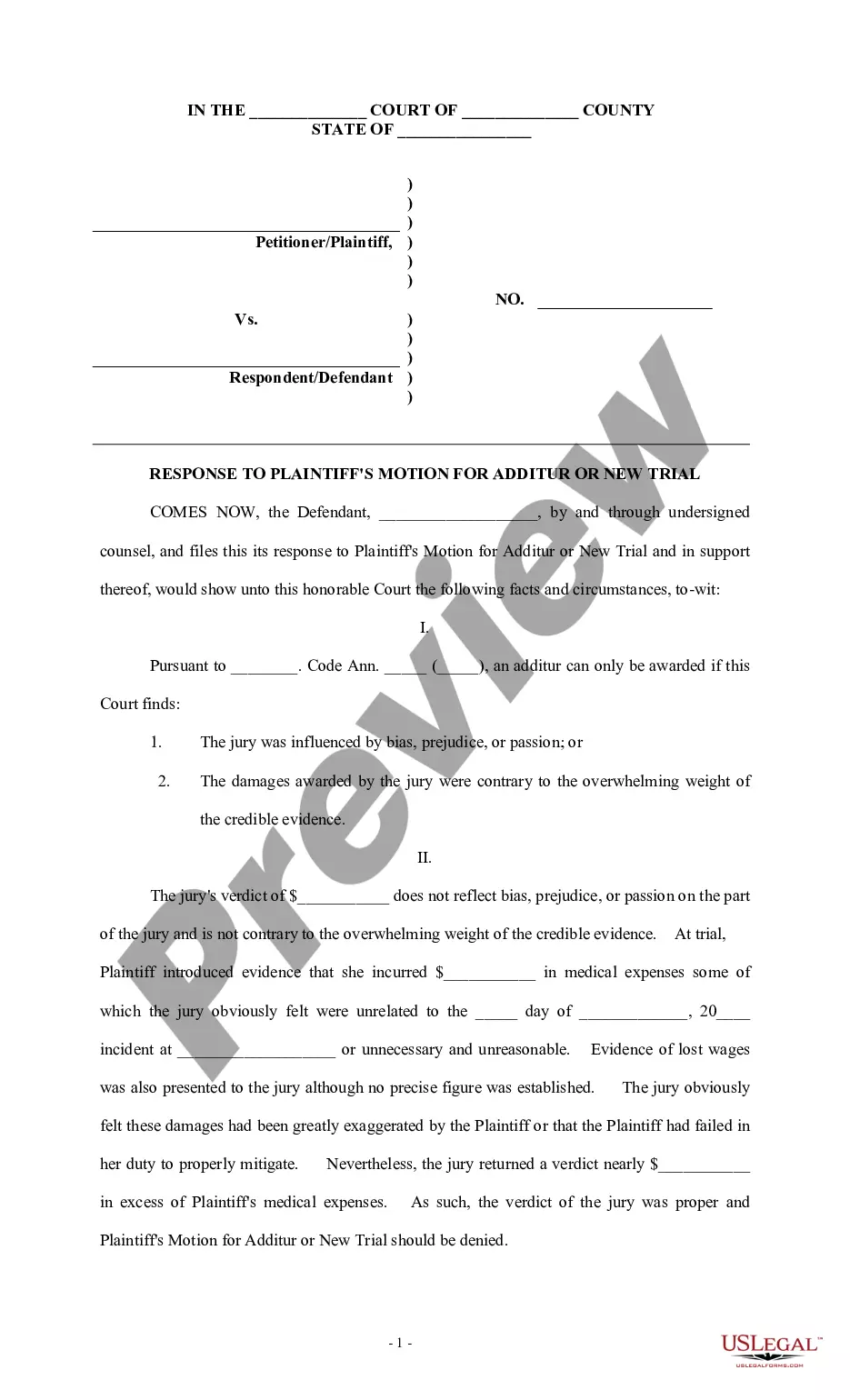
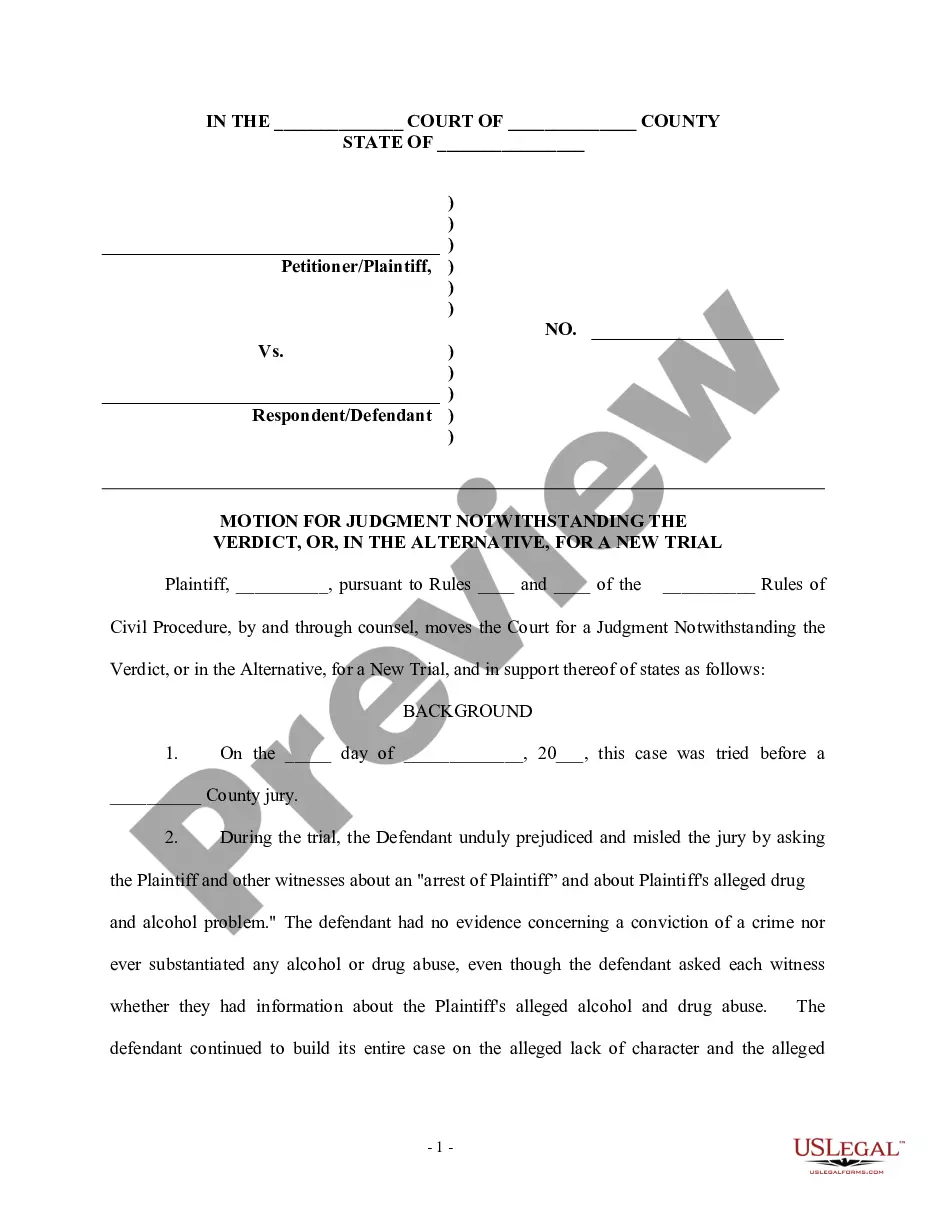
This form, the Response to Motion for Judgment Notwithstanding the Verdict, or in the Alternative, for a New Trial, is a legal document filed by the defendant in response to a plaintiff's motion seeking a judgment despite a jury's verdict or requesting a new trial. This form is essential for contesting claims made by the plaintiff that may not have sufficient legal grounds to warrant a renewed evaluation by the court.
Form components explained
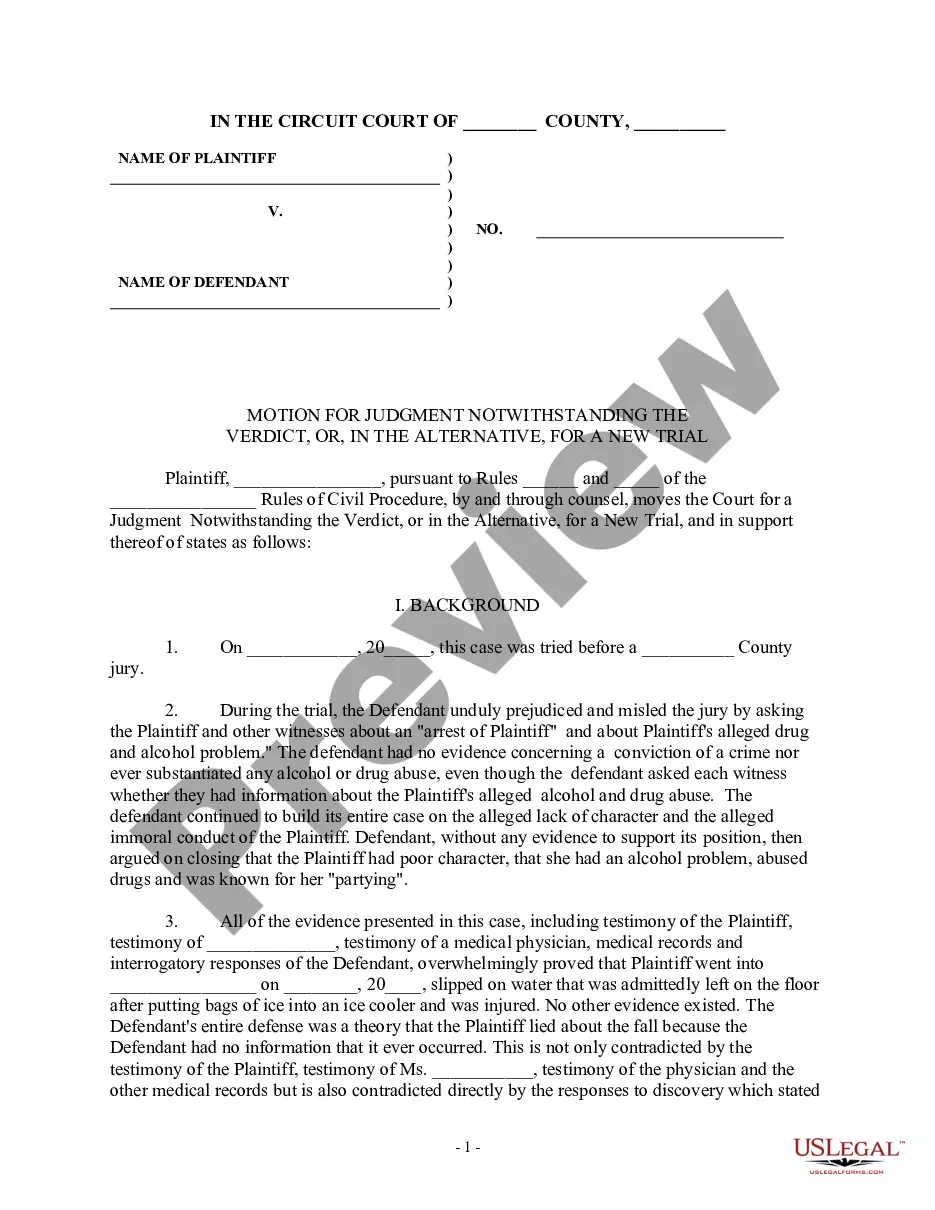
- Details of the trial date and jury's verdict
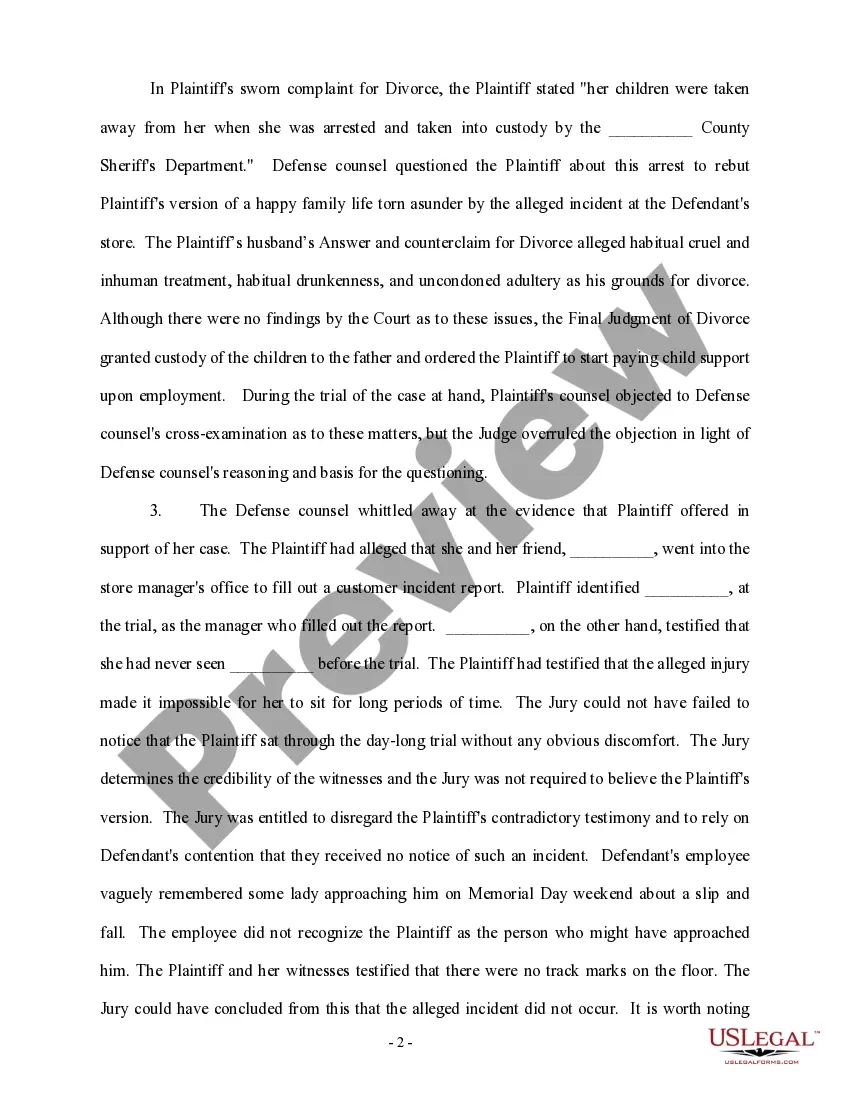
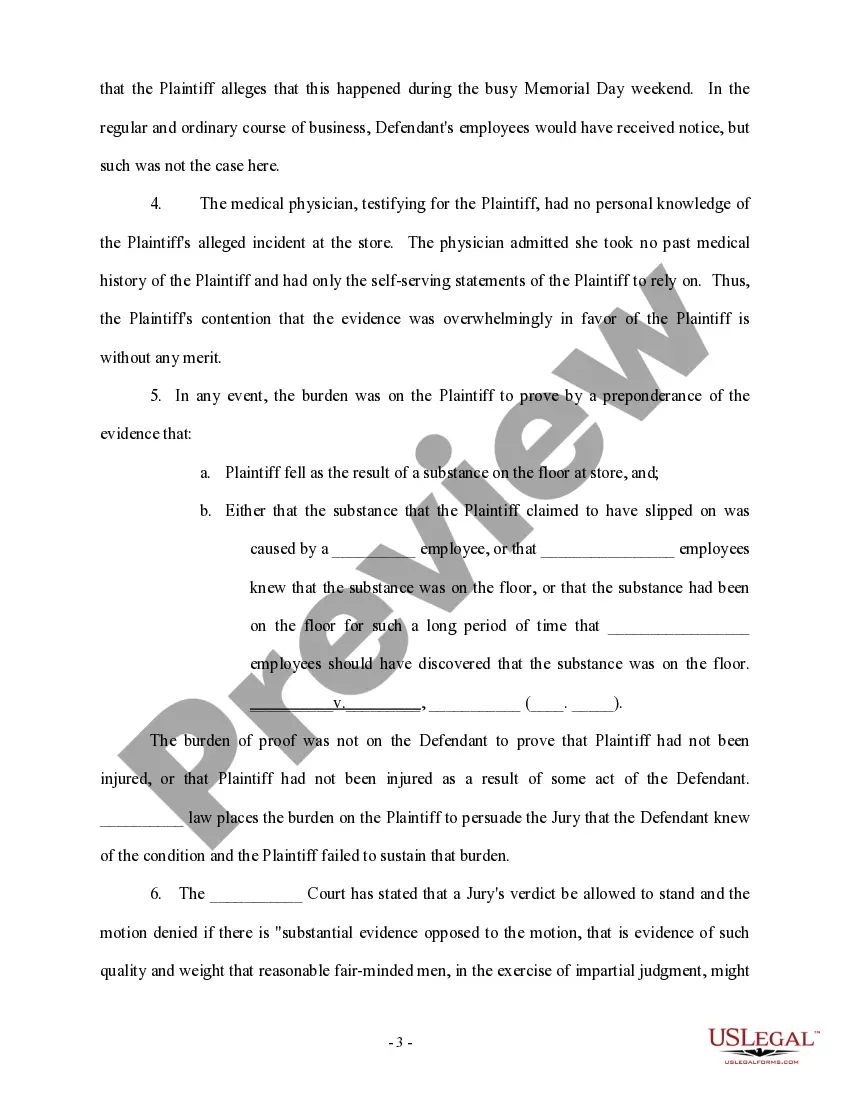
- Arguments against the plaintiff's claims regarding jury bias or lack of evidence
- Documentation of the plaintiff's background related to the case
- Summation of the evidence presented during the trial
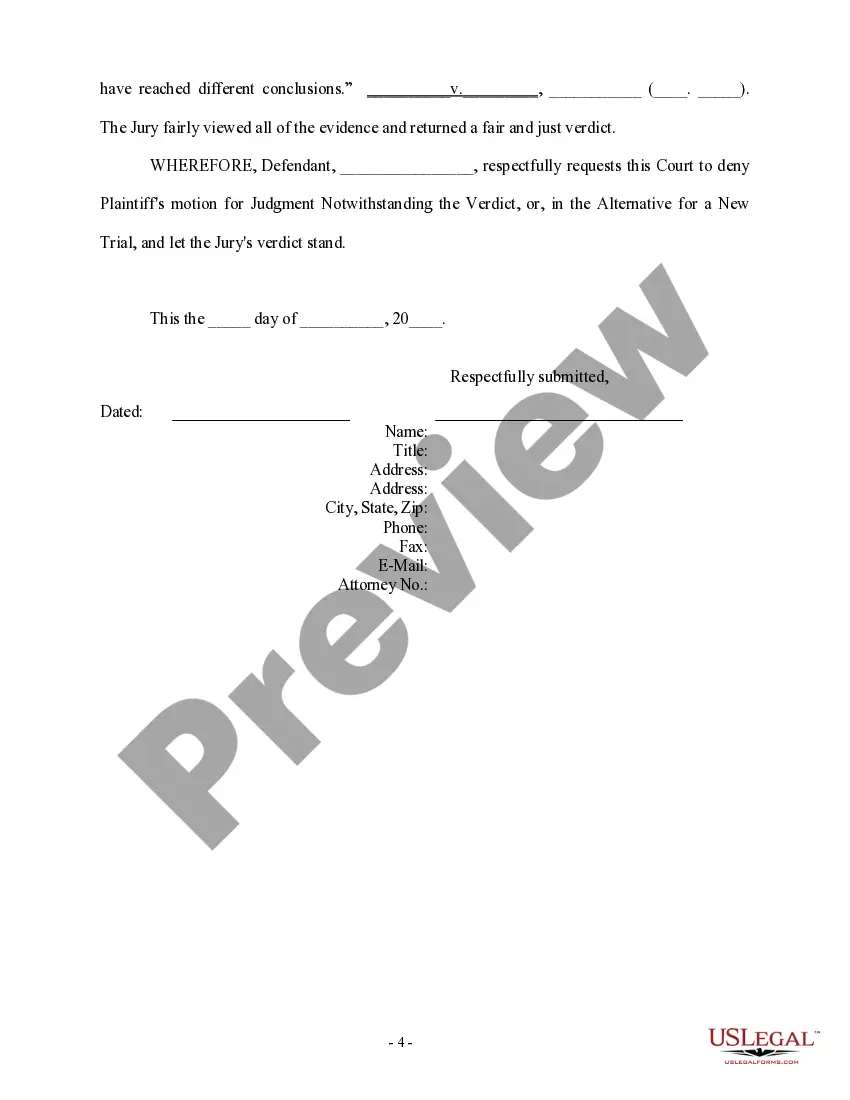
- Plea for the court to deny the plaintiff's motion
- Certificate of service to confirm that the form has been properly filed with all parties
Situations where this form applies
This form should be used after a jury trial in which the defendant received a favorable verdict, and the plaintiff has filed a motion for a judgment notwithstanding the verdict or a new trial. It is crucial when the defendant believes that the plaintiff's claims lack merit and seeks to formally counter the plaintiff's request to overturn the verdict.
Who needs this form
- Defendants who have won a jury trial
- Individuals or businesses facing a motion for judgment or new trial
- Legal representatives or attorneys representing a defendant in civil litigation
Instructions for completing this form
- Enter the date of the trial and the county where it was held.
- Provide the jury's verdict as indicated.
- Detail the arguments against the plaintiff's motion, referencing any relevant evidence.
- Clearly state your request to deny the plaintiff's motion.
- Include your signature along with the date of submission.
- Complete and include the certificate of service to confirm delivery to the opposing party.
Notarization guidance
In most cases, this form does not require notarization. However, some jurisdictions or signing circumstances might. US Legal Forms offers online notarization powered by Notarize, accessible 24/7 for a quick, remote process.
Get your form ready online
Our built-in tools help you complete, sign, share, and store your documents in one place.
Make edits, fill in missing information, and update formatting in US Legal Forms—just like you would in MS Word.
Download a copy, print it, send it by email, or mail it via USPS—whatever works best for your next step.
Sign and collect signatures with our SignNow integration. Send to multiple recipients, set reminders, and more. Go Premium to unlock E-Sign.
If this form requires notarization, complete it online through a secure video call—no need to meet a notary in person or wait for an appointment.
We protect your documents and personal data by following strict security and privacy standards.

Make edits, fill in missing information, and update formatting in US Legal Forms—just like you would in MS Word.

Download a copy, print it, send it by email, or mail it via USPS—whatever works best for your next step.

Sign and collect signatures with our SignNow integration. Send to multiple recipients, set reminders, and more. Go Premium to unlock E-Sign.

If this form requires notarization, complete it online through a secure video call—no need to meet a notary in person or wait for an appointment.

We protect your documents and personal data by following strict security and privacy standards.
Common mistakes to avoid
- Failing to include all necessary details about the trial and jury verdict.
- Not properly addressing each point raised in the plaintiff's motion.
- Ignoring local rules regarding filing procedures and deadlines.
- Submitting the form without the required certificate of service.
Benefits of completing this form online
- Instant access to downloadable templates specifically tailored by licensed attorneys.
- Convenience of completing the form at your own pace and in your own environment.
- Accessibility from any device, making it easy to fill out and manage your legal documents.
Legal use & context
- This form serves to maintain the integrity of jury verdicts against challenges based on alleged injustices.
- The legal standards for overturning a jury's verdict are strict and require substantial evidence.
- Defendants must effectively argue their case within the confines of legal precedent and evidentiary standards.
Main things to remember
- The form is essential for defendants contesting a plaintiff's motion post-verdict.
- Carefully crafted arguments and evidence are critical for success.
- Adhering to local rules and deadlines is crucial for procedural integrity.
Looking for another form?



Form popularity
FAQ
The High Court found that a trial judge is able to direct a jury to return a verdict of not guilty where a verdict of guilty would be 'unsafe or unsatisfactory. 'So, all in all, courts can intervene to either direct the outcome of a case or overturn a verdict of guilty but these situations are rare.
A motion asking the court to enter judgment as a matter of law. This motion is made before a case is submitted to the jury, and argues that no reasonable jury could find for the opposing party (i.e., whatever evidence exists for such ruling is legally insufficient).
The judge can direct a jury, but cannot oblige it to go along with his interpretation.The law makes it clear that this is an offence and, assuming that the accusation is proven beyond any reasonable doubt, a judge would probably request a guilty verdict to be returned.
The reversal of a jury's verdict by a judge occurs when the judge believes that there were insufficient facts on which to base the jury's verdict or that the verdict did not correctly apply the law.
If he or she feels the jury made a decision that isn't reasonably supported by the evidence of a case, the judge can overturn the verdict in certain situations. While it's very rare, it does happen every once in a while. This is typically called a judgment of acquittal or a judgment notwithstanding the verdict (JNOV).
1. The Rule. Rule 50(a) provides for a motion for judgment as a matter of law (JMOL) which may be made at any time before submission of the case to the jury.If the court decides the initial motion should have been granted, it may set aside the verdict of the jury and enter judgment as a matter of law.
A judge will issue a JNOV if he or she determines that no reasonable jury could have reached the jury's verdict based on the evidence presented at trial, or if the jury incorrectly applied the law in reaching its verdict.
In other words, each and every member of a given jury must agree in order to acquit or convict the defendant.But judges must be careful not to go too farappeals courts will overturn convictions where judges have coerced juries into verdicts.
21 provides that misjoinder of parties is not ground for dismissal of an action, and that parties may be dropped or added by court order on motion of any party or of the court's own initiative at any stage in the action and on such terms as are just.