Motion for Judgment Notwithstanding the Verdict or in the Alternative, for a New Trial
Overview of this form
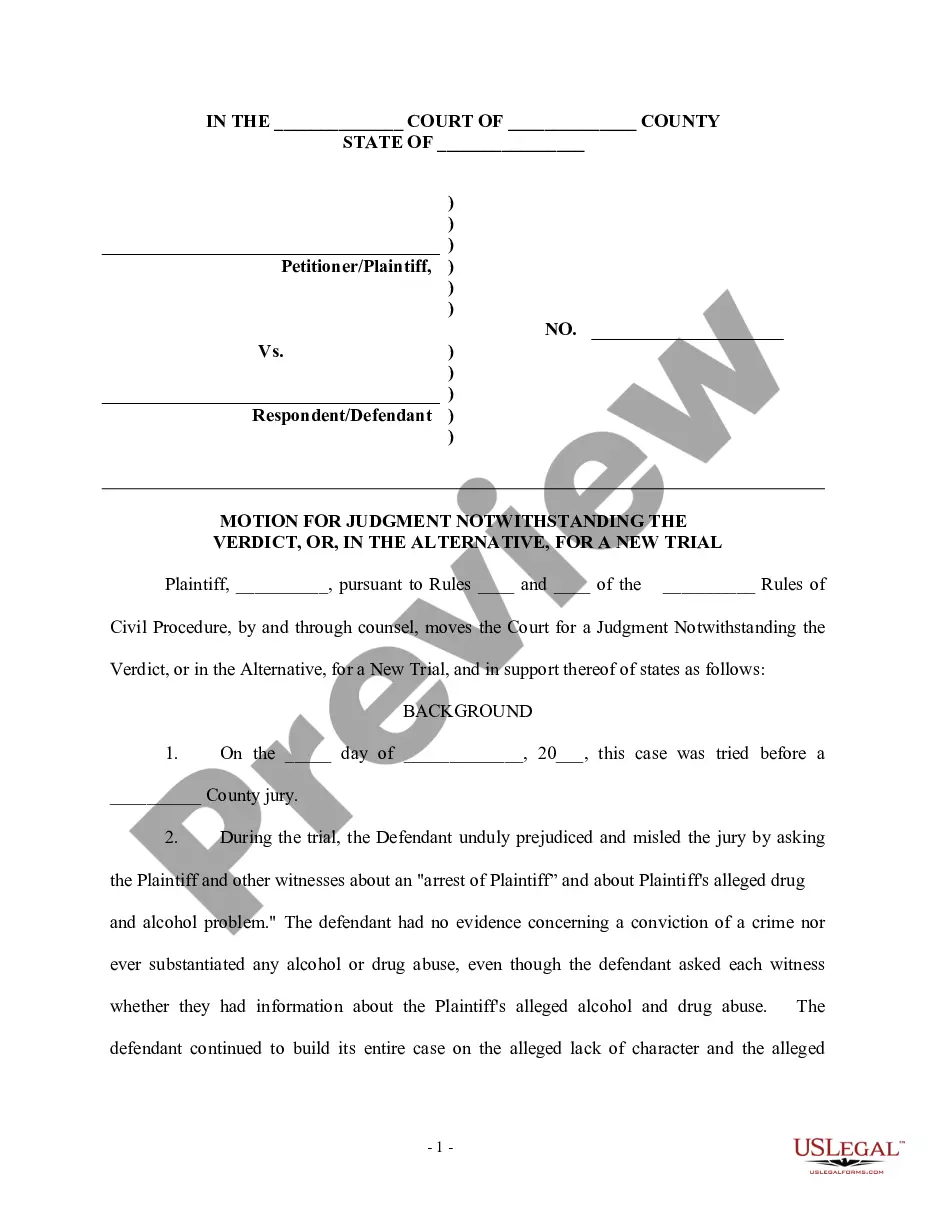
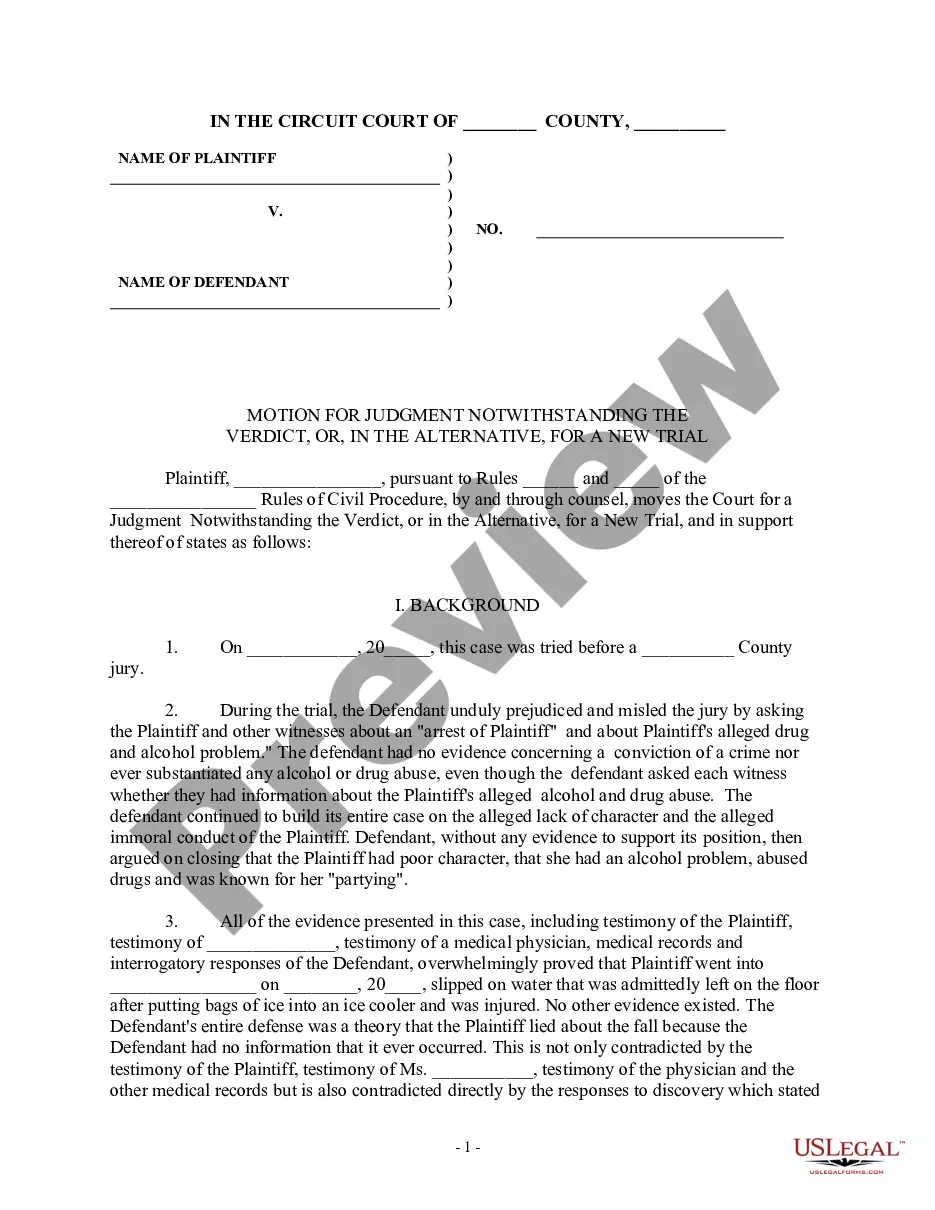
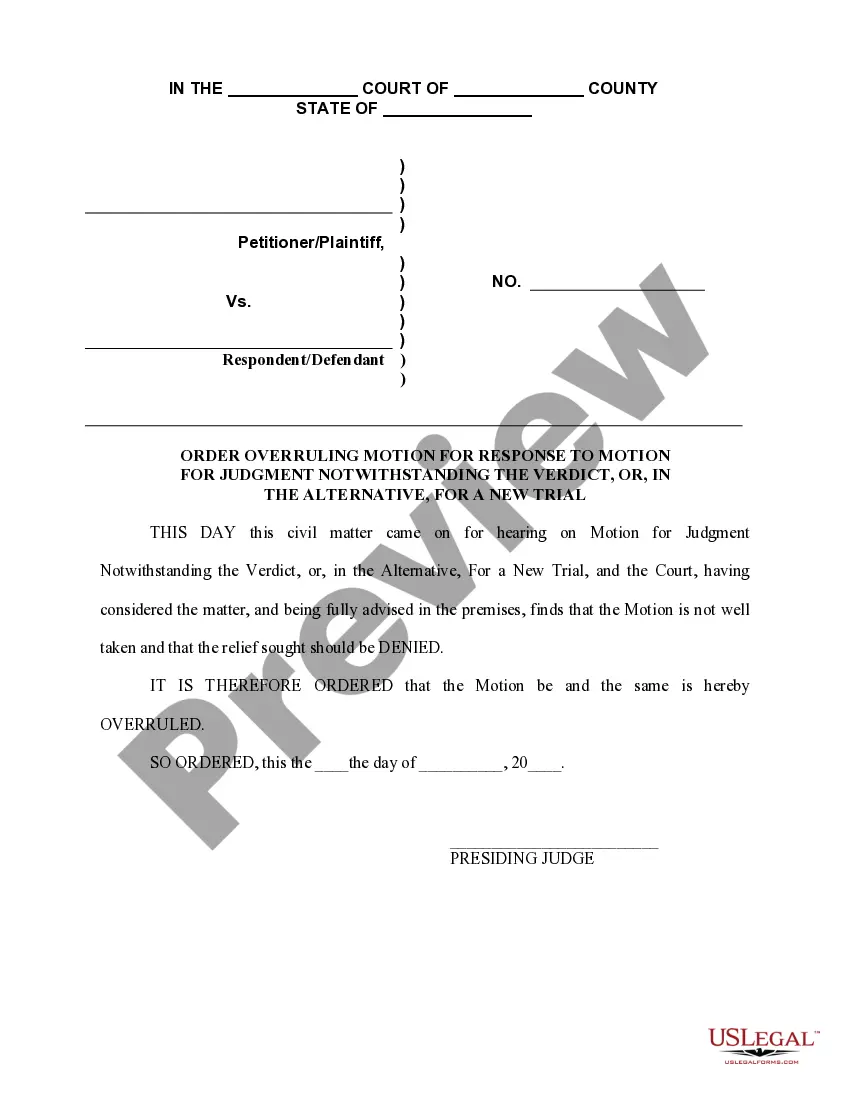
The Motion for Judgment Notwithstanding the Verdict or in the Alternative, for a New Trial is a legal document filed by a plaintiff in personal injury cases. This motion requests the court to either set aside a jury verdict that the plaintiff believes was unjust or, if not, to grant a new trial due to errors or prejudicial information presented during the initial trial. This form is distinct from other motions because it specifically addresses issues related to jury verdicts and the fairness of the trial process.
What’s included in this form
- Background information about the trial and jury.
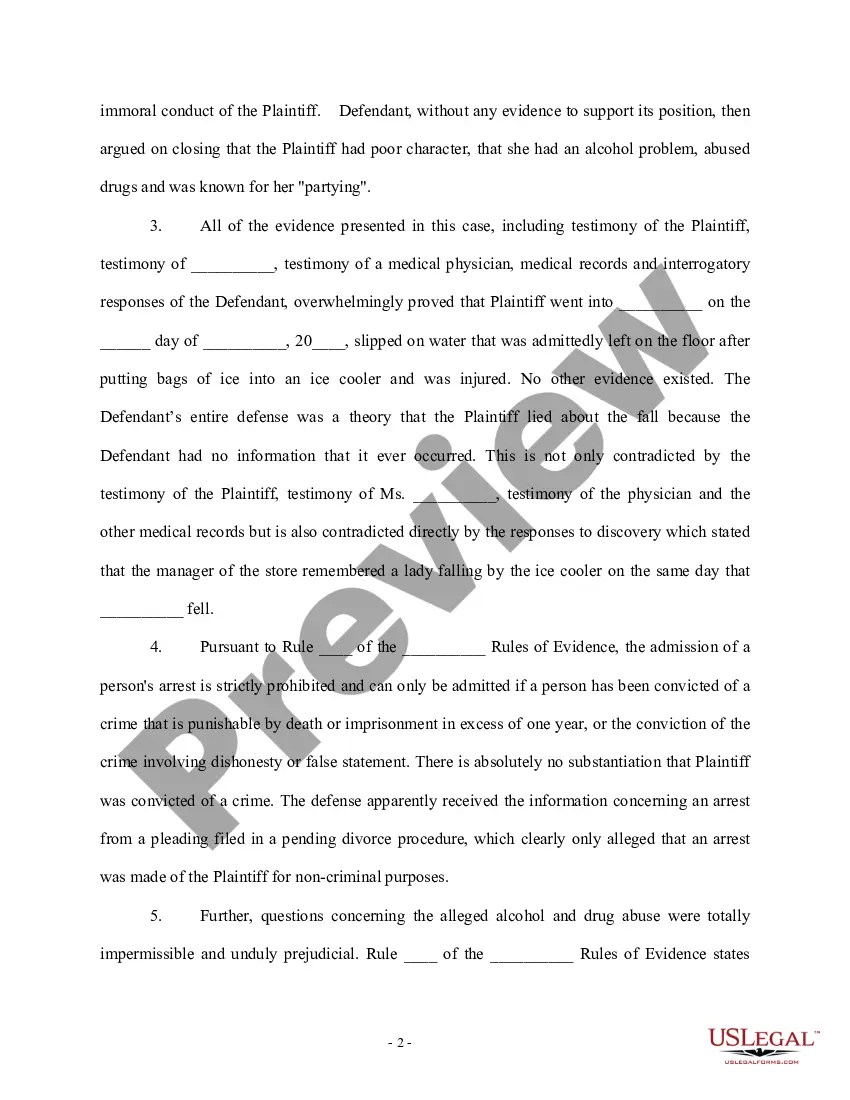
- Claims of prejudice and misconduct by the defense during the trial.
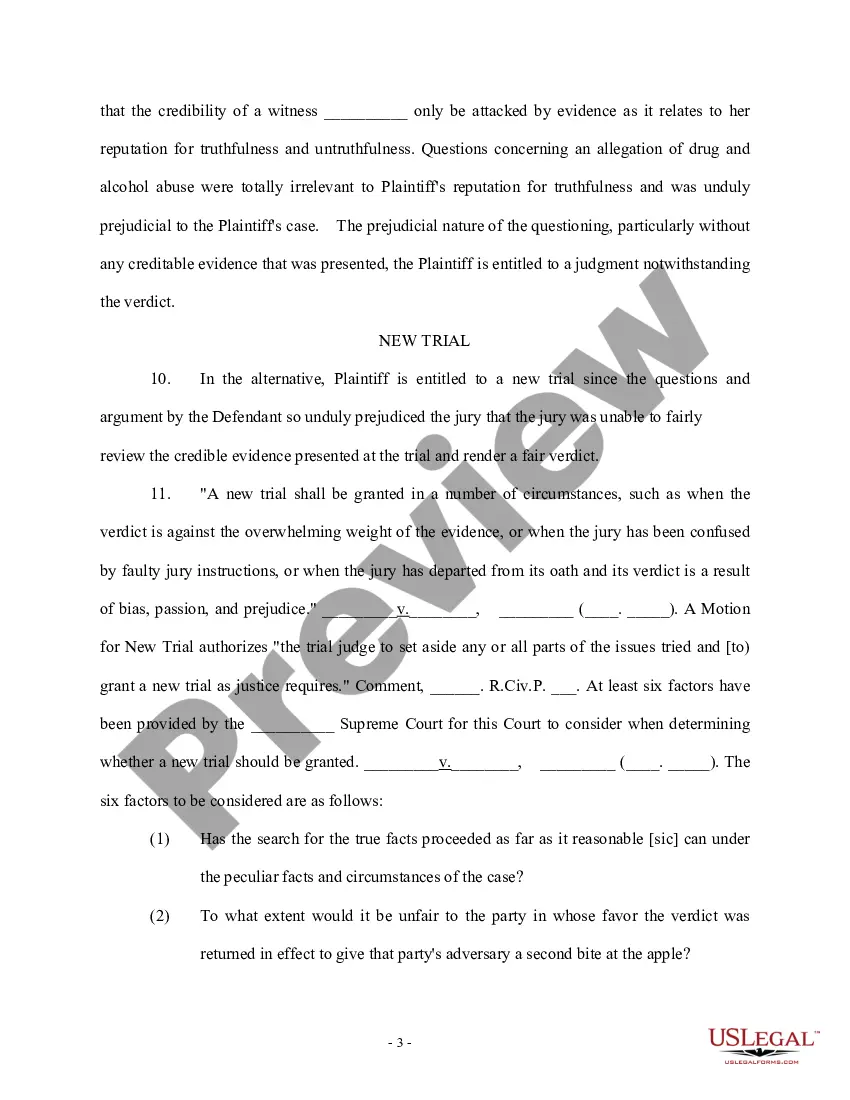
- Citations of relevant rules and evidence to support claims.
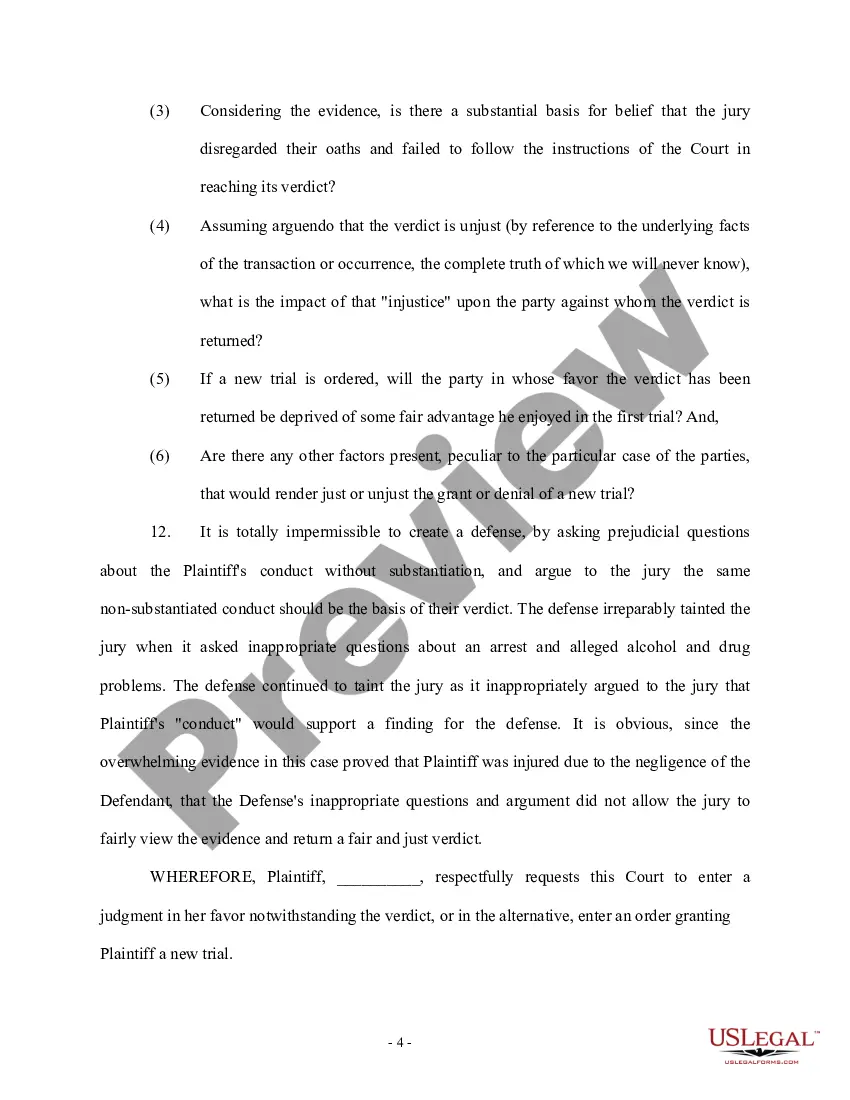
- Arguments for why a judgment should be entered or a new trial granted.
- Signature and date lines for the plaintiff's attorney.

When to use this document
This form is used in situations where the jury's verdict is believed to be flawed due to improper evidence or arguments presented by the opposing party. Plaintiffs typically file this motion after a trial when they feel that key evidence was either ignored or improperly considered, leading to an unfair outcome. It is also appropriate when the jury may have been improperly influenced by irrelevant or prejudicial information.
Who needs this form
- Plaintiffs in a personal injury lawsuit who believe the jury verdict was unjust.
- Attorneys representing plaintiffs in need of a formal means to challenge a jury's decision.
- Individuals seeking a legal remedy after a trial that did not go in their favor.
How to prepare this document
- Fill in the date of trial and the county where the case was tried.
- Detail instances of prejudice or misleading information presented by the defendant.
- Summarize evidence that supports your claim for a judgment or new trial.
- Cite relevant rules and evidence that were violated during the trial.
- Sign and date the motion to submit it to the court.
Is notarization required?
In most cases, this form does not require notarization. However, some jurisdictions or signing circumstances might. US Legal Forms offers online notarization powered by Notarize, accessible 24/7 for a quick, remote process.
Get your form ready online
Our built-in tools help you complete, sign, share, and store your documents in one place.
Make edits, fill in missing information, and update formatting in US Legal Forms—just like you would in MS Word.
Download a copy, print it, send it by email, or mail it via USPS—whatever works best for your next step.
Sign and collect signatures with our SignNow integration. Send to multiple recipients, set reminders, and more. Go Premium to unlock E-Sign.
If this form requires notarization, complete it online through a secure video call—no need to meet a notary in person or wait for an appointment.
We protect your documents and personal data by following strict security and privacy standards.

Make edits, fill in missing information, and update formatting in US Legal Forms—just like you would in MS Word.

Download a copy, print it, send it by email, or mail it via USPS—whatever works best for your next step.

Sign and collect signatures with our SignNow integration. Send to multiple recipients, set reminders, and more. Go Premium to unlock E-Sign.

If this form requires notarization, complete it online through a secure video call—no need to meet a notary in person or wait for an appointment.

We protect your documents and personal data by following strict security and privacy standards.
Common mistakes to avoid
- Failing to include specific evidence of prejudice or misconduct.
- Missing relevant citations of rules or case law.
- Not adhering to local filing procedures or deadlines.
- Inadequately explaining why a new trial is warranted.
Advantages of online completion
- Easy access to professionally drafted templates that reduce the chance of errors.
- Convenience of filling out the form at your own pace using a digital format.
- Ability to save and edit the document before finalizing and submitting.
- Access to legal guidance and support through the online platform.
Legal use & context
- This form is used as a formal request to challenge a jury's verdict based on perceived injustices during trial.
- It is a critical tool for plaintiffs seeking to ensure their rights are protected in personal injury cases.
- Each state may have different procedural rules regarding the submission of such motions, making it essential to be familiar with local laws.
Looking for another form?



Form popularity
FAQ
A motion asking the court to enter judgment as a matter of law. This motion is made before a case is submitted to the jury, and argues that no reasonable jury could find for the opposing party (i.e., whatever evidence exists for such ruling is legally insufficient).
Directed Verdict a) After Plaintiff201fs evidence or after the close of all the evidence, a party may move for a directed verdict in its favor. Standard: If the non-moving party201fs evidence is insufficient as a matter of law to go to a jury, the Court should grant a directed verdict for the moving party.
Overview. A motion for directed verdict is a motion asking the court to issue a directed verdict. This motion is made before a case is submitted to the jury, and argues that no reasonable jury could find for the opposing party. Either the plaintiff or the defendant may make this motion.
JMOL is also known as a directed verdict, which it has replaced in American federal courts.Judgment on the pleadings is a motion made after pleading and before discovery; summary judgment happens after discovery and before trial; JMOL occurs during trial.
A motion is a way to ask the court for certain action. The party will move the court for an order or other action. This subchapter concerns usual pretrial motions, such as motions to dismiss and motions for summary judgment, but will not deal with discovery motions.
A motion for judgment as a matter of law (JMOL) is a motion made by a party, during trial, claiming the opposing party has insufficient evidence to reasonably support its case.If there is no evidence to support a reasonable conclusion for the opposing party, judgment is entered by the court and the case is over.
A directed verdict may be granted at any time, but usually occurs after at least one party has been fully heard. Motions for a directed verdict are governed by Rule 50 of the Federal Rules of Civil Procedure and Rule 29 of the Federal Rules of Criminal Procedure.
1. The Rule. Rule 50(a) provides for a motion for judgment as a matter of law (JMOL) which may be made at any time before submission of the case to the jury.If the court decides the initial motion should have been granted, it may set aside the verdict of the jury and enter judgment as a matter of law.
A motion for summary judgment asks the court to decide the case or specific claims in the case in the moving party's favor.The main difference between a motion to dismiss and a motion for summary judgment is that the court actually gets to evaluate the meat of the claims on a motion for summary judgment.