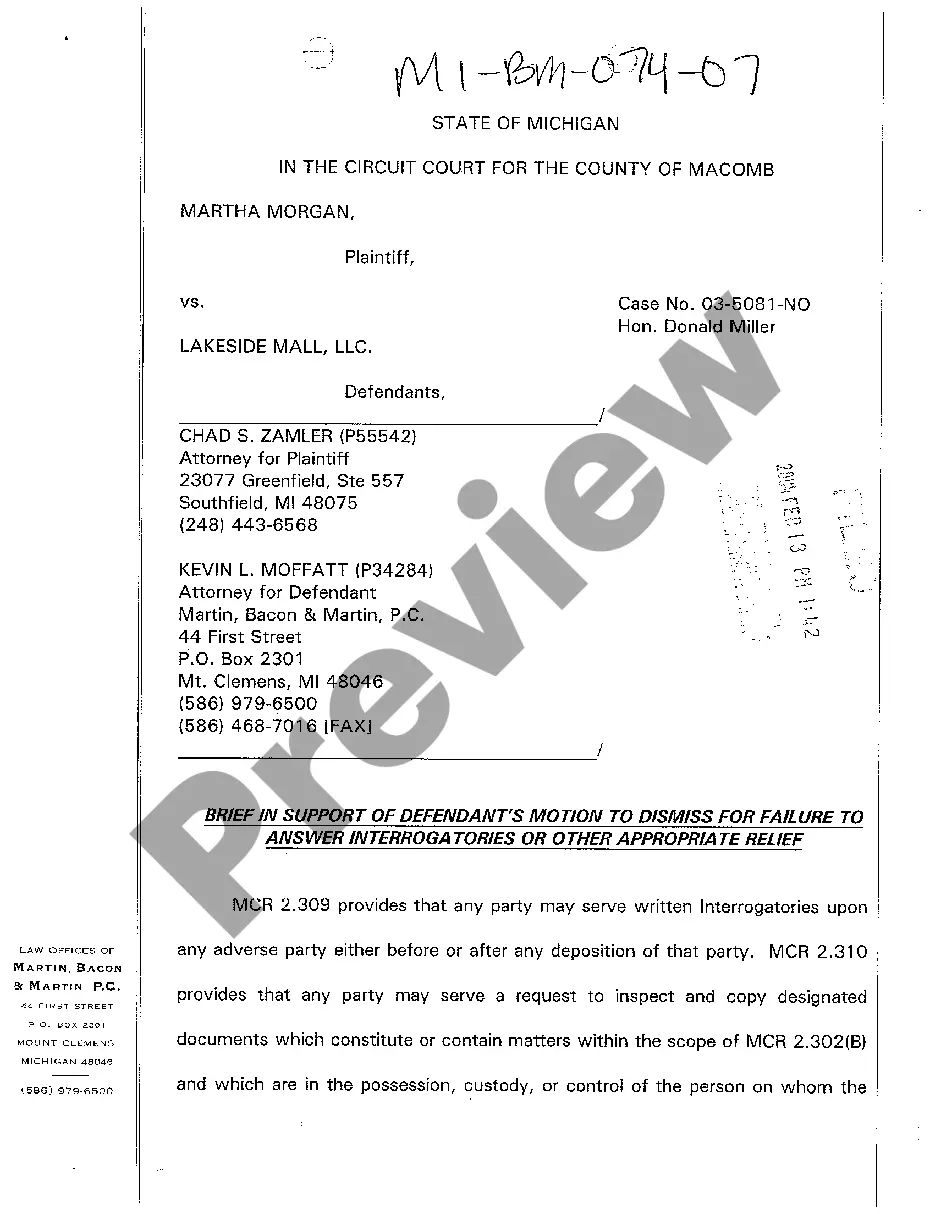
Release and Indemnity Agreement for Settlement
About this form
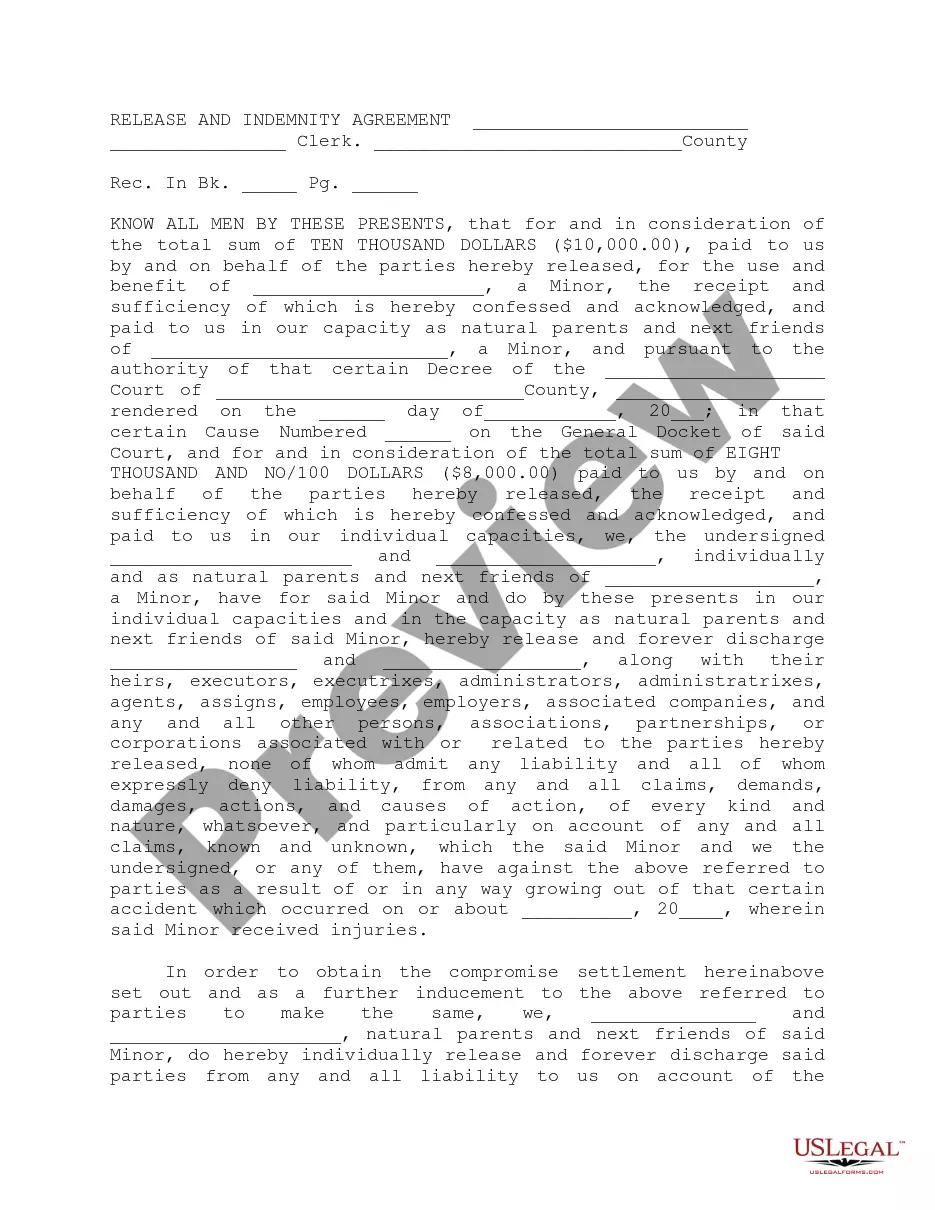
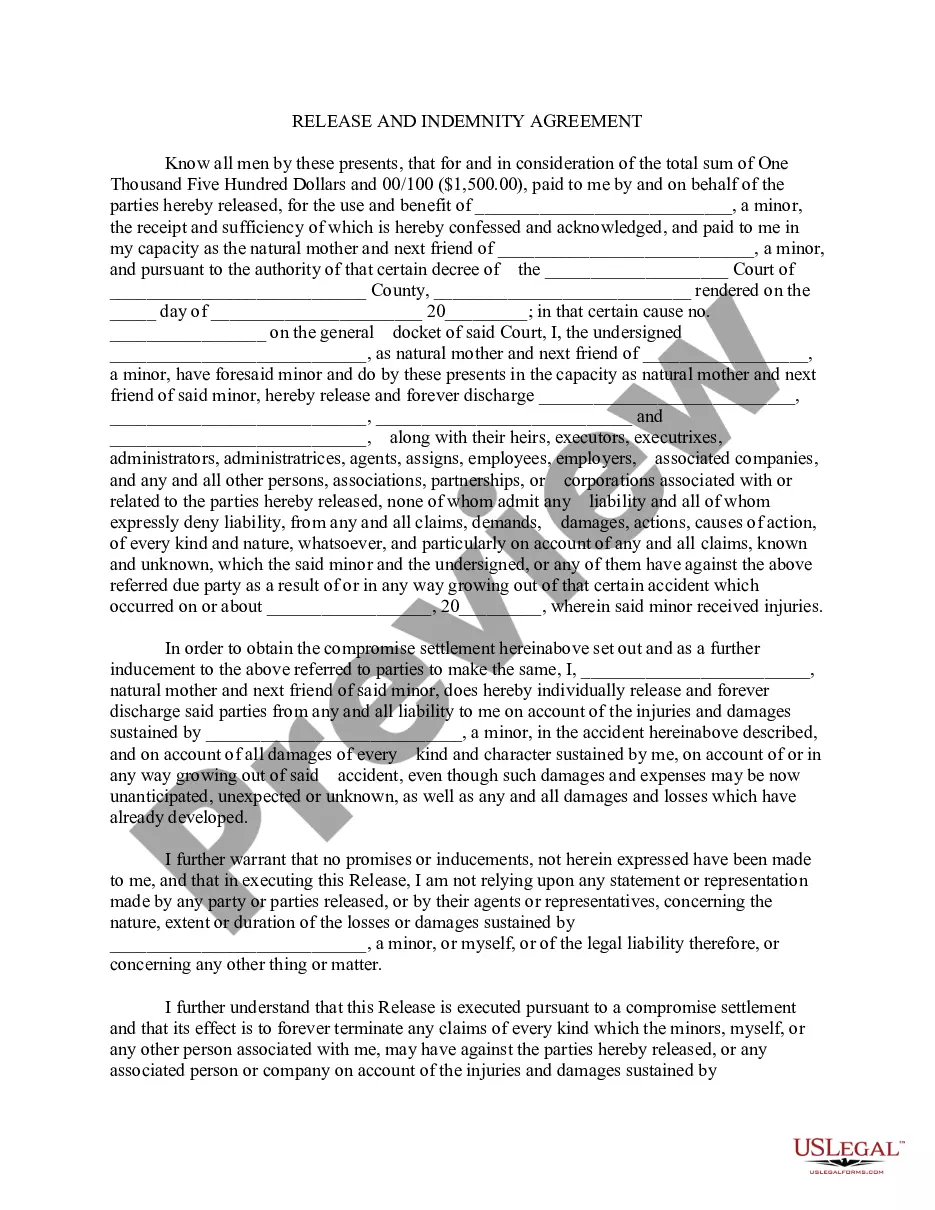
The Release and Indemnity Agreement for Settlement serves to formally release parties from any liability related to injuries suffered by a minor due to an accident, in exchange for a settlement amount. This agreement is crucial in legal contexts where parents or guardians agree to compensate and absolve responsible parties from future claims regarding the incident, differing from other agreements by focusing on the discharge of liability while ensuring compensation for the minor's injuries.
Main sections of this form
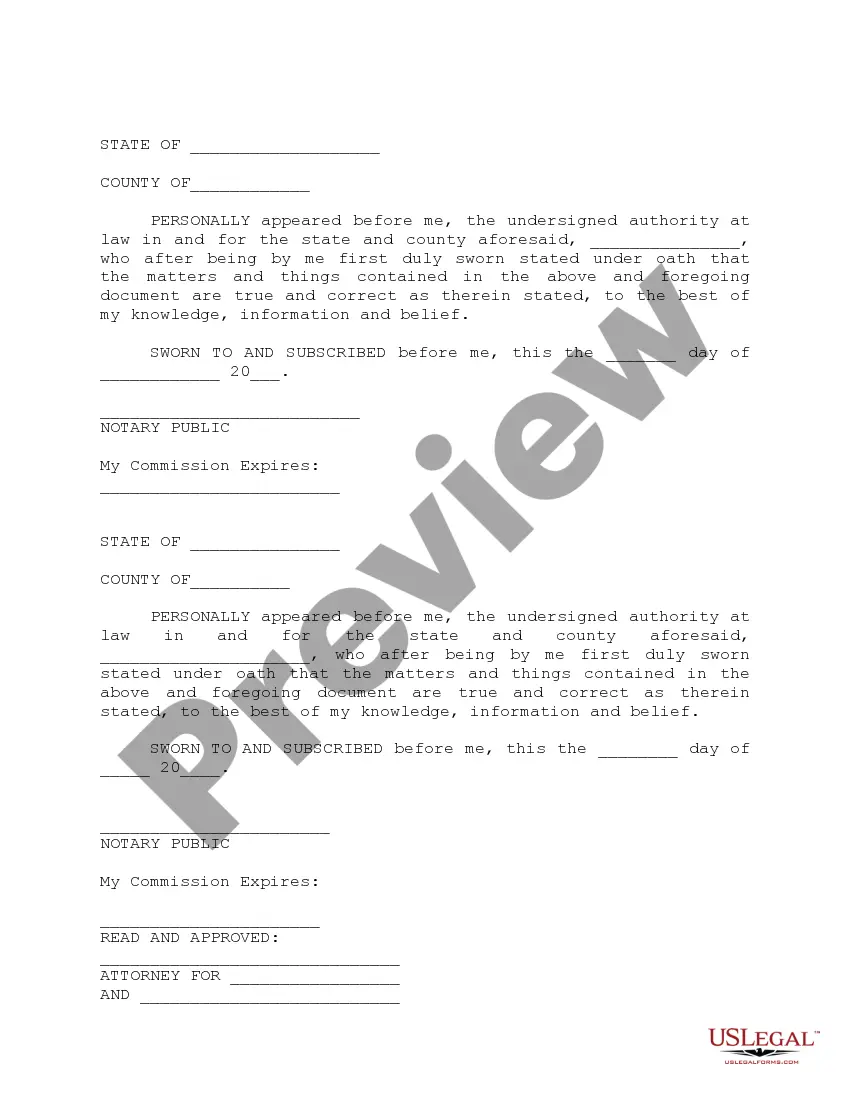
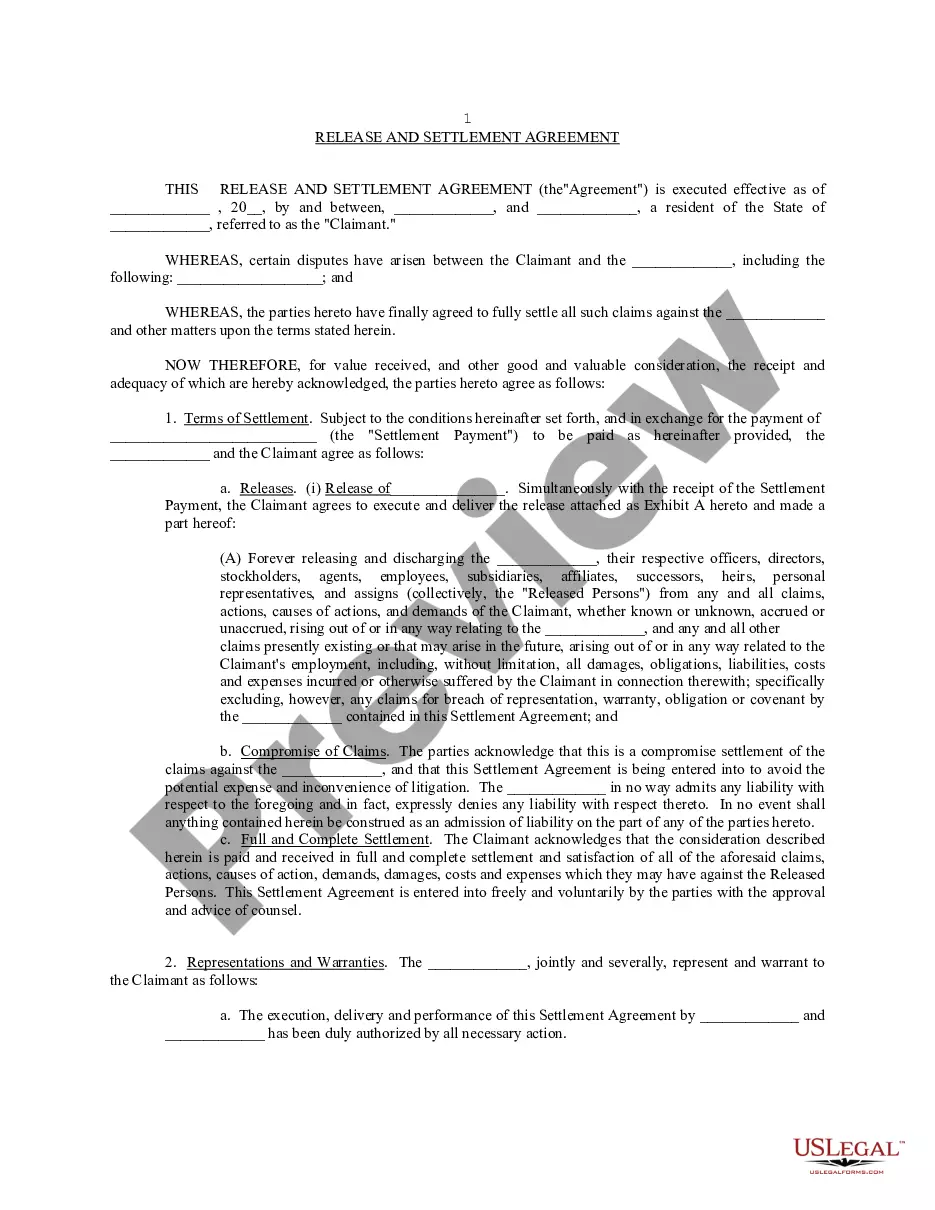
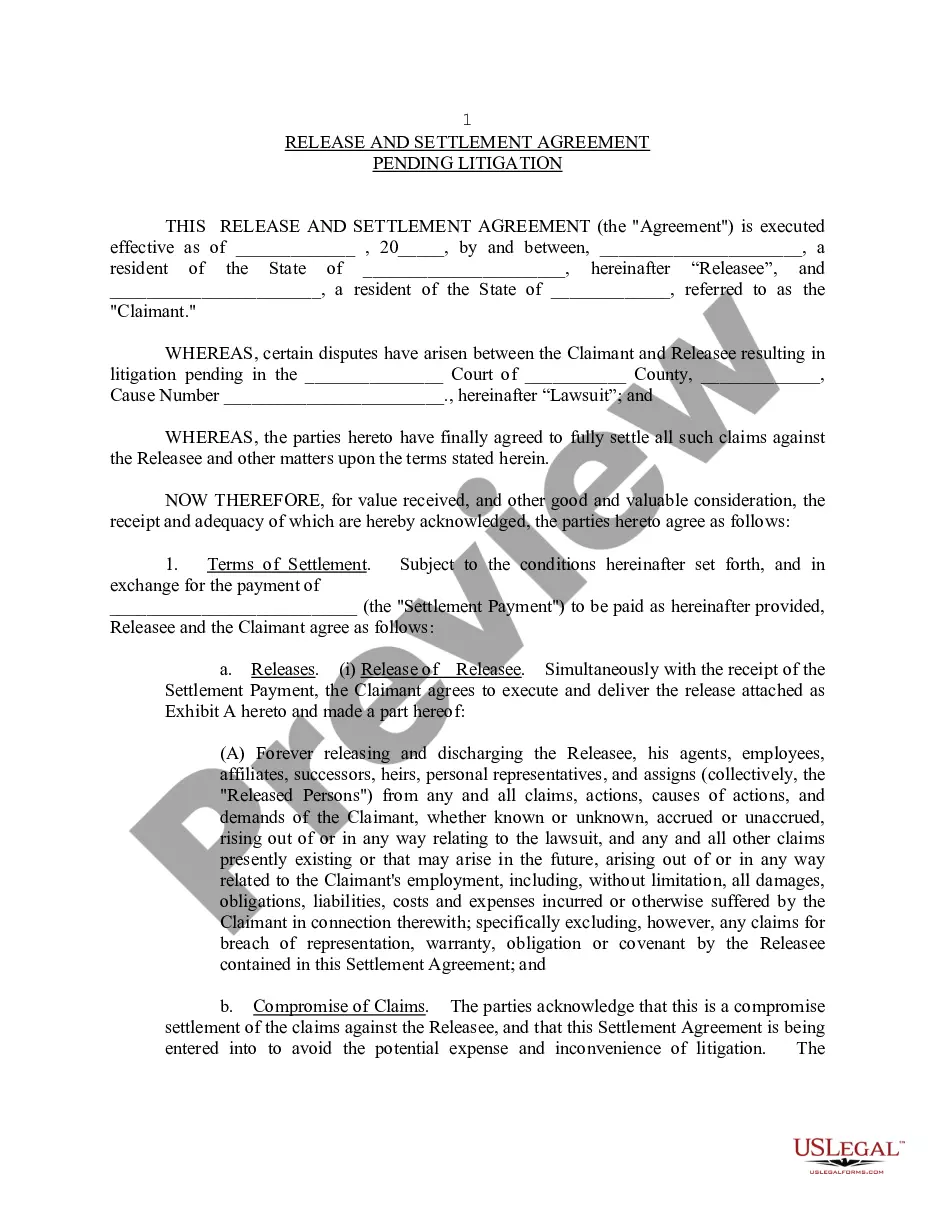
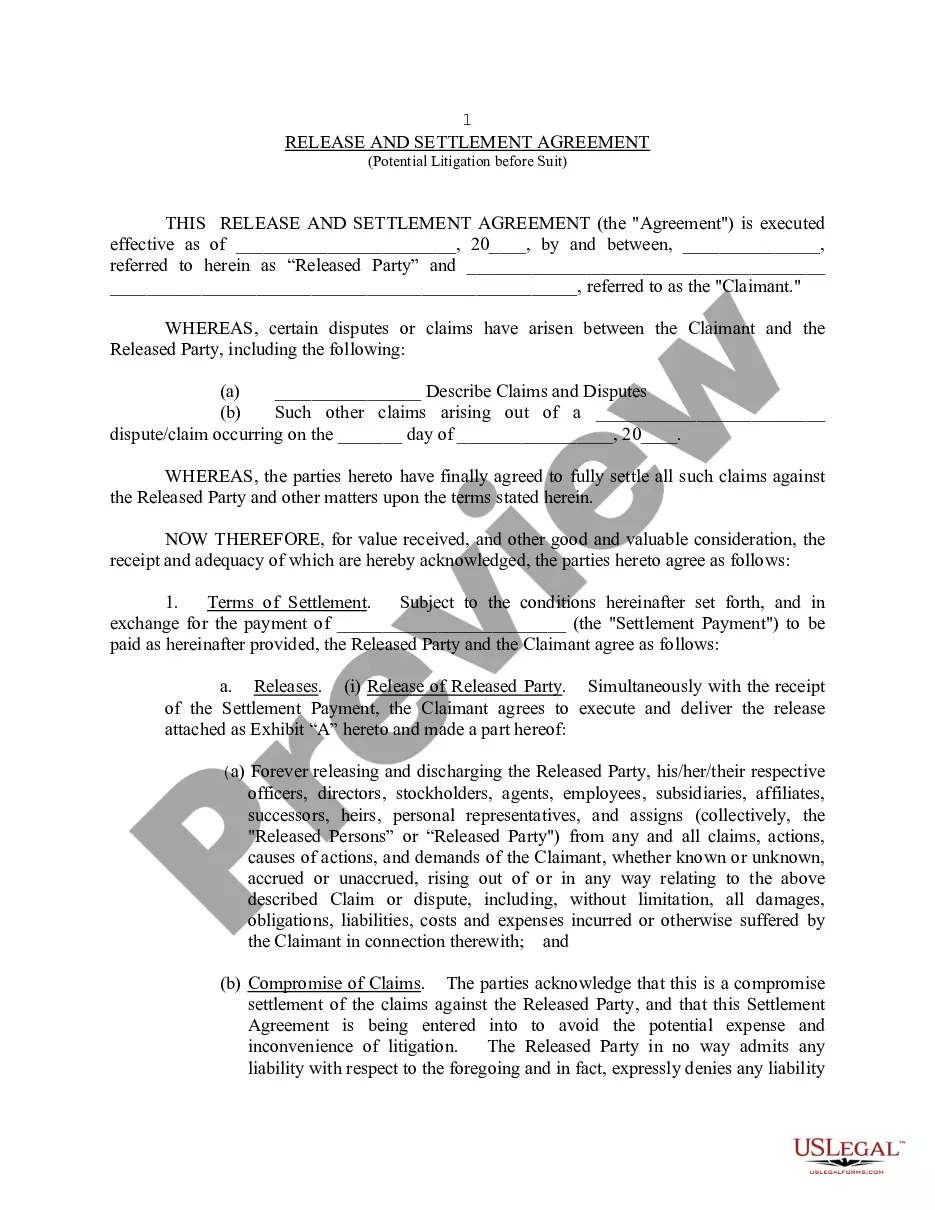
- Identification of the parties involved in the settlement.
- Details of the accident that caused the minor's injuries.
- Settlement payment amount clearly stated.
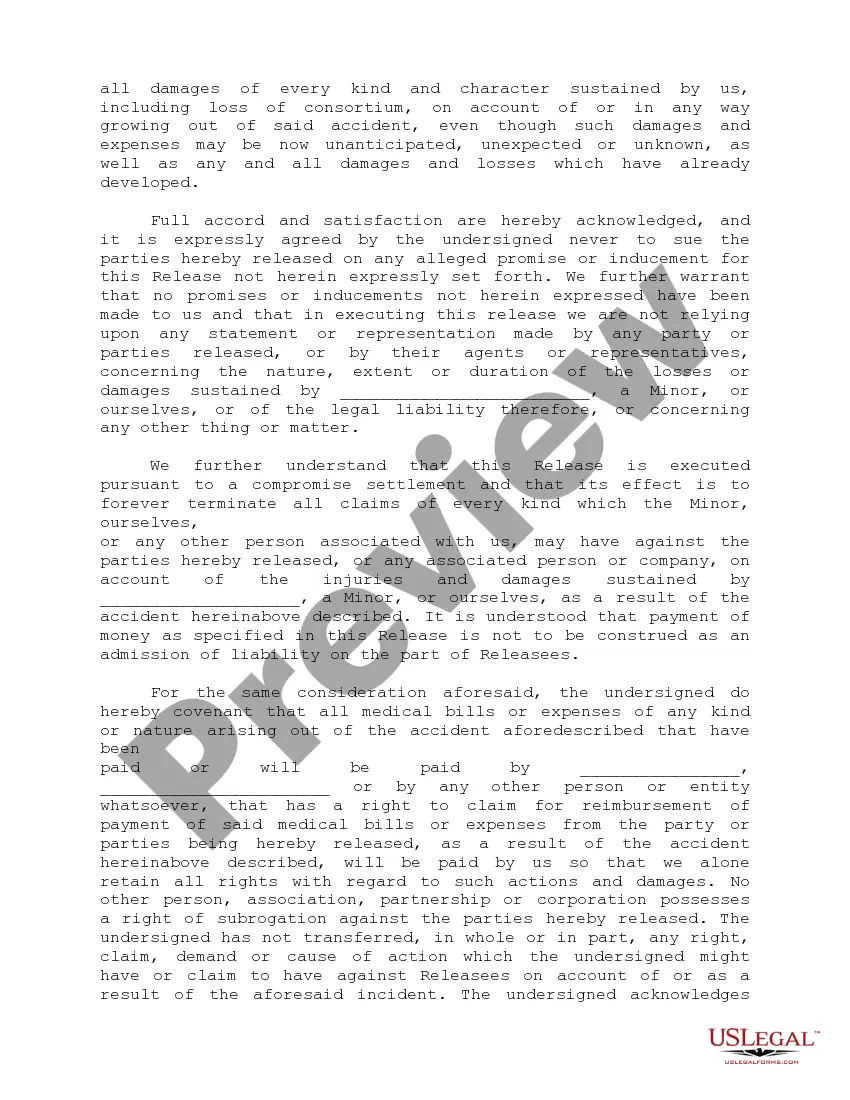
- Release of liability for the designated parties, including heirs and representatives.
- Indemnification clause to protect released parties from future claims.
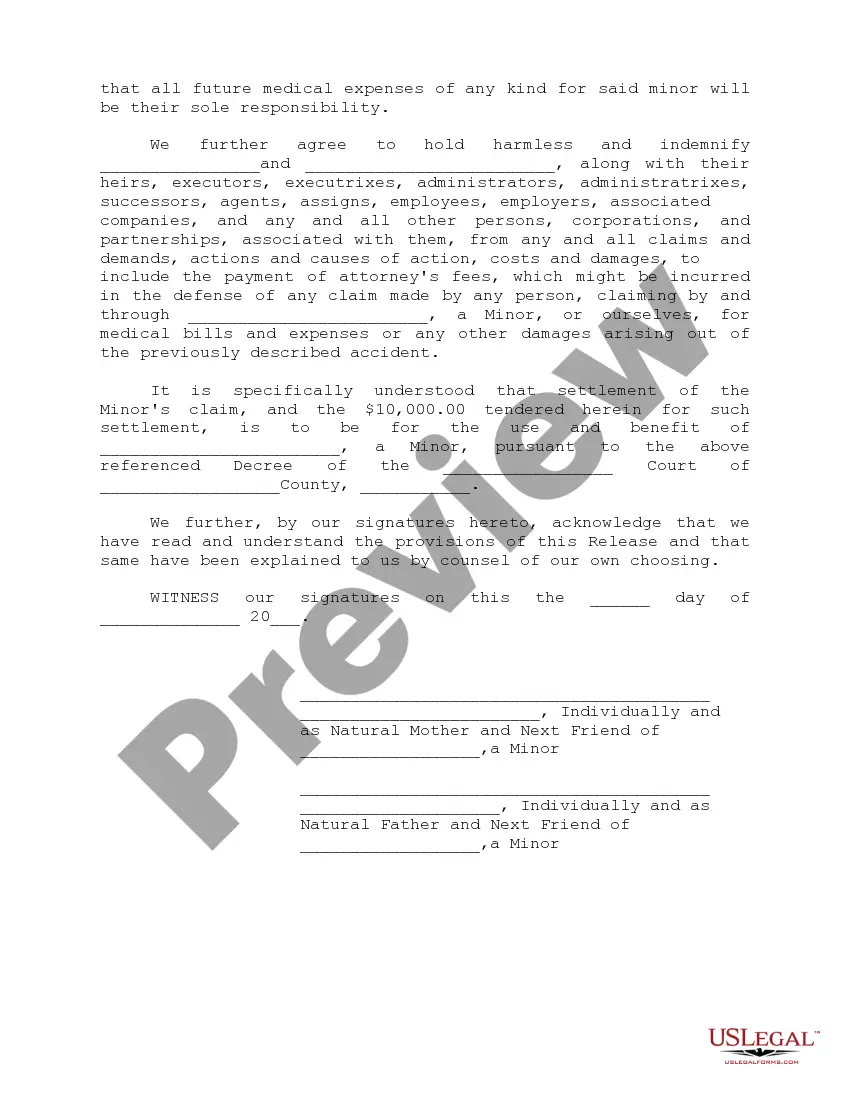
- Signature lines for the natural parents and necessary notarization acknowledgments.

When to use this document
This form is typically used when a minor has been involved in an accident that resulted in injuries, and a financial settlement has been negotiated. It is essential when parents or legal guardians seek to formalize the agreement to release the parties at fault from further claims related to the incident, ensuring that the minor receives compensation while protecting the interests of all parties involved.
Who this form is for
- Natural parents or legal guardians of a minor who has sustained injuries in an accident.
- Individuals negotiating a settlement on behalf of a minor.
- Parties involved in a legal claim seeking resolution without further litigation.
Completing this form step by step
- Identify and provide the names of all parties involved, including the minor.
- Clearly state the date and details of the accident.
- Enter the settlement amounts being agreed upon for compensation.
- Ensure all parties sign the document in front of a notary public if required.
- Review the document carefully to confirm all terms are understood and agreed upon.
Is notarization required?
To make this form legally binding, it must be notarized. Our online notarization service, powered by Notarize, lets you verify and sign documents remotely through an encrypted video session.
Get your form ready online
Our built-in tools help you complete, sign, share, and store your documents in one place.
Make edits, fill in missing information, and update formatting in US Legal Forms—just like you would in MS Word.
Download a copy, print it, send it by email, or mail it via USPS—whatever works best for your next step.
Sign and collect signatures with our SignNow integration. Send to multiple recipients, set reminders, and more. Go Premium to unlock E-Sign.
If this form requires notarization, complete it online through a secure video call—no need to meet a notary in person or wait for an appointment.
We protect your documents and personal data by following strict security and privacy standards.

Make edits, fill in missing information, and update formatting in US Legal Forms—just like you would in MS Word.

Download a copy, print it, send it by email, or mail it via USPS—whatever works best for your next step.

Sign and collect signatures with our SignNow integration. Send to multiple recipients, set reminders, and more. Go Premium to unlock E-Sign.

If this form requires notarization, complete it online through a secure video call—no need to meet a notary in person or wait for an appointment.

We protect your documents and personal data by following strict security and privacy standards.
Common mistakes to avoid
- Failing to include all parties who should be released from liability.
- Not specifying the accident details or settlement amount accurately.
- Neglecting to have the agreement notarized if required by state law.
- Signing the document without reading or understanding the terms.
Benefits of using this form online
- Convenience of accessing the form anytime and anywhere.
- Editable fields allow for customization to suit specific situations.
- Access to legal resources and support for completing the form accurately.
- Time-saving process compared to traditional forms of obtaining legal documents.
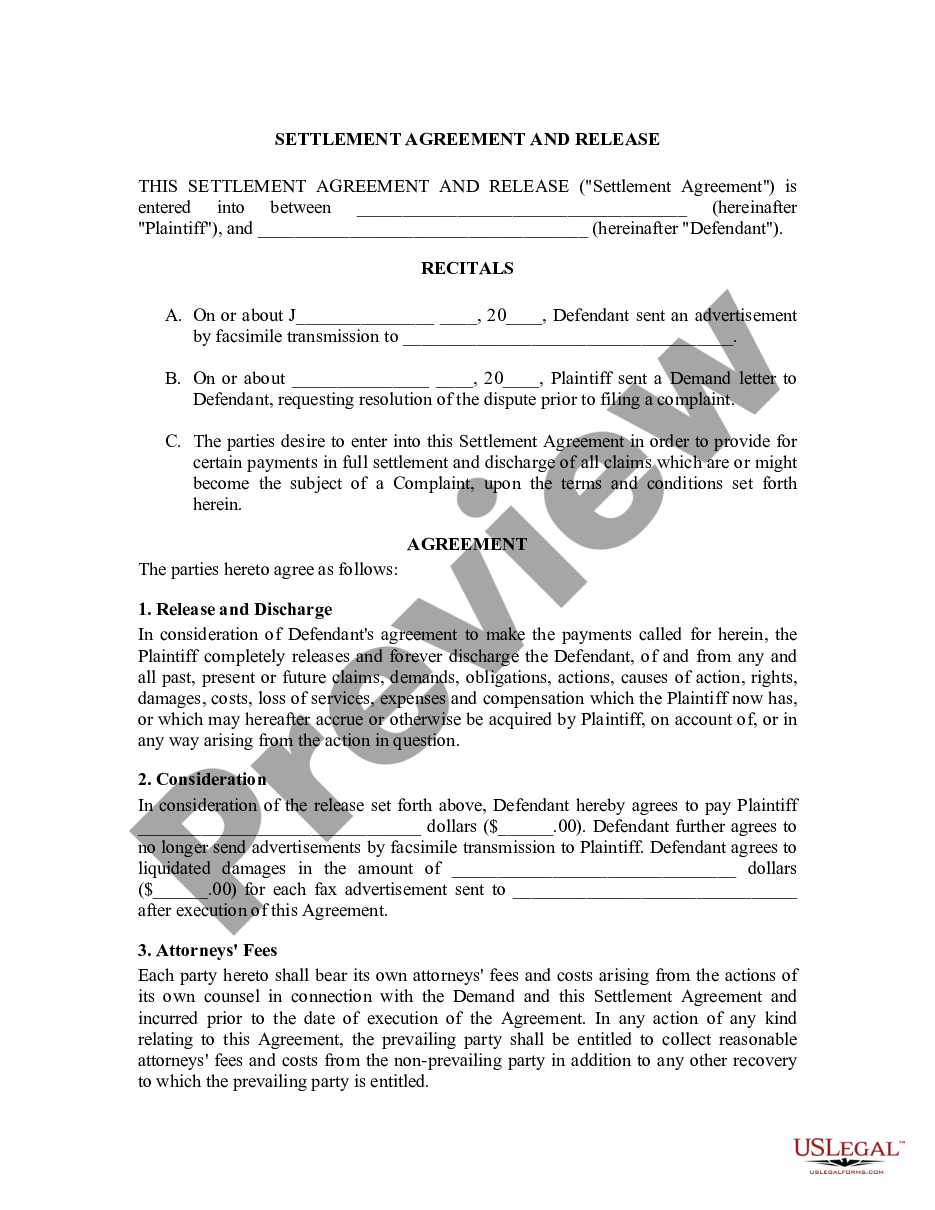
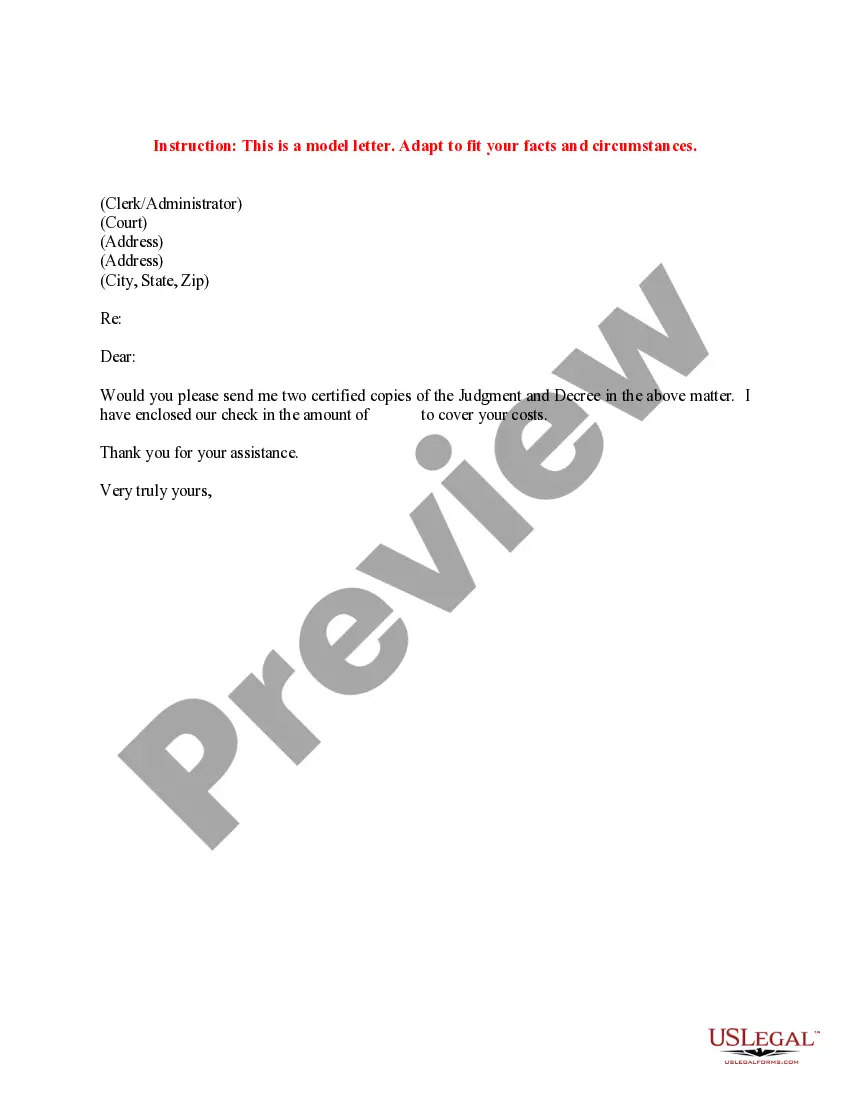
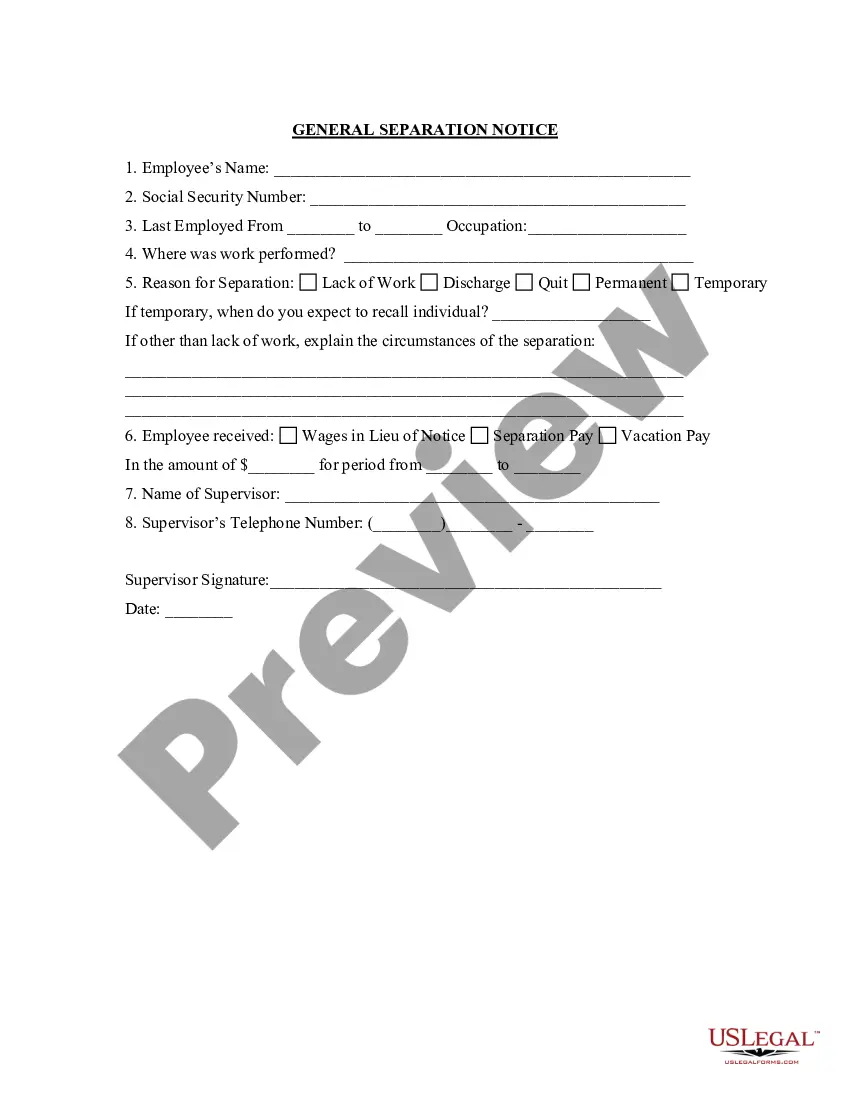
Looking for another form?

Form popularity
FAQ
Unlike a release, which suppresses a cause of action, an indemnity creates a potential cause of action between the indemnitee and the indemnitor.A release extinguishes any actual or potential claims the releasor may have against the releasee without regard to third parties.
An indemnity is a promise by one party to compensate another for the loss suffered as a consequence of a specific event, called the 'trigger event'. The trigger event can be anything defined by the parties, including: a breach of contract. a party's fault or negligence. a specific action.
Indemnity Only Settlement Now More Popular The Indemnity Only Settlement is when the Workers Comp adjusters settle the compensation payments part of the claim. The medical part of the claims is left open for the employee's lifetime.
This form of a Release Agreement, Indemnity Agreement and Hold Harmless Agreement releases a party from certain specified liabilities. Releases are used to transfer risk from one party to another and protect against the released party or reimburse the released party for damage, injury, or loss.
In practice, a hold harmless and an indemnity are functionally equivalent in that both require a party to assume responsibility for losses incurred by another party in connection with certain acts and circumstances. Some argue that while an indemnity shifts losses, a hold harmless shifts both losses and liability.
This form of a Release Agreement, Indemnity Agreement and Hold Harmless Agreement releases a party from certain specified liabilities. Releases are used to transfer risk from one party to another and protect against the released party or reimburse the released party for damage, injury, or loss.
In its simplest form, indemnity means that one party in the contract is responsible for compensating another for loss, damages, and/or injury incurred as a result of that party's actions. In other words, indemnity provides a form of protection against a financial liability.
Lawyers call an agreement to settle a dispute a "release," because in exchange for some act (often the payment of money), one person gives up (or releases) his or her claim against another.