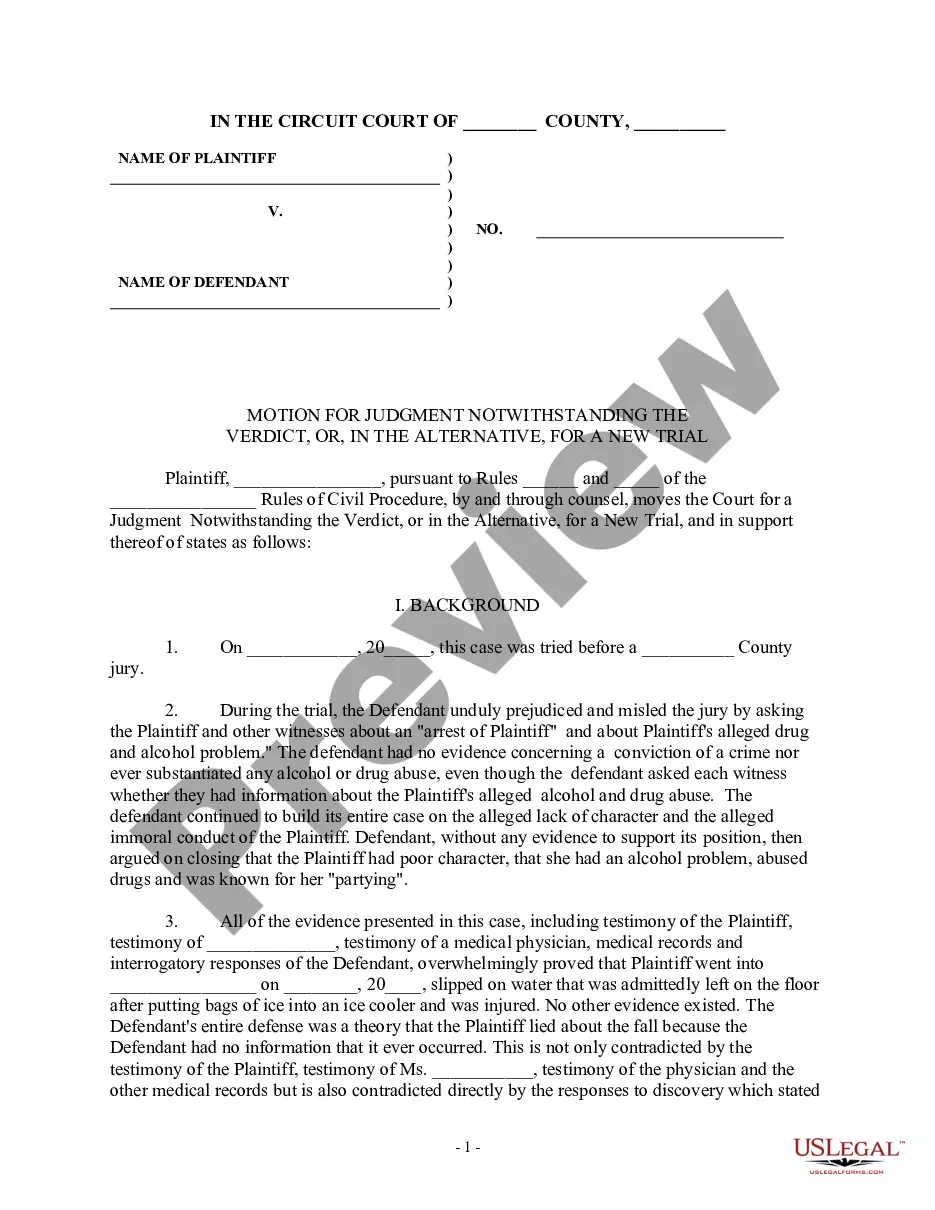
Motion for Judgment Notwithstanding the Verdict, or in the Alternative, for a New Trial - for prejudicial statements at trial
What this document covers
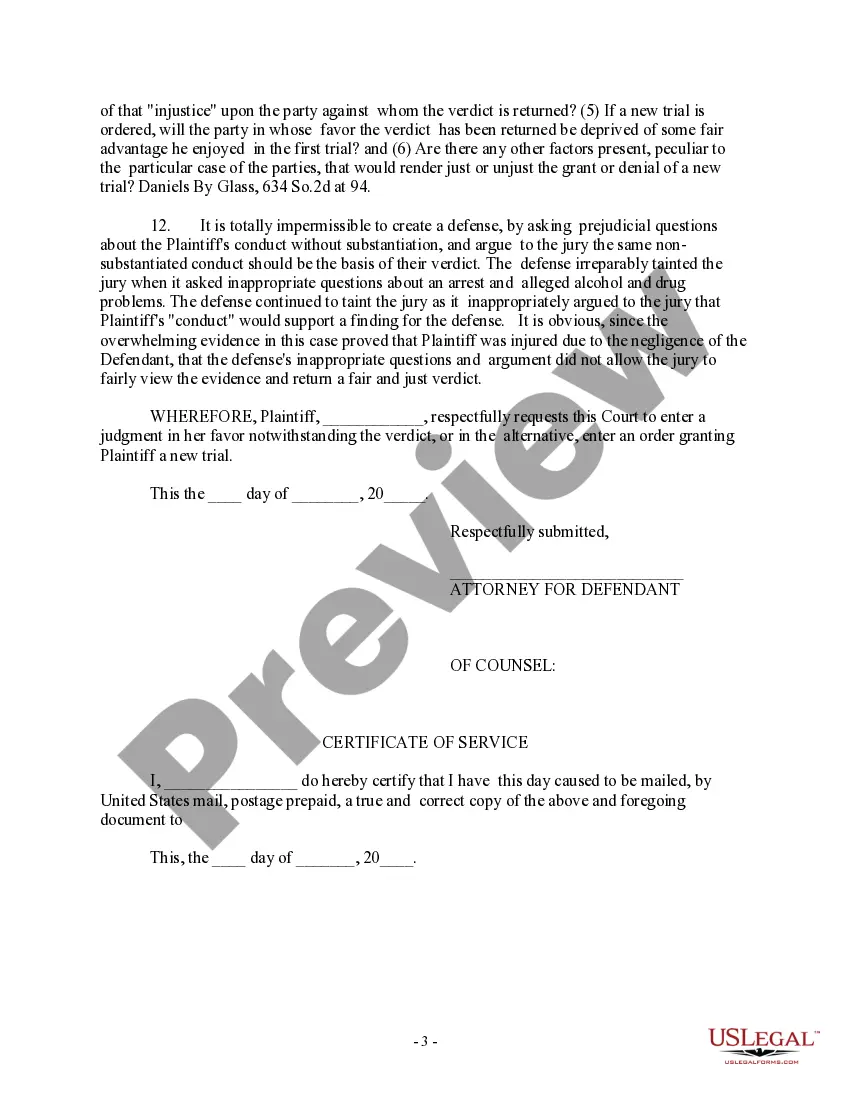
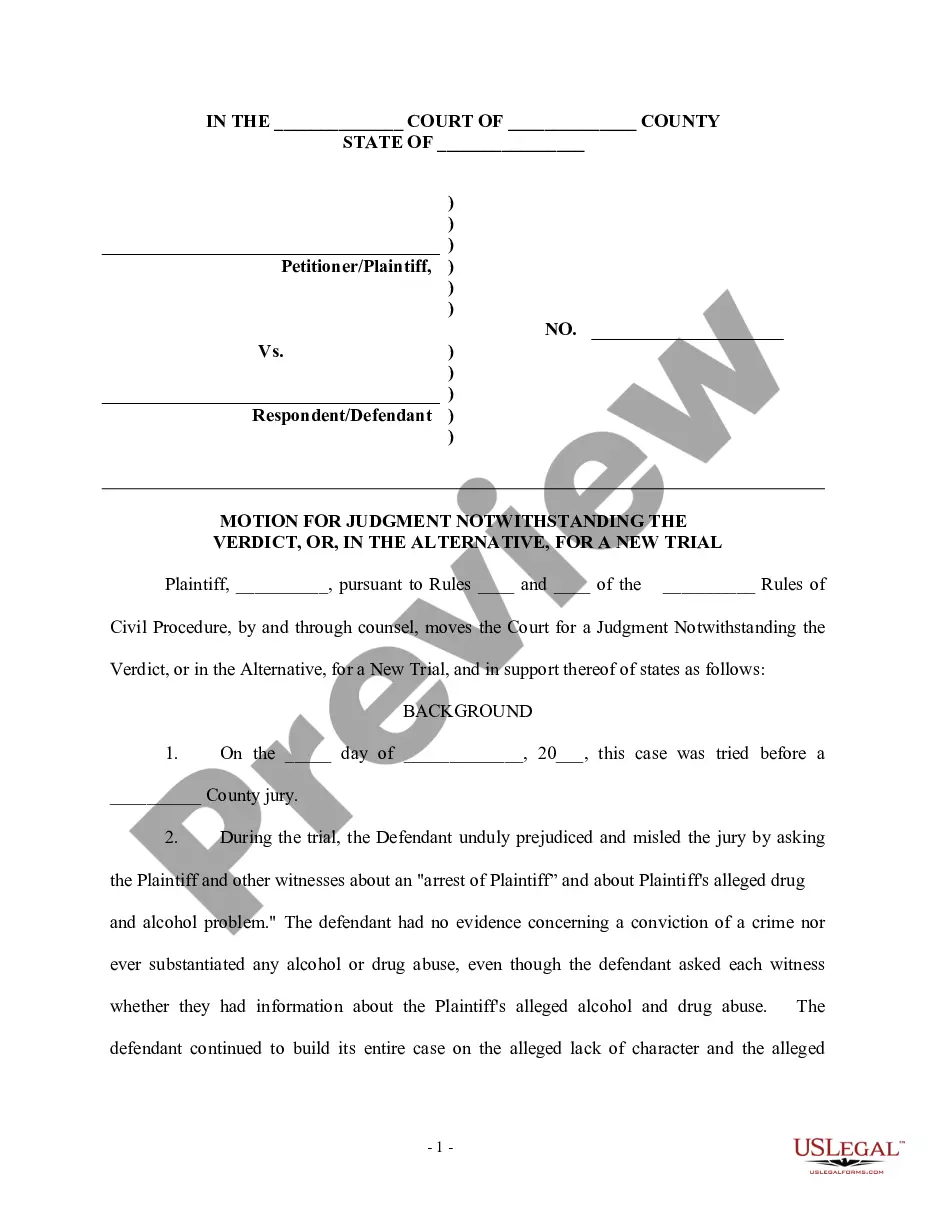
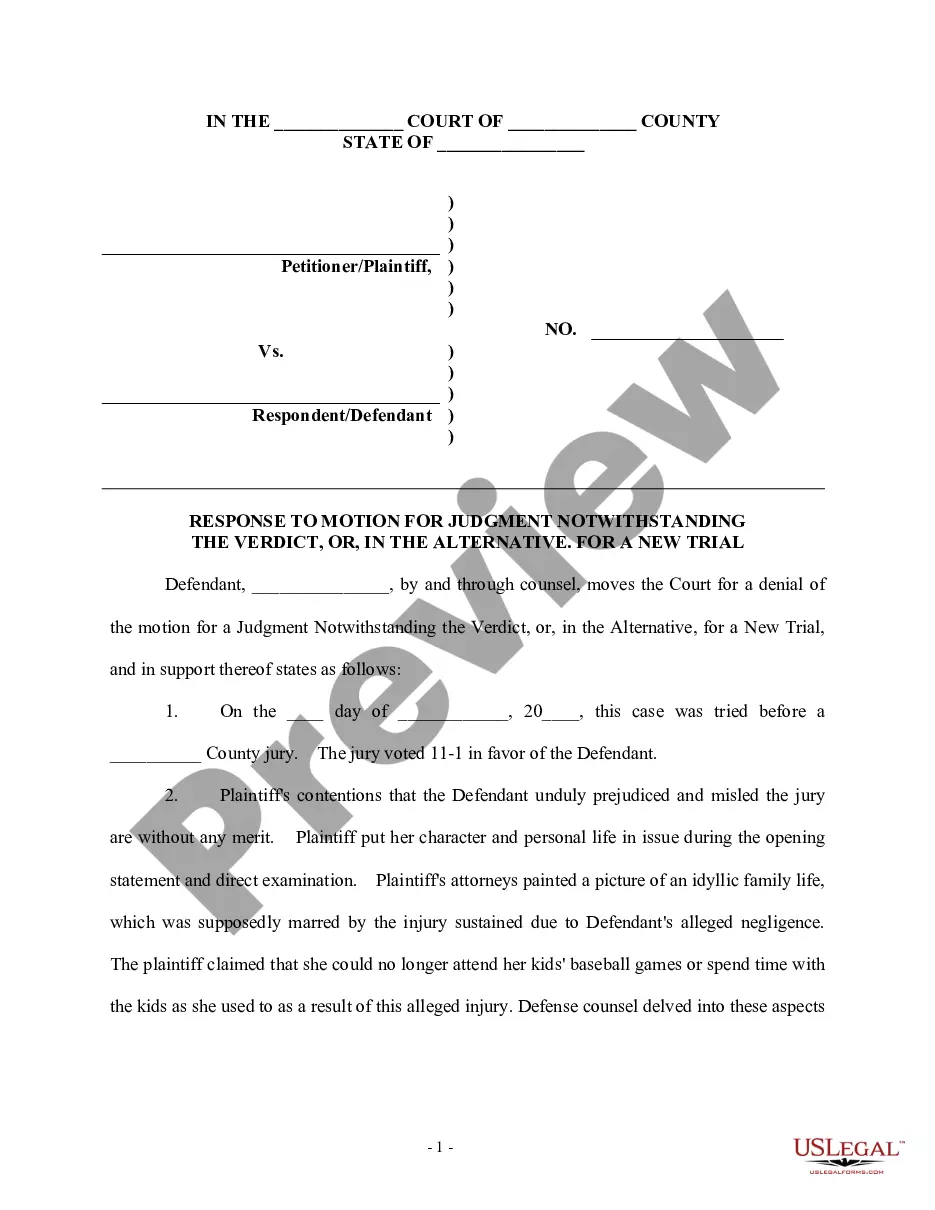
The Motion for Judgment Notwithstanding the Verdict, or in the Alternative, for a New Trial is a legal document used to request the court to reverse a jury's decision or grant a new trial. This form is specifically for situations where prejudicial statements during a trial may have influenced the jury's verdict. Unlike other motions, this form directly addresses issues related to jury bias stemming from improper evidence or arguments made by the opposing party, making it essential for ensuring a fair trial outcome.
Key parts of this document
- Background of the case including trial details and prejudicial actions.
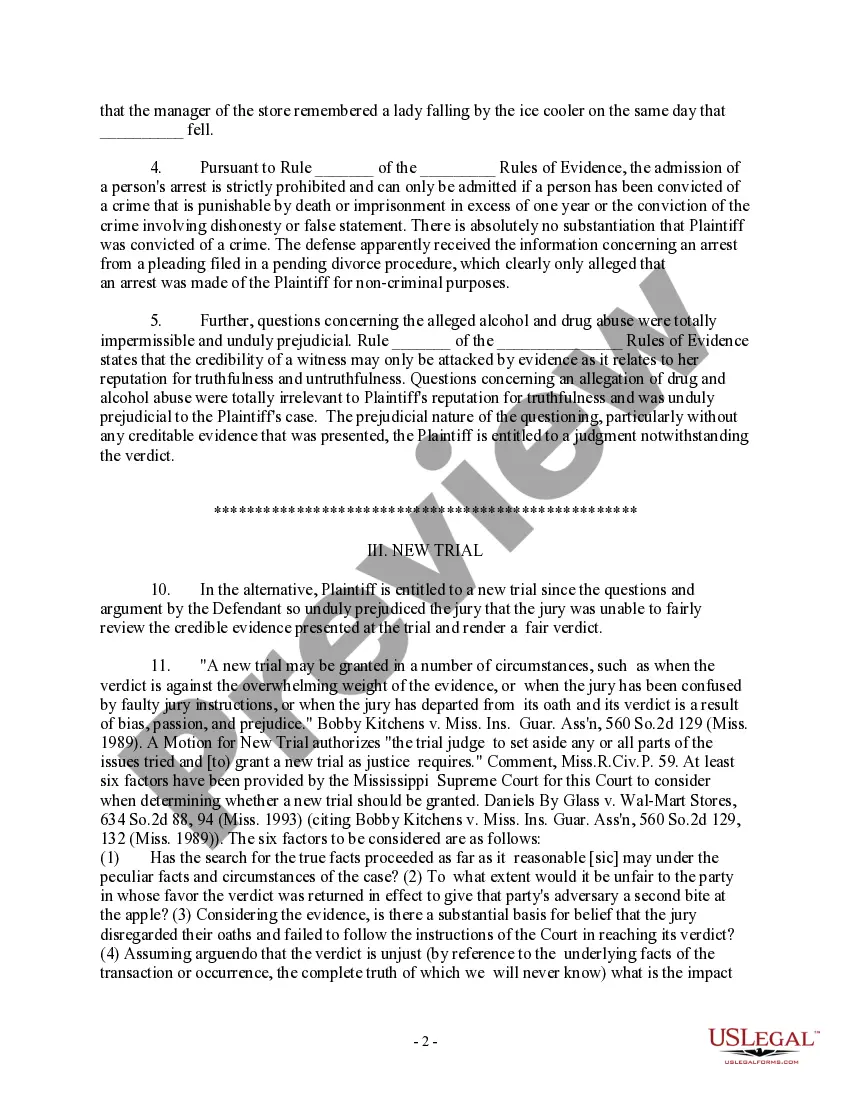
- Foundation for the motion citing specific rules of evidence violated.
- Section requesting a judgment notwithstanding the verdict.
- Alternative request for a new trial based on juror prejudice.
- Closing statement with a request for favorable court action.

Situations where this form applies
This form should be used when a party believes that a trial verdict was unjustly influenced by prejudicial statements or improper evidence presented during the trial. Examples include cases where the opposing counsel improperly questioned witnesses about irrelevant personal matters, such as arrests or alleged substance abuse, which may have tainted the jury's perception of the plaintiff.
Who needs this form
- Plaintiffs seeking to challenge a jury verdict in their case.
- Defendants wishing to protect their rights after a trial verdict.
- Attorneys representing parties involved in civil litigation.
- Individuals who have experienced prejudicial treatment during litigation.
How to complete this form
- Identify the name of the plaintiff and defendant involved in the case.
- Include the relevant details about the original trial and jury verdict.
- Clearly outline the prejudicial statements or evidence that impacted the jury's decision.
- Draft a formal request indicating whether you seek a judgment notwithstanding the verdict or a new trial.
- Sign and date the document, ensuring it complies with local filing procedures.
Notarization requirements for this form
In most cases, this form does not require notarization. However, some jurisdictions or signing circumstances might. US Legal Forms offers online notarization powered by Notarize, accessible 24/7 for a quick, remote process.
Get your form ready online
Our built-in tools help you complete, sign, share, and store your documents in one place.
Make edits, fill in missing information, and update formatting in US Legal Forms—just like you would in MS Word.
Download a copy, print it, send it by email, or mail it via USPS—whatever works best for your next step.
Sign and collect signatures with our SignNow integration. Send to multiple recipients, set reminders, and more. Go Premium to unlock E-Sign.
If this form requires notarization, complete it online through a secure video call—no need to meet a notary in person or wait for an appointment.
We protect your documents and personal data by following strict security and privacy standards.

Make edits, fill in missing information, and update formatting in US Legal Forms—just like you would in MS Word.

Download a copy, print it, send it by email, or mail it via USPS—whatever works best for your next step.

Sign and collect signatures with our SignNow integration. Send to multiple recipients, set reminders, and more. Go Premium to unlock E-Sign.

If this form requires notarization, complete it online through a secure video call—no need to meet a notary in person or wait for an appointment.

We protect your documents and personal data by following strict security and privacy standards.
Common mistakes
- Failing to cite specific rules of evidence violated during the trial.
- Neglecting to provide adequate background and context for the motion.
- Omitting necessary signatures or dates from the form.
- Not filing the motion within the required timeframe post-verdict.
Benefits of completing this form online
- Convenience of downloading and completing it at your own pace.
- Editability allows for easy modification to meet specific case needs.
- Access to professionally drafted forms ensures legal accuracy.
- Secure storage and easy retrieval of completed documents.
Looking for another form?


Form popularity
FAQ
21 provides that misjoinder of parties is not ground for dismissal of an action, and that parties may be dropped or added by court order on motion of any party or of the court's own initiative at any stage in the action and on such terms as are just.
1. The Rule. Rule 50(a) provides for a motion for judgment as a matter of law (JMOL) which may be made at any time before submission of the case to the jury.If the court decides the initial motion should have been granted, it may set aside the verdict of the jury and enter judgment as a matter of law.
A motion for a judgment notwithstanding the verdict is often filed together with a motion for a new trial by the losing party in response to the jury's verdict. A judge's decision to grant or deny a motion for JNOV is often reviewable on appeal.
A motion for judgment as a matter of law (JMOL) is a motion made by a party, during trial, claiming the opposing party has insufficient evidence to reasonably support its case.If there is no evidence to support a reasonable conclusion for the opposing party, judgment is entered by the court and the case is over.
A motion asking the court to enter judgment as a matter of law. This motion is made before a case is submitted to the jury, and argues that no reasonable jury could find for the opposing party (i.e., whatever evidence exists for such ruling is legally insufficient).
Directed Verdict a) After Plaintiff201fs evidence or after the close of all the evidence, a party may move for a directed verdict in its favor. Standard: If the non-moving party201fs evidence is insufficient as a matter of law to go to a jury, the Court should grant a directed verdict for the moving party.
A JNOV is proper when the court finds that the party bearing the BURDEN OF PROOF fails to make out a PRIMA FACIE case (a case that on first appearance will prevail unless contradicted by evidence). To be granted relief by a JNOV, a party must make a motion seeking that relief.
A directed verdict may be granted at any time, but usually occurs after at least one party has been fully heard. Motions for a directed verdict are governed by Rule 50 of the Federal Rules of Civil Procedure and Rule 29 of the Federal Rules of Criminal Procedure.