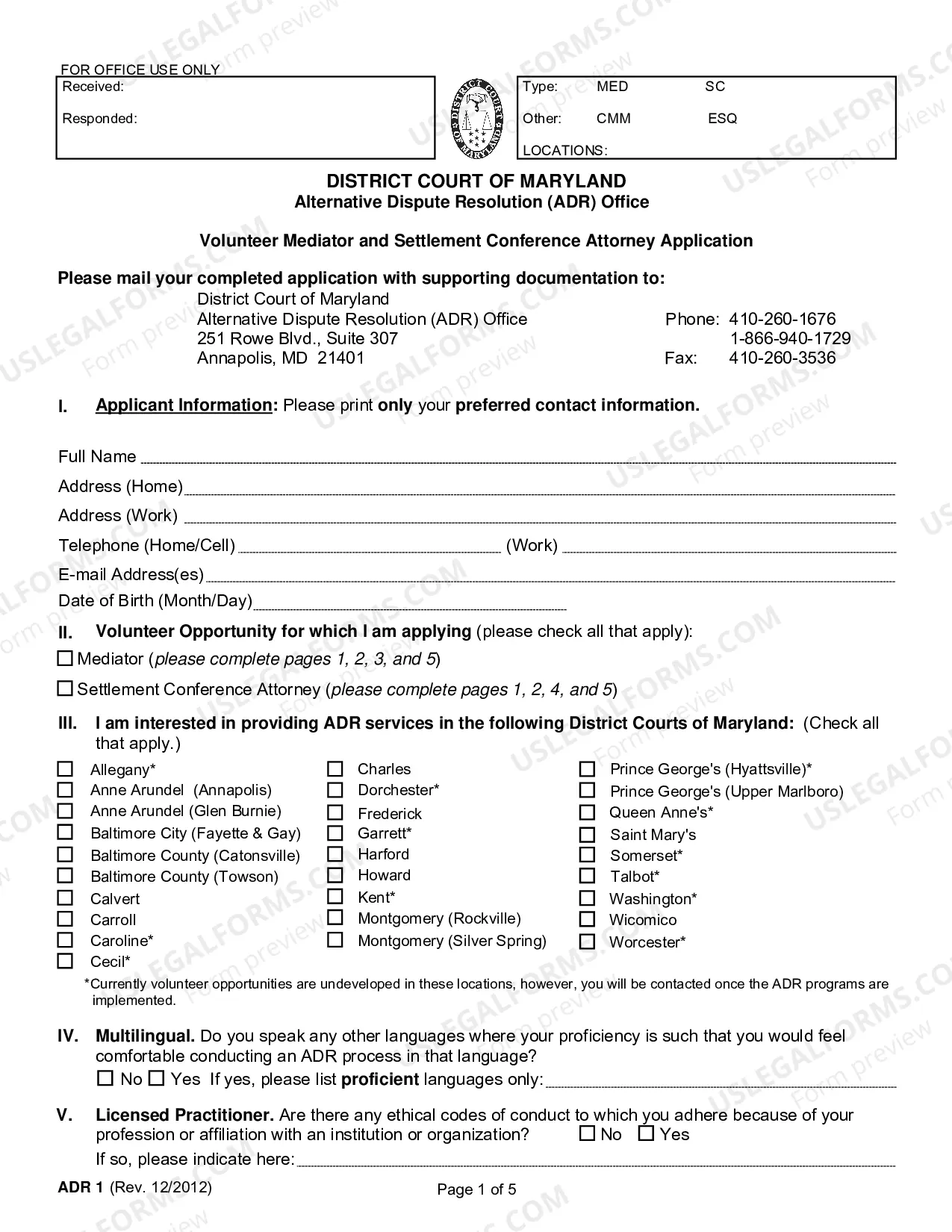
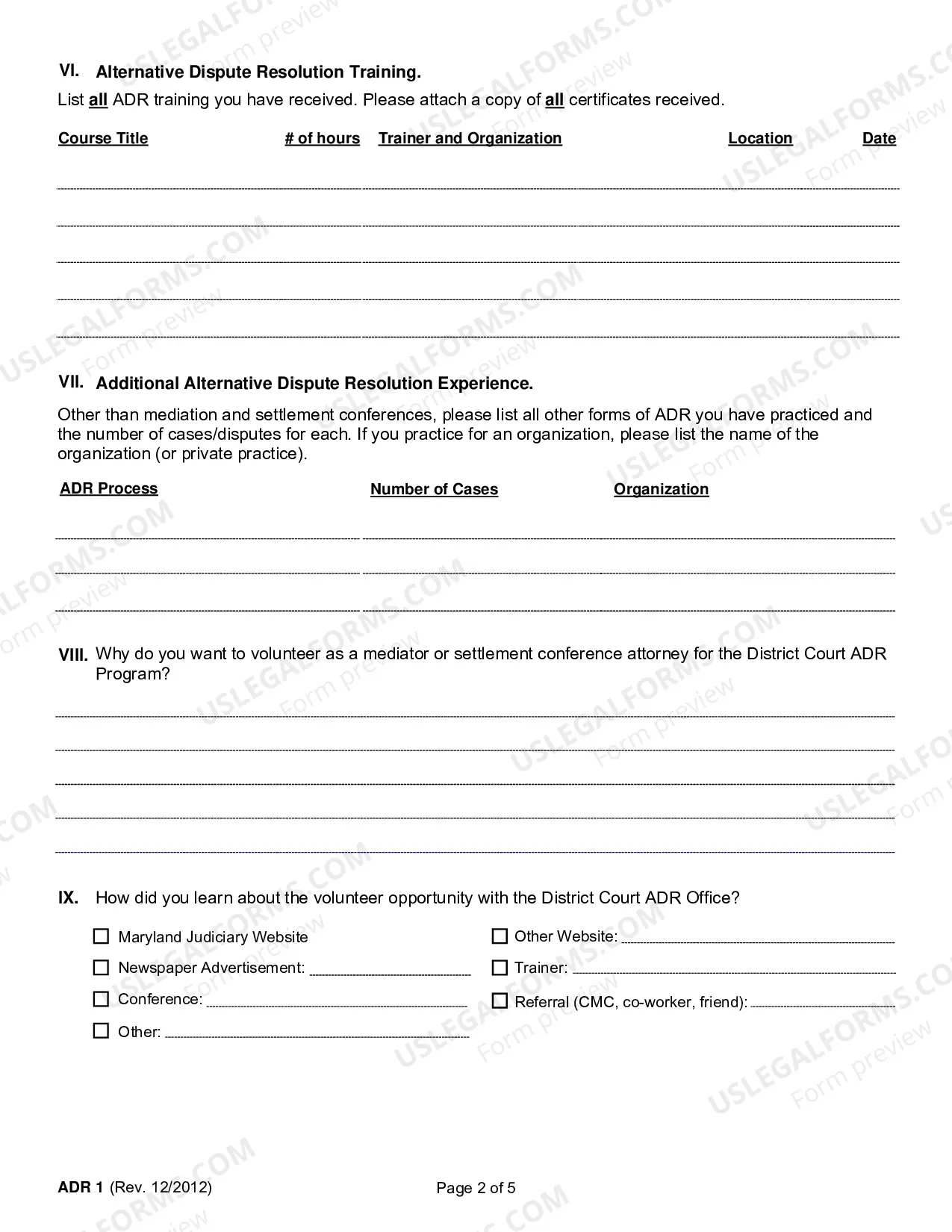
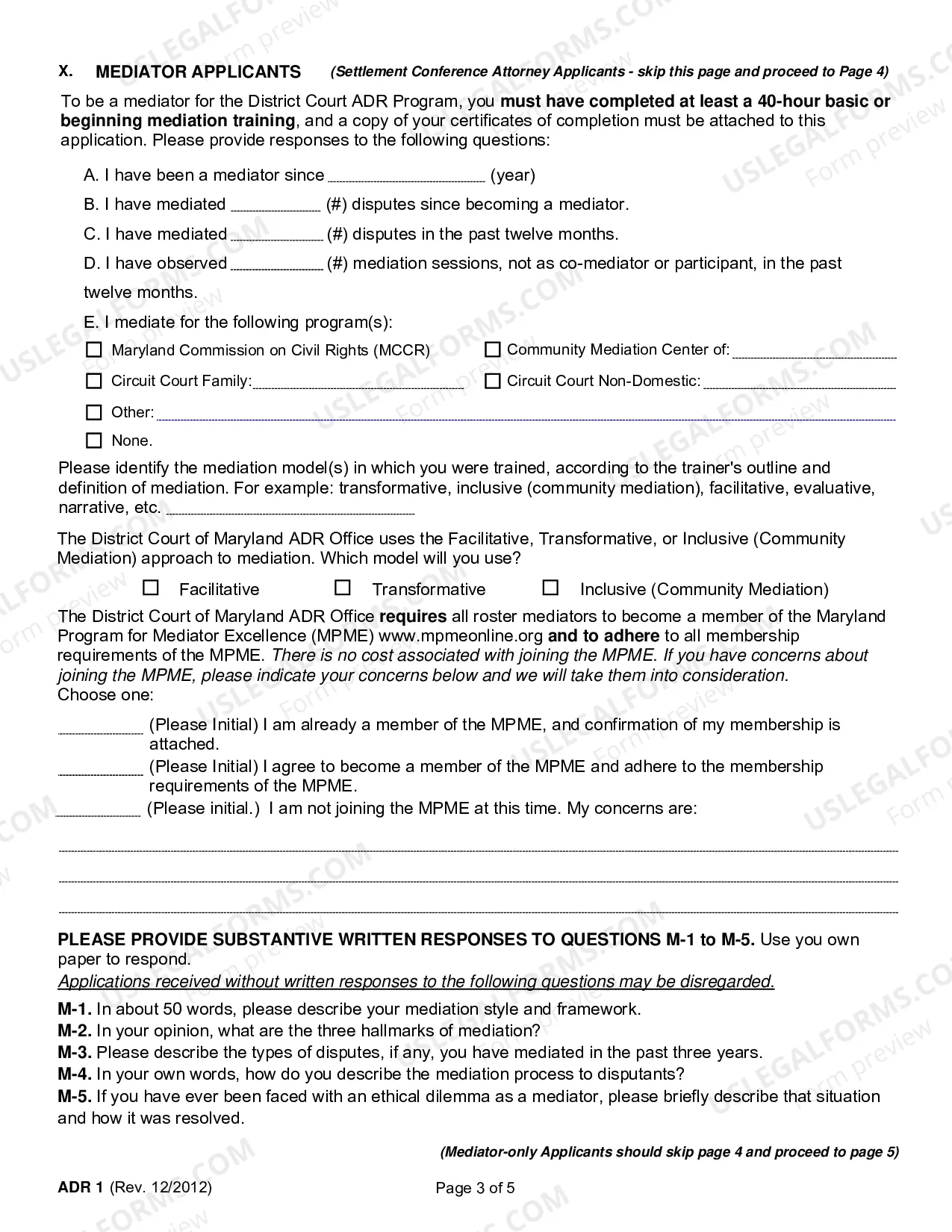
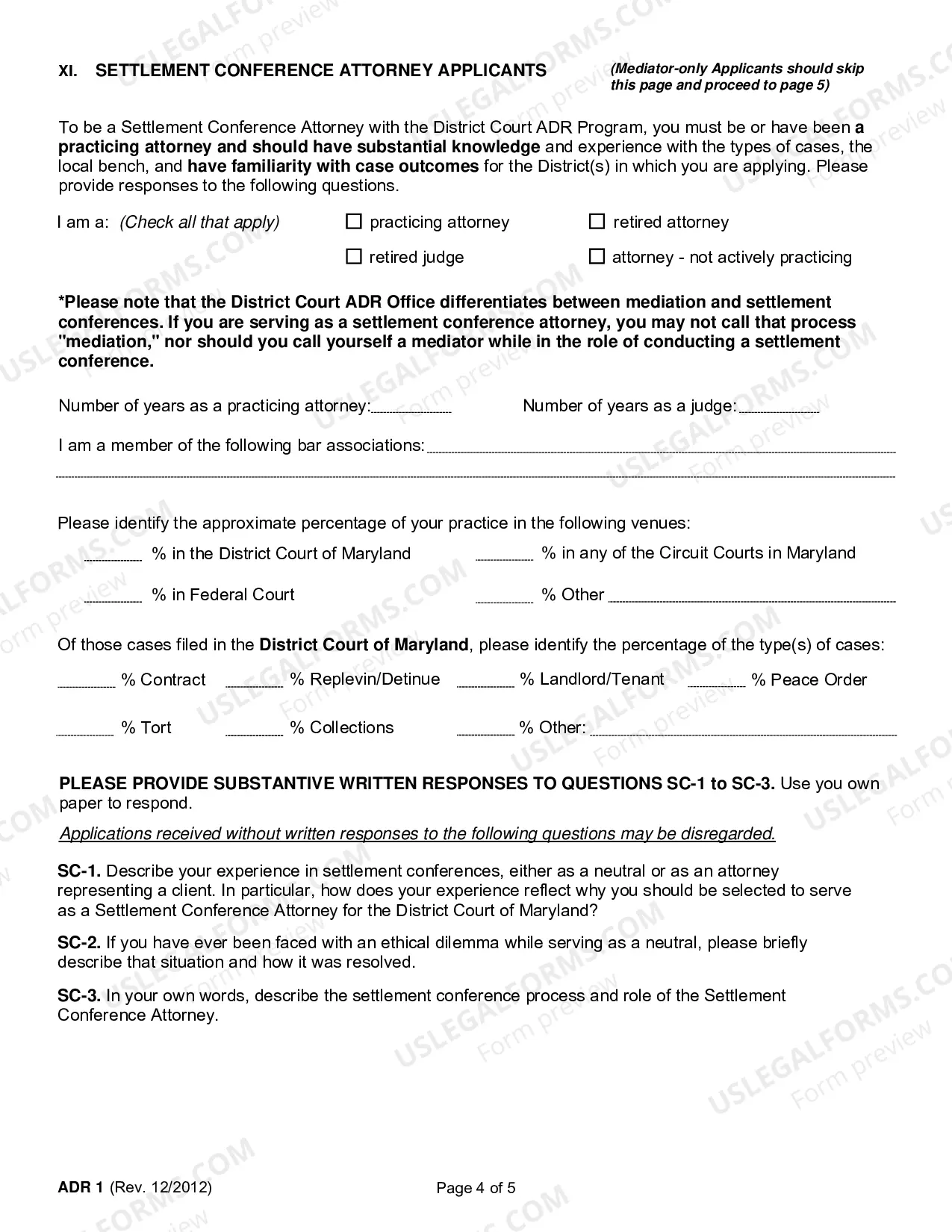
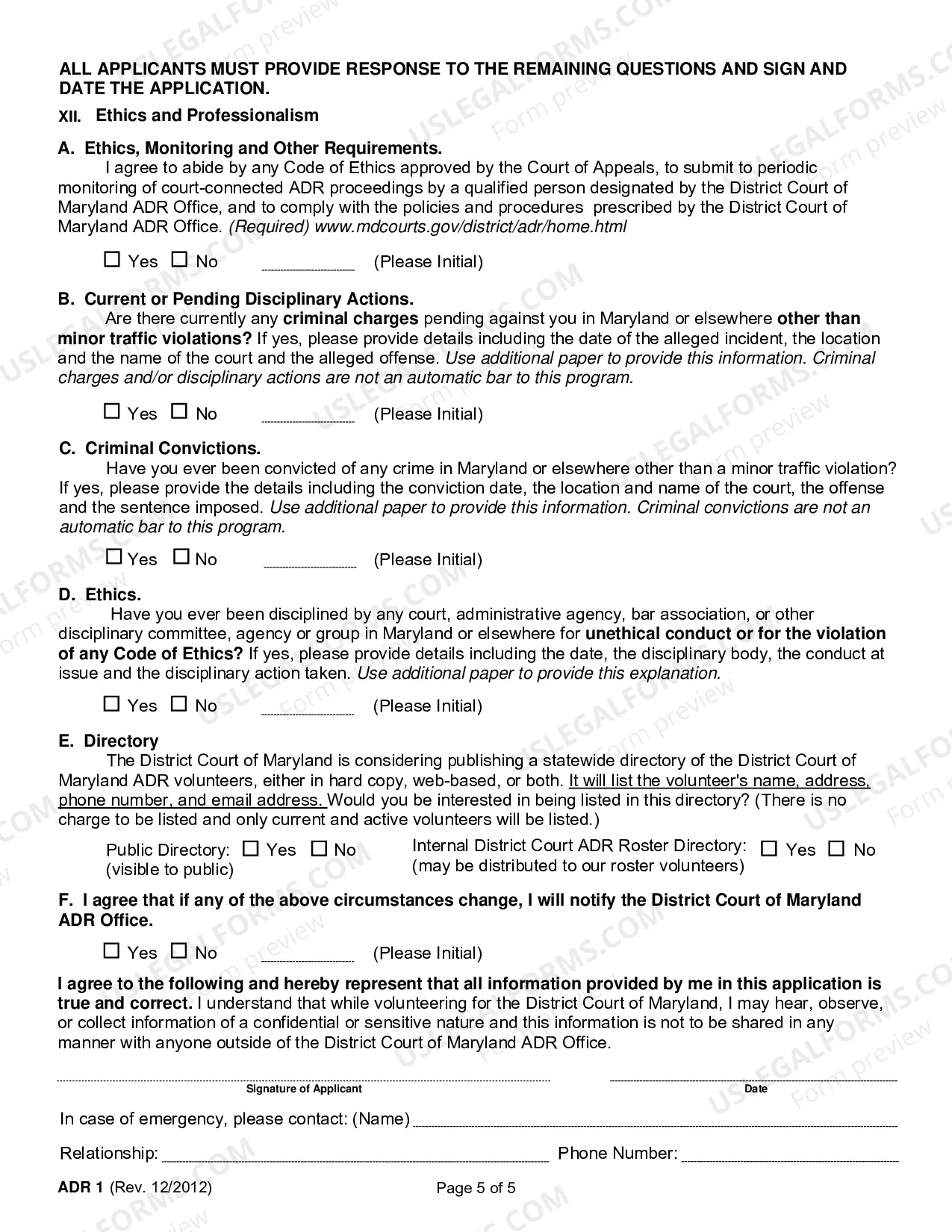
Maryland Alternative Dispute Resolution (ADR) Volunteer Application is a form that helps organizations and individuals in the state of Maryland to find volunteers who are knowledgeable and experienced in conflict resolution and dispute resolution. The application helps to match volunteers with organizations that best fit their skills and interests. There are two types of Maryland ADR Volunteer Applications: Mediation and Arbitration. Mediation applications are designed for volunteers who are experienced in mediation and have the skills to act as an impartial third-party mediator. Arbitration applications are for volunteers who are knowledgeable in arbitration and can act as a neutral third-party arbitrator. Both applications require the volunteer to provide information about their background, experience, and qualifications.
Maryland Alternative Dispute Resolution Volunteer Application
Description
Get your form ready online
Our built-in tools help you complete, sign, share, and store your documents in one place.
Make edits, fill in missing information, and update formatting in US Legal Forms—just like you would in MS Word.
Download a copy, print it, send it by email, or mail it via USPS—whatever works best for your next step.
Sign and collect signatures with our SignNow integration. Send to multiple recipients, set reminders, and more. Go Premium to unlock E-Sign.
If this form requires notarization, complete it online through a secure video call—no need to meet a notary in person or wait for an appointment.
We protect your documents and personal data by following strict security and privacy standards.

Make edits, fill in missing information, and update formatting in US Legal Forms—just like you would in MS Word.

Download a copy, print it, send it by email, or mail it via USPS—whatever works best for your next step.

Sign and collect signatures with our SignNow integration. Send to multiple recipients, set reminders, and more. Go Premium to unlock E-Sign.

If this form requires notarization, complete it online through a secure video call—no need to meet a notary in person or wait for an appointment.

We protect your documents and personal data by following strict security and privacy standards.
Looking for another form?
How to fill out Maryland Alternative Dispute Resolution Volunteer Application?
How much duration and resources do you usually allocate to creating formal documentation.
There’s a superior method to acquire such forms than enlisting legal professionals or spending countless hours searching online for a suitable template.
Another benefit of our library is that you can reach previously acquired documents that you securely store in your profile under the My documents tab. Retrieve them at any time and re-complete your filings as often as you require.
Save time and effort preparing official documents with US Legal Forms, one of the most trustworthy online solutions. Sign up with us today!
- Investigate the form details to confirm it fulfills your state's requirements. To do this, review the form description or utilize the Preview option.
- If your legal template does not satisfy your needs, discover another one using the search feature at the top of the page.
- If you are already signed up with our service, Log In and download the Maryland Alternative Dispute Resolution Volunteer Application. If not, move on to the next steps.
- Click Buy now after you find the suitable document. Choose the subscription plan that best fits you to access our library's complete offerings.
- Establish an account and settle your subscription fee. You can pay via credit card or PayPal - our service is entirely safe for transactions.
- Download your Maryland Alternative Dispute Resolution Volunteer Application to your device and fill it out on a printed copy or digitally.
Form popularity
FAQ
The most common types of ADR for civil cases are mediation, settlement conferences, neutral evaluation, and arbitration. Read more about these ADR processes, when they may or may not be appropriate or watch a video demonstration.
Arbitration, much like mediation or negotiation, is an alternative dispute resolution (?ADR?) method. ADR methods represent alternatives to traditional litigation. Thus, when parties agree to an arbitration, they take the matter of dispute out of a state or federal court.
Negotiation, mediation and arbitration, often called ADR or alternative dispute resolution, are the most well known. Whether you are involved in a family or neighborhood dispute or a lawsuit involving thousands of dollars, these processes should be considered.
Voluntary Dispute Resolution Program It is the Court's intention that the VDRP shall allow the participants to take advantage of a wide variety of alternative dispute resolution methods. These methods may include, but are not limited to, mediation, negotiation, early neutral evaluation and settlement facilitation.
Parties in a legal dispute have the option to pursue ADR methods in a parallel process, upon consent by all parties. This way, parties can resolve their differences even during litigation.
Typically, all aspects of ADR are voluntary, including the decision to participate, the type of process used, and the content of any final agreement. This last point means that participants in an ADR process cannot be forced against their will to reach a resolution of their dispute.
Know What You're Asking For.Determine What the Disagreements Are.Schedule the Mediation Session Thoughtfully.Make Sure You Have What You Need.Make Sure the Other Side Has Someone Present With the Authority to Settle the Case.Know What Your Absolutes Are, and Know Where You Can Compromise.Use a Caucus.