On or About
Overview of this form
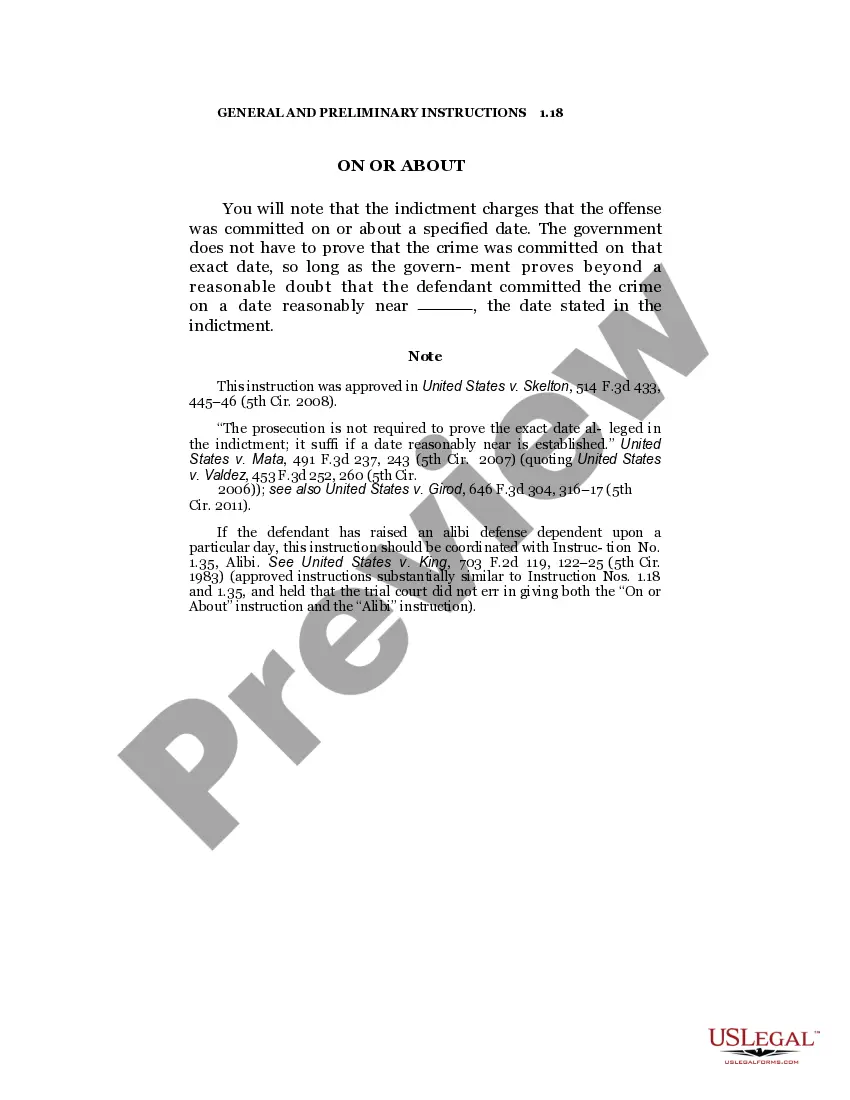
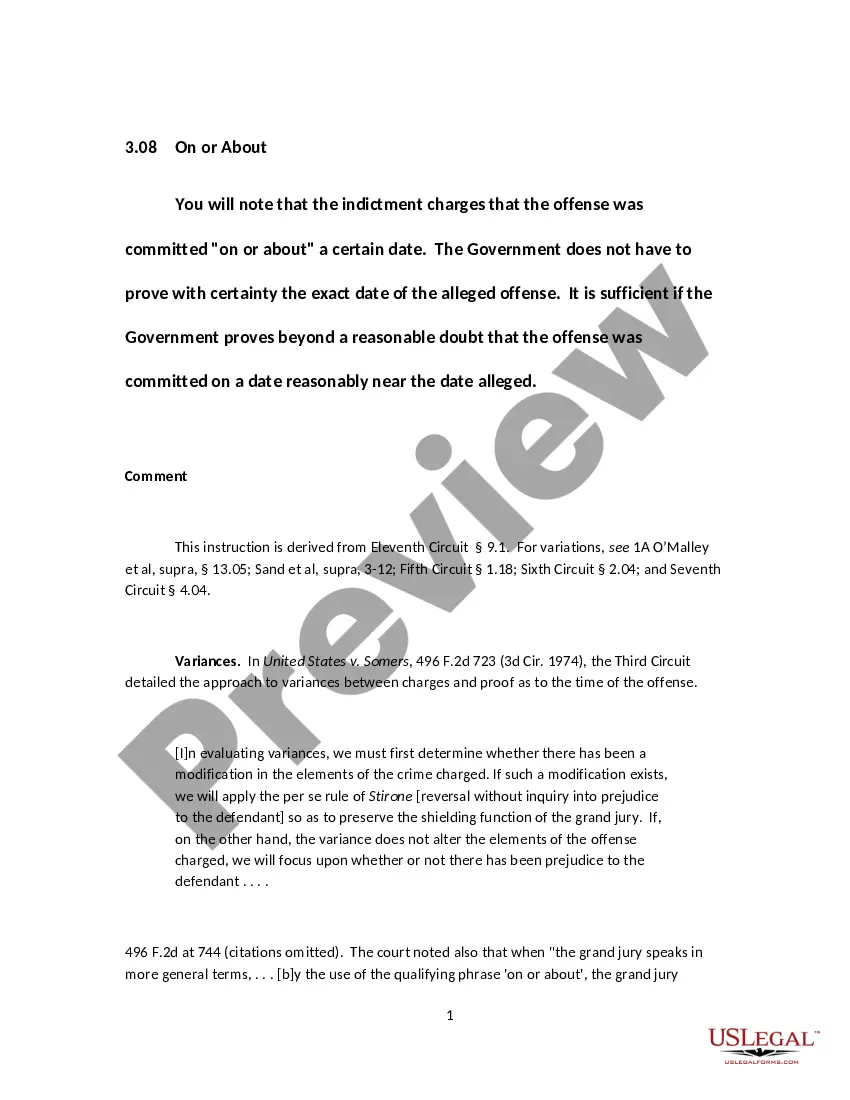
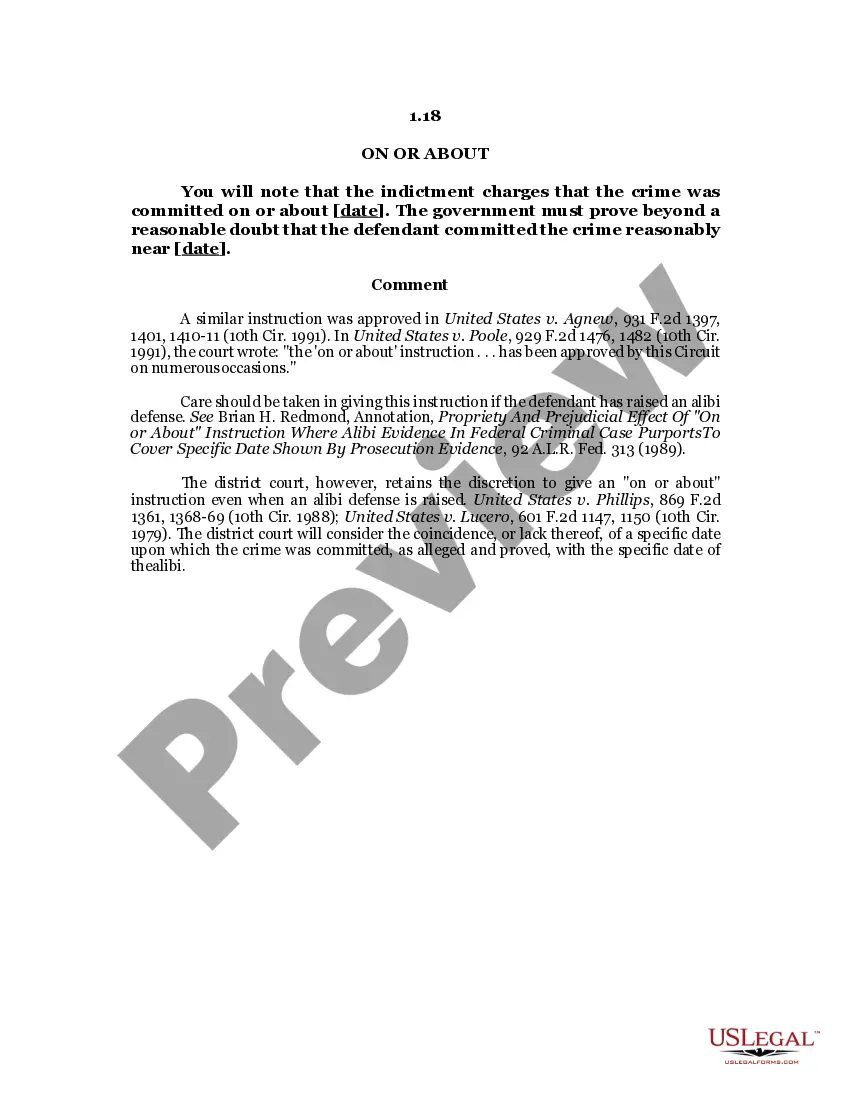
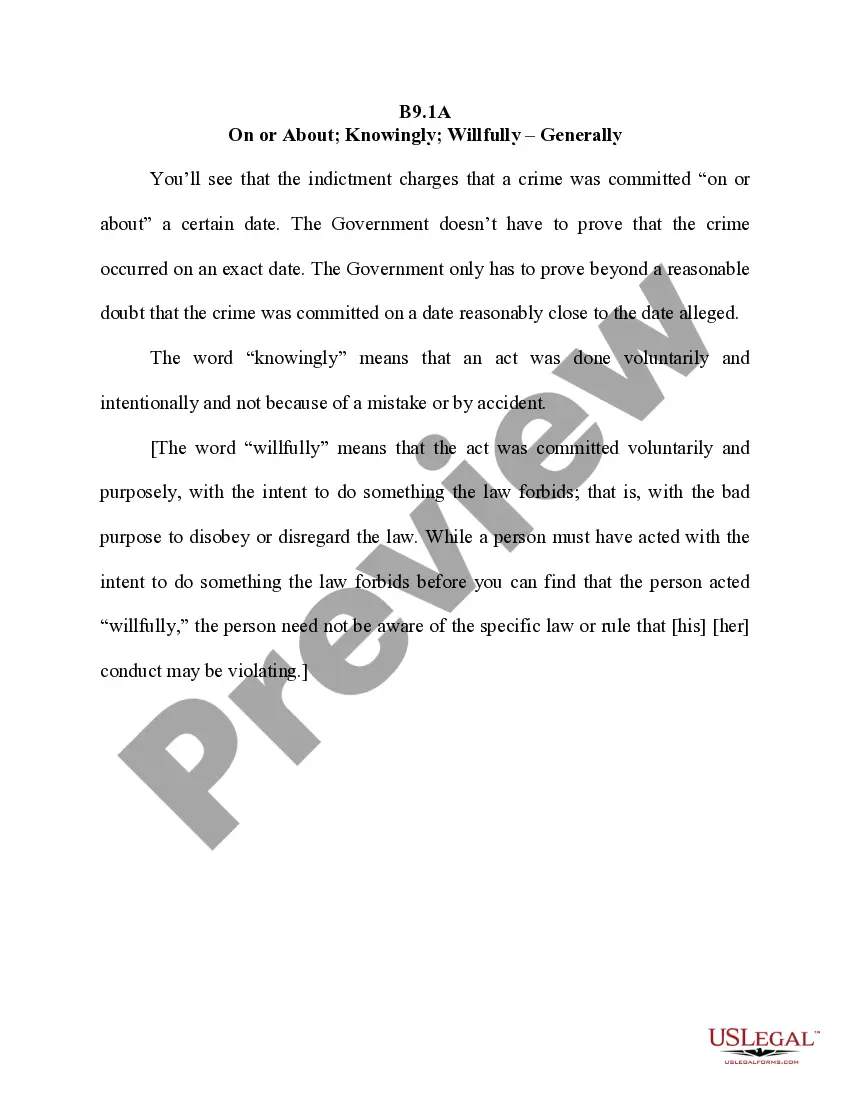
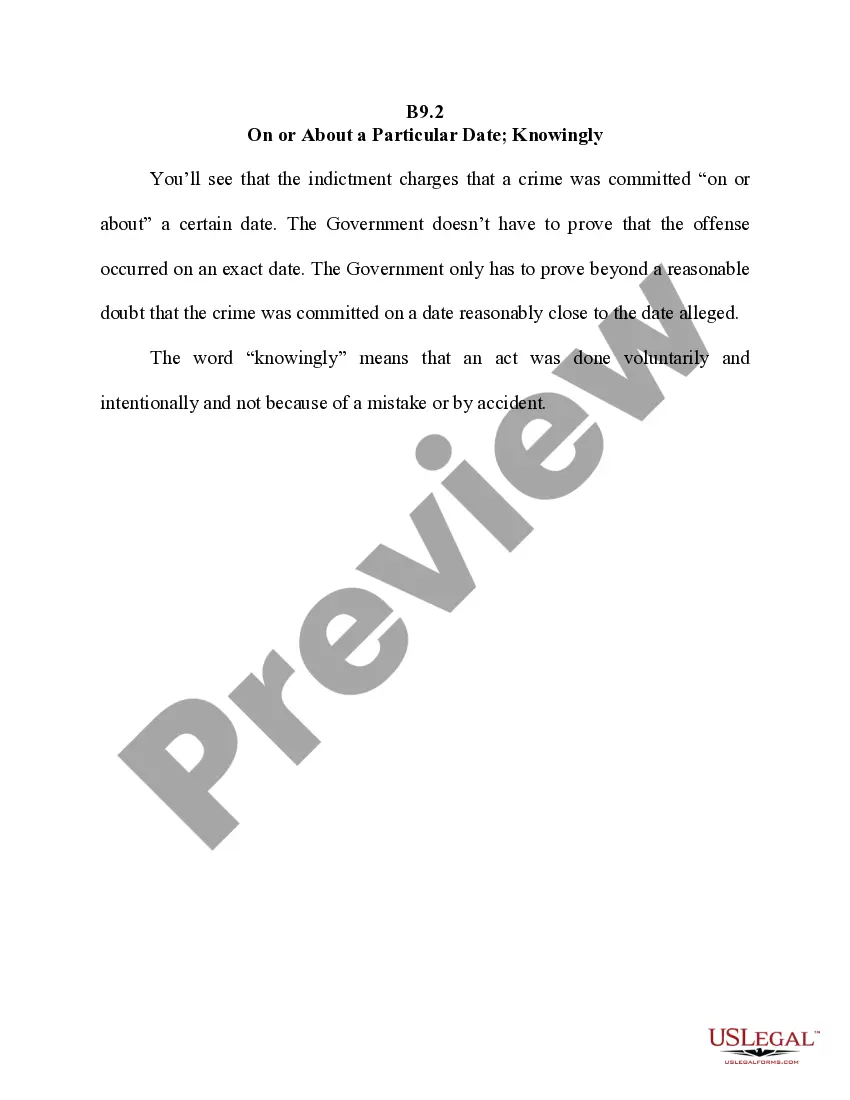
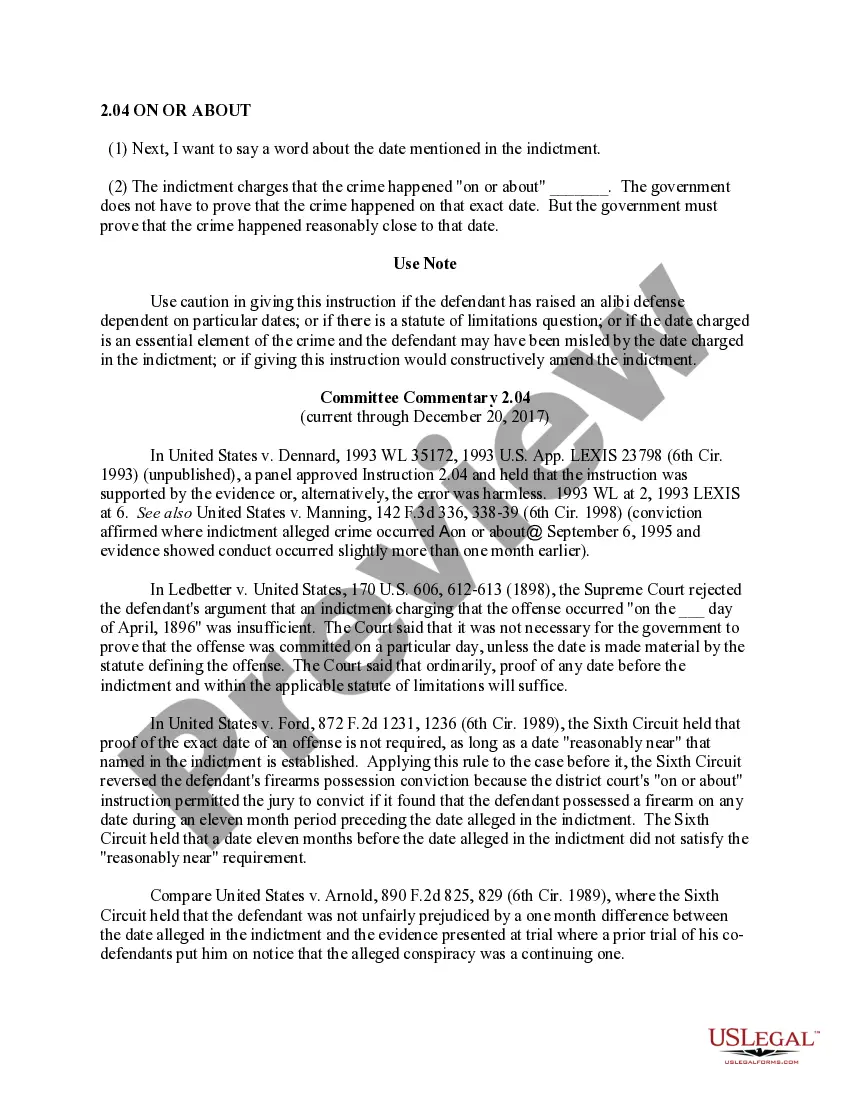
The "On or About" form is a legal document used in criminal proceedings to indicate that the defendant may have committed an offense on or near a specified date. This form acknowledges that the prosecution does not need to prove the exact date of the crime, but rather a date that is reasonably close to the one stated in the indictment. This flexibility is crucial in cases where the exact timing of the offense may be uncertain, thereby assisting in the fair administration of justice.
What’s included in this form
- Indicates the charged offense in relation to a specific date.
- Clarifies the prosecution's burden of proving a reasonably close date.
- Addresses the relevance of alibi defenses related to specific dates.
- Citations from relevant case law that support the use of the form.
Common use cases
This form is typically used in criminal cases where the timing of an offense is critical, yet specific details are hard to prove. Situations may include cases of theft, assault, or fraud, where the exact date of the crime may be in dispute, but the prosecution can demonstrate the crime occurred close to the date listed. The form helps provide clarity in cases where a defendant raises an alibi based on specific timing.
Who needs this form
This form is intended for:
- Prosecutors seeking to draft charges in criminal indictments.
- Defense attorneys preparing alibi defenses for their clients.
- Legal practitioners involved in criminal law.
- Individuals accused of crimes who wish to understand the implications of the dates related to their charges.
How to prepare this document
- Identify the offense being charged and provide a brief description.
- Clearly state the date or range of dates relevant to the charges.
- Indicate the specific time frame in which the alleged offense occurred.
- Reference any applicable case citations to support the use of the form.
- Review the completed form for accuracy before submission.
Notarization requirements for this form
Notarization is generally not required for this form. However, certain states or situations might demand it. You can complete notarization online through US Legal Forms, powered by Notarize, using a verified video call available anytime.
Get your form ready online
Our built-in tools help you complete, sign, share, and store your documents in one place.
Make edits, fill in missing information, and update formatting in US Legal Forms—just like you would in MS Word.
Download a copy, print it, send it by email, or mail it via USPS—whatever works best for your next step.
Sign and collect signatures with our SignNow integration. Send to multiple recipients, set reminders, and more. Go Premium to unlock E-Sign.
If this form requires notarization, complete it online through a secure video call—no need to meet a notary in person or wait for an appointment.
We protect your documents and personal data by following strict security and privacy standards.

Make edits, fill in missing information, and update formatting in US Legal Forms—just like you would in MS Word.

Download a copy, print it, send it by email, or mail it via USPS—whatever works best for your next step.

Sign and collect signatures with our SignNow integration. Send to multiple recipients, set reminders, and more. Go Premium to unlock E-Sign.

If this form requires notarization, complete it online through a secure video call—no need to meet a notary in person or wait for an appointment.

We protect your documents and personal data by following strict security and privacy standards.
Mistakes to watch out for
- Failing to specify a reasonable range of dates.
- Neglecting to include case law references that support the use of the form.
- Using vague language that does not clearly describe the offense.
- Overlooking the implications of a raised alibi defense.
Benefits of completing this form online
- Convenient access to accurately drafted legal language.
- Easy download and use across multiple jurisdictions.
- Edit and customize the form to suit specific legal scenarios.
- Reliability from licensed attorneys who prepare these forms.
Legal use & context
- The form is used to convey flexibility in the timing of alleged offenses.
- It is crucial in criminal trials to ensure the prosecution meets its burden of proof.
- Relevant case law establishes precedents on the validity of using approximate dates in indictments.
Main things to remember
- The "On or About" form guides the prosecution regarding date flexibility in criminal cases.
- Understanding this form is essential for both prosecutors and defense attorneys to navigate legal proceedings effectively.
- Proper completion of the form facilitates the fair administration of justice by providing clear timelines.
Looking for another form?

Form popularity
FAQ
The ?any and all? phrasing is something you will likely come across in legal writing. It is a way of ensuring that there is no misunderstanding of which items are included. In most contexts, ?all? is sufficient.
ANY OR ALL means readers may choose any item(s) (they choose which and how many) OR all of them, whichever they prefer. If you have used this phrase, you probably meant "each," "every," or "each and every," which is a phrase of emphasis often used by lawyers.
If you ask someone what they are on about, you are asking that person, often in a slightly annoyed way, what they mean: I dunno what you're on about. Want to learn more?
Definitions can play an important role in legislation. Defining words or phrases is done to provide the reader of the legislative text with clear guidance regarding how these words or phrases are to be understood and used in the forthcoming legislation.
The main purpose of a definition is to achieve clarity without needless repetition. For this reason, "it is unnecessary" to define ordinary words that are used in their usual dictionary meaning. DON'T SAY: Trash can means a receptacle for waste material.
It provides an approximation of a time and/or place and expands the accuracy or coverage of a statement without pointing to an exact date or place that would be more easily challenged. When used to describe a location ?on or about? means anywhere and everywhere on, but not outside of, the locus at issue.
When to use opinion on. For the most part, opinion on and opinion about can be interchanged. Your opinion on something describes your ideas or beliefs regarding a particular matter or topic.
The term "On or About" is commonly used in legal documents to indicate an approximate or estimated date or location. It allows for some flexibility and avoids making a specific and potentially inaccurate claim that could be challenged by the defendant.