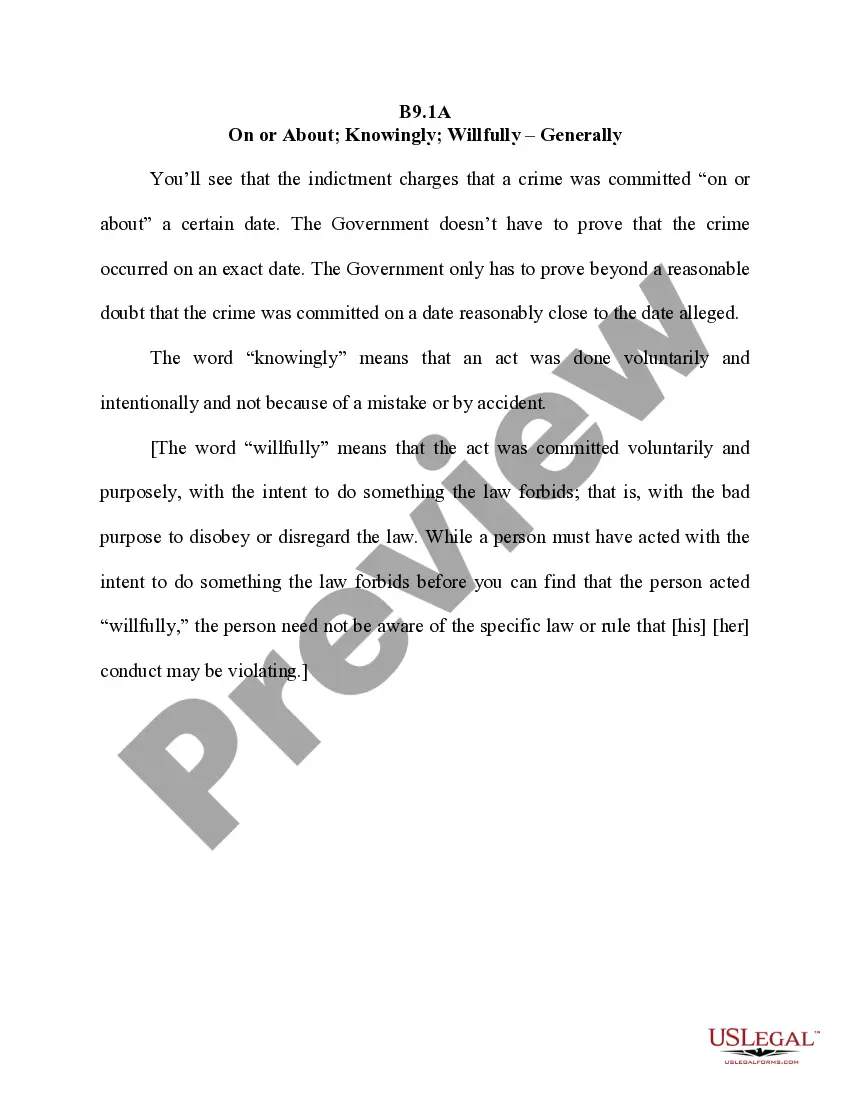
On or About; Knowingly; Willfully - Generally
Understanding this form
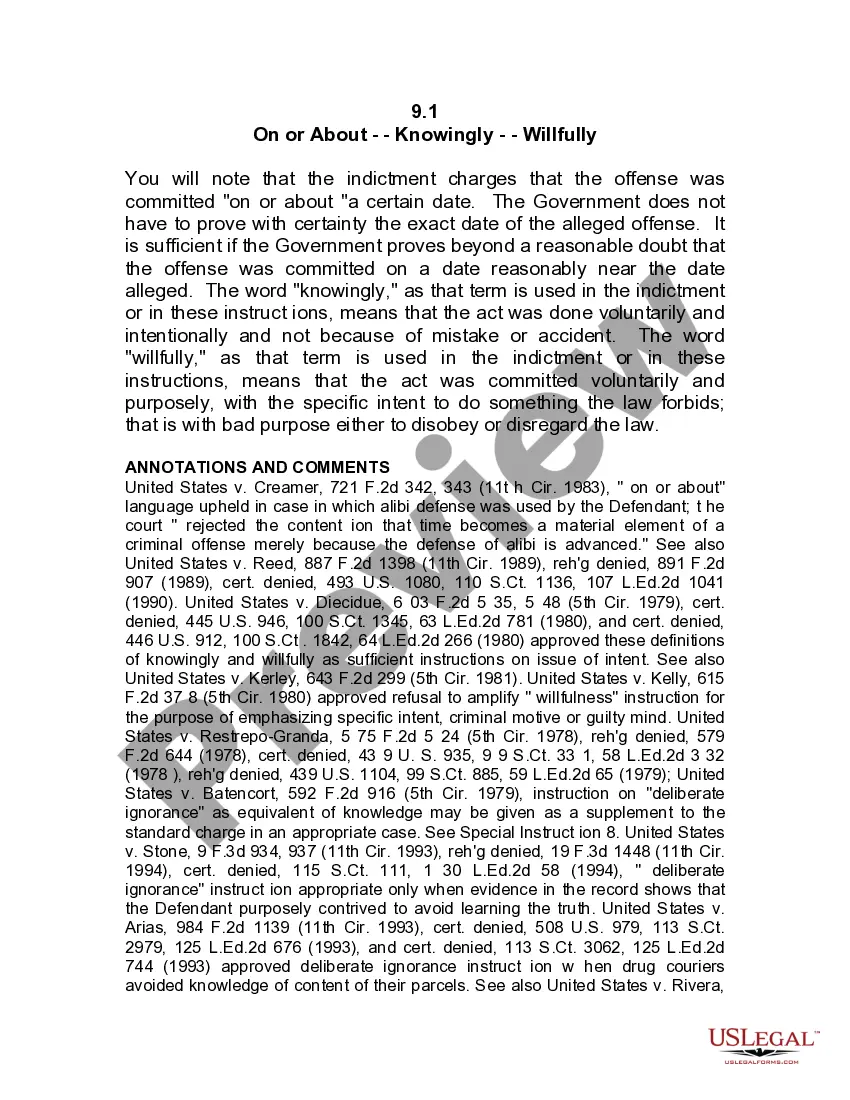
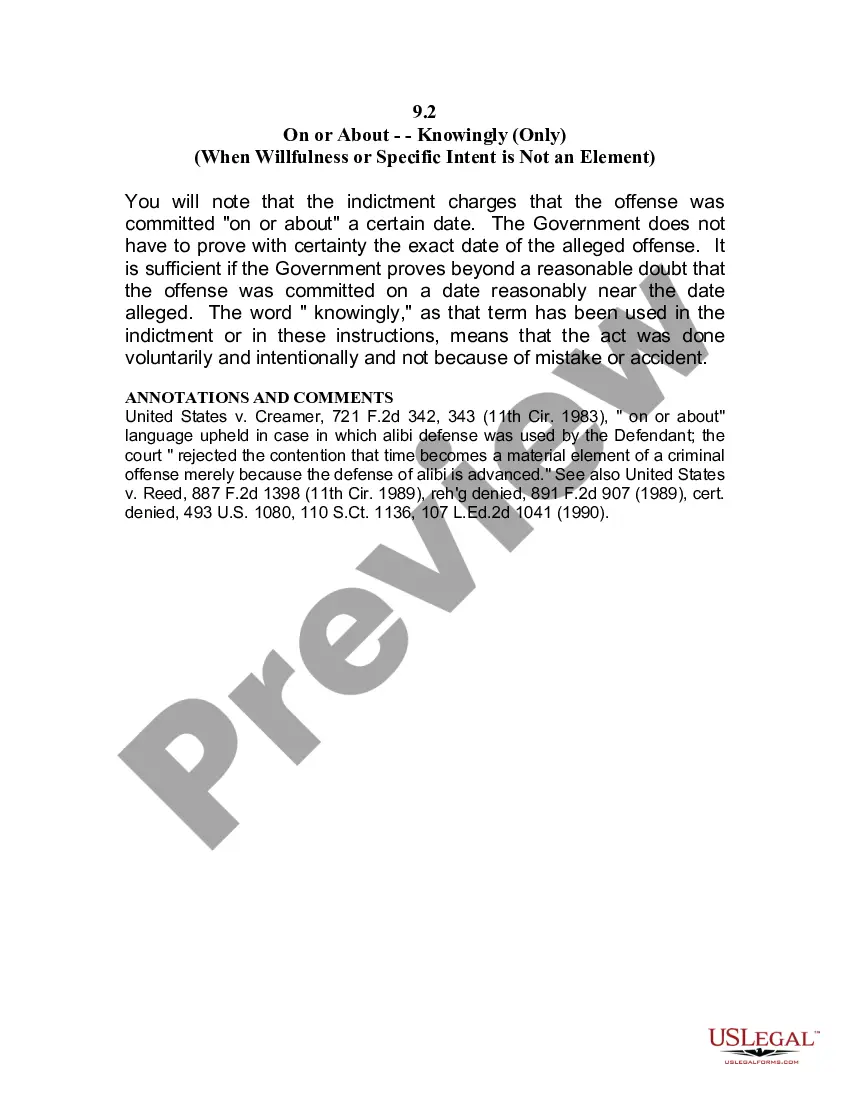
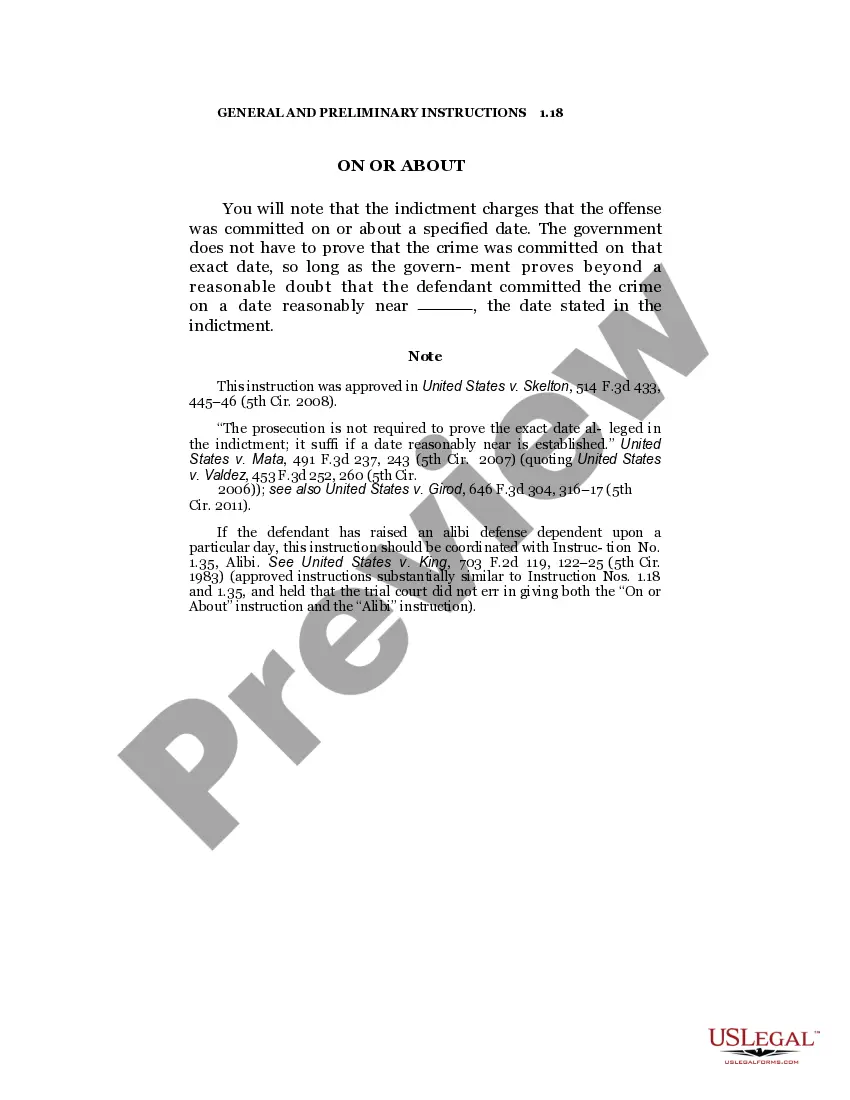
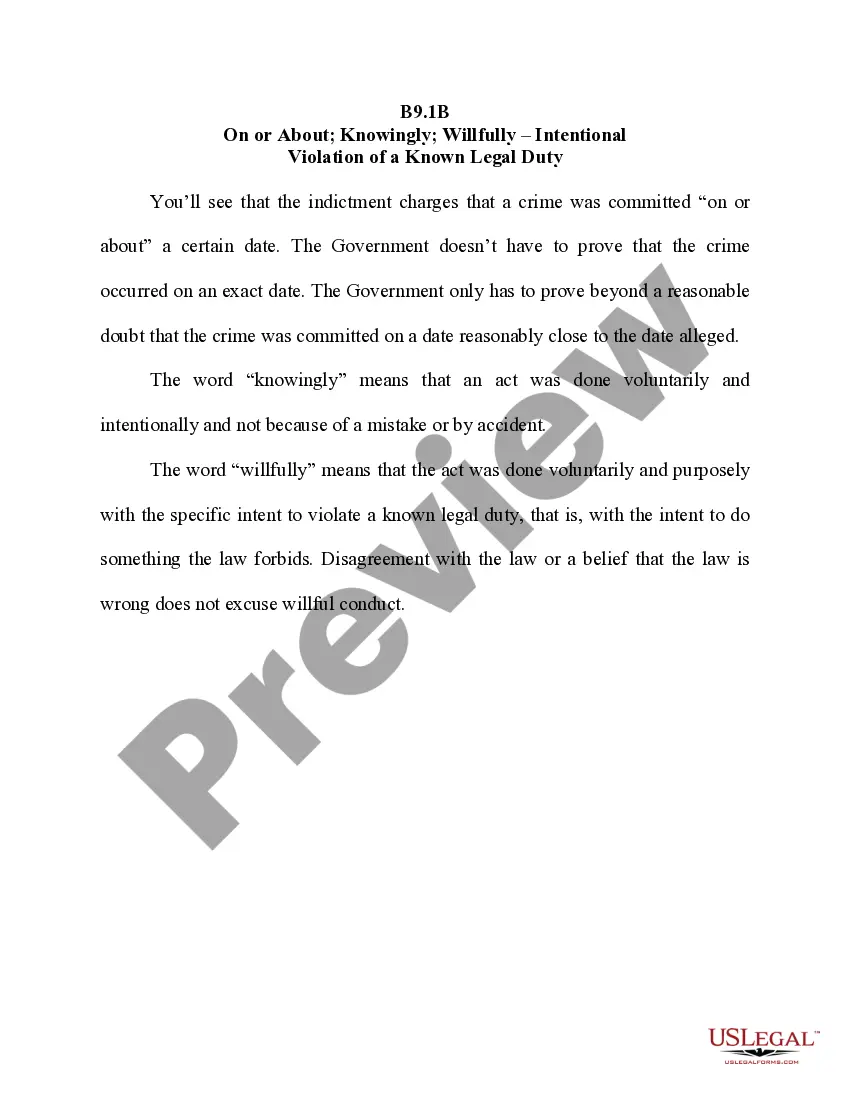
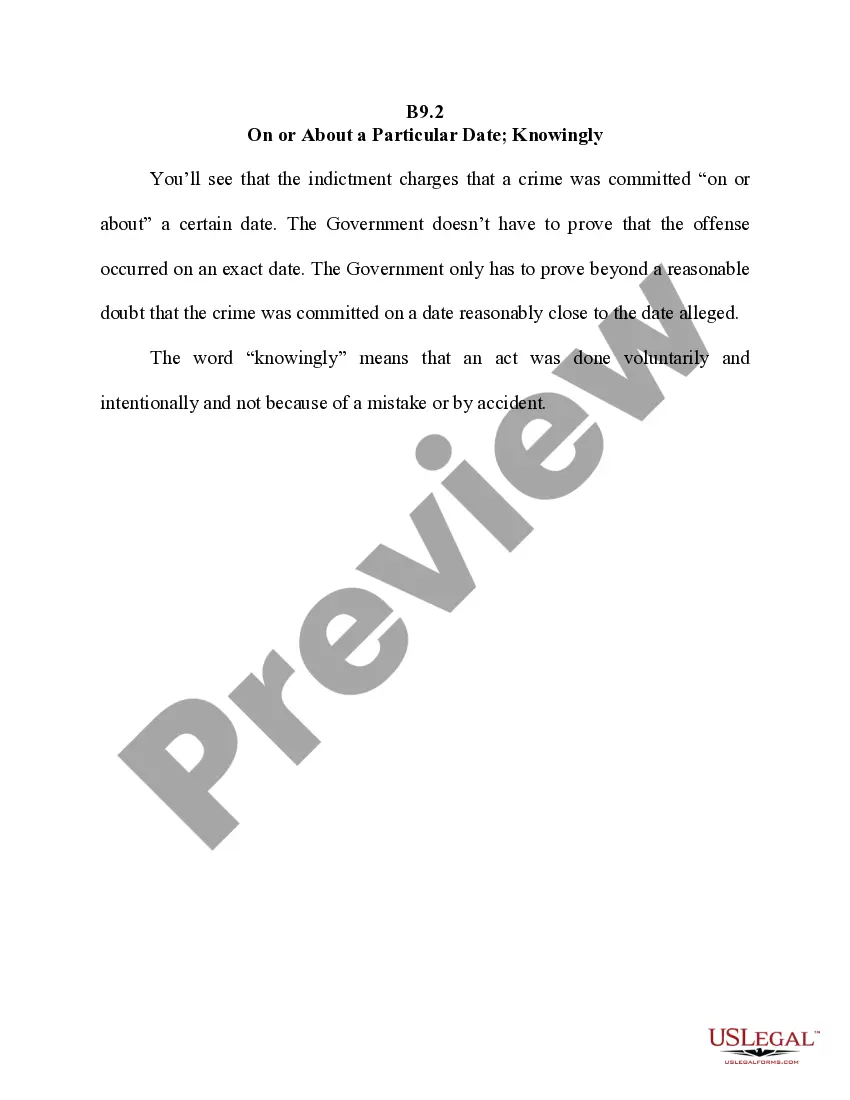
The "On or About; Knowingly; Willfully - Generally" form is a pattern jury instruction used in the 11th Circuit Federal Court of Appeals. It outlines the standards for proving that a crime was committed on or about a specific date, emphasizing the importance of intentional actions and willfulness. This form helps clarify what the prosecution must demonstrate in criminal cases and differs from other jury instructions by focusing specifically on these two critical concepts.
Key components of this form
- Definition of "on or about" regarding the date of the alleged crime.
- Explanation of "knowingly" as acting intentionally and voluntarily.
- Clarification of "willfully," emphasizing intentional disobedience of the law.
- Legal implications of intent in criminal actions.
Situations where this form applies
This form is necessary when a defendant is charged with a crime and the prosecution must prove that the crime occurred approximately on the date mentioned in the indictment. It is applicable in criminal cases where the intent behind the actions is a key element of the charge.
Who this form is for
- Judges presiding over criminal cases in the 11th Circuit.
- Prosecutors presenting cases where the timing of the crime is relevant.
- Defense attorneys defending clients against charges requiring proof of intent.
- Jury members needing clarification on legal standards related to the case.
Completing this form step by step
- Review the indictment to understand the date of the alleged crime.
- Clarify the definition of "knowingly" to establish intent.
- Define "willfully" as it pertains to the defendant's actions.
- Present the necessary evidence to support the claims of timing and intent.
- Ensure all jury members are informed of the legal standards outlined in the instructions.
Does this document require notarization?
Notarization is not commonly needed for this form. However, certain documents or local rules may make it necessary. Our notarization service, powered by Notarize, allows you to finalize it securely online anytime, day or night.
Get your form ready online
Our built-in tools help you complete, sign, share, and store your documents in one place.
Make edits, fill in missing information, and update formatting in US Legal Forms—just like you would in MS Word.
Download a copy, print it, send it by email, or mail it via USPS—whatever works best for your next step.
Sign and collect signatures with our SignNow integration. Send to multiple recipients, set reminders, and more. Go Premium to unlock E-Sign.
If this form requires notarization, complete it online through a secure video call—no need to meet a notary in person or wait for an appointment.
We protect your documents and personal data by following strict security and privacy standards.

Make edits, fill in missing information, and update formatting in US Legal Forms—just like you would in MS Word.

Download a copy, print it, send it by email, or mail it via USPS—whatever works best for your next step.

Sign and collect signatures with our SignNow integration. Send to multiple recipients, set reminders, and more. Go Premium to unlock E-Sign.

If this form requires notarization, complete it online through a secure video call—no need to meet a notary in person or wait for an appointment.

We protect your documents and personal data by following strict security and privacy standards.
Typical mistakes to avoid
- Misunderstanding the difference between "knowingly" and "willfully."
- Failing to link the crime's timing to the prosecution's burden of proof.
- Overlooking the requirement for reasonable doubt in proving the date of the crime.
Why use this form online
- Convenient access to legal instructions anytime.
- Ability to customize instructions using an online builder.
- Reliability of content drafted by licensed attorneys.
Legal use & context
- This form is used exclusively in the context of federal criminal proceedings.
- It provides a necessary framework for jury instructions related to intent.
- Understanding these concepts is crucial for fair deliberation in criminal trials.
Looking for another form?
Form popularity
FAQ
§ 561.314 Knowingly. The term knowingly, with respect to conduct, a circumstance, or a result, means that a person has actual knowledge, or should have known, of the conduct, the circumstance, or the result.
The term knowingly, with respect to conduct, a circumstance, or a result, means that a person has actual knowledge, or should have known, of the conduct, the circumstance, or the result.
Purposely is similar to specific intent to cause a particular result. Knowingly is awareness that results are practically certain to occur.
The important difference between willfully as defined in this instruction and the most frequently used definition of knowingly, as stated in Instruction 5.02, is that willfully requires proof beyond a reasonable doubt that the defendant knew his or her conduct was unlawful and intended to do something that 16 Page 17
§ 1001 requires that the false statement, concealment or cover up be "knowingly and willfully" done, which means that "The statement must have been made with an intent to deceive, a design to induce belief in the falsity or to mislead, but § 1001 does not require an intent to defraud -- that is, the intent to deprive
Black's Law Dictionary defines ?knowingly? as ?with knowledge; consciously; intelligently; willfully; inten- tionally. An individual acts 'knowingly' when he acts with awareness of the nature of his conduct.?
Black's Law Dictionary defines ?knowingly? as ?with knowledge; consciously; intelligently; willfully; inten- tionally. An individual acts 'knowingly' when he acts with awareness of the nature of his conduct.?